Uppark, a National Trust Property, and Boyhood Home of H. G. Wells

800px-Uppark-Sfront-01 Uppark is a 17th-century house in South Harting, Petersfield, West Sussex, England and a National Trust property.

The house, set high on the South Downs, was built for Ford Grey (1655—1701), the first Earl of Tankerville, c. 1690 and was sold in 1747 to Sir Matthew Fetherstonhaugh and his wife Sarah. Matthew and Sarah redecorated the house extensively from 1750 to 1760 and introduced most of the existing collection of household items displayed today, much of it collected on their Grand Tour of 1749 to 1751. Their only son, Sir Harry Fetherstonhaugh, added to the collection and commissioned Humphry Repton to add a new pillared portico, dairy and landscaped garden. In the 19th century stables and kitchens were added as separate buildings connected to the main building by tunnels.

On 30 August 1989 the building was devastated by a fire caused by a workman’s blowtorch whilst repairing lead flashing on the roof, just two days before the work was due to be completed. The fire broke out during opening hours. Many works of art and pieces of furniture were carried out of the burning building by members of the Meade-Fetherstonehaugh family, National Trust staff and members of the public. Although the garret and first floors collapsed onto the lower floors and the garret and first floor contents were lost completely, the floors largely fell clear of the ground floor walls and much of the panelling and decoration survived. Much of the contents of the ground floor was crushed but not burned; metalwork was able to be straightened and cleaned, crystal chandeliers were able to be reassembled, and even the elaborate tassels on the chandelier ropes were able to be conserved. The decision to restore the house came after it was determined that restoration would be a cheaper insurance settlement than complete payout for a total loss.

Most of the pictures and furniture in the house were saved. The building has since been completely restored with many lost crafts relearned in the restoration process, and it re-opened its doors in 1995.

H.G. Wells spent part of his boyhood at Uppark, where his mother, Sarah, was housekeeper between 1880 and 1893. She had previously been employed there between 1850 and 1855, as housemaid to Lady Fetherstonhaugh’s sister. Wells’ father Joseph, a gardener, was employed at Uppark in 1851, and he and Sarah married in 1853.

Posted in British history, buildings and structures, Georgian Era, Living in the Regency, real life tales, Regency era, Regency personalities, Victorian era | Tagged , , | Comments Off on Uppark, a National Trust Property, and Boyhood Home of H. G. Wells

Charlecote Park, a National Trust Showplace

800px-Charlecote_Park Charlecote Park is a grand 16th century country house, surrounded by its own deer park, on the banks of the River Avon near Wellesbourne, about 4 miles (6 km) east of Stratford-upon-Avon and 5.5 miles (9 km) south of Warwick, Warwickshire, England. It has been administered by the National Trust since 1946 and is open to the public. It is a Grade I listed building.

The Lucy family has owned the land since 1247. Charlecote Park was built in 1558 by Sir Thomas Lucy, and Queen Elizabeth I stayed in the room that is now the drawing room. Although the general outline of the Elizabethan house remains, nowadays it is in fact mostly Victorian. Successive generations of the Lucy family had modified Charlecote Park over the centuries, but in 1823, George Hammond Lucy (High Sheriff of Warwickshire in 1831) inherited the house and set about recreating the house in its original style.

In the middle of the 19th century the Fairfax Baronets inherited the property when the male line of the Lucy family failed on the death of Henry Spencer Lucy. The baronets changed their family name to Lucy to reflect the traditions of Charlecote.

The Great Hall has a barrel-vaulted ceiling made of plaster painted to look like timber and is a fine setting for the splendid collection of family portraits. Other rooms have richly coloured wallpaper, decorated plaster ceilings and wood panelling. There are magnificent pieces of furniture and fine works of art, including a contemporary painting of Queen Elizabeth I. The original two-storey Elizabethan gatehouse that guards the approach to the house remains unaltered.

Charlecote Park covers 185 acres (75 ha), backing on to the River Avon. William Shakespeare has been alleged to have poached rabbits and deer in the park as a young man and been brought before magistrates as a result. But it is unclear whether there were any deer in the park at that time. It was landscaped by Capability Brown in about 1760.

In the Tudor great hall, the 1680 painting Charlecote Park by Sir Godfrey Kneller, is said to be one of the earliest depictions of a black presence in the West Midlands. The painting, of Captain Thomas Lucy, shows a black boy in the background dressed in a blue livery coat and red stockings and wearing a gleaming, metal collar around his neck. The National Trust’s Charlecote brochure describes the boy as a “black page boy.” In 1735, a black child called Philip Lucy was baptised at Charlecote.

On display at the house is an original letter from Oliver Cromwell, dated 1654, summoning then owner Richard Lucy to the Barebone’s Parliament. Also on display is a 1760 portrait of George Lucy by Thomas Gainsborough, which cost Lucy the sum of eight guineas.

A set of archives for the Lucy family at Charlecote is held by the National Archive. The house also has a display of carriages and a period laundry and brewroom.

In April 2012, Charlecote Park was featured as the venue for BBC1’s Antiques Roadshow.

Posted in British history, buildings and structures, Georgian Era, Living in the Regency, real life tales, Regency era, Regency personalities | Tagged , , , | 1 Comment

Regency Ghost Story from Viscount Robert Stewart Castlereagh

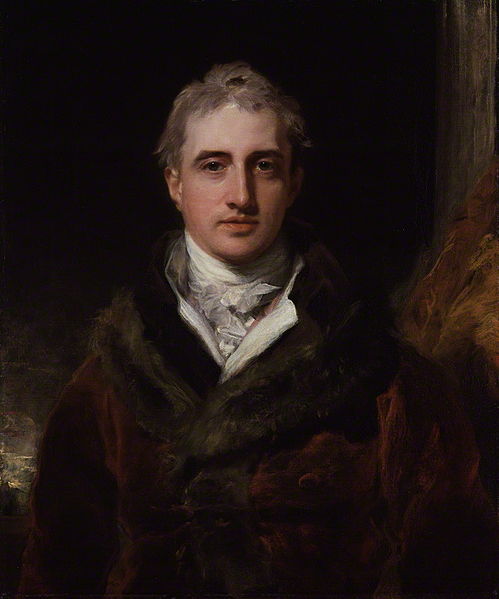
499px-Lord_Castlereagh_Marquess_of_Londonderry Robert Stewart, 2nd Marquess of Londonderry, KG, GCH, PC, PC (Ire) (18 June 1769 – 12 August 1822), usually known as Lord Castlereagh, was an Irish and British statesman. As British Foreign Secretary, from 1812 he was central to the management of the coalition that defeated Napoleon and was the principal British diplomat at the Congress of Vienna. Castlereagh was also leader of the British House of Commons in the Liverpool government from 1812 until his death by suicide in August 1822. Early in his career, as Chief Secretary for Ireland, he was involved in putting down the Irish Rebellion of 1798 and was instrumental in securing the passage of the Irish Act of Union of 1800.

His foreign policy from 1814 was to work with the leaders represented at the Congress of Vienna to provide a peace in Europe consistent with the conservative mood of the day. Much more than prime minister Lord Liverpool, he was responsible for the repressive domestic measures. Historian Charles Webster concludes:

“There probably never was a statesman whose ideas were so right and whose attitude to public opinion was so wrong. Such disparity between the grasp of ends and the understanding of means amounts to a failure in statesmanship.”

Title
Robert Stewart acquired the courtesy title Viscount Castlereagh in 1796 when his father was created Earl of Londonderry in the Irish peerage. Upon his father’s death in 1821, he succeeded as 2nd Marquess of Londonderry, a title to which his father had been raised in 1816. His younger half-brother, the soldier, politician and diplomat Charles Stewart (later Vane) succeeded him as 3rd Marquess of Londonderry.

Family
Robert Stewart was born in Henry Street, Dublin, Ireland, in 1769 the son of Robert Stewart (1739–1821) of Newtownards and Comber in County Down, with properties in Counties Donegal and Londonderry. The family seat was Mount Stewart, County Down.

The elder Stewart was an Irish politician and prominent Ulster landowner. He was created Baron Londonderry in 1789, Viscount Castlereagh in 1795, and Earl of Londonderry in 1796 by King George III. In 1771 he was elected in the Whig interest to the Irish House of Commons, where he was a supporter of Lord Charlemont and his allies who called for greater independence from Britain. From the Act of Union of 1800, however, he sat in the British House of Lords as an Irish representative peer. In 1816 he was created Marquess of Londonderry by the Prince Regent.

Stewart’s mother, who died in childbirth when he was a year old, was Lady Sarah Frances Seymour, daughter of Francis Seymour-Conway, 1st Marquess of Hertford (a former British Ambassador to France (1764–65) and Lord Lieutenant of Ireland (1765–66)) and Isabella Fitzroy, daughter of Charles FitzRoy, 2nd Duke of Grafton. His father remarried five years later to Frances Pratt, daughter of Charles Pratt, 1st Earl Camden (1714–94), a leading English jurist and prominent political supporter of both the 1st Earl of Chatham and his son, William Pitt the Younger. Through the elder Stewart’s marriages, he linked his family with the upper ranks of English nobility and political elites. The Camden connection was to be especially important for the political careers of both him and his elder son. By Frances Pratt, Stewart’s father had three children who survived to adulthood, including Stewart’s half-brother, Charles William Stewart (later Vane), Baron Stewart of Stewart’s Court and Ballylawn in County Donegal (1814) and 3rd Marquess of Londonderry (1822).

In 1794, Stewart married Amelia (Emily) Hobart a daughter of John Hobart, 2nd Earl of Buckinghamshire, a former British Ambassador to Russia (1762–65) and Lord Lieutenant of Ireland (1776–80). Her mother, Caroline Conolly, was the granddaughter of William Conolly, Speaker of the Irish House of Commons in the early 18th century and one of the wealthiest landowners in Ireland. Caroline’s brother, Thomas Conolly, was married to Louisa Lennox, sister of Emily FitzGerald, Duchess of Leinster, whose son and Emily’s cousin-by-marriage, the aristocratic rebel Lord Edward FitzGerald, was a leader of the United Irishmen and one of their martyrs in the early stages of the Irish Rebellion of 1798.

Emily Stewart was well known as a hostess for her husband in both Ireland and London and during some of his most important diplomatic missions. In later years she was a leader of Regency London high society as one of the Lady Patronesses of Almack’s. She is noted in contemporary accounts for her attractiveness, volubility and eccentricities. By all accounts, the two remained devoted to each other to the end, but they had no children. The couple did, however, care for the young Frederick Stewart, while his father, Stewart’s half-brother, Charles, was serving in the army.

Early Life and Career
Stewart had recurring health problems throughout his childhood, and his family elected to send him to The Royal School, Armagh, rather than to England for his secondary education. At the encouragement of Earl Camden, who took a great interest in him and treated him as a grandson by blood, he later attended St. John’s College, Cambridge (1786–87), where he applied himself with greater diligence than expected from an aristocrat and obtained first class in his last examinations. He left Cambridge due to an extended illness, and after returning to Ireland did not pursue further formal education.

In 1790, Stewart was elected as a Member of the Irish Parliament for Down in one of the most expensive elections in Irish history. Though for a time he was associated with the Northern Whig Club, he entered the Irish House of Commons as an Independent. He ran on a platform supporting Whig principles of electoral reform and opposing the Irish policies of the British Government. But even from the outset of his career, he was a personal supporter of the Prime Minister, William Pitt. Stewart was a lifelong advocate of Catholic concessions, though his position on the specific issue of Catholic emancipation varied depending on his assessment of the potential repercussions on other policy priorities.

When war with France forced Government attention on defense of Ireland, the Irish Volunteers, a potential source of disaffection, were disbanded by Dublin Castle, and a reorganised Militia was created in 1793. Stewart enrolled as an officer, a matter of course for a young Protestant aristocrat, and served as Lieutenant Colonel under the command of his wife’s uncle, Thomas Conolly. Between Stewart’s attendance to his militia duties, his pursuit of cultural, family and political interests in London, two trips to the Continent (in 1791, when he visited revolutionary Paris, and 1792), and the courtship of his wife whom he married in 1794, his life during this period was not centered on the activities of the Irish House of Commons, where he was listened to with respect but where he was not yet an important player. He was also beginning to disappoint some of his more radical original supporters in his constituency. As the French Revolution grew more bloody and Ireland more rebellious, Stewart increasingly worried about Ireland’s future if the threats from France succeeded in breaking Ireland’s links to Britain. He became further inclined to support not only Pitt personally but the British Government, even when he did not approve of a specific line taken in Irish policy.

In 1794, partly as a result of the promotion of Stewart’s interests by his Camden connections, he was offered the Government-controlled seat of Tregony in Cornwall, where he was elected to the British House of Commons on a similar platform of reform principles and support for Pitt, on whose side he sat in Westminster. In 1796, he transferred to a seat for the Suffolk constituency of Orford, which was in the interest of his mother’s family, the Seymour-Conways (Marquess of Hertford).

Chief Secretary for Ireland
In 1795, Pitt replaced the popular Lord Lieutenant of Ireland, Lord Fitzwilliam, with Stewart’s uncle, the 2nd Earl Camden. Camden’s arrival in Dublin was greeted with riots, and that year Stewart crossed the floor to join the supporters of the British Government. Stewart became an essential adviser to the inexperienced and unpopular Lord Lieutenant, who was Stewart’s senior by only ten years.

In 1796, when the French invasion of Ireland failed at Bantry Bay due to bad weather and not to Ireland’s military preparations or the British Navy, Castlereagh as a leader of the Militia saw first hand how ripe Ireland was for breaking from Britain and becoming another French satellite. Despairing of obtaining timely military support from Britain if Ireland were again threatened with invasion, for the next several years, he was increasingly involved in measures against those promoting rebellion, but his initial principles of reform and emancipation continued to hold a place in his political thought.

In 1797, Castlereagh was at last appointed to office, as Keeper of the King’s Signet for Ireland. As martial law was declared in the face of growing turmoil, he was made both a Lord of the Treasury and a Member of the Privy Council of Ireland (1797–1800). At the urging of Camden, Castlereagh assumed many of the onerous duties of the often-absent Chief Secretary for Ireland who was responsible for day-to-day administration and asserting the influence of Dublin Castle in the House of Commons. In this capacity, and after March 1798 as Acting Chief Secretary, Castlereagh played a key role in crushing the Irish Rebellion of 1798, offering clemency to commoners who had supported the rebellion, and focusing instead on pursuing rebel leaders.

In 1799, in furtherance of both his own political vision and Pitt’s policies, Castlereagh began lobbying in the Irish and British Parliaments for an official union between the two, convinced that it was the best way to soothe the long-standing divides in Ireland, insulate Ireland from further radical disaffection, and protect Britain from French military threats via Ireland. His first attempt, at the opening of the Irish session of 1799, met with failure during long, heated debates. A year of further intense preparation followed, with an impressive display of Machiavellian tactics that included the common practice of bribery through peerages, honours and money, but bribery on a truly uncommon scale. In the summer of 1800, Castlereagh together with the Lord Lieutenant, Marquess Cornwallis, finally succeeded in steering the Irish Act of Union through both Parliaments.

During the campaign for the Act of Union, both Castlereagh and Cornwallis had, in good faith, forwarded informal assurances they had received from Pitt’s Cabinet to the Irish Catholics that they would be allowed to sit in Parliament. Both Castlereagh and Cornwallis knew Catholic emancipation would be critical if their objectives for Union were to be realised. Emancipation was, however, opposed by much of the British establishment, including George III, who was convinced that it would violate his royal oath as protector of the Protestant faith. Pitt tried to follow through on his commitment, but when it came to light that the King had approached Henry Addington, an opponent of Catholic emancipation, about becoming Prime Minister to replace the pro-emancipation Pitt, both Castlereagh and Pitt resigned in protest. Still, Castlereagh would long be held personally responsible by many Catholics in Ireland for the apparent breach of promise and Government’s betrayal of their interests.

In Dublin, he was a member of the Kildare Street Club. He was elected a Fellow of the Royal Society in 1802.

At Westminster and in Government
When the newly united Parliament of the United Kingdom met in 1801, Castlereagh took his seat in the House of Commons from his Down constituency. By 1802, tensions between Tories supporting emancipation and those opposing had relaxed, and Addington had obtained his desired cessation of hostilities with France (the Peace of Amiens). At a shift in the composition of Addington’s Government, Castlereagh accepted the offer to enter the Cabinet as President of the Board of Control, where he mediated bitter disputes between the Governor-General of India, Richard Wellsley, and the Directors of the East India Company, smoothing quarrels while generally supporting Lord Wellesley’s policies.

After the renewal of the war against Napoleon, at the urging of Castlereagh and other long-time supporters, in 1804 Pitt returned as Prime Minister, and Castlereagh was promoted to Secretary of State for War and the Colonies. As the only other member of Pitt’s Government in the House of Commons, Castlereagh became Pitt’s political deputy, taking on ever more burdens as Pitt’s health continued to decline. After Pitt’s death in 1806, Castlereagh resigned amid the chaos of the Ministry of All the Talents. When that Government collapsed, Castlereagh again became Secretary of State for War and the Colonies in 1807, this time in the ministry of the Duke of Portland.

The Duel with Canning
As minister for War, he became involved in disputes with Foreign Secretary George Canning over the Walcheren Expedition and its failure. Canning saw it as a diversion of troops from the Peninsular War based on a hopeless plan. However, Castlereagh had the support of Lord Wellesley’s younger brother General Arthur Wellesley (future Duke of Wellington), and evidence later surfaced that Canning himself had interfered with the plan, selecting the Earl of Chatham to command the expedition. The Portland government became increasingly paralysed by disputes between the two men. Portland was in deteriorating health and gave no lead, until Canning threatened resignation unless Castlereagh was removed and replaced by Lord Wellesley. Wellesley himself was neither complicit with nor even aware of the arrangement, but Portland secretly agreed to make this change when it became possible.

Castlereagh discovered the deal in September 1809 and demanded redress. He challenged Canning to a duel, which Canning accepted. Canning had never before fired a pistol. The duel was fought on 21 September 1809 on Putney Heath. Canning missed but Castlereagh wounded his opponent in the thigh. There was much outrage that two cabinet ministers had resorted to such a method, and they both felt compelled to resign from the government. Six months later, Canning published a full account of his actions in the affair, and many who had initially rallied to him became convinced Castlereagh had been betrayed by his cabinet colleague.

Diplomatic Career
Marble bust of Castlereagh by Joseph Nollekens, 1821. Yale Center for British Art
Three years later, in 1812, Castlereagh returned to the government, this time as Foreign Secretary, a role in which he served for the next ten years. He also became leader of the House of Commons in the wake of Spencer Perceval’s assassination in 1812. In his role of Foreign Secretary he was instrumental in negotiating what has become known as the quadruple alliance between Britain, Austria, Russia, and Prussia at Chaumont in March 1814, in the negotiation of the Treaty of Paris that brought peace with France, and at the Congress of Vienna.

At the Congress of Vienna, Castlereagh designed and proposed a form of collective and collaborative security for Europe, then called a Congress system. In the Congress system, the main signatory powers met periodically (every two years or so) and collectively managed European affairs. This system was successfully used to resolve the Polish-Saxon crisis at Vienna and the question of Greek independence at Laibach. The following ten years saw five European Congresses where disputes were resolved with a diminishing degree of effectiveness. Finally, by 1822, the whole system had collapsed because of the irreconcilable differences of opinion among Britain, Austria, and Russia, and because of the lack of support for the Congress system in British public opinion. The Holy Alliance, which Castlereagh opposed, lingered for some time, however, and even had effects on the international stage as late as the Crimean war. The order created by the Congress of Vienna was also more successful than Congresses themselves, preventing major European land wars until the First World War a century later. Scholars and historians have seen the Congress system as a forerunner of the modern collective security, international unity, and cooperative agreements of NATO, the EU, the League of Nations, and the United Nations.

In the years 1812 to 1822, Castlereagh continued to competently manage Britain’s foreign policy, generally pursuing a policy of continental engagement uncharacteristic of British foreign policy in the nineteenth century. Castlereagh was not known to be an effective public speaker and his diplomatic presentation style was at times abstruse. Henry Kissinger says he developed a reputation for integrity, consistency, and goodwill, which was perhaps unmatched by any diplomat of that era. His views on foreign policy were ahead of his time.

Decline and Death
Despite his contributions to the defeat of Napoleon and restoration of peace, Castlereagh became extremely unpopular at home. He was attacked for his construction of a peace that gave a free hand to reactionary governments on the Continent to suppress dissent. He was also condemned for his association with repressive measures of the Home Secretary, Lord Sidmouth (the former Prime Minister Addington). As Leader of the House of Commons for the Liverpool Government, he was often called upon to defend government policy in the House. He had to support the widely reviled measures taken by Sidmouth and the others, including the infamous Six Acts, in order to remain in cabinet and continue his diplomatic work. For these reasons, Castlereagh appears with other members of Lord Liverpool’s Cabinet in Shelley’s poem The Masque of Anarchy, which was inspired by, and heavily critical of, the Peterloo massacre:

I met Murder on the way –
He had a face like Castlereagh –
Very smooth he looked, yet grim;
Seven bloodhounds followed him
All were fat; and well they might
Be in admirable plight,
For one by one, and two by two,
He tossed them human hearts to chew
Which from his wide cloak he drew.

After the death of his father in 1821, Castlereagh became the 2nd Marquess of Londonderry. As a non-representative Irish peer Londonderry was eligible to sit in the House of Commons though he had to leave his Irish seat and instead be elected to an English seat. In 1822, he began to suffer from a form of paranoia or a nervous breakdown, possibly as a result of an attack of gout combined with the stress of public criticism. He was also severely overworked with both his responsibilities in leading the government in the House and the never-ending diplomacy required to manage conflicts among the other major powers. At the time, he said “My mind, is, as it were, gone.” Londonderry returned to his country seat at Loring Hall in Water Lane, North Cray, Kent on the advice of his doctor. On 9 August 1822 he had an audience with King George IV in which he appeared distracted and mentally disturbed. Among other surprising remarks he revealed to the King that he thought he was being blackmailed for homosexuality.

On 12 August, although his wife had succeeded in removing razors from his possession and even though his doctor was in attendance, Castlereagh managed to find a pen knife with which he committed suicide by cutting his own throat.

An inquest concluded that the act had been committed while insane, avoiding the harsh strictures of a felo de se verdict. The verdict allowed Lady Londonderry to see her husband buried with honour in Westminster Abbey near his mentor, William Pitt. Some radicals, notably William Cobbett, claimed a “cover-up” within the government and viewed the verdict and Castlereagh’s public funeral as a damning indictment of the elitism and privilege of the unreformed electoral system. His funeral on 20 August was greeted with jeering and insults along the processional route, although not to the level of unanimity projected in the radical press. A funeral monument was not erected until 1850 by his half-brother and successor, Charles Stewart Vane, 3rd Marquess of Londonderry.

Sometime after Castlereagh’s death, Lord Byron wrote a savage quip about his grave:
Posterity will ne’er survey
A nobler grave than this:
Here lie the bones of Castlereagh:
Stop, traveller, and piss.

And yet, some of Castlereagh’s political opponents were gracious in their epigrams. Henry Brougham, a Whig politician and later the Lord Chancellor, who had battled frequently with Castlereagh, once almost to the point of calling him out, and had denigrated his skills as Leader, wrote in the week following Castlereagh’s death:

Put all their other men together in one scale, and poor Castlereagh in the other – single he plainly weighed them down… One can’t help feeling a little for him, after being pitted against him for several years, pretty regularly. It is like losing a connection suddenly. Also he was a gentleman, and the only one amongst them.

An English Heritage blue plaque is displayed at the entrance to the listed building Loring Hall, now a care facility for those with learning disabilities, in commemoration of Castlereagh, who occupied the property from 1811 until his death.

Ghost Story
Robert Stewart was said to have seen a ghost in the barracks at Ballyshannon one night. He claimed that the face of a boy came out of the fireplace and approached him. When he stepped forward toward it, it receded and then faded away. Castlereagh supposedly told this story to Sir Walter Scott, and called the apparition “The Radiant Boy.”

Posted in British history, Georgian Era, Jane Austen, Living in the Regency, real life tales, Regency era, Regency personalities, Victorian era | Tagged , , , | 2 Comments

Regency Personality: Prince Adolphus, Duke of Cambridge

Adolphus_Frederick_Duke_of_Cambridge The Prince Adolphus, 1st Duke of Cambridge KG GCB GCMG GCH PC (Adolphus Frederick; 24 February 1774 – 8 July 1850), was the tenth child and seventh son of George III and Queen Charlotte. He held the title of Duke of Cambridge from 1801 until his death. He also served as Viceroy of Hanover on behalf of his brothers George IV and William IV. He was the grandfather of Mary of Teck, Queen consort of King George V and great-great-grandfather of the current monarch, Elizabeth II.

Early Life
Prince Adolphus was born at Buckingham Palace. He was the youngest son of George and Charlotte to survive childhood. On 24 March 1774, the young prince was christened in the Great Council Chamber at St James’s Palace by Frederick Cornwallis, Archbishop of Canterbury. His godparents were Prince John Adolphus of Saxe-Gotha-Altenburg (his great-uncle, for whom the Earl of Hertford, Lord Chamberlain, stood proxy), Landgrave Charles of Hesse-Kassel (his first cousin once-removed, for whom the Earl of Jersey, Extra Lord of the Bedchamber, stood proxy) and Princess Wilhelmina of Orange (the wife of his first cousin once-removed, for whom Elizabeth Howard, Dowager Countess of Effingham, former Lady of the Bedchamber to Queen Charlotte, stood proxy).

He was tutored at home until summer 1786, when he was sent to the University of Göttingen in Germany, along with his brothers Prince Ernest (created Duke of Cumberland in 1799) and Prince Augustus (created Duke of Sussex in 1801).

Military Career
He was made honorary Colonel-in-Chief of the Hanoverian Guard Foot Regiment 1789–1803, but his military training began in 1791, when he and Prince Ernest went to Hanover to study under the supervision of the Hanoverian commander Field Marshal von Freytag. He remained on Freytag’s staff during the Flanders Campaign in 1793. His first taste of action was at Famars on 23 May. He was wounded and captured at the Battle of Hondschoote 6 September, but was quickly rescued. As a Hanovarian General-Major, he commanded a Hessian brigade under his paternal uncle, General Johann Ludwig von Wallmoden-Gimborn in Autumn 1794, then commanded the Hanovarian Guards during the retreat through Holland. Remaining in Germany, he commanding a brigade of the Corps of Observation, 22 October 1796 – 12 January 1798. He was made a British army colonel in 1794, and lieutenant general 24 August 1798. In 1800 – stationed in the Electorate of Hanover – he attended the foundation of a village in the course of the cultivation and colonisation of the moorlands in the north of Bremen and named the municipality after himself Adolphsdorf (since 1974 a component locality of Grasberg).

Over the course of the War of the Second Coalition against France (1799–1802), he travelled to Berlin in 1801, in order to prevent the impending Prussian occupation of the Electorate. France demanded it, as it was stipulated in the Treaty of Basel (1795), obliging Prussia to ensure the Holy Roman Empire’s neutrality in all the latter’s territories north the demarcation line of the river Main, including Hanover. Regular Hanoveran troops, therefore, had been commandeered to join the multilateral so-called “Demarcation Army.” His efforts were in vain. In 1803, he was senior army commander, and replaced Wallmoden as commander of the on the Weser 1 June. With the advance of French forces on one side and 24,000 Prussian soldiers on the other, the situation was hopeless. Cambridge refused to become involved in discussions of capitulation, handed over his command to Hammerstein (Ompteda claims he was forced to resign), and withdrew to England. A plan to recruit additional soldiers in Hanover to be commanded by the Prince had also failed.

In 1803, he was appointed as commander-in-chief of the newly founded King’s German Legion, and in 1813, he became field marshal. George III appointed Prince Adolphus a Knight of the Garter on 6 June 1786, and created him Duke of Cambridge, Earl of Tipperary, and Baron Culloden on 17 November 1801.

The Duke served as colonel-in-chief of the Coldstream Regiment of Foot Guards (Coldstream Guards after 1855) from September 1805, and as colonel-in-chief of the 60th (The Duke of York’s Own Rifle Corps) Regiment of Foot from January 1824. After the collapse of the Napoleon’s empire, he became Military Governor of Hanover 4 November 1813 – 24 October 1816, then Governor General of Hanover 24 October 1816 – 20 June 1837 (viceroy from 22 February 1831). He was made Field Marshal 26 November 1813. In his time as Hanoverian Viceroy, the Duke became name-giving for the Hanoveran Regiment of the Cambridge-Dragoons (German: Cambridge-Dragoner), stationed in Celle, where the Bundeswehr used their baracks, the Cambridge-Dragoner Kaserne, until 1995. The march of the Hannoversches Cambridge-Dragoner-Regiment is part of the Bundeswehr’s traditional music repertoire.

Marriage
After the death of Princess Charlotte in 1817, the Duke was set the task of finding a bride for his eldest unmarried brother, the Duke of Clarence (later William IV), in the hope of securing heirs to the throne—Charlotte had been the only legitimate grandchild of George III, despite the fact that the King had twelve surviving children. After several false starts, the Duke of Clarence settled on Princess Adelaide of Saxe-Meiningen. The way was cleared for the Duke of Cambridge to find a bride for himself.

The Duke of Cambridge was married first at Kassel, Hesse on 7 May and then at Buckingham Palace on 1 June 1818 to his second cousin Augusta (25 July 1797 – 6 April 1889), the third daughter of Prince Frederick of Hesse.

He was, as is shown in the list of issue below, the maternal grandfather of Mary of Teck, consort of George V. This makes Adolphus the great-great-grandfather of the present British monarch, Elizabeth II

Viceroy
From 1816 to 1837, the Duke of Cambridge served as viceroy of the Kingdom of Hanover on behalf of his elder brothers, George IV and later William IV.[1] When his niece, Queen Victoria succeeded to the British throne on 20 June 1837, the 123-year union of the crowns of Great Britain (the United Kingdom of Great Britain and Ireland from 1801) and Hanover ended. The Duke of Cumberland became King Ernest Augustus I of Hanover and the Duke of Cambridge returned to Britain.

Later Life
The Duke of Cambridge died on 8 July 1850 at Cambridge House, Piccadilly, London, and was buried at Kew. His remains were later removed to St George’s Chapel, Windsor Castle. His only son, Prince George, succeeded to his peerages.

Titles, Styles, Honours and Arms
Titles and Styles
24 February 1774 – 17 November 1801: His Royal Highness The Prince Adolphus
17 November 1801 – 8 July 1850: His Royal Highness The Duke of Cambridge

His full style at death was Field Marshal His Royal Highness The Prince Adolphus Frederick, Duke of Cambridge, Earl of Tipperary, Baron Culloden, Knight of the Most Noble Order of the Garter, Member of Her Majesty’s Most Honourable Privy Council, Knight Grand Cross of the Most Honourable Military Order of the Bath, Knight Grand Cross of the Most Distinguished Order of Saint Michael and Saint George, Knight Grand Cross of the Royal Guelphic Order

Honours
British Honours

KG: Knight of the Garter, 6 June 1786
GCB: Knight Grand Cross of the Bath, 2 January 1815
GCMG: Knight Grand Cross of St Michael and St George, 20 June 1825 – later Grand Master of the Order
PC: Privy Counsellor, 1802
GCH: Knight Grand Cross of the Royal Guelphic Order, 12 August 1815
Overseas Honours
Knight of the Order of the Black Eagle (Prussia)
Knight of the Order of St Andrew (Russia) 1844

Arms
The Duke’s arms were the Royal Arms of the House of Hanover, with a three point label of difference. The first and third points containing two hearts, and the centre point bearing a red cross. His arms were adopted by his youngest daughter, Princess Mary Adelaide, and her heirs included them in their arms quartered with the arms of the Duke of Teck.

Issue

The Duke and Duchess of Cambridge had three children:
Prince George, Duke of Cambridge (26 March 1819 to 17 March 1904) married 1847, Sarah Louisa Fairbrother; had issue (this marriage was contracted in contravention of the Royal Marriages Act and was not recognized in Law).

Princess Augusta of Cambridge (19 July 1822 to 4 December 1916) married 1843, Friedrich Wilhelm, Grand Duke of Mecklenberg-Strelitz; had issue

Princess Mary Adelaide of Cambridge (27 November 1833 to 27 October 1897) married 1866, Francis, Duke of Teck; had issue, including Mary of Teck, later Queen consort of the United Kingdom.

Posted in British history, Georgian Era, Jane Austen, Living in the Regency, real life tales, Regency era, Scotland | Tagged , , , | Comments Off on Regency Personality: Prince Adolphus, Duke of Cambridge

Regency Personality: Lady Hester Lucy Stanhope, British Socialite, Adventurer, and Traveler

468px-Hester_Stanhope Lady Hester Lucy Stanhope (12 March 1776 – 23 June 1839) was a British socialite, adventurer and traveler. Her archaeological expedition to Ashkelon in 1815 is considered the first modern excavation in the history of Holy Land archeology. Her use of a medieval Italian document is described as “one of the earliest uses of textual sources by field archaeologists.”

Lady Hester Lucy Stanhope was the eldest child of Charles Stanhope, 3rd Earl Stanhope, by his first wife, Lady Hester Pitt. She was born at her father’s seat of Chevening and lived there until early in 1800, when she was sent to live with her grandmother, Hester Pitt, Countess of Chatham, at Burton Pynsent.

In August 1803, she became chief of the household of her uncle, William Pitt the Younger. In his position as British Prime Minister, Pitt, who was unmarried, needed a hostess. Lady Hester sat at the head of his table and assisted in welcoming his guests; she became known for her beauty and conversational skills. When Pitt was out of office, she served as his private secretary. She was also the prime initiator of the gardens at Walmer Castle during his tenure as Lord Warden of the Cinque Ports. Britain awarded her an annual pension of £1200 after Pitt’s death in January 1806. After living for some time at Montagu Square in London, she moved to Wales, and then left England for good in February 1810 after the death of her brother. A romantic disappointment is said to have prompted her decision to go to a long sea voyage.

Among her entourage were her physician and later biographer Charles Meryon, her maid, Anne Fry, and Michael Bruce, who became her lover. It is claimed that when they arrived in Athens, the poet, Lord Byron, dived into the sea to greet her. From Athens they traveled to Constantinople, capital of the Ottoman Empire, and intended to proceed to Cairo, only recently emerged from the chaos following Napoleon’s invasion of Egypt and the international conflicts that followed.

Journey to the Near and Middle East
En route to Cairo, the ship encountered a storm and was shipwrecked on Rhodes. With all their possessions gone, the party borrowed Turkish clothing. Stanhope refused to wear a veil, choosing the garb of a Turkish male: robe, turban and slippers. When a British frigate took them to Cairo, she bought a purple velvet robe, embroidered trousers, waistcoat, jacket, saddle and saber. In this costume she went to greet the Pasha.

From Cairo she continued her travels in the Middle East. Over a period of two years she visited Gibraltar, Malta, the Ionian Islands, the Peloponnese, Athens, Constantinople, Rhodes, Egypt, Palestine, Lebanon and Syria. She refused to wear a veil even in Damascus. In Jerusalem, the Church of the Holy Sepulchre was cleared of visitors and reopened in her honour.

Learning from fortune-tellers that her destiny was to become the bride of a new messiah, she made matrimonial overtures to Ibn Saud, the chief of the Wahabies. She decided to visit the city of Palmyra, even though the route went through a desert with potentially hostile Bedouins. She dressed as a Bedouin and took with her a caravan of 22 camels to carry her baggage. Emir Mahannah el Fadel received her and she became known as “Queen Hester.”

Archaeological Expedition
According to Charles Meryon, she came into possession of a medieval Italian manuscript copied from the records of a monastery somewhere in Syria. According to this document, a great treasure was hidden under the ruins of a mosque at the port city of Ashkelon, which had been lying in ruins for 600 years. In 1815, on the strength of this map, she traveled to the ruins of Ashkelon on the Mediterranean coast north of Gaza, and persuaded the Ottoman authorities to allow her to excavate the site. The governor of Jaffa, Abu Nabbut (Father of the Cudgel) was ordered to accompany her. This resulted in the first archaeological excavation in Palestine. While she did not find the hoard of three million gold coins reportedly buried there, the excavators unearthed a seven-foot headless marble statue. She ordered the statue to be smashed into “a thousand pieces” and thrown into the sea.

Life Amongst the Arabs
Lady Hester settled near Sidon, a town on the Mediterranean coast in what is now Lebanon, about halfway between Tyre and Beirut. She lived first in the disused Mar Elias monastery at the village of Abra, and then in another monastery, Deir Mashmousheh, southwest of the Casa of Jezzine. Her companion, Miss Williams, and medical attendant, Dr Charles Meryon, remained with her for some time; but Miss Williams died in 1828, and Meryon left in 1831, only returning for a final visit from July 1837 to August 1838.

When Meryon left for England, Lady Hester moved to a remote abandoned monastery at Joun, a village eight miles from Sidon, where she lived until her death. Her residence, known by the villagers as Dahr El Sitt, was at the top of a hill. Meryon implied that she liked the house because of its strategic location, “the house on the summit of a conical hill, whence comers and goers might be seen on every side.”

At first she was greeted by emir Bashir Shihab II, but over the years she gave sanctuary to hundreds of refugees of Druze inter-clan and inter-religious squabbles and earned his enmity. In her new setting, she wielded almost absolute authority over the surrounding districts. Her control over the natives was enough to cause Ibrahim Pasha, when about to invade Syria in 1832, to seek her neutrality, and this supremacy was maintained by her commanding character and by the belief that she possessed the gift of divination.

She kept up a correspondence with important people and received curious visitors who went out of their way to visit her. Finding herself deeply in debt, her pension from England was used to pay off her creditors in Syria. She became a recluse and her servants began to take off with her possessions because she could not pay them. She would not receive visitors until dark and then would only let them see her hands and face. She wore a turban over her shaven head.

Memoirs
In 1846, some years after her death, Dr Meryon published three volumes of Memoirs of the Lady Hester Stanhope as related by herself in Conversations with her Physician, and these were followed in the succeeding year by three volumes of Travels of Lady Hester Stanhope, forming the Completion of her Memoirs narrated by her Physician.lady hester stanhope 3

Posted in British history, Georgian Era, legends and myths, Living in the Regency, real life tales, Regency era | Tagged , , , , , | 3 Comments

Georgian Personality: Granville Leveson-Gower, 1st Earl Granville

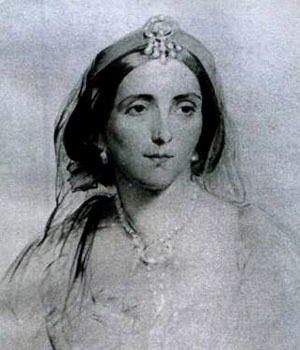
Portrait of Lord Granville Leveson-Gower, later 1st Earl Granville.

Portrait of Lord Granville Leveson-Gower, later 1st Earl Granville.

Granville Leveson-Gower, 1st Earl Granville GCB PC (12 October 1773 – 8 January 1846), known as Lord Granville Leveson-Gower from 1786 to 1814 and as the Viscount Granville from 1814 to 1833, was a British Whig statesman and diplomat.

Granville was a son of Granville Leveson-Gower, 1st Marquess of Stafford and his third wife Lady Susannah Stewart, daughter of Alexander Stewart, 6th Earl of Galloway. He was also a younger, paternal half-brother of George Leveson-Gower, 1st Duke of Sutherland. He was educated at Dr Kyle’s school at Hammersmith, and then by the Revd John Chappel Woodhouse, before matriculating at Christ Church, Oxford, in April 1789. He took no degree, but became a DCL in 1799.

Political and Diplomatic Career
He served as British ambassador to Russia (10 August 1804 – 28 November 1805 and 1806–1807) and France (1824–1828, 1830–1835, 1835–1841). In 1815 he was raised to the peerage as Viscount Granville, of Stone Park in the County of Stafford. In 1833, he was further honoured when he was created Baron Leveson, of Stone Park in the County of Stafford, and Earl Granville.

Family
Lord Granville married Lady Harriet Cavendish (1785–1862), daughter of William Cavendish, 5th Duke of Devonshire and Lady Georgiana Spencer, in 1809. They had two sons and two daughters. Their eldest son, Granville Leveson-Gower, 2nd Earl Granville, became a distinguished politician. Their second son the Hon. Frederick Leveson-Gower was also a politician. Their daughter Lady Georgiana married Alexander Fullerton. She was a biographer, novelist, and great philanthropist. Lord Granville died in January 1846, aged 72. The Countess Granville died in November 1862, aged 77. Lord Granville, prior to marrying Lady Harriet Cavendish, was the lover of Lady Harriet’s maternal aunt, Henrietta Ponsonby, Countess of Bessborough, née Lady Henrietta Frances Spencer, with whom he fathered two illegitimate children: Harriette Stewart and George Stewart.

Posted in British history, Georgian Era, Living in the Regency, real life tales, Regency era | Tagged | Comments Off on Georgian Personality: Granville Leveson-Gower, 1st Earl Granville

Child and Co., the Model for Tellson’s Bank in Dickens’ “A Tale of Two Cities”

This is the logo for Child and Co.

This is the logo for Child and Co.

Child & Co. is a formerly independent private bank that is now a separate wholly owned subsidiary and branch or brand of the Royal Bank of Scotland (RBS) Group. It is based at 1 Fleet Street in the City of London. It is authorised by the Financial Services Authority as a brand of the Royal Bank of Scotland for regulatory compliance purposes.

Child & Co. was one of the oldest independent financial institutions in the UK, and can trace its roots back to a London goldsmith business in the late 17th century. Francis Child established his business as a goldsmith in 1664, when he entered into partnership with Robert Blanchard. Child married Blanchard’s stepdaughter and inherited the whole business on Blanchard’s death. Renamed Child and Co, the business thrived, and was appointed the “jeweller in ordinary” to King William III. In 1923, the bank was acquired by Glyn, Mills & Co., that eventually became part of RBS.

After Child died in 1713, his three sons ran the business, and during this time, the business transformed from a goldsmith’s to a fully fledged bank. The bank claims it was the first to introduce a pre-printed cheque form, prior to which customers simply wrote a letter to their bank but sent it to their creditor who presented it for payment. Its first bank note was issued in 1729.

By 1782, Child’s grandson Robert Child was the senior partner in the firm. However, when he died in 1782 without any sons to inherit the business, he did not want to leave it to his only daughter, Sarah Anne Child, because he was furious over her elopement with John Fane, 10th Earl of Westmorland earlier in the year. To prevent the Earls of Westmorland from ever acquiring his wealth, he left it in trust to his daughter’s second surviving son or eldest daughter. This turned out to be Lady Sarah Sophia Fane, who was born in 1785. She married George Child-Villiers, 5th Earl of Jersey in 1804, and upon her majority in 1806, she became senior partner. She exercised her rights personally until her death in 1867. At that point the Earl of Jersey and Frederick William Price of Harringay House were appointed as the two leading partners. Ownership continued in the Jersey family until the 1920s.

In 1923, George, 8th Earl of Jersey sold the bank to Glyn, Mills & Co., a London-based commercial bank. Williams Deacon’s Bank acquired Glyn’s in 1939 (both subsequently taken over by the Royal Bank of Scotland and known as Williams & Glyn’s Bank from 1970 to 1985), retaining Child & Co. as a separate business, as which it continues to this day at No. 1, Fleet Street.

Clientele

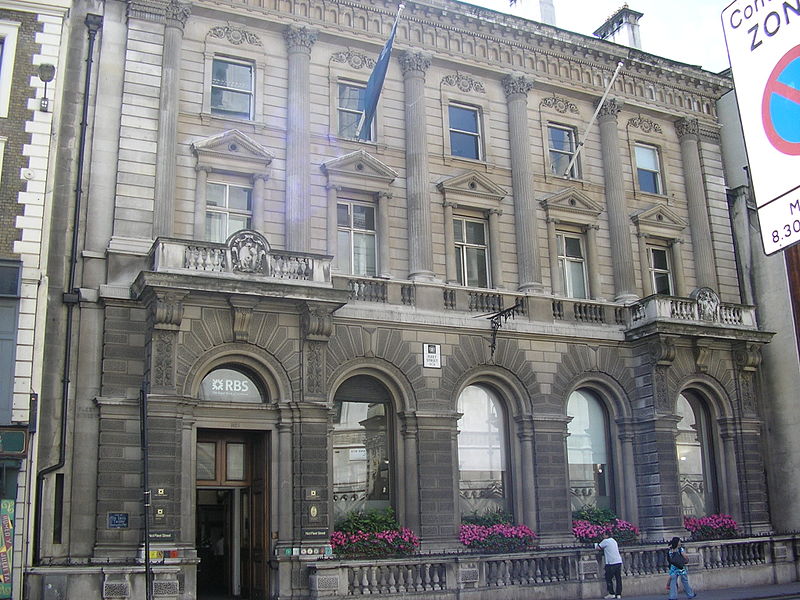
Child and Co. at 1 Fleet Street, London, UK

Child and Co. at 1 Fleet Street, London, UK

Over their 350-year history Child & Co has attracted an exclusive client base including The Honourable Societies of Middle Temple and Lincoln’s Inn, and numerous landowning families. Scholars of the Inns receive their awards by cheques drawn on Child & Co, and many Barristers continue to use the bank throughout their professional lives. Several universities including The London School of Economics, Oxford University, and Imperial College London are reported to hold accounts. Until 1979 there was a ‘representative office’ (technically not a branch) at St Giles Street Oxford.

Relationship with Royal Bank of Scotland
Child & Co. is authorised with the Financial Services Authority for the purposes of the Financial Services Compensation Scheme as a brand of the Royal Bank of Scotland. When the 311 Royal Bank of Scotland branches in England and Wales are sold to another organisation (a requirement of the financial services regulators of the UK and EU), Drummonds Bank and Child & Co. will remain part of RBS.

Literary Reference
Child & Co. was the model for Tellson’s Bank in “A Tale of Two Cities” by Charles Dickens.

Posted in British history, Georgian Era, Living in the Regency, real life tales, Regency era, Scotland | Tagged , , | 2 Comments

Winners of Summer Banquet Blog Hop

summer-banquet-hop-copyI am proud to announce the winners of my part of the Summer Banquet Blog Hop.


Elizabeth MacGregor will receive an autographed copy of A Touch of Mercy.

Heidi S. will receive an autographed copy of Christmas at Pemberley.

Marsha will receive an autographed copy of His: Two Regency Novellasparty-clip-art-balloons-different-colours

Posted in Uncategorized | 2 Comments

Summer Banquet Blog Hop~The Spice Trade Changes the World’s History

DF054796-9264-4082-951345953AB3F485

summer-banquet-hop-copyWelcome to the last day of Summer Banquet Hop Giveaway. Like always to be eligible to win one of the three books I have listed below, leave a comment on the post or Tweet or Share the post on Facebook and Twitter. Winners will be drawn by Random.org at noon (EDST) on Sunday, June 9. Also, visit the other authors who are participating in the Blog Hop for additional opportunities to win fabulous books and prizes.

Spices have played a role in many of history’s most famous events from the discovery of new countries to the vanquishing of powerful rulers. According to the Online Etymology Dictionary, spice is a noun from the early 13th Century. It is from Old French espice, from Late Latin species (plural) “spices, goods, wares,” from Latin “kind, sort.” Early druggists recognized four “types” of spices: saffron, clove, cinnamon, nutmeg. Figurative sense of “slight touch or trace of something” is recorded from 1530s. Spice-cake first attested in the 1520s.

Using herbs dates back to primitive people used aromatic leaves to wrap and enhance the taste of their food. Spices and herbs were used to disguise the taste of some foods and, much later, to keep food fresh.

Those in power coveted their spices. According to legend, Queen Sheba offered King Solomon “120 measures of gold, many spices, and precious stones.” According to McCormick’s online resources, “A handful of cardamom was worth as much as a poor man’s yearly wages, and many slaves were bought and sold for a few cups of peppercorns.”

The first spices to come to European ports came via Arab trades. The Phoenicians controlled the 14th Century spice trade. The easily maneuvered their ways across the Mediterranean, as well as the Indian Ocean.

The Roman Empire brought the world’s notice to the use of spices. It is said that Cleopatra seduced Caesar with enchanted spices. The Roman spice of choice was pepper. The Romans used pepper in a fish-based sauce called “garum.” Garum was prepared from the intestines of small fishes through the process of bacterial fermentation. Fishermen would lay out their catch according to the type and part of the fish, allowing makers to pick the exact ingredients they wanted. The fish parts were then macerated in salt, and cured in the sun for one to three months. The mixture fermented and liquefied in the dry warmth, with the salt inhibiting the common agents of decay. Garum was the clear liquid that formed on the top, drawn off by means of a fine strainer inserted into the fermenting vessel. The sediment or sludge that remained was allec. Concentrated decoctions of aromatic herbs might be added. Flavors would vary according to the locale, with ingredients sometimes from in-house gardens.

The Three Kings brought gold, frankincense, and myrrh to the baby Jesus. Frankincense and myrrh were rare spices and were quite expensive. The prophet Mohammed used his roots to a merchant tribe to spread his message and to sell spices. It is said that the Romans celebrated Nero’s entrance into the city by strewing saffron upon the streets.

The Crusades renewed the European interest in the spice trade. Italian ships delivered Oriental spices to the courts of Europe’s most powerful kings and queens. Spiced wines from Spain and Italy became very popular in the Middle Ages, and spices made appearances in market towns. Pepper has been used as a spice in India since prehistoric times. Pepper is native to India and has been known to Indian cooking since at least 2000 BCE. Peppercorns were a much-prized trade good, often referred to as “black gold” and used as a form of commodity money. Until well after the Middle Ages, virtually all of the black pepper found in Europe, the Middle East, and North Africa traveled there from India’s Malabar region. The Ancient History Encyclopedia has a wonderful history of pepper article.

Again from the McCormick’s website, we find, “In court, litigants bribed judges with spices. A prototype of sugared almonds, some spices were covered in honey in order to disguise them as candy. Their culinary and medicinal uses overlapped, and grocers and apothecaries often worked in the same companies. Besides traditional black pepper, some of the other prized spices of the era were long pepper from Sumatra, ginger, cloves, cinnamon, nutmeg, and galanga (a ginger-like spice from Southeast Asia).”

Even before Christopher Columbus, Portuguese geographers had advocated the exploration of the African continent. The hope of following the African shoreline to open new routes to India and its spice trade became an obsession for the Portuguese and Spanish courts. Vasco de Gama arrived in India in 1498, after crossing the Cape of Good Hope. The Spanish, Portuguese, Dutch, and British empires traded positions in the saga of the spice trade. At one time, the British East India Company held a monopoly on all trade with India.

Columbus, of course, did not make it to India, but he did explore the Caribbean islands. He and those who followed into the Americas brought back to their respective courts such common everyday spices as vanilla, allspice, and red pepper.

According to History of Spices, “But the economic value of these products declined as farming sites increased. The Dutch jealously protected access to the Moluccas [Islands in Indonesia] for fear of seeing their clove and nutmeg trees exported to other regions, which would have ruined their monopoly. Thievery of this sort was punishable by death. After many attempts, a few pepper and nutmeg trees were successfully transplanted on Mauritius Island. This eventually led to a dispersion of plant production sites across Dutch, English, and French colonial empires, which involved spices in addition to coffee, cocoa, and many other plants. The tight reins on the industry were loosening.”

In the 18th and 19th Centuries, America’s sleek clipper ships dominated the world trade. “So many pepper voyages were undertaken from New England to Sumatra that the price of pepper dropped to less than three cents a pound in 1843, a disastrous slump that affected many aspects of American business.”

Please visit my website for an introduction to all 17 of my titles (www.rjeffers.com).

Leave a comment below to be eligible for my giveaway. On Sunday, June 9, 2013, I will draw a winner for each of these titles from my catalogue. This giveaway is open internationally. 

I will present a winner for each of these three titles…

His: Two Regency Novellas; A Touch of Mercy (Book 5 of the Realm Series); and Christmas at Pemberley

JeffersC@PemberleyATOMCropHisCrop

Other Participants in the Blog Hop…

Maria Grace

David Phillings

Gillian Bagwell

Violet Bedford

Anna Belfrage

Debra Brown

Allison Bruning

P.O. Dixon

Heather Domin

Grace Elliot

Yves Fey

Lauren Gilbert

Tinney S. Heath

Evangeline Holland

Helen Hollick

Regina Jeffers

Sharon Lathan

Cora Lee

Diane Scott Lewis

Sue Millard

Donna Russo Morin

Ginger Myrick

JL Oakley

Sally Smith O’Rourke

E. M. Powell 

Laura Purcell

Kim Rendfeld

Shauna Roberts

Julie Rose

Margaret Skea

Shannon Winslow

Posted in British history, food and drink, Georgian Era, Living in the Regency, real life tales, Regency era, Scotland | Tagged , , , , | 2 Comments

Summer Banquet Blog Hop~Regency Era Libations

summer-banquet-hop-copyWelcome to Day 4 of the Summer Banquet Hop Giveaway. To be eligible for my giveaway, please leave a comment on the post below or Tweet or Share on Twitter and Facebook. The giveaway ends on Sunday, June 9, 2013. Please visit the others involve for other great giveaways. 

Beer Casks and Tilting: A stillage is like a pallet or skid but with a cage or sides or some form of support specifically tailored to the material it is intended to carry. Some are designed to be stackable.

Stillages are mainly used to transport goods without the need to load and unload the product being carried, which saves time and decreases the chance of damage. An example is the use of stillages in the glass industry, where they are shaped like an upright “A”; the glass leans inward and is strapped to the stillage ready for transport.

A stillage is any device on which a cask of ale is placed for service.
Unlike kegs, which can be simply stood upright on the floor, casks are used lying on their sides. This allows the beer to run from the tap under gravity, with room in the “belly” of the cask below the outlet for the finings to collect. The shive with the spile will then be the highest point on the cask. As the beer clears (see finings), the inside of the cask becomes coated with sediment. It is important that the stillage holds the cask absolutely still with no rocking or shaking, otherwise the sediment will be shaken into suspension and the beer will be cloudy.

A stillage need not be complicated – anything that will support a cask (preferably on three points to avoid any wobbling) will do. At temporary events, sturdy tables or frames made of scaffolding and planks might be used, with the casks placed on wooden wedges (two at the front, one at the back). At the other end of the scale, many pub cellars use specially-made steel racking, often with two rows of casks one above the other. Some pubs have brick or stone stillages, sometimes quite ancient, built into the wall of the cellar.

As the cask empties, it needs to be gently tilted to obtain the last of the beer. With wooden wedges, moving the rear wedge forward will achieve this; purpose-built metal units often have springs incorporated that automatically tilt the cask as it becomes lighter. This requires less effort from bar staff, and also helps beer quality – the lift is so smooth and gradual that there is no danger of stirring up the lees and making the beer cloudy.

Tea_leaves_steeping_in_a_zhong_čaj_05Tea: Until the Victorian era, people blended their own tea at home. Often this was within the housekeeper’s duties. Each tea was stored in a tea chest, with many compartments to keep the teas separate. The chests were equipped with a heavy lock, as the tea was expensive. Afternoon tea was generally served between three and six of the clock. Those closer to three of the clock sported a lighter fare of food. High tea, with heavier selections of food, was closer to six. High tea was never meant to be a “fashionable” event. The practice came from the workers returning home from their jobs at five or six. As was customary, dinner was served between seven and eight of the clock. The “high tea” was a quick meal for the very hungry workers. Housekeepers mixed cheaper tea leaves, usually those known as Common Bohea or Common green leaves, being mixed with more expensive teas: Hyson, Congo, and Gunpowder.

Tea Adulteration: “New tea” was often sold in the marketplace. Estimates say 1500 pounds of “new tea” was processed each week in 19th Century London. Servants and the poor working class often sold used tea leaves to tea vendors. The old leaves were redried on heated plates and redyed. A dye containing copper brought back the green tones to the leaves. Logwood would be used to restore the color to black teas. This recycled black tea leaves were known as “smouch” and were often sold to the lower classes.

SyllabubsSyllabub: Syllabub (also sillabub, sillibub) is a traditional English dessert, popular from the 16th to the 19th century. It is usually made from rich milk or cream seasoned with sugar and lightly curdled with wine. Mrs Beeton (1861) gives two recipes. One author’s recipe says to mix the other ingredients together in a large bowl, “place the bowl under the cow, and milk it full.” The recipe can be traced back to the time of the Tudor Dynasty. In its early variations, syllabub was a drink made of new milk and cider, with the cows milked directly into an ale pot. A variation, known as an Everlasting Syllabub, allows for the cream to rise and thicken by letting it stand for several days.

The Writer’s Guide to Everyday Life in Regency and Victorian England (page 28) lists the Average Wine Prices in 1804 (per dozen bottles [in shillings]) as
Superior Old Port 38 shillings
Prime Old Sherry 42 shillings
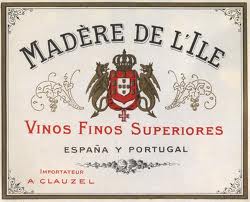
Prime Madeira 63 shillings
Superior Claret 70 shillings
Old Jamaica Rum 15 shillings
Holland’s Geneva 10 shillings
Cognac Brandy 20 shillings per gallon

imagesThe middle classes drank port, sherry, and Madeira, brown brandy, and gin in place of the expensive wines.

It is possible that distillation was practised by the Babylonians in Mesopotamia in the 2nd millennium BC, with perfumes and aromatics being distilled, but this is subject to uncertain and disputable interpretation of evidence. The earliest certain chemical distillations were by Greeks in Alexandria in about the 3rd century AD, but these were not distillations of alcohol. The medieval Arabs adopted the distillation technique of the Alexandrian Greeks, and written records in Arabic begin in the 9th century, but again these were not distillations of alcohol. Distilling technology passed from the medieval Arabs to the medieval Latins, with the earliest records in Latin in the early 12th century. The earliest records of the distillation of alcohol are in Italy in the 13th century, where alcohol was distilled from wine. An early description of the technique was given by Ramon Llull (1232 – 1315). Its use spread through medieval monasteries, largely for medicinal purposes, such as the treatment of colic and smallpox.

The art of distillation spread to Ireland and Scotland no later than the 15th century, as did the common European practice of distilling ‘Aqua Vitae’ or spirit alcohol primarily for medicinal purposes. The practice of medicinal distillation eventually passed from a monastic setting to the secular via professional medical practitioners of the time, The Guild of Surgeon Barbers. The first confirmed written record of whisky comes from 1405 in Ireland. In the Irish Annals of Clonmacnoise in 1405, the first written record of whisky attributes the death of a chieftain to “taking a surfeit of aqua vitae” at Christmas.

In Scotland, the first evidence of whisky production comes from an entry in the Exchequer Rolls for 1494 where malt is sent “To Friar John Cor, by order of the king, to make aquavitae,” enough to make about 500 bottles.

James IV of Scotland (r. 1488–1513) reportedly had a great liking for Scotch whisky, and in 1506 the town of Dundee purchased a large amount of whisky from the Guild of Surgeon Barbers, which held the monopoly on production at the time. Between 1536 and 1541, King Henry VIII of England dissolved the monasteries, sending their monks out into the general public. Whisky production moved out of a monastic setting and into personal homes and farms as newly independent monks needed to find a way to earn money for themselves.

The distillation process was still in its infancy; whisky itself was not allowed to age, and as a result tasted very raw and brutal compared to today’s versions. Renaissance-era whisky was also very potent and not diluted. Over time whisky evolved into a much smoother drink.

With a licence to distil Irish whiskey from 1608, the Old Bushmills Distillery in the north coast of Ireland is the oldest licenced whiskey distillery in the world. In 1707, the Acts of Union merged England and Scotland, and thereafter taxes on it rose dramatically.

After the English Malt Tax of 1725, most of Scotland’s distillation was either shut down or forced underground. Scotch whisky was hidden under altars, in coffins, and in any available space to avoid the governmental Excisemen. Scottish distillers, operating out of homemade stills, took to distilling whisky at night when the darkness hid the smoke from the stills. For this reason, the drink became known as moonshine. At one point, it was estimated that over half of Scotland’s whisky output was illegal.

In America, whisky was used as currency during the American Revolution. It also was a highly coveted sundry and when an additional excise tax was levied against it, the Whiskey Rebellion erupted in 1791.

In 1823, the UK passed the Excise Act, legalizing the distillation (for a fee), and this put a practical end to the large-scale production of Scottish moonshine.

In 1831, Aeneas Coffey patented the Coffey still, allowing for cheaper and more efficient distillation of whisky. In 1850, Andrew Usher began producing a blended whisky that mixed traditional pot still whisky with that from the new Coffey still. The new distillation method was scoffed at by some Irish distillers, who clung to their traditional pot stills. Many Irish contended that the new product was, in fact, not whisky at all.

By the 1880s, the French brandy industry was devastated by the phylloxera pest that ruined much of the grape crop; as a result, whisky became the primary liquor in many markets.

During the Prohibition era in the United States lasting from 1920 to 1933, all alcohol sales were banned in the country. The federal government made an exemption for whisky prescribed by a doctor and sold through licensed pharmacies. During this time, the Walgreens pharmacy chain grew from 20 retail stores to almost 400.

Please visit my website for an introduction to all 17 of my titles (www.rjeffers.com).

Leave a comment below to be eligible for my giveaway. On Sunday, June 9, 2013, I will draw a winner for each of these titles from my catalogue. This giveaway is open internationally.  

These three titles are available as part of the Summer Banquet Hop Giveaway…

His: Two Regency Novellas; A Touch of Mercy (Book 5 of the Realm Series); and Christmas at Pemberley

ATOMCropJeffersC@PemberleyHisCrop


Other Summer Banquet Hop Participants…
Random Bits of Fascination (Maria Grace)
Pillings Writing Corner (David Pilling)
Anna Belfrage
Debra Brown
Lauren Gilbert
Gillian Bagwell
Julie Rose
Donna Russo Morin
Regina Jeffers
Shauna Roberts
Tinney S. Heath
Grace Elliot
Diane Scott Lewis
Ginger Myrick
Helen Hollick
Heather Domin
Margaret Skea
Yves Fey
JL Oakley
Shannon Winslow
Evangeline Holland
Cora Lee
Laura Purcell
P. O. Dixon
E.M. Powell
Sharon Lathan
Sally Smith O’Rourke
Allison Bruning
Violet Bedford
Sue Millard
Kim Rendfeld

Posted in British history, food and drink, Georgian Era, Living in the Regency, real life tales, Regency era | Tagged , , , , , | 2 Comments