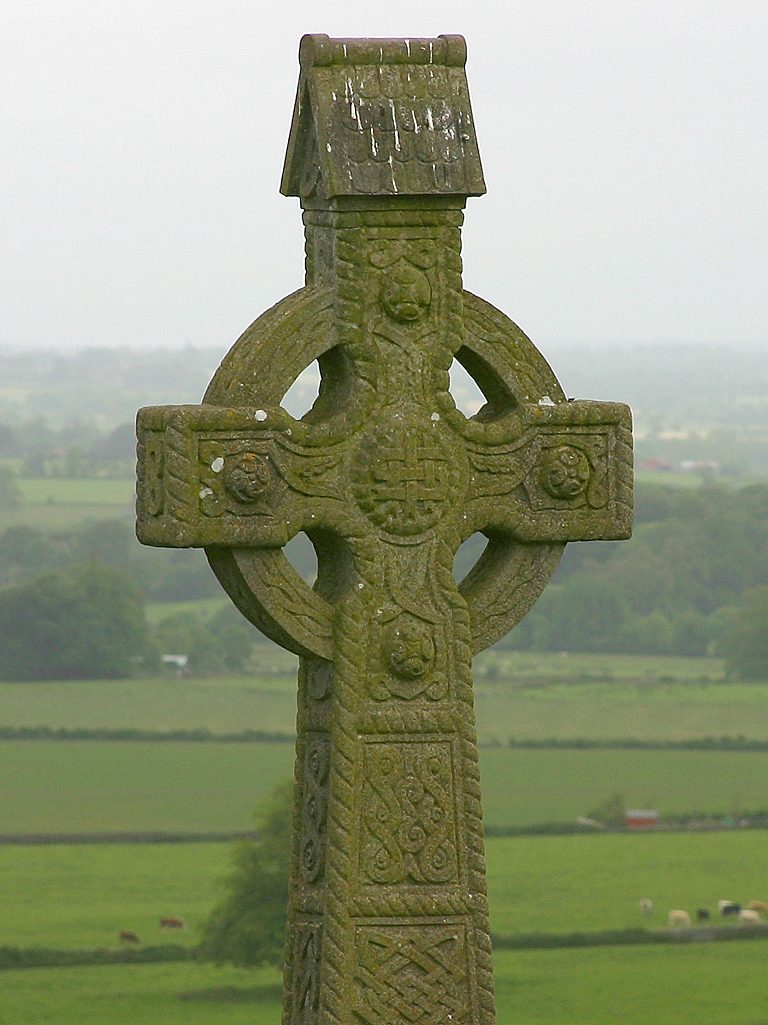
A great empire once stretched from the Black Sea to the British Isles. So powerful, the Celts leveled Rome, as well as conquering the Carthaginians in Spain. Unfortunately, the Celts left no written account of their society – most of what we know of them comes from the histories of their enemies and their allies. Other than a few coins and bronze weapons, we possess little proof of their existence.
We have what is known as the “Celtic fringe,” which means the Celts retreated to the “edges” of many of the lands they once occupied. For example, in Britain, an unmixed Celtic population is evident in Wales, as well as in Scotland’s Highlands, and in Ireland. Roman legionaries never entered Ireland, and so that area retained much of its early Celtic influences. Likewise, we find a short Celtic tradition in Brittany.
The Celts were known as a warlike race, one which fought many battles. The art of war was part of the heritage passed on to their descendants. In general, the Celts were tall, fair complected, and red of head. They were known to be fond of gossip and of their own opinions. They were also very intelligent and shrewd. The created stories rich in the beauty of nature and life and love. Their stories have influenced much of the literature which followed.
The Celtic languages form a branch of the larger Indo-European family. By the time speakers of Celtic languages enter history around 400 BC, they were already split into several language groups, and spread over much of Western continental Europe, the Iberian Peninsula, Ireland and Britain.
Some scholars think that the Urnfield culture of Western Middle Europe represents an origin for the Celts as a distinct cultural branch of the Indo-European family. This culture was preeminent in central Europe during the late Bronze Age, from c. 1200 BC until 700 BC, itself following the Unetice and Tumulus cultures. The Urnfield period saw a dramatic increase in population in the region, probably due to innovations in technology and agricultural practices. The Greek historian Ephoros of Cyme in Asia Minor, writing in the 4th century BC, believed that the Celts came from the islands off the mouth of the Rhine and were “driven from their homes by the frequency of wars and the violent rising of the sea.”
The spread of iron-working led to the development of the Hallstatt culture directly from the Urnfield (c. 700 to 500 BC). Proto-Celtic, the latest common ancestor of all known Celtic languages, is considered by this school of thought to have been spoken at the time of the late Urnfield or early Hallstatt cultures, in the early 1st millennium BC. The spread of the Celtic languages to Iberia, Ireland and Britain would have occurred during the first half of the 1st millennium BC, the earliest chariot burials in Britain dating to c. 500 BC.
Other scholars see Celtic languages as covering Britain and Ireland, and parts of the Continent, long before any evidence of “Celtic” culture is found in archaeology. Over the centuries the language(s) developed into the separate Celtiberian, Goidelic and Brythonic languages. 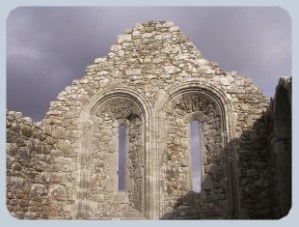
The Hallstatt culture was succeeded by the La Tène culture of central Europe, which was overrun by the Roman Empire, though traces of La Tène style are still to be seen in Gallo-Roman artefacts. In Britain and Ireland La Tène style in art survived precariously to re-emerge in Insular art. Early Irish literature casts light on the flavour and tradition of the heroic warrior elites who dominated Celtic societies. Celtic river-names are found in great numbers around the upper reaches of the Danube and Rhine, which led many Celtic scholars to place the ethnogenesis of the Celts in this area.
Diodorus Siculus and Strabo both suggest that the heartland of the people they called Celts was in southern France. The former says that the Gauls were to the north of the Celts, but that the Romans referred to both as Gauls (in linguistic terms the Gauls were certainly Celts). Before the discoveries at Hallstatt and La Tene, it was generally considered that the Celtic heartland was southern France, see Encyclopædia Britannica for 1813.
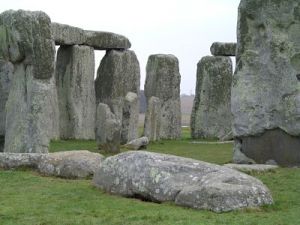
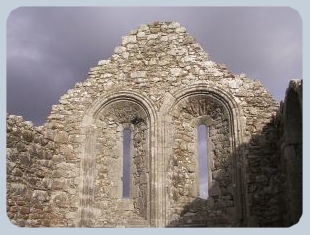
Celtic remains of Tintagel Castle
Linguistic Evidence
The Proto-Celtic language is usually dated to the Late Bronze Age. The earliest records of a Celtic language are the Lepontic inscriptions of Cisalpine Gaul, the oldest of which still predate the La Tène period. Other early inscriptions are Gaulish, appearing from the early La Tène period in inscriptions in the area of Massilia, in the Greek alphabet.
Celtiberian inscriptions appear comparatively late, after about 200 BC. Evidence of Insular Celtic is available only from about 400 AD, in the form of Primitive Irish Ogham inscriptions. Besides epigraphical evidence, an important source of information on early Celtic is toponymy.
In 2010, Koch tentatively proposed that the language of the Tartessian inscriptions of south Portugal and southwest Spain (dating from the 7th–5th centuries BC) was Celtic.
Archaeological Evidence
Before the 19th century, scholars assumed that the original land of the Celts was west of the Rhine, more precisely in Gaul, because it was where Greek and Roman ancient sources, namely Caesar, located the Celts. This view was challenged by the 19th-century historian Marie Henri d’Arbois de Jubainville, who placed the land of origin of the Celts east of the Rhine.
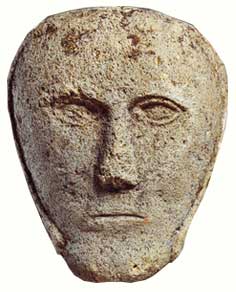 Jubainville based his arguments on a phrase of Herodotus’ that placed the Celts at the source of the Danube, and argued that Herodotus had meant to place the Celtic homeland in southern Germany. The finding of the prehistoric cemetery of Hallstat in 1846 by Johan Ramsauer and the finding of the archaeological site of La Tène by Hansli Kopp in 1857 drew attention to this area. The concept that the Hallstatt and La Tene cultures could be seen not just as chronological periods but as “Culture Groups”, entities composed of people of the same ethnicity and language, started to grow by the end of the 19th century. In the beginning of the 20th century the belief that those “Culture Groups” could be thought in racial or ethnic terms was strongly held by Gordon Childe whose theory was influenced by the writings of Gustaf Kossinna. Along the 20th century the racial ethnic interpretation of La Tene culture rooted much stronger, and any findings of “La Tene culture” and “flat inhumation cemeteries” were directly associated with the celts and the Celtic language. The Iron Age Hallstatt (c. 800–475 BC) and La Tène (c. 500–50 BC) cultures are typically associated with Proto-Celtic and Celtic culture.
In various academic disciplines the Celts were considered a Central European Iron Age phenomenon, through the cultures of Hallstatt and La Tène. However, archaeological finds from the Halstatt and La Tène culture were rare in the Iberian Peninsula, in southwestern France, northern and western Britain, southern Ireland and Galatia and did not provide enough evidence for a cultural scenario comparable to that of Central Europe. It is considered equally difficult to maintain that the origin of the Peninsular Celts can be linked to the preceding Urnfield culture, leading to a more recent approach that introduces a ‘proto-Celtic’ substratum and a process of Celticisation having its initial roots in the Bronze Age Bell Beaker culture.
The La Tène culture developed and flourished during the late Iron Age (from 450 BC to the Roman conquest in the 1st century BC) in eastern France, Switzerland, Austria, southwest Germany, the Czech Republic, Slovakia and Hungary. It developed out of the Hallstatt culture without any definite cultural break, under the impetus of considerable Mediterranean influence from Greek, and later Etruscan civilisations. A shift of settlement centres took place in the 4th century.
The western La Tène culture corresponds to historical Celtic Gaul. Whether this means that the whole of La Tène culture can be attributed to a unified Celtic people is difficult to assess; archaeologists have repeatedly concluded that language, material culture, and political affiliation do not necessarily run parallel. Frey notes that in the 5th century, “burial customs in the Celtic world were not uniform; rather, localised groups had their own beliefs, which, in consequence, also gave rise to distinct artistic expressions.” Thus, while the La Tène culture is certainly associated with the Gauls, the presence of La Tène artefacts may be due to cultural contact and does not imply the permanent presence of Celtic speakers.
Historical Evidence
Polybius published a history of Rome about 150 BC in which he describes the Gauls of Italy and their conflict with Rome. Pausanias in the 2nd century AD says that the Gauls “originally called Celts,” “live on the remotest region of Europe on the coast of an enormous tidal sea.” Posidonius described the southern Gauls about 100 BC. Though his original work is lost it was used by later writers such as Strabo. The latter, writing in the early 1st century AD, deals with Britain and Gaul as well as Hispania, Italy and Galatia. Caesar wrote extensively about his Gallic Wars in 58–51 BC. Diodorus Siculus wrote about the Celts of Gaul and Britain in his 1st-century history.
Minority Views
Myles Dillon and Nora Kershaw Chadwick accepted that “the Celtic settlement of the British Isles” might have to be dated to the Beaker period concluding that “There is no reason why so early a date for the coming of the Celts should be impossible.”
Martín Almagro Gorbea proposed the origins of the Celts could be traced back to the 3rd millennium BC, seeking the initial roots in the Bell Beaker culture, thus offering the wide dispersion of the Celts throughout western Europe, as well as the variability of the different Celtic peoples, and the existence of ancestral traditions an ancient perspective. Using a multidisciplinary approach Alberto J. Lorrio and Gonzalo Ruiz Zapatero reviewed and built on Almagro Gorbea’s work to present a model for the origin of the Celtic archaeological groups in the Iberian Peninsula (Celtiberian, Vetton, Vaccean, the Castro Culture of the northwest, Asturian-Cantabrian and Celtic of the southwest) and proposing a rethinking the meaning of “Celtic” from a European perspective. More recently, John Koch and Barry Cunliffe have suggested that Celtic origins lie with the Atlantic Bronze Age, roughly contemporaneous with the Hallstatt culture but positioned considerably to the West, extending along the Atlantic coast of Europe.
Stephen Oppenheimer points out that Herodotus seemed to believe the Danube rose near the Pyrenees.
Distribution
Continental Celts: Gaul
The Romans knew the Celts then living in what became present-day France as Gauls. The territory of these peoples probably included the Low Countries, the Alps and present-day northern Italy. Julius Caesar in his Gallic Wars described the 1st-century BC descendants of those Gauls.
Eastern Gaul became the centre of the western La Tène culture. In later Iron Age Gaul, the social organisation resembled that of the Romans, with large towns. From the 3rd century BC the Gauls adopted coinage, and texts with Greek characters from southern Gaul have survived from the 2nd century BC.
Greek traders founded Massalia about 600 BC, with some objects (mostly drinking ceramics) being traded up the Rhone valley. But trade became disrupted soon after 500 BC and re-oriented over the Alps to the Po valley in the Italian peninsula. The Romans arrived in the Rhone valley in the 2nd century BC and encountered a mostly Celtic-speaking Gaul. Rome wanted land communications with its Iberian provinces and fought a major battle with the Saluvii at Entremont in 124–123 BC. Gradually Roman control extended, and the Roman Province of Gallia Transalpina developed along the Mediterranean coast.
The Romans knew the remainder of Gaul as Gallia Comata – “Hairy Gaul.”
In 58 BC the Helvetii planned to migrate westward but Julius Caesar forced them back. He then became involved in fighting the various tribes in Gaul, and by 55 BC had overrun most of Gaul. In 52 BC Vercingetorix led a revolt against the Roman occupation but was defeated at the siege of Alesia and surrendered.
Following the Gallic Wars of 58–51 BC, Caesar’s Celtica formed the main part of Roman Gaul, becoming the province of Gallia Lugdunensis. This territory of the Celtic tribes was bounded on the south by the Garonne and on the north by the Seine and the Marne. The Romans attached large swathes of this region to neighboring provinces Belgica and Aquitania, particularly under Augustus.
Place- and personal-name analysis and inscriptions suggest that the Gaulish Celtic language was spoken over most of what is now France.
Iberia
Until the end of the 19th century, traditional scholarship dealing with the Celts did acknowledge their presence in the Iberian Peninsula as a material culture relatable to the Hallstatt and La Tène cultures. However, since according to the definition of the Iron Age in the 19th century Celtic populations were supposedly rare in Iberia and did not provide a cultural scenario that could easily be linked to that of Central Europe, the presence of Celtic culture in that region was generally not fully recognised. Three divisions of the Celts of the Iberian Peninsula were assumed to have existed: the Celtiberians in the mountains near the centre of the peninsula, the Celtici in the southwest, and the celts in the northwest (in Gallaecia and Asturias).
Modern scholarship, however, has clearly proven that Celtic presence and influences were most substantial in what is today Spain and Portugal (with perhaps the highest settlement saturation in Western Europe), particularly in the central, western and northern regions. The Celts in Iberia were divided into two main archaeological and cultural groups, even though that division is not very clear:
One group was spread out along Galicia and the Iberian Atlantic shores. They were made up of the Proto / Para-Celtic Lusitanians (in Portugal) and the Celtic region that Strabo called Celtica in the southwestern Iberian peninsula, including the Algarve, which was inhabited by the Celtici, the Vettones and Vacceani peoples (of central-western Spain and Portugal), and the Gallaecian, Astures and Cantabrian peoples of the Castro culture of northern and northwestern Spain and Portugal.
The Celtiberian group of central Spain and the upper Ebro valley. This group originated when Celts (mainly Gauls and some Celtic-Germanic groups) migrated from what is now France and integrated with the local Iberian people.
The origins of the Celtiberians might provide a key to understanding the Celticisation process in the rest of the Peninsula. The process of Celticisation of the southwestern area of the peninsula by the Keltoi and of the northwestern area is, however, not a simple Celtiberian question. Recent investigations about the Callaici and Bracari in northwestern Portugal are providing new approaches to understanding Celtic culture (language, art and religion) in western Iberia.
John T. Koch of the University of Wales-Aberystwyth suggested that Tartessian inscriptions of the 8th century BC might already be classified as Celtic. This would mean that Tartessian is the earliest attested trace of Celtic by margin of more than a century.
Alps and Po Valley
It had been known for some time that there was an early, although apparently somewhat limited, Celtic (Lepontic, sometimes called Cisalpine Celtic) presence in Northern Italy since inscriptions dated to the 6th century BC have been found there.
The site of Golasecca, where the Ticino exits from Lake Maggiore, was particularly suitable for long-distance exchanges, in which Golaseccans acted as intermediaries between Etruscans and the Halstatt culture of Austria, supported on the all-important trade in salt.
In 391 BC Celts “who had their homes beyond the Alps streamed through the passes in great strength and seized the territory that lay between the Appennine mountains and the Alps” according to Diodorus Siculus. The Po Valley and the rest of northern Italy (known to the Romans as Cisalpine Gaul) was inhabited by Celtic-speakers who founded cities such as Milan.
Later the Roman army was routed at the battle of Allia and Rome was sacked in 390 BC by the Senones.
At the battle of Telamon in 225 BC a large Celtic army was trapped between two Roman forces and crushed.
The defeat of the combined Samnite, Celtic and Etruscan alliance by the Romans in the Third Samnite War sounded the beginning of the end of the Celtic domination in mainland Europe, but it was not until 192 BC that the Roman armies conquered the last remaining independent Celtic kingdoms in Italy.
Eastward Expansion
The Celts also expanded down the Danube river and its tributaries. One of the most influential tribes, the Scordisci, had established their capital at Singidunum in 3rd century BC, which is present-day Belgrade, Serbia. The concentration of hill-forts and cemeteries shows a density of population in the Tisza valley of modern-day Vojvodina, Serbia, Hungary and into Ukraine. Expansion into Romania was however blocked by the Dacians.
Further south, Celts settled in Thrace (Bulgaria), which they ruled for over a century, and Anatolia, where they settled as the Galatians. Despite their geographical isolation from the rest of the Celtic world, the Galatians maintained their Celtic language for at least 700 years. St Jerome, who visited Ancyra (modern-day Ankara) in 373 AD, likened their language to that of the Treveri of northern Gaul.
For Venceslas Kruta, Galatia in central Turkey was an area of dense Celtic settlement.
The Boii tribe gave their name to Bohemia, Bologna and possibly Bavaria, and Celtic artefacts and cemeteries have been discovered further east in what is now Poland and Slovakia. A Celtic coin (Biatec) from Bratislava’s mint was displayed on the old Slovak 5-crown coin.
As there is no archaeological evidence for large-scale invasions in some of the other areas, one current school of thought holds that Celtic language and culture spread to those areas by contact rather than invasion. However, the Celtic invasions of Italy and the expedition in Greece and western Anatolia, are well documented in Greek and Latin history.
There are records of Celtic mercenaries in Egypt serving the Ptolemies. Thousands were employed in 283–246 BC and they were also in service around 186 BC. They attempted to overthrow Ptolemy II.
Insular Celts
All Celtic languages extant today belong to the Insular Celtic languages, derived from the Celtic languages spoken in Iron Age Britain and Ireland. They were separated into a Goidelic and a Brythonic branch from an early period.
Linguists have been arguing for many years whether a Celtic language came to Britain and Ireland and then split or whether there were two separate “invasions.” The older view of prehistorians was that the Celtic influence in the British Isles was the result of successive invasions from the European continent by diverse Celtic-speaking peoples over the course of several centuries, accounting for the P-Celtic vs. Q-Celtic isogloss. This view has fallen into disfavour, to be replaced by the model of a phylogenetic Insular Celtic dialect group.
In the 19th and 20th centuries, scholars commonly dated the “arrival” of Celtic culture in Britain to the 6th century BC, corresponding to archaeological evidence of Hallstatt influence and the appearance of chariot burials in what is now England. Some Iron Age migration does seem to have occurred but the nature of the interactions with the indigenous populations of the isles is unknown. In the late Iron Age.
According to this model, by about the 6th century (Sub-Roman Britain), most of the inhabitants of the Isles were speaking Celtic languages of either the Goidelic or the Brythonic branch. Since the late 20th century, a new model has emerged (championed by archaeologists such as Barry Cunliffe and Celtic historians such as John T. Koch) which places the emergence of Celtic culture in Britain much earlier, in the Bronze Age, and credits its spread not to invasion, but due to a gradual emergence in situ out of Proto-Indo-European culture, perhaps introduced to the region by the Bell Beaker People, and enabled by an extensive network of contacts that existed between the peoples of Britain and Ireland and those of the Atlantic seaboard.
Romanisation
Under Caesar the Romans conquered Celtic Gaul, and from Claudius onward the Roman empire absorbed parts of Britain. Roman local government of these regions closely mirrored pre-Roman tribal boundaries, and archaeological finds suggest native involvement in local government.
The native peoples under Roman rule became Romanised and keen to adopt Roman ways. Celtic art had already incorporated classical influences, and surviving Gallo-Roman pieces interpret classical subjects or keep faith with old traditions despite a Roman overlay.
The Roman occupation of Gaul, and to a lesser extent of Britain, led to Roman-Celtic syncretism. In the case of the continental Celts, this eventually resulted in a language shift to Vulgar Latin, while the Insular Celts retained their language.
There was also considerable cultural influence exerted by Gaul on Rome, particularly in military matters and horsemanship, as the Gauls often served in the Roman cavalry. The Romans adopted the Celtic cavalry sword, the spatha, and Epona, the Celtic horse goddess.
Society
To the extent that sources are available, they depict a pre-Christian Iron Age Celtic social structure based formally on class and kingship, although this may only have been a particular late phase of organization in Celtic societies.
Patron-client relationships similar to those of Roman society are also described by Caesar and others in the Gaul of the 1st century BC.
In the main, the evidence is of tribes being led by kings, although some argue that there is also evidence of oligarchical republican forms of government eventually emerging in areas which had close contact with Rome. Most descriptions of Celtic societies portray them as being divided into three groups: a warrior aristocracy; an intellectual class including professions such as druid, poet, and jurist; and everyone else. In historical times, the offices of high and low kings in Ireland and Scotland were filled by election under the system of tanistry, which eventually came into conflict with the feudal principle of primogeniture in which succession goes to the first-born son.
Little is known of family structure among the Celts. Patterns of settlement varied from decentralised to urban. The popular stereotype of non-urbanised societies settled in hillforts and duns, drawn from Britain and Ireland (there are about 3,000 hill forts known in Britain) contrasts with the urban settlements present in the core Hallstatt and La Tene areas, with the many significant oppida of Gaul late in the first millennium BC, and with the towns of Gallia Cisalpina.
Slavery, as practised by the Celts, was very likely similar to the better documented practice in ancient Greece and Rome.
Slaves were acquired from war, raids, and penal and debt servitude. Slavery was hereditary, though manumission was possible. The Old Irish word for slave, cacht, and the Welsh term caeth are likely derived from the Latin captus, captive, suggesting that slave trade was an early venue of contact between Latin and Celtic societies. In the Middle Ages, slavery was especially prevalent in the Celtic countries. Manumissions were discouraged by law and the word for “female slave,” cumal, was used as a general unit of value in Ireland.
Archaeological evidence suggests that the pre-Roman Celtic societies were linked to the network of overland trade routes that spanned Eurasia. Archaeologists have discovered large prehistoric trackways crossing bogs in Ireland and Germany. Due to their substantial nature, these are believed to have been created for wheeled transport as part of an extensive roadway system that facilitated trade. The territory held by the Celts contained tin, lead, iron, silver and gold. Celtic smiths and metalworkers created weapons and jewellery for international trade, particularly with the Romans.
The myth that the Celtic monetary system consisted of wholly barter is a common one, but is in part false. The monetary system was complex and is still not understood (much like the late Roman coinages), and due to the absence of large numbers of coin items, it is assumed that “proto-money” was used. This included bronze items made from the early La Tene period and onwards, which were often in the shape of axeheads, rings, or bells. Due to the large number of these present in some burials, it is thought they had a relatively high monetary value, and could be used for “day to day” purchases. Low-value coinages of potin, a bronze alloy with high tin content, were minted in most Celtic areas of the continent and in South-East Britain prior to the Roman conquest of these lands. Higher-value coinages, suitable for use in trade, were minted in gold, silver, and high-quality bronze. Gold coinage was much more common than silver coinage, despite being worth substantially more, as while there were around 100 mines in Southern Britain and Central France, silver was more rarely mined. This was due partly to the relative sparcity of mines and the amount of effort needed for extraction compared to the profit gained. As the Roman civilisation grew in importance and expanded its trade with the Celtic world, silver and bronze coinage became more common. This coincided with a major increase in gold production in Celtic areas to meet the Roman demand, due to the high value Romans put on the metal. The large number of gold mines in France is thought to be a major reason why Caesar invaded.
There are only very limited records from pre-Christian times written in Celtic languages. These are mostly inscriptions in the Roman and sometimes Greek alphabets. The Ogham script, an Early Medieval alphabet, was mostly used in early Christian times in Ireland and Scotland (but also in Wales and England), and was only used for ceremonial purposes such as inscriptions on gravestones. The available evidence is of a strong oral tradition, such as that preserved by bards in Ireland, and eventually recorded by monasteries. Celtic art also produced a great deal of intricate and beautiful metalwork, examples of which have been preserved by their distinctive burial rites.
In some regards the Atlantic Celts were conservative: for example, they still used chariots in combat long after they had been reduced to ceremonial roles by the Greeks and Romans. However, despite being outdated, Celtic chariot tactics were able to repel the invasion of Britain attempted by Julius Caesar.
According to Diodorus Siculus:
The Gauls are tall of body with rippling muscles and white of skin and their hair is blond, and not only naturally so for they also make it their practice by artificial means to increase the distinguishing colour which nature has given it. For they are always washing their hair in limewater and they pull it back from the forehead to the nape of the neck, with the result that their appearance is like that of Satyrs and Pans since the treatment of their hair makes it so heavy and coarse that it differs in no respect from the mane of horses. Some of them shave the beard but others let it grow a little; and the nobles shave their cheeks but they let the moustache grow until it covers the mouth.
—Diodorus Siculus
Clothing
During the later Iron Age the Gauls generally wore long-sleeved shirts or tunics and long trousers (called braccae by the Romans). Clothes were made of wool or linen, with some silk being used by the rich. Cloaks were worn in the winter.
Brooches and armlets were used, but the most famous item of jewellery was the torc, a neck collar of metal, sometimes gold. The horned Waterloo Helmet in the British Museum, which long set the standard for modern images of Celtic warriors, is in fact a unique survival, and may have been a piece for ceremonial rather than military wear.
Gender and Sexual Norms
According to Aristotle, most “belligerent nations” were strongly influenced by their women, but the Celts were unusual because their men openly preferred male lovers (Politics II 1269b). H. D. Rankin in Celts and the Classical World notes that “Athenaeus echoes this comment (603a) and so does Ammianus (30.9). It seems to be the general opinion of antiquity.” In book XIII of his Deipnosophists, the Roman Greek rhetorician and grammarian Athenaeus, repeating assertions made by Diodorus Siculus in the 1st century BC (Bibliotheca historica 5:32), wrote that Celtic women were beautiful but that the men preferred to sleep together. Diodorus went further, stating that “the young men will offer themselves to strangers and are insulted if the offer is refused.” Rankin argues that the ultimate source of these assertions is likely to be Poseidonius and speculates that these authors may be recording male “bonding rituals.”
The sexual freedom of women in Britain was noted by Cassius Dio:
… a very witty remark is reported to have been made by the wife of Argentocoxus, a Caledonian, to Julia Augusta. When the empress was jesting with her, after the treaty, about the free intercourse of her sex with men in Britain, she replied: “We fulfill the demands of nature in a much better way than do you Roman women; for we consort openly with the best men, whereas you let yourselves be debauched in secret by the vilest.” Such was the retort of the British woman. —Cassius Dio
There are instances recorded where women participated both in warfare and in kingship, although they were in the minority in these areas. Plutarch reports that Celtic women acted as ambassadors to avoid a war among Celts chiefdoms in the Po valley during the 4th century BC.
Very few reliable sources exist regarding Celtic views towards gender divisions and societal status, though some archaeological evidence does suggest that their views towards gender roles may differ from contemporary and less egalitarian classical counterparts of the Roman era.
There are some general indications from Iron Age burial sites in the Champagne and Bourgogne regions of Northeastern France suggesting that women may have had roles in combat during the earlier La Tène period. However, the evidence is far from conclusive. Examples of individuals buried with both female jewellery and weaponry have been identified, such as the Vix Grave, and there are questions about the gender of some skeletons that were buried with warrior assemblages. However, it has been suggested that “the weapons may indicate rank instead of masculinity.”
Among the insular Celts, there is a greater amount of historic documentation to suggest warrior roles for women. In addition to commentary by Tacitus about Boudica, there are indications from later period histories that also suggest a more substantial role for “women as warriors,” in symbolic if not actual roles. Posidonius and Strabo described an island of women where men could not venture for fear of death, and where the women ripped each other apart. Other writers, such as Ammianus Marcellinus and Tacitus, mentioned Celtic women inciting, participating in, and leading battles. Poseidonius’ anthropological comments on the Celts had common themes, primarily primitivism, extreme ferocity, cruel sacrificial practices, and the strength and courage of their women.
Under Brehon Law, which was written down in early Medieval Ireland after conversion to Christianity, a woman had the right to divorce her husband and gain his property if he was unable to perform his marital duties due to impotence, obesity, homosexual inclination or preference for other women.
Celtic Art
Celtic art is generally used by art historians to refer to art of the La Tène period across Europe, while the Early Medieval art of Britain and Ireland, that is what “Celtic art” evokes for much of the general public, is called Insular art in art history. Both styles absorbed considerable influences from non-Celtic sources, but retained a preference for geometrical decoration over figurative subjects, which are often extremely stylised when they do appear; narrative scenes only appear under outside influence. Energetic circular forms, triskeles and spirals are characteristic. Much of the surviving material is in precious metal, which no doubt gives a very unrepresentative picture, but apart from Pictish stones and the Insular high crosses, large monumental sculpture, even with decorative carving, is very rare; possibly it was originally common in wood.
The interlace patterns that are often regarded as typical of “Celtic art” were in fact introduced to Insular art from the animal Style II of Germanic Migration Period art, though taken up with great skill and enthusiasm by Celtic artists in metalwork and illuminated manuscripts. Equally, the forms used for the finest Insular art were all adopted from the Roman world: Gospel books like the Book of Kells and Book of Lindisfarne, chalices like the Ardagh Chalice and Derrynaflan Chalice, and penannular brooches like the Tara Brooch. These works are from the period of peak achievement of Insular art, which lasted from the 7th to the 9th centuries, before the Viking attacks sharply set back cultural life.
In contrast the less well known but often spectacular art of the richest earlier Continental Celts, before they were conquered by the Romans, often adopted elements of Roman, Greek and other “foreign” styles (and possibly used imported craftsmen) to decorate objects that were distinctively Celtic. After the Roman conquests, some Celtic elements remained in popular art, especially Ancient Roman pottery, of which Gaul was actually the largest producer, mostly in Italian styles, but also producing work in local taste, including figurines of deities and wares painted with animals and other subjects in highly formalised styles. Roman Britain also took more interest in enamel than most of the Empire, and its development of champlevé technique was probably important to the later Medieval art of the whole of Europe, of which the energy and freedom of Insular decoration was an important element.
Warfare and Weapons
Tribal warfare appears to have been a regular feature of Celtic societies. While epic literature depicts this as more of a sport focused on raids and hunting rather than organised territorial conquest, the historical record is more of tribes using warfare to exert political control and harass rivals, for economic advantage, and in some instances to conquer territory.
The Celts were described by classical writers such as Strabo, Livy, Pausanias, and Florus as fighting like “wild beasts,” and as hordes. Dionysius said that their “manner of fighting, being in large measure that of wild beasts and frenzied, was an erratic procedure, quite lacking in military science. Thus, at one moment they would raise their swords aloft and smite after the manner of wild boars, throwing the whole weight of their bodies into the blow like hewers of wood or men digging with mattocks, and again they would deliver crosswise blows aimed at no target, as if they intended to cut to pieces the entire bodies of their adversaries, protective armour and all.” Such descriptions have been challenged by contemporary historians.
Polybius indicates that the principal Celtic weapon was a long bladed sword which was used for hacking edgewise rather than stabbing. Celtic warriors are described by Polybius and Plutarch as frequently having to cease fighting in order to straighten their sword blades. This claim has been questioned by some archaeologists, who note that Noric steel, steel produced in Celtic Noricum, was famous in the Roman Empire period and was used to equip the Roman military.
However, Radomir Pleiner, in The Celtic Sword (1993) argues that “the metallographic evidence shows that Polybius was right up to a point,” as around one third of surviving swords from the period might well have behaved as he describes.
Polybius also asserts that certain of the Celts fought naked, “The appearance of these naked warriors was a terrifying spectacle, for they were all men of splendid physique and in the prime of life.” According to Livy this was also true of the Celts of Asia Minor.
Head Hunting
Celts had a reputation as head hunters. According to Paul Jacobsthal, “Amongst the Celts the human head was venerated above all else, since the head was to the Celt the soul, centre of the emotions as well as of life itself, a symbol of divinity and of the powers of the other-world.” Arguments for a Celtic cult of the severed head include the many sculptured representations of severed heads in La Tène carvings, and the surviving Celtic mythology, which is full of stories of the severed heads of heroes and the saints who carry their own severed heads, right down to Sir Gawain and the Green Knight, where the Green Knight picks up his own severed head after Gawain has struck it off, just as St. Denis carried his head to the top of Montmartre.
A further example of this regeneration after beheading lies in the tales of Connemara’s St. Feichin, who after being beheaded by Viking pirates carried his head to the Holy Well on Omey Island and on dipping the head into the well placed it back upon his neck and was restored to full health.
Diodorus Siculus, in his 1st-century History had this to say about Celtic head-hunting:
They cut off the heads of enemies slain in battle and attach them to the necks of their horses. The blood-stained spoils they hand over to their attendants and striking up a paean and singing a song of victory; and they nail up these first fruits upon their houses, just as do those who lay low wild animals in certain kinds of hunting. They embalm in cedar oil the heads of the most distinguished enemies, and preserve them carefully in a chest, and display them with pride to strangers, saying that for this head one of their ancestors, or his father, or the man himself, refused the offer of a large sum of money. They say that some of them boast that they refused the weight of the head in gold.
In Gods and Fighting Men, Lady Gregory’s Celtic Revival translation of Irish mythology, heads of men killed in battle are described in the beginning of the story The Fight with the Fir Bolgs as pleasing to Macha, one aspect of the war goddess Morrigu.
Religion
Polytheism
Like other European Iron Age tribal societies, the Celts practised a polytheistic religion. Many Celtic gods are known from texts and inscriptions from the Roman period. Rites and sacrifices were carried out by priests known as druids. The Celts did not see their gods as having human shapes until late in the Iron Age. Celtic shrines were situated in remote areas such as hilltops, groves, and lakes.
Celtic religious patterns were regionally variable; however, some patterns of deity forms, and ways of worshipping these deities, appeared over a wide geographical and temporal range. The Celts worshipped both gods and goddesses. In general, Celtic gods were deities of particular skills, such as the many-skilled Lugh and Dagda, while goddesses were associated with natural features, particularly rivers (such as Boann, goddess of the River Boyne). This was not universal, however, as goddesses such as Brighid and The Morrígan were associated with both natural features (holy wells and the River Unius) and skills such as blacksmithing and healing.
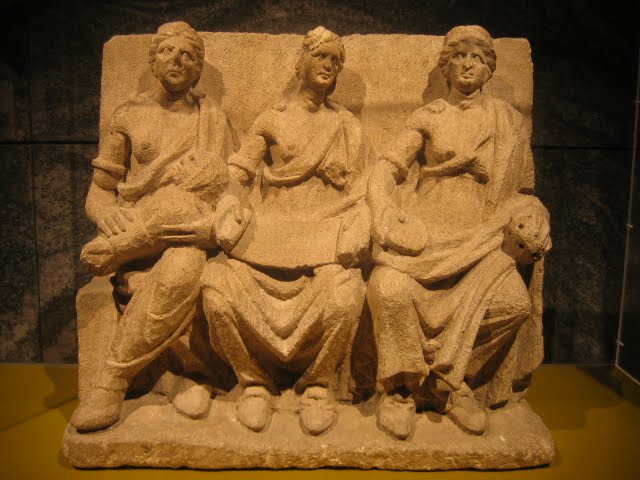
Triplicity is a common theme in Celtic cosmology, and a number of deities were seen as threefold. This trait is exhibited by The Three Mothers, a group of goddesses worshipped by many Celtic tribes (with regional variations). 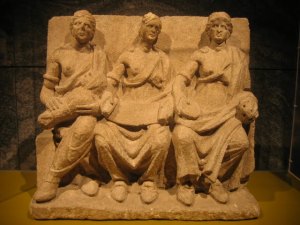
The Celts had literally hundreds of deities, some of which were unknown outside a single family or tribe, while others were popular enough to have a following that crossed lingual and cultural barriers. For instance, the Irish god Lugh, associated with storms, lightning, and culture, is seen in similar forms as Lugos in Gaul and Lleu in Wales. Similar patterns are also seen with the continental Celtic horse goddess Epona and what may well be her Irish and Welsh counterparts, Macha and Rhiannon, respectively.
Roman reports of the druids mention ceremonies being held in sacred groves. La Tène Celts built temples of varying size and shape, though they also maintained shrines at sacred trees and votive pools.
Druids fulfilled a variety of roles in Celtic religion, serving as priests and religious officiants, but also as judges, sacrificers, teachers, and lore-keepers. Druids organised and ran religious ceremonies, and they memorised and taught the calendar. Other classes of druids performed ceremonial sacrifices of crops and animals for the perceived benefit of the community.
Gallic Calendar
The Coligny calendar, which was found in 1897 in Coligny, Ain, was engraved on a bronze tablet, preserved in 73 fragments, that originally was 1.48 m wide and 0.9 m high (Lambert p. 111). Based on the style of lettering and the accompanying objects, it probably dates to the end of the 2nd century. It is written in Latin inscriptional capitals, and is in the Gallic language. The restored tablet contains 16 vertical columns, with 62 months distributed over 5 years.

Overview of the reassembled tablet (This work is in public domain.)
The French archaeologist J. Monard speculated that it was recorded by druids wishing to preserve their tradition of timekeeping in a time when the Julian calendar was imposed throughout the Roman Empire. However, the general form of the calendar suggests the public peg calendars (or parapegmata) found throughout the Greek and Roman world.
Roman Influence
The Roman invasion of Gaul brought a great deal of Celtic peoples into the Roman Empire. Roman culture had a profound effect on the Celtic tribes which came under the empire’s control. Roman influence led to many changes in Celtic religion, the most noticeable of which was the weakening of the druid class, especially religiously; the druids were to eventually disappear altogether. Romano-Celtic deities also began to appear: these deities often had both Roman and Celtic attributes and combined the names of Roman and Celtic deities. Other changes included the adaptation of the Jupiter Pole, a sacred pole which was used throughout Celtic regions of the empire, primarily in the north. Another major change in religious practice was the use of stone monuments to represent gods and goddesses. The Celts had only created wooden idols (including monuments carved into trees, which were known as sacred poles) previously to Roman conquest.
Celtic Christianity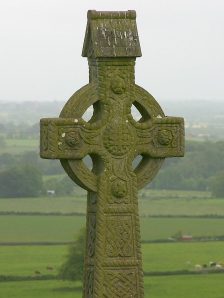
While the regions under Roman rule adopted Christianity along with the rest of the Roman empire, unconquered areas of Ireland and Scotland moved from Celtic polytheism to Christianity in the 5th century. Ireland was converted under missionaries from Britain, such as Patrick. Later missionaries from Ireland were a major source of missionary work in Scotland, Saxon parts of Britain, and central Europe. Celtic Christianity, the forms of Christianity that took hold in Britain and Ireland at this time, have carried traditions distinct from the rest of Western Christianity. The development of Christianity in Ireland and Britain brought an early medieval renaissance of Celtic art between 390 and 1200 AD. Many of the styles now thought of as typically “Celtic” developed in this period, and are found throughout much of Ireland and Britain, including the northeast and far north of Scotland, Orkney and Shetland. Notable works produced during this period include the Book of Kells and the Ardagh Chalice. Antiquarian interest from the 17th century led to the term Celt being extended, and rising nationalism brought Celtic revivals from the 19th century.

 While editing, we must take comfort in the fact none of us can know everything about language choices. I know the frustration. There is nothing worse than to reread a passage six months after its publication and to spot an error in usage. It is impossible to catch every mistake. The challenge is to learn enough to reach a point where we are comfortable with our language choices. That being said, …