Editing 101

EDITING 101

Early on in my career, I learned a painfully difficult lesson: an editor will NOT catch all my errors. Having been trained in journalism, I was accustomed to the concept of editors cutting out the “deadwood” in a piece, and I made the assumption that those hired in the publishing business had practiced their craft and had earned their positions. I was such a publishing virgin!!! Little did I know that finding an “experienced” editor, especially one well versed in the Regency Period, would be an ongoing issue. I am not here to complain. If anything, I am laughing at my “selective memory.” Life has blessed me, and if I have to be more proactive in the editing process, then so be it. I, too, was once a college graduate, sporting my degree in English and journalism, and seeking a job opening.


What I wish to highlight are some language lapses – those I commit, but try to rectify. What do I mean by “language lapses”? It is a term I have blatantly stolen from my dear friend George Arnold, who is preparing his sixth edition of the Media Writer’s Handbook: A Guide to Common Writing and Editing Problems. Arnold says, “[Language lapses] result from brains idling in neutral, not because writers and broadcasters do not know better.” Notice in the previous paragraph that I boldfaced the words try to. One should use try to, not try and. Likewise, be sure to, not be sure and.

*** A double negative occurs when one says “cannot help but.” Instead, say, “I cannot help thinking Mr. Darcy is too proudful.” Do not say, “I cannot help but think that Mr. Darcy is too proudful.”
*** Remember that “precede” means to go before, while “proceed” means to continue.
*** “Last” should refer to the final week, month, or year, and “past” should be used to refer to the previous week, month, or year. I must say this rule in my head as I write. Unfortunately, I often make this mistake. Sometimes the editor finds it; sometimes she does not.
*** One should use “because” to indicate a cause or a reason. “Wentworth says he cannot return to Kellynch Hall because of his previous relationship with Anne Elliot.” The word “since” refers to time, meaning between then and now. “Since her time at Pemberley, Elizabeth held a better understanding of Mr. Darcy.”
*** “Beside” and “besides” is a sore point in my editing experience. “Beside” means by the side of. “Besides” means in addition to.
*** “Blond” is used as an adjective in all references and as a noun to refer to males. “Blonde” is a noun to refer to females.
*** One item repeatedly irritates me. Often I use a pen to correct it in the books I am reading. I apologize if others find this offensive, but please recall that I spent four decades making this correction on countless papers. Exclusively, use “different from,” rather than “different than.”
*** “A lot” is two words. Never use “alot.”
*** “Altogether” means wholly or entirely, while “all together” means every person or thing in the same place.
*** “Amount” is an indefinite quantity and cannot be counted. “Number” consists of a quantity of people or things that can be counted.
*** “All ready” means everyone or everything prepared or available. “Already” means previously and refers to time.
*** “All right” should be used exclusively. Do not use “alright.”
*** “Farther” refers to distance. “Further” refers to degree or extent.
*** Use “proved” as a verb. “He proved to be a true gentleman.” Use “proven” as an adjective. “Her proven methods…”
*** The proper word for a reminder of the past (a souvenir) is “memento,” not momento.

My list, dear Readers, could go on forever. I make these mistakes also, but as a writer, I must be more diligent. I just finished another round of editing for my latest book in the Realm Series, A Touch of Honor.

My list has grown each day. Do you have pet peeves when it comes to word choices? Leave your comments below.

Posted in editing, Industry News/Publishing, language choices, word play, writing | Tagged , | 10 Comments

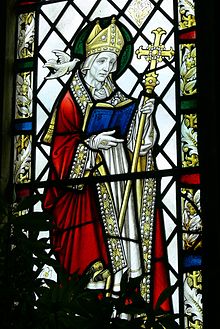
Saint David, Patron Saint of Wales

Stained glass, Our Lady and Saint Non's chapel, St Davids, Wales, 1934

Stained glass, Our Lady and Saint Non’s chapel, St Davids, Wales, 1934

Saint David (Welsh: Dewi Sant; c. 500 – c. 589) was a Welsh bishop of Menevia during the 6th century; he was later regarded as a saint and as the patron saint of Wales. David was a native of Wales, and much is known about his life. However, his birth date is still uncertain, as suggestions range from 462 to 512. The Welsh annals place his death 569 years after the birth of Christ, but Phillimore’s dating revised this to 601.

Monasticism
Many of the traditional tales about David are found in the Buchedd Dewi, a hagiography written by Rhygyfarch in the late 11th century. Rhygyfarch claimed it was based on documents found in the cathedral archives. Modern historians are sceptical of some of its claims: one of Rhygyfarch’s aims was to establish some independence for the Welsh church, which had refused the Roman rite until the 8th Century and now sought a metropolitan status equal to that of Canterbury. (This may apply to the supposed pilgrimage to Jerusalem where he was anointed as an archbishop by the patriarch).

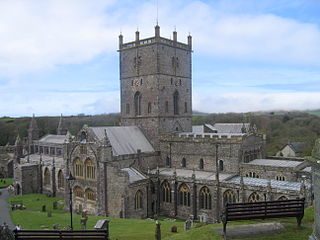
St David's Cathedral, built in its present form 1181 at St David's, Pembrokeshire

St David’s Cathedral,
built in its present form 1181
at St David’s, Pembrokeshire

He became renowned as a teacher and preacher, founding monastic settlements and churches in Wales, Dumnonia, and Brittany. St David’s Cathedral stands on the site of the monastery he founded in the Glyn Rhosyn valley of Pembrokeshire. He rose to a bishopric and presided over two synods against Pelagianism: the first at Brefi around 560 and the second at Caerleon (the “Synod of Victory”) around 569.

His best-known miracle is said to have taken place when he was preaching in the middle of a large crowd at the Synod of Brefi: the village of Llanddewi Brefi stands on the spot where the ground on which he stood is reputed to have risen up to form a small hill. A white dove, which became his emblem, was seen settling on his shoulder. John Davies notes that one can scarcely “conceive of any miracle more superfluous” in that part of Wales than the creation of a new hill. David is said to have denounced Pelagianism during this incident and he was declared archbishop by popular acclaim according to Rhygyfarch, bringing about the retirement of Dubricius. St David’s metropolitan status as an archbishopric was later supported by Bernard, Bishop of St David’s, Geoffrey of Monmouth and Gerald of Wales.

The Monastic Rule of David prescribed that monks had to pull the plough themselves without draught animals, must drink only water and eat only bread with salt and herbs, and spend the evenings in prayer, reading and writing. No personal possessions were allowed: even to say “my book” was considered an offence. He lived a simple life and practised asceticism, teaching his followers to refrain from eating meat and drinking beer. His symbol, also the symbol of Wales, is the leek (this largely comes from a reference in Shakespeare’s Henry V, Act V scene 1).

Connections to Glastonbury
Rhygyfarch counted Glastonbury Abbey among the churches David founded. Around forty years later William of Malmesbury, believing the Abbey older, said that David visited Glastonbury only to rededicate the Abbey and to donate a travelling altar, including a great sapphire. He had had a vision of Jesus who said “the church had been dedicated long ago by Himself in honour of His Mother, and it was not seemly that it should be re-dedicated by human hands.” So David instead commissioned an extension to be built to the abbey, east of the Old Church. (The dimensions of this extension given by William were verified archaeologically in 1921). One manuscript indicates that a sapphire altar was among the items King Henry VIII confiscated from the abbey at its dissolution a thousand years later.

Death
It is claimed that David lived for over 100 years, and that he died on a Tuesday 1 March (now St David’s Day). It is generally accepted that this was around 590, and March 1 fell on a Tuesday in 589.

The monastery is said to have been “filled with angels as Christ received his soul.” His last words to his followers were in a sermon on the previous Sunday. The Welsh Life of St David gives these as: “Bydwch lawen a chedwch ych ffyd a’ch cret, a gwnewch y petheu bychein a glywyssawch ac a welsawch gennyf i. A mynheu a gerdaf y fford yd aeth an tadeu idi,” which translates as, “Be joyful, and keep your faith and your creed, and do the little things that you have seen me do and heard about. I will walk the path that our fathers have trod before us.”

“Do ye the little things in life” (“Gwnewch y pethau bychain mewn bywyd”) is today a very well known phrase in Welsh.

David was buried at St David’s Cathedral at St David’s, Pembrokeshire, where his shrine was a popular place of pilgrimage throughout the Middle Ages. During the 10th and 11th centuries the Cathedral was regularly raided by Vikings, who removed the shrine from the church and stripped off the precious metal adornments. In 1275 a new shrine was constructed, the ruined base of which remains to this day, which was originally surmounted by an ornamental wooden canopy with murals of St David, St Patrick and St Denis of France. The relics of St David and St Justinian were kept in a portable casket on the stone base of the shrine. It was at this shrine that Edward I came to pray in 1284. During the reformation Bishop Barlow (1536–48), a staunch Protestant, stripped the shrine of its jewels and confiscated the relics of David and Justinian.

Reputation
David’s popularity in Wales is shown by the Armes Prydein Fawr, of around 930, a popular poem which prophesied that in the future, when all might seem lost, the Cymry (the Welsh people) would unite behind the standard of David to defeat the English; “A lluman glân Dewi a ddyrchafant” (“And they will raise the pure banner of Dewi”).

Unlike many contemporary “saints” of Wales, David was officially recognised at the Vatican by Pope Callixtus II in 1120, thanks to the work of Bernard, Bishop of St David’s. Music for his office has been edited by O.T. Edwards in Matins, Lauds and Vespers for St David’s Day: the Medieval Office of the Welsh Patron Saint in National Library of Wales MS 20541 E (Cambridge, 1990).

David’s life and teachings have inspired a choral work by Welsh composer Karl Jenkins, Dewi Sant. It is a seven-movement work best known for the classical crossover series Adiemus, which intersperses movements reflecting the themes of David’s last sermon with those drawing from three Psalms. An oratorio by another Welsh composer Arwel Hughes, also entitled Dewi Sant, was composed in 1950.

Saint David is also thought to be associated with corpse candles, lights that would warn of the imminent death of a member of the community. The story goes that David prayed for his people to have some warning of their death, so they could prepare themselves. In a vision, David’s wish was granted and told from then on, people who lived in the land of Dewi Sant (Saint David) “would be forewarned by the dim light of mysterious tapers when and where the death might be expected.” The color and/or size of the tapers indicated whether the person to die would be a woman, man, or child.

Roman Martyrology

The flag of St David

The flag of St David

In the 2004 edition of the Roman Martyrology, David is listed under 1 March with the Latin name Dávidis. He is recognised as bishop of Menevia in Wales who governed his monastery following the example of the Eastern Fathers. Through his leadership, many monks went forth to evangelise Wales, Ireland, Cornwall and Armorica (Brittany and surrounding provinces).

Posted in British history, Great Britain, legends and myths, real life tales, religion, Wales | Tagged , , | Comments Off on Saint David, Patron Saint of Wales

Whuppity Scoorie?

stnicholas-450So what is Whuppity Scoorie? It is a unique celebration of spring taking place in Lanark (on the east bank of the River Clyde), Scotland. On March 1, youngsters take part in the ancient custom of “Whuppity Scoorie.” They gather in early evening outside St. Nicholas’s church. Then as the bells ring out, they run around the church waving balls of paper around their heads. Years ago, it was a race, but now the celebration is a bit more structured. At the end, the children scramble for coins thrown by community members.
The celebration’s origin is vague. Many say it is a remembrance of days when miscreants were whipped around the cross, which was then “scoored” in the Clyde. It is supposed to reflect the spring’s light replacing the dark winter nights. Whatever its origins, generations of children have taken part and have made sure that this part of Lanark’s past endures. (www.thecapitalscot.com/pastfeatures/whuppity.html)
By the way, “a plaque on a stone plinth set in an unpromising gap between two buildings facing across to St. Nicholas’s church states, ‘Here stood the house of William Wallace who in Lanark in 1297 first drew his sword to free his native land.’”’
__________________________
And what is “Whoopy Do,” you may ask? It is what I utter as I do a little computer dance. The re-release of book 5 of my Realm series, A Touch of Mercy, with a new cover and a small rewrite has arrived, and I am shouting “Whoopy!” ATOMCrop2
Posted in British history, customs and tradiitons, legends and myths, Scotland, White Soup Press, writing | Tagged , , , , , , , | Comments Off on Whuppity Scoorie?

Exquisite Excerpt from “His: Two Regency Novellas”

Celebrating Re-Release of “His: Two Regency Novellas” with an Excerpt HisCrop2


My Regency romance, His: Two Regency Novellas is available on Amazon, Kindle, Nook, and Kobo. The book contains two novellas (each between 60,000 – 65,000 words). The first is “His American Heartsong.” It is the story Lawrence Lowery, the future Baron of Blakehell, and Arabella Tilney. Some of you may recognize Lowery as Sir Carter Lowery’s older brother in my Realm series. Many asked for more on how Law and Arabella came together. The second is “His Irish Eve.” The main character, Adam Lawrence, is my “go-to” guy. Adam makes appearances in nine of my novels and plays an integral part in The Phantom of Pemberley. This story is what happens to Adam after he released his mistress at the end of Phantom. 

The Deepest Love Is Always Unexpected

His American Heartsong

Lawrence Lowery has been the dutiful elder son his whole life, but when his father Baron Blakehell arranges a marriage with the insipid Annalee Dryburgh, Lowery must choose between his responsibility to his future estate and the one woman who makes sense in his life. By Society’s standards, Arabella Tilney is completely wrong to be the future Baroness–she is an American hoyden, who demands that Lowery do the impossible: Be the man he has always dreamed of being. (A Novella from the Realm Series

His Irish Eve

When the Earl of Greenwall demands his only son, Viscount Stafford, retrieve the viscount’s by-blow, everything in Adam Lawrence’s life changes. Six years prior, Lawrence had released his former mistress Cathleen Donnell from his protection, only to learn in hindsight Cathleen was with child. Lawrence arrives in Cheshire to discover not only a son, but also two daughters, along with a strong-minded woman, who fascinates him from the moment of their first encounter. Aoife Kennice, the children’s caregiver, is a woman impervious to Adam’s usual tricks and ruses as one of England’s most infamous rakes. But this overconfident lord is about to do battle: A fight Adam must win–a fight for the heart of a woman worth knowing.

Chapter One of “His American Heartsong”

“I think…if it is true that there are as many minds as there are heads, then there are as many kinds of love as there are hearts.”

– Leo Tolstoy

“What do you mean, you left them above Derwerth?” Lawrence Lowery demanded. “Please tell me you have more sense than to leave three women alone on the mountain!”

“But two of them be Americans, Your Lordship.” The coachman frantically worked his hat’s rim.

Lowery, who stiffened at the groundless denunciation, turned to his father Baron Blakehell. “Did you hear that? It is acceptable to treat these women with no respect because two are Americans! What the bloody hell does that mean?” He loomed over the hired driver.

Lowery stalked away from the man. He told the estate steward, Mr. Beauchamp, to find out what else the imbecile knew and then angrily turned toward the stable. “I require my horse and another for a coach immediately, Sack. I want, at least, ten men saddled and ready to ride within a quarter hour,” he barked out orders.

“Yes, Your Lordship.” The head groomsman hustled to do his bidding.

Lowery spoke privately to the baron, “I must go.”

“You might send Beauchamp and the men,” his father counseled. “There is no need for you to face the danger yourself, Lawrence.”

Lowery touched the baron’s arm encouragingly. Although his father was still quite spry for a man of his age, Lawrence realized the time for his succession drew nearer. “You know I must, Father. I would not count myself a gentleman if I left three ladies in danger.” Lawrence knew what it meant to be lost in the hills surrounding his estate. At age ten, he thought himself quite grown when he set off on a dare toward the summit. He had not made it more than a mile into the wilderness before becoming disoriented. It had taken his father some six hours to find him, and Lawrence could still recall the fear bubbling in his throat. He could not imagine being both a woman and an outsider and to be lost in England’s famous Peak District.

“I understand.” Blakehell turned toward the manor house. “You will take care, Lawrence. Remember you are my heir.”

Law had heard those words his whole life. “You always have Carter.” Lawrence could not control his constant need to deflect his father’s demands on him.

“I love my youngest child,” the baron began, “but Carter is not the right person for this title.” Which only meant Carter had defied their father on more than one front–something Lawrence rarely did. “Besides, Carter has his property now; he does not require this one.”

“Yes, Father.” He knew the baron meant well, but Lawrence could not spend his life locked in the house, afraid to risk the title. That was the reason his mother had delivered forth Lawrence’s younger brother Carter after the three sisters they shared–an heir and a spare, as the old adage went.

* * *

“How long must we wait for that stupid man to return?” Abigail Tilney complained for the fifth time in an hour. She despised any form of discomfort. It was for her wellbeing that they had taken the small coach when traveling on horseback would have been more appropriate. Abigail did not ride well, and she had refused anything, which did not come naturally to her; therefore, keeping her perfection in tact.

“I imagine at least a couple of hours,” Annalee Dryburgh, Abby’s cousin assured her. “Walking the horse after it threw a shoe must slow Mr. Moss’s progress.”

Abigail pulled her cloak tighter about her. “I hope it is soon. The air is much cooler in the uplands.”

“Lord, Abby, one would think a woman from Virginia’s mountainous region would appreciate the land’s beauty. I certainly prefer it to the coast lines.” Arabella Tilney stood, feet shoulder width apart and hands on hips, admiring the craggy landscape.

“It is a bog!” Abby asserted.

Bella sighed deeply. “But this day trip’s purpose was to explore the sights. The plateau above from this angle is spectacular. Come look!”

Abby turned her body to rest her head on the coach’s soft cushions. “The only view of which I wish to partake is the one from my room at the inn,” she grumbled. “Wake me when Mr. Moss returns.”

Bella sat good-naturedly on an uprooted tree trunk. They had left Hayfield to visit the Kinder Plateau, but did not reach their destination on this day. The horse had thrown a shoe, and now there was nothing to do but to wait and look out on the land’s beauty. If they had traveled by horseback, as she had preferred, then they could double up and still make it back safely to the inn. They foolishly had taken an open carriage to pacify Abigail, and now she, her sister, and her cousin were without options. Bella wished she had persisted when Mr. Moss suggested that they all walk the horse out, but again, they had deferred to Abby’s insensibility. Now, Bella prayed for Mr. Moss’s early return. She would not wish to hear her younger sister’s tirade if the man did not come before nightfall. Abigail would not be happy, and Bella knew that when Abby was not happy, her sister made everyone else within earshot miserable.

 * * *

 “Storm comin’ in, Your Lordship!” Mr. Beauchamp pointed to the encroaching cloudbank. “We should call off the search until it passes. Too dangerous out in the open.”

“Lead the men to the Cliff Hole cottage and wait it out. I will take the extra horse into Brook Pass. If I discover nothing, I will follow you.” The wind had increased, and debris had begun to swirl about them.

“Are you certain, my Lord? I could go.” Law knew the baron would have Beauchamp’s head if Law placed himself in real danger, but he felt he had to see this through.

Lawrence shook his head in the negative. “I must go, Beauchamp. I know it sounds unreasonable; yet, I cannot desert the search so soon.”

“Seek shelter, Sir, if it the conditions become worse.”

“I have it.” Lawrence took the horse’s leading rope. “See to the men.” Law rode toward where the path split, taking the one leading to the plateau. He thought the women quite foolish to have attempted such a trek in a carriage, but he understood the female mind as well as any man. He possessed three sisters, and he could easily picture one of them doing the same.

The wind whipped his coat tails, and Law had removed his hat so as not to lose it. He scanned the pathway, knowing it unlikely that the women strayed from the worn road. He felt the urgency of finding them. Lawrence knew the rain line spread across the valley below. He and the women would require immediate shelter; therefore, he nudged the horse forward, picking up the pace.

* * *

 “Abby, we must find shelter,” Bella tugged on her sister’s hand. “A storm is coming!”

“I am going nowhere,” the girl asserted. “Unlike you, I am not afraid of lightning.”

Bella looked to where the storm clouds rolled over a nearby ridge. Thunder and lightning preceded nature’s drenching. “Well, I am! Please, Abby!” She had managed to bring her sister to a standing position just as the man approached on a coal black stallion–like a dark angel riding toward them. He whipped the horse’s reins, barreling down on them, but Bella experienced no fear. As dark and as foreboding as the man appeared, she felt her heart lurch in recognition.

Dismounting, he offered them no British civilities. There was no time: Large droplets accompanied him and quickly soaked the open carriage seat. “This way!” he yelled over the tumult, catching Bella’s hand and taking off on a run. Automatically, the other two women followed.

* * *

Without forethought, Law tugged the girl’s hand again, but she stumbled, unable to keep up with his long strides. Feeling her go down, he instinctively, grabbed the woman about the waist, lifting her petite form. In the other hand, he kept a death grip on the horses’ reins. When he saw the familiar cave, Law half shoved the woman he carried into the narrow opening, turning awkwardly to pull the other two along the trail.

The rain pelted them with a staccato of droplets, and Lawrence felt the dampness soak his greatcoat, but before he entered the rock face’s slit, he tied the horses to a Spanish oak’s lowest branches. Finally, Law squeezed his large form through the opening, impulsively, shaking the water from his hair and coat.

Law could barely make out their forms in the shadowed light. They hugged one another tightly, cloaks wrapped around each other–unopened wings of a gigantic eagle. “Is anyone hurt?” he asked between thunderclaps.

From somewhere within the monstrous depths of cooing females, a melodic voice rang clearly, “No, Sir. We thank you for finding us.” The butterfly wings opened and closed and became three.

Although he already offered a “bow,” being hunched over in the low-ceilinged crevice, Lawrence remembered his manners at last. “I am Lord Hellsman.” He timed his introduction between God’s fireworks. “I apologize for my rude entrance on the trail.”

“That is quite acceptable under the circumstances, Your Lordship.” Annalee straightened her clothing. “Without you, we could be miserable, suffering the storm’s worst. I am Miss Dryburgh. Annalee. My father, Lord Dryburgh, is Lord Graham’s second son.”

“From Staffordshire?” Law had prided himself on knowing the British nobility’s countryseats.

“Yes, Sir.” The woman remained the group’s spokesperson. “And these are my cousins from America, Miss Tilney. Arabella. And her sister Miss Abigail.”

Again, Lawrence could not make out their faces in the darkness. He could discern only their sizes–both small in stature–one downright petite. He could still feel the pressure of the smallest one along his side where he had carried her with him to the cave. Surprisingly, Law found he missed that brief feeling of warmth.

“We are pleased for the acquaintance, Your Lordship,” the sweet voice came from the shadows. Another lightning flash made the smaller one jump and clutch at her cousin’s arm. “My sister does not like storms,” the taller one explained.

“Forgive me, Ladies. I plan to practice rudeness again. I can barely see you in the cave’s recess, and I am a bit disoriented. I have discerned that Miss Dryburgh is the tallest in height among the three of you, but between the Miss Tilneys, I am confused.”

The melodious voice continued, “I am Abigail Tilney.”

Law turned his attention to the petite one, the one who trembled from the storm, the one he had carried. “Then that must make you, Miss Tilney,” he half teased. A squeaky “Yes, Sir” brought a smile to his face.

Miss Dryburgh asked, “How did you know the cave was here, Your Lordship?”

Law mocked himself. “When I was ten, I quakingly proved my manliness by hiding in this cave until my father rescued me from my wild imagination. If I am riding in the area, I revisit this spot. It keeps me humble.”

The squeak became a screech with a powerful flash. “How…how long will the storm last?”

Lawrence glanced toward the downpour. “The rain usually lasts several hours.”

“Hours?” The woman’s voice betrayed her fear.

“Do not worry, Miss Tilney. The fireworks will end soon, even if the rain remains.”

“It will be dark before long,” Miss Dryburgh noted. “I mean darker than it is now.”

Law stared at the sheets of rain streaming along the opening. A waterfall rushing down the cliff face and splashing outside their refuge. “When it eases a bit, I will gather some wood so we may have a fire.”

“You plan for us to spend the night in this cave, Lord Hellsman!” The sweetness left Miss Abigail’s voice. “That is not possible!”

“Miss Abigail, if there was no storm, we might maneuver the limited path down the mountain with some degree of safety. However, between the rain and the fog, which will blanket the woodlands with the darkness, there is no possibility of us driving your carriage off this peak tonight. Nor would I consider walking out at this point or even riding the two horses I have brought with me. The road is narrow, and one false step could send us plummeting into emptiness. Plus, who knows creatures the woods hold?”

“Are you attempting to frighten us, Your Lordship?” Miss Tilney found her voice. His exaggerations caused her to momentarily forget the storm.

“Absolutely, not, Miss Tilney. Simply speaking the truth. I will not assume the responsibility of endangering you after rescuing you.” Thinking on the conversation, Law could not help but to chuckle.

“What is so amusing, Lord Hellsman?” The petite one took a confrontational stance.

Law wiped the grin from his lips, but something shifted in his chest. “I suppose, Miss Tilney, I find it a bit bizarre to be having this discussion hunched over from my surroundings and attempting to impress the three ladies of my most recent acquaintance with my ability to protect them through the night. It is somewhat surreal.”

“It is out of the ordinary,” Miss Dryburgh took the sting from her cousin’s tone. “We Brits are practical that way, are we not, Your Lordship?”

Although the faces were still in shadows, he could recognize the timbre of their voices. “Absolutely, Miss Dryburgh.”

“Well, I shall not sleep a wink. What if the walls collapse in on us? What if there are bugs or even snakes!” Abigail declared.

“Then by all means, Abby, be unreasonable,” Miss Dryburgh asserted. “If you had been “reasonable,” we could have ridden out of here hours ago. So, if you do not wish to accept His Lordship’s protection, then walk down the mountain at your own risk.”

“You do not have to snipe,” the girl retorted in an obvious pout.

Surprisingly, Miss Tilney took her cousin’s side. “Yes, Annalee does. You pay no attention unless we “snipe,” Abby!”

Law felt as if he had stepped into a parallel universe, one where men finally heard how women really spook to each other. Mayhap the cave held some sort of magical power: He had believed so as a child.

Miss Dryburgh approached a now seated Hellsman. “When you wander out for the firewood, Your Lordship, there is a basket under the coach’s seat. The bread is likely ruined, but the other items should still be edible.”

“More British practicality, Miss Dryburgh?” he responded in bemusement.

“Someone must make decisions for our American counterparts. We Brits possess the impeccable manners,” the woman taunted.

“So, we do, Miss Dryburgh.” Lawrence began to silently count to ten, seeing how long it would be before one of the Tilney sisters reacted to her cousin’s assertion. He reached two.

“Annalee, we are not barbarians! We have culture also. America does not exist only as in the eleventh century with stampeding hordes!” Miss Tilney closed the distance between them.

Miss Dryburgh laughed aloud. “I am well aware you were raised by Lady Althea, Cousin. You need not convince me.” She straightened her cloak. “And…by the way, Bella…you have forgotten the storm.”

Arabella Tilney held her fists on her hips but the length of a breath before she laughed also. A laugh that Law thought the most perfect one he had ever heard. It held the timbre of soft tinkling bells. Turning in Law’s direction, she asked, “How might we be of assistance, Your Lordship?”

“I would not have you exposed to the elements, Miss Tilney. My coat is heavier and my gloves thicker.” Lawrence peered through the opening. “The rain is not relenting, but it shall soon be dark. I must go while I can still make out shapes. I will bring the supplies to the opening and hand them to you? If my idea is acceptable?”

Miss Dryburgh shared conspiratorially, “You have discovered Arabella’s weakness, Lord Hellsman. My cousin lives to be of use to others.”

“There are worse vices, Miss Dryburgh.” Law pulled up his coat’s collar. Then he squeezed through the opening and ran toward the carriage. He retrieved the basket from under the bench. There were two lap blankets stuffed behind the box; he quickly placed them under his coat and ran once again toward the cave. “Here!” he called as he shoved the items into Arabella’s waiting hands.

Immediately, he turned to where he had tethered the horses. At least, under the trees’ thick canopy, the rain did not fall relentlessly. The thick foliage blocked the light, as well as the moisture. He efficiently removed the saddle and blanket from Triton’s back and carried them to the cave. He dropped it in the opening, saying he would move it when he returned, but Law noticed as he reversed directions that Miss Tilney tugged the leather in from the rain.

Next, he located as much dry wood as he could muster. The copse seemed the most likely source. He found several broken limbs and some branches he could use for kindling. It took four trips to stock enough wood for them to maintain a fire during the night. Law knew his men would not come until the morning, and it would be his responsibility to protect the women until then. He found it exhilarating in many ways to have to fend for himself. Occasionally, he enjoyed being out of the drawing room and into nature. He often made overnight hunting or fishing trips with some of the local gentry. As one of the highest-ranking men in his shire, Law felt the responsibility of maintaining a sense of Society in his home. Yet, having been raised essentially alone, always in training to replace his father, he appreciated the communion of a group of men enjoying sport.

“That should serve us,” he announced as he bent over to reenter the cave. He laid the wood to one side of the opening. Forgetting about the low ceiling, he banged his head when he instinctively straightened. Law laughed at his error. “Surprisingly, this cave’s roof has descended since I was age ten.”

“It is perfectly tall enough for me, Your Lordship,” Miss Tilney taunted as she spread one of the two blankets he had retrieved from the carriage on the earthen floor. He looked closely at the diminutive form moving freely about the dead end crevice in which they had sought shelter. Miss Arabella Tilney was as busy as the mouse of which she reminded him. First the squeak and now darting everywhere. He shook his head in amusement.

Law turned his attention to removing his drenched greatcoat. He sat close to the cave’s opening. “I will start a fire. We should place it close to the opening. That will serve for circulation, keeping the heat in and the smoke out. Plus, I think it important to deter any animal, which might also seek shelter from the elements.”

Abigail half whined as she sat bundled up against the back wall of the enclosure. “Is there no way we might leave here tonight?”

“Personally, Miss Abigail, I pray my men do not attempt to rescue us this evening. I want none of them to perish. The danger is eminent, and although we may be a bit uncomfortable, we shall not perish. However, the fire at the cave’s opening will serve as a signal if they do search against my orders.” Law noticed how Miss Tilney and Miss Dryburgh busied themselves with preparing what food they had, as well as a space the ladies might share overnight, while Miss Abigail offered no assistance. He disapproved of those who would not assist themselves.

He used a small spade he kept attached to the saddle to dig a shallow pit; then, Lawrence stacked the wood he had found, lacing the kindling between the logs. He removed the flint and matches he stored in his saddlebag. The kindling flamed and soon they had a small fire burning steadily. The heat radiated throughout the tiny enclosure, removing the damp chill and driving away the encroaching darkness. “That is better,” he declared as he turned toward the women.

“Come join us, Your Lordship,” Miss Dryburgh gestured to the spread.

Law moved forward on hands and knees. “Thank you, Miss Dryburgh.”

“One end of the bread remained untouched. It appears you reached it in time, Lord Hellsman,” Miss Tilney revealed.

Lawrence reached for an apple, allowing the women to eat before he chose any of the scarce offerings the ladies had laid before him. He took a small bite, trying to make the fruit last longer.

The fire’s muted light provided him a better look at the three women. Abigail Tilney appeared the youngest, likely seventeen or eighteen years of age. She had a head of golden locks that reflected the dancing flames’ brilliance, as well as a long, slender neck. Miss Abigail was likely very lithe in stature based on his peek of her thin arms when the girl reached for the bread. She had yet to remove her cloak so he had no true idea of her figure.

Annalee Dryburgh’s full figure showed well in the dark gown she had chosen for the day. Her corset cinched her waist, making it seem small compared to her ample bust line and hips. Not plump, but compared to the excessively thin Miss Abigail, Miss Dryburgh appeared well fed. Her chestnut hair framed a heart shaped face.

Then his eyes rested on the elder of the Tilney sisters. Arabella. She was nondescript–dull, brown hair–very wavy–small breasts–excessively petite–and always moving–foot tapping–fingers drumming. Amorphous. Yet, for some reason, Lawrence’s eyes remained on her.

“Might we know more of your family, Your Lordship?” Miss Dryburgh asked as she wrapped some bread about hard cheese.

Lawrence’s gaze scanned all three women. “My home seat is Blake’s Run in Derbyshire, and I am the eldest son of Baron Blakehell, Niall Lowery. There are three sisters–Louisa, who is married to Ernest Hutton, Lord MacLauren; Marie, who recently married Viscount Sheffield; and, lastly, Delia, the Viscountess Duff. From them, I have one nephew and two nieces. The youngest of the family is my brother Carter, upon whom the Prince Regent quite recently bestowed a baronetcy for Carter’s service during the war.”

“Two seats within one family? Quite unusual, my Lord.”

“It is Miss Dryburgh, but my father is more than pleased to have both his sons holding a title. Sir Carter is renovating Huntingborne Abbey in Kent, under my father’s guidance, of course. Actually, I believe it has given the baron new life to have another son to instruct in the way of the land.” Lawrence grinned knowingly. “The baron is a great one on duty and responsibility.” He took a small sip of the wine, which Miss Tilney had poured for him. “And what of you, Ladies?”

“We are seeing some of the English countryside before we travel to London for the Season,” Miss Dryburgh shared. “This will be my second Season. Unfortunately, we did not stay the entire Season last year because Grandmama took ill. My cousins are being presented by our Aunt Sarah, the Marquessa of Fayarrd.”

“And you, Miss Tilney? What of you? Are you anxious for a London Season?” His face told her he half teased.

* * *

Arabella took a closer look at the man who had literally carried her into their shelter. She thought it amusing in some ways. If His Lordship had manhandled either Abby or Annalee as he had her, they would have had a case of the vapors. But Bella knew hard work’s value and was accustomed to being around men. However, Lord Hellsman held a mystique, which made her a bit uncomfortable. Gentle and aristocratic, Lawrence Lowery exemplified the English nobility; yet, raw masculinity exuded from him. He made decisions based on reason and followed them through. Bella found those qualities very appealing.

“Our mother, Sir, was at one time a member of the court, but she left to the Americas with our father some two and twenty years prior. However, she always dreamed of sending her daughters to London to enjoy what she determined was real society.”

* * *

 “And is there no society in America, Miss Tilney?” he taunted.

She smiled at him, and Law felt something like desire shoot through him. “The Appalachian Mountains possess their own culture, but it is not society as you know it, Lord Hellsman.”

“The Appalachians?” he questioned, rolling the word around in his mouth. “I am not familiar with the area.”

Miss Tilney countered, “You are in error, Your Lordship. They are the same mountain range the English celebrates in Scotland and Wales.”

Lawrence enjoyed being challenged. Miss Tilney’s audacity was quite beguiling.

“That is just your theory, Bella,” Miss Abigail asserted. “To think the mountains at home might be under the oceans and part of this land demonstrates your blue stocking education.” To draw his attention to her, the girl lightly touched Lawrence’s arm. “I am certain His Lordship does not wish to discuss geography with a mere female.”

Lawrence casually shifted his weight to allow the lady’s hand to fall away. “Far be it from me to correct you, Miss Abigail, but I find any mental challenge invigorating. Regrettably, any woman who chooses to be successful during the Season must temper her words. Many men prefer their potential wives to simply be an excellent household manager.”

“See, Bella, even His Lordship agrees with me,” Miss Abigail preened. “You cannot be Papa’s hoyden if you expect to attract a husband.”

Miss Tilney shrugged her shoulders. “Who says I wish a husband? I would be content to return home and to take care of the manor house.”

“Of course, you wish a husband,” her sister corrected. “Mama would have been horrified to have you return to American unmarried.”

“Papa insists I meet my obligations this Season,” Miss Dryburgh also did not guard her words. “I have two younger sisters who have yet to know a Come Out.”

The parallel world remained: Even his sisters never spoke so liberally before him. Mayhap the openness of the Americans led them all into an instant intimacy. The Tilneys exemplified the American spirit and the American primitiveness, especially Miss Tilney, but Lawrence thought he would not trade this moment in this cave for all the drawing rooms in England. It was “freedom.”

“Did you travel from Staffordshire?” He asked to change the subject.

“We came to Matlock with my parents,” Miss Dryburgh shared. “They traveled to Lincolnshire to share time with my paternal grandparents. We thought my cousins might enjoy the Peak District after leaving western Virginia. We departed Hayfield this morning.”

And so, the conversation continued over the next ninety minutes. Lawrence told them of the areas’ history, of his estate, and of some of the other families in the area. Miss Dryburgh related like information regarding Staffordshire, and the Tilneys spoke of their life–describing the land, the people, and their situation. Ironically, Miss Abigail spoke of rolling hills and Southern manners and a genteel lifestyle at her mother’s feet, while Miss Tilney spoke of rugged mountains, poor tenants, and the use of slaves on the adjoining properties. A more diverse description of their home could not be had. It was as if the sisters had described two different lands. Yet, as he thought on it, little difference existed with what he knew of England. Poor tenants and rich landowners subsisted side by side on English estates.

Outside, the rain had not lessened, and Law added more wood to the fire. He could not imagine women of the ton adapting so quickly to their surroundings. Although he suspected Miss Abigail would easily matriculate into the ways of the “beau monde,” her cousin’s and her sister’s censure managed to quail the girl’s constant complaining.

“I will sleep near the fire to assure it does not go out overnight,” Lawrence announced as the time on his pocket watch indicated sleep might be possible. His clothes remained damp, and a chill ran up and down his spine. If alone, he would remove his boots and his waistcoat, but a gentleman would never think of doing so before a lady. Besides, if he removed the boots, Law was not certain he could get them on in the morning. The leather would likely shrink.

He gave the women the blankets to use along with their cloaks, and they made a “group” bed near the enclosure’s back wall. Lawrence used his saddle as a pillow and his damp greatcoat for a blanket. Miserable as he remembered being in a long while, Law forced himself to settle on the floor of the rock face.

“Your Lordship,” a half sleepy voice he recognized as Arabella Tilney’s called out, “do you have a gun for protection?”

He smiled at her practicality. “Aye, Miss Tilney. Several.”

“That is exceedingly fine, Lord Hellsman,” she said huskily. “So do I.”

Law did not answer. He just widened his smile as he closed his eyes to welcome sleep.

* * *

He did not know how long he had slept–ten minutes or ten hours–but definitely not long enough. A sharp sound came from behind him and to the left, and Law forced his eyes open to let the fire’s light in. A squeak told him immediately who and a sharp crack of thunder told him what, as he scrambled to his feet to reach her. This new storm, was, obviously, more violent than the previous one.

Arabella Tilney huddled, like a broken animal, against the cave’s sidewall, shivering and incoherent. A quick glance behind told him that neither Miss Dryburgh nor Miss Abigail had heard their traveling companion, and for a moment, Lawrence wondered if he should not wake them. But Miss Tilney cringed and covered her head with her arms in a protective stance, and Law could do nothing else but to take her in his arms. He draped an arm about her small form. On his knees before her, he gently encompassed her, hiding the woman’s face in his chest and pulling Bella to him. “Easy, Sweetling,” he whispered close to her ear. “I have you.” Another thunderclap and an accompanying lightning bolt sent her clawing at his shirt and whimpering. “Come, Mouse.” He instinctively rocked Bella in place, stroking her back and caressing her arms. “I will permit nothing to harm you.”

She clutched at him, attempting to, literally, crawl under his skin, seeking his body as her shield. Bella plastered herself to him. “Do not leave me,” she begged.

“Never, Sweetling,” he murmured. Madness must have taken his reason. He held this woman in an intimate embrace, and if either of her relatives awoke and observed them, Lawrence would be honor bound to offer for her; however, he could not release her. Besides, Bella Tilney’s obvious distress, Law realized belatedly that he liked the feel of her along his body: her heat suffused into him. The blood rushed to his groin. She fit. Fit as if she was made for him alone. “Come, Mouse,” he nuzzled behind her ear. “Come with me.” Bent over, he led her to his makeshift bed. “I will hold you until the storm passes.”

Posted in book excerpts, British history, Industry News/Publishing, White Soup Press | Tagged , , , | 2 Comments

Locations for “Pride and Prejudice 2005”

For this movie discussion, I decided to visit some of my favorite places in the UK for filming. The places below were all used in Pride and Prejudice 2005. I have also included some of the history. If you know additional facts, please chime in. Most of these facts came from http://www.infobritain.co.uk.

Groombridge Place and Enchanted Forest, Kent (Longbourn)
In 1662 by architect Philip Packer, with the help of his friend, Christopher Wren, the seventeenth century’s premier architect, built Groombridge Place. Packer’s house was built on the site of a series of former manor houses owned by wealthy nobles, including Richard Waller, who famously kept Charles Duke of Orleans at Groombridge after capturing him at the Battle of Agincourt. Completing his new house in 1662 Packer then started thinking about his garden. Beginning in 1674, Packer began designing the gardens surrounding Groombridge House He was assisted by John Evelyn, a horticulturist and famous diarist. Evelyn was a multi-talented man who showed an unusually modern concern with the problems of urban living, and a reverence for gardens as an escape from them. Evelyn conceived a series of formal gardens arranged as “outside rooms” of the house. Although Evelyn was generally formal in his gardening ideas, the sense of blurring the boundary between indoors and outdoors was actually a theme that would emerge once again in the 20th Century. Some of Evelyn’s garden rooms at Groombridge also preempted modern design in creating an artfully “natural” landscape. The Secret Garden is the best example. It is suggested that this was Packer’s favourite garden. He is supposed to have died here in 1686 while reading a book.

Basildon Park, Berkshire (Netherfield Park)
Building of Basildon Park began in 1776 under Francis Sykes’ tutelage. A farmer’s son, who joined the British East India Company to make his fortune to support his political career, Sykes became governor of Kazimbazar. Returning to England in 1771 a rich man, Sykes bought the Basildon estate. Although facing financial difficulties, he managed to win a baronetcy and to become an MP. Sykes struggled on with the building of his grand house, in a palladian style, which was already going out of fashion. When Sykes died in London in 1804, Basildon Park remained unfinished. Sykes’ son inherited the property, but he too died within a few weeks, and the new owner, Sykes’ grandson, Francis Sykes the third baronet, was only five years old. With little money, ownership somehow remained with the boy, who at age 14 started entertaining Prince George at the house. Prince George was famously dissolute, and Sykes’ association with him only drained the family fortune further. With the family in a state of financial turmoil, Basildon Park was offered for sale. Just for good measure, personal turmoil was also thrown into the mix, when Sykes’ wife Henrietta started having an affair with future Prime Minister Benjamin Disraeli. Henrietta also had an affair with the painter Daniel Maclise. When her husband denounced Maclise he broke the unwritten rule that such goings on in high society should be kept discreet. As a result, Charles Dickens, a friend of Maclise, decided to use the name Bill Sykes for a villainous character in a new book he was writing. Oliver Twist, complete with Bill Sykes, was published in 1838, and Francis Sykes was humiliated. He finally sold Basildon Park that year.

Burghley, Lincolnshire (Rosings Park)
Burghley is perhaps the grandest of all England’s sixteenth century Elizabethan houses, capturing the drama and other-worldly spirit of that time. Lord Burghley, William Cecil, Treasurer to Elizabeth I, and her most influential advisor, directed its structure. His grand house is like others of the period, Longleat or Wollaton Hall for example, except Burghley just had more of everything. In fact it may claim to be the definitive grand house of late Tudor England. Burghley, like most great properties, housed lavish collections of art and valuable objects. The Heaven Room became Lady Catherine’s drawing room in the 2005 film. The fifth Earl, Lord Exeter, commissioned the Italian artist Verrio to paint the murals on the wall and ceiling. There is a Hell Staircase leading to this room. Owned by a family trust, Lady Victoria Leatham, daughter of the Marquis of Exeter, the medal-winning Olympic runner portrayed inChariots of Fire, manages the estate. (As footnote,s the late Ian Charleson, who played Exeter in the film, has a RSC Award named after him. Matthew Macfadyen previously was nominated for the award. Also, Lady Victoria appears regularly on Antiques Roadshow.) Burghley has been used as a location for a number of films including Pride and PrejudiceElizabeth, the Golden Age, and The DaVinci Code.

Chatsworth, Derbyshire
Chatsworth is home to the Duke and Duchess of Devonshire. Since Chatsworth was first built in the early sixteenth century, it has been closely involved with religious disputes that have shaped Britain into modern times. Elizabeth Hardwick, and her husband Sir William Cavendish, treasurer to Henry VIII, built Chatsworth. When the king decided to marry Anne Boleyn, he needed to escape the influence of the pope who refused to grant Henry a divorce from his first wife Catherine of Aragon. In the upheaval of the Reformation that followed, huge amounts of money were taken from dissolved Catholic monasteries. From 1532 onwards a significant amount of this appropriated money went to Sir William Cavendish. He was made First Earl of Devonshire, and Chatsworth benefited from William’s newfound wealth. The Earls of Devonshire remained Protestant champions thereafter. Protestant Elizabeth I held the Catholic Mary Queen of Scots prisoner at Chatsworth on a number of occasions between 1569 and 1584.

Wilton House, Wiltshire (Mr. Darcy’s music room at Pemberley, where Elizabeth first meets Georgiana)
Wilton has been linked to royalty since early Anglo Saxon times. A nunnery was founded here, which figures quite frequently in Anglo Saxon royal history. The twelfth century saw the nunnery at Wilton being replaced by a Benedictine abbey, which was disbanded during Henry VIII’s Dissolution of the Monasteries. In 1542 Henry VIII granted the abbey and its lands to William Herbert, whose descendents, the Earls of Pembroke, still own Wilton. A year after acquiring his new property William Herbert began creating a Tudor house, incorporating parts of the old abbey. This house was famous during Tudor times as the residence of Mary Sidney, sister of Elizabethan poet Sir Philip Sidney. In the 1630s the 4th Earl of Pembroke commissioned Inigo Jones to re-model Wilton House in a Palladian style. The Double Cube Room used in the film is an example of the style. Many films have used Wilton House as a location including The Young VictoriaPride and PrejudiceSense and Sensibility,The Madness of King GeorgeMrs Brown, and The Bounty.

Haddon Hall, Derbyshire (the inn at Lambton)
Originally built as a fortified manor house in the eleventh century, Haddon Hall belonged to the Vernon family, and then passed by marriage to the powerful Manners family. In 1703 John Manners, 9th Earl of Rutland left Haddon Hall, and went to live at the Manners family seat at Belvoir Castle in Leicestershire. A long period of neglect followed for Haddon Hall. For over two hundred years it lay in a kind of suspended animation in an almost unaltered sixteenth century condition. A lesser house would have fallen down, but this was a strong stone built, fortified manor house. The empty house endured through the centuries until the 1920s when the 9th Duke of Rutland visited his long forgotten family property and realised how important it was. With the help of a restoration expert named Harold Brakspear the building was restored, not as a building representing a single time period, but more as a building that had accreted layers like sedimentary rock over long periods of time. There are small sections that date to the eleventh century, but there are also parts of the building which date to rebuilding between the thirteenth and early seventeenth centuries.
With Haddon Hall illustrating a long period in history it is fitting that the house is often used as a film location for historical film and drama. Haddon Hall has been used for The Princess Bride (1986), Jane Eyre (1996), Elizabeth(1998), and Pride and Prejudice (2005).

Stourhead, Wiltshire (location of The Temple of Apollo used for the first proposal scene)
Henry Hoare, whose father, Sir Richard Hoare had made his fortune in banking, built Stourhead between 1717 and 1725. Stourhead and the banking fortune, which created it, date from a financial revolution that accompanied the Glorious Revolution of 1688. After 1688, British monarchs were obliged to work within the constitution set out by Parliament. Now debt run up by the country became the “national debt.” Debt became increasingly accepted, and this new attitude was one of the reasons Britain became such a powerful country in the 18th century. The gardens at Stourhead illustrate the worldwide power that Britain began to enjoy following the financial revolution. It became increasingly fashionable to have exotic foreign plants in gardens, brought back from countries under British influence. The estate is huge, and includes King Alfred’s Tower, a folly of monumental proportions. This fifty meter high building lies at the end of a long coach track leading away from the house. It commemorates King Alfred’s victory over the Danes in 878 A.D. Stourhead remained with the Hoare family until 1946. Henry Hoare, the Sixth Baronet lost his only son during World War One, and a year before his own death in 1947, he gave Stourhead to the National Trust.

Posted in buildings and structures, film | Tagged , | 4 Comments

“X” Doesn’t Mark the Spot

“X” Doesn’t Mark the Spot

Recently, I spent a delightful morning counting words in Pride and Prejudice. Why? You may ask: Regina, do you not have enough to do with your retirement years than to sit around counting how many times Jane Austen used the word “sex” in this novel? (That would be seven times, by the way.) The truth is I am a bit OCD about some things. (Okay, I’m a lot OCD at times, but not as afflicted as my friend Brooke who turns all the paperclips in the holder on her desk in the same direction. Yet, that is another story.) Counting and numbers actually are distracting. It exercises the other side of my brain, and on that particular day, I had hit a wall with my new novel. I had three possible scenarios for endings, and I could not make up my mind, which one would play out the best. Of course, choosing the ending affected the events I would choose early on in the storyline. My writing was at a stand still. (Yes, that is one of my glorious duties as the person who runs the contests on this site.) Therefore, I turned my attention to the post I had yet to write for my own blog.

Preparing to post the last in my three part series of “Do You Speak Jane Austen?”, I needed to find a word or two in Austen’s writings that began with the letter “X.” I was soon to find out that “X” as the beginning letter was quite elusive. I scanned Pride and PrejudiceSense and Sensibility, and Mansfield Park. No “X” words were to be found. However, that doesn’t mean that our Jane never used the letter. On the contrary, 158 different words containing the letter “X” are used within Pride and Prejudice alone.

The most commonly used word containing “x” was “next,” and I shall take great pleasure in telling my editor, who seems to frown on the word, that Jane Austen used “next” one and seventy times in Pride and Prejudice. Other “X” words that our Jane used repeatedly were “expected” (43); “expect” (35); “exactly” (30); “exceedingly” (27); “expressed” (25); “anxious” (25); “express” (to mean both “to state” and “the mail”) (24); “expression” (22); “fixed” (22); “except” (22); and “excellent” (20).

Jane was also quite fond of “expectation” (19); “anxiety” (18); “extraordinary” (17); “excuse” (used both as a noun and a verb) (16); “extremely” (14); “excessively” (11); “expressions” (11); “vexation” (10); and “excited” (10). Of course, there are the variations of each of these words:
“vexing” (1); “vex” (1); “vexed” (8); “vexatious” (2): “vexations” (1); “exceeding” (1); “exceeded” (2); “exceed” (2); “expectations” (7); “expecting” (8); “expects” (1); “expecting” (1); “excepting” (4); “fixing” (2); “fix” (3); “inexpressibly” (1); “expressing” (3); “inexpressible” (1); “expressly” (1); “expressed” (1); “expressively” (1); “anxiously” (1); “excessive” (4); “excess” (2); “excellency” (1) “unexpected” (8); “unexpectedly” (3); “excuses” (2); and “extreme” (4).

However, some of my favorite finds had nothing to do with Austen’s repeating of these common words. Instead, I enjoyed finding “Oxford” (1), “annexed” (1), “exigence” (1), “bandbox” (1), “beaux” (1), “proxy” (1), “expostulation” (1), “exercise” (6), “exertion” (9), and “foxhounds” (1). Another thing I noted (minus the deep scientific study I should have executed) is that Austen seems to use the number “six” quite often in her writing. In Pride and Prejudice, she used “six” ten times, “sixth” once, and “sixteen” seven times. I laughingly told myself it was because our dear Jane had to handwrite her stories (which you might recall is an act in my writing process) and “six” is much shorter to write than say “seven” or “eight.” That reasoning died away when I thought of the words “one,” “two,” and “ten.” Perhaps, “six” was Austen’s lucky number. After all, in Mandarin, “six” is good for business and can mean happiness. Did our Jane anticipate her literary success by using the number “six” often? Yes, it is used multiple times in Sense and Sensibility also. Or, mayhap, I am simply looking for a good story behind all this counting. My mathematical brain is now assuaged. (Did I ever tell you that I began college as a math major? Eventually, I switched to language arts, and the rest is history.) Hopefully, some of you are also both right and left brained and can understand my need to be whole brained in my daily life. If not, you will continue to see me as quite eccentric. [By the way, if one is looking for more delicious Jane Austen words, check out the Jane Austen Thesaurus (http://writelikeausten.com/).]

Posted in Jane Austen, language choices, word play | Tagged , , | Comments Off on “X” Doesn’t Mark the Spot

I See Jane Austen Everywhere!

I See Jane Austen Everywhere!!!!

As much as I love Jane Austen, one of my best friends loves Elizabeth Gaskell equally as well. I admit to having read only three Gaskell pieces in my time: CranfordNorth and South, and Mary Barton. Last Christmas Season, I reread Cranford, but it has been many years since I have truly studied Gaskell’s works. However, recently, I agreed I would reread North and South, and my friend Jasmine and I would have a two-person book discussion. (Unfortunately, I’m a bit behind in my reading – working on the sequel to The Disappearance of Georgiana Darcy and working on a release of Book 7 of my Realm series, A Touch of Honor.) Gaskell’s brilliance lies in her ability to negotiate the relationships between the social classes, while adding Unitarian values of freedom, reason, and tolerance.

That being said, first, permit me to clarify one major misconception regarding North and South. That delicious scene in the mini-series where Margaret Hale (Daniela Denby-Ashe) spies on John Thornton (Richard Armitage) at his factory, and the air is filled with the cotton fibers, is NOT in the book – at least, not in the first 20 chapters. (I have read through the scene where Margaret and her father dine with the Thorntons.) The director, Brian Percival, and screenwriter, Sandy Welch, have followed in the traditional romantic period dramas of the late 1990s and early 2000s.

So, you may ask, why discuss Gaskell’s North and South on a blog, essentially dedicated to the Regency era? Well, the problem lies in the fact I keep seeing Darcy and Elizabeth and Pride and Prejudice‘s influence in Gaskell’s passages. I am not suggesting Ms. Gaskell “borrowed” her ideas from my Miss Jane. On the contrary, the fault lies with me. I see Austen’s influence in story line after story line.

For example, in Chapter 7, “New Scenes and Faces,” I imagine Darcy realizing Elizabeth’s power over him when I read, “Mr. Thornton was in habits of authority himself, but she seemed to assume some kind of rule over him at once. He had been getting impatient at the loss of his time on a market-day, the moment before she appeared, yet now he calmly took a seat at her bidding.”

From the same chapter, Thornton’s first meeting with Miss Hale could easily have been Darcy and Elizabeth’s. “She sat facing him and facing the light; her full beauty met his eye; her round white flexile throat rising out of the full, yet lithe figure; her lips, moving so slightly as she spoke, not breaking the cold serene look of her face with any variation from the one lovely haughty curve; her eyes, with their soft gloom, meeting his with quiet maiden freedom. He almost said to himself that he did not like her,before their conversation ended; he tried so to compensate himself for the mortified feeling, that while he looked upon her with an admiration he could not repress, she looked at him with proud indifference, taking him, he thought, for what, in his irritation, he told himself he was–a great rough fellow, with not a grace or a refinement about him. Her quiet coldness of demeanour he interpreted into contemptuousness, and resented itin his heart to the pitch of almost inclining him to get up and go away, and have nothing more to do with these Hales, and their superciliousness.”

From Chapter 10, “Wrought Iron and Gold,” Thornton and Margaret have a heated discussion over the merits of living in the North versus residing in the South. I was reminded of Darcy and Elizabeth saying, “And your defect is a propensity to hate everybody.”
“And yours,” he replied, with a smile, “is willfully to misunderstand them.”

John Thornton and Miss Hale says, “You do not know anything about the South. If there is less adventure or less progress–I suppose I must not say less excitement–from the gambling spirit of trade, which seems requisite to force out these wonderful inventions, there is less suffering also…. You do not know the South, Mr.Thornton,” she concluded, collapsing into a determined silence, and angry with herself for having said so much.
“And may I say you do not know the North?” said he.

Later on, when Thornton means to shake Margaret’s hand in farewell, but Margaret is unfamiliar with the custom, I am reminded of Elizabeth’s refusal to dance with Darcy at Sir William Lucas’s house, and of Elizabeth’s initial “first impression” of Darcy. “When Mr. Thornton rose up to go away, after shaking hands with Mr. and Mrs. Hale, he made an advance to Margaret to wish her good-bye in a similar manner. It was the frank familiar custom of the place; but Margaret was not prepared for it. She simply bowed her farewell; although the instant she saw the hand, half put out, quickly drawn back, she was sorry she had not been aware of the intention. Mr. Thornton, however, knew nothing of her sorrow, and, drawing himself up to his full height, walked off, muttering as he left the house– ‘A more proud, disagreeable girl I never saw. Even her great beauty is blotted out of one’s memory by her scornful ways.’”

From Chapter 9, Thornton explains to his mother that Miss Hale has not set her sights on him. “‘Well! I only say, take care. Perhaps our Milton girls have too
much spirit and good feeling to go angling after husbands; but this Miss Hale comes out of the aristocratic counties, where, if all tales be true, rich husbands are reckoned prizes.’
Mr. Thornton’s brow contracted, and he came a step forward into the room. ‘Mother’ (with a short scornful laugh), ‘you will make me confess. The only time I saw Miss Hale, she treated me with a haughty civility which had a strong flavour of contempt in it. She held herself aloof from me as if she had been a queen, and I her humble, unwashed vassal. Be easy, mother.’”

Although the situation is reversed: Thornton is rich, but of the working class, and Miss Hale is poor, but of the genteel class. Despite her poverty, the lady does not view Mr. Thornton as a possible suitor, but he is enthralled with her with his first glance. In fact, Chapter 11 is entitled “First Impressions.” Must I say more???41VLgv9qigL._SL500_AA278_PIkin4BottomRight-4622_AA300_SH20_OU01_-150x150 

Posted in book excerpts, British history, George IV, Great Britain, Jane Austen, language choices, political stance, real life tales, Victorian era | Tagged , , , , | 11 Comments

Georgian Celebrity: Dorothy Kilner, Author of Children’s Books

200px-Dorothy_Kilner_1755_-_1836 Dorothy Kilner (pseudonyms M. P. and Mary Pelham, 1755–1836) was a prolific English writer of children’s books during the late 18th century.

Life
Dorothy was born on 17 February 1755, probably at Woodford, Essex. She was the youngest of five children of Thomas Kilner (1719–1804), public servant and landowner, and his wife, Frances, née Ayscough (1718–1768). The family moved to Maryland Point, then in Essex, in 1759. She was greatly inspired by a friendship that began in childhood with Mary Ann Maze (Mary Ann Kilner, 1753–1831).
This involved exchanging copious verse letters on religious and personal matters. When Maze married Dorothy’s brother Thomas Kilner (1750–1812) in 1774, Dorothy moved into their house in Spitalfields, London, and helped to bring up their five children. Both Dorothy and Mary Ann became prolific writers of books for children. The family moved to Margate in 1787 and to Dorothy’s father’s house at Maryland Point in 1789. Predeceased by most of her family, Dorothy became an invalid after a back injury in 1817, and her mind became unhinged in her later years, but she was looked after by her niece Frances and her grand-niece Maria. She died on 5 February 1836 and was buried in West Ham.

Writings

Title page from The Life and Perambulation of a Mouse

Title page from The Life and Perambulation of a Mouse

Dorothy Kilner published anonymously at first and then under the successive pseudonyms of M. P. and Mary Pelham, in line with general practice for female authors in that period. “M. P.” may have referred to her home town of Maryland Point. Both she and her sister-in-law were published by the London firm of John Marshall.

Dorothy’s most famous book was The Life and Perambulation of a Mouse (1784). Other titles included Anecdotes of a Boarding School, or an antidote to the vices of those Establishments (1790) and Little Stories for Little Folks (c. 1785). Kilner wrote clearly and well, but in an age when the moral element in children’s literature was still dominant. So her book The Village School (1795) is subtitled A Collection of Entertaining Histories for the Instruction and Amusement of All Good Children, and the stories feature a Mrs. Bell (the schoolteacher) and a Mr. Right (the parson). The book concludes: “From this fatal accident it is to be hoped, that every body will learn to be extremely cautious not to leave candles burning near linen, nor, indeed, any where, without constantly watching, that they may not do mischief.”

Nonetheless, her discernment of children’s character and amusements shines through.
Copies of the books of Dorothy and Mary Ann were found long after their deaths in a trunk in their Maryland Point home. Several titles continued to be reprinted for many years. The Life and Perambulation of a Mouse, for instance, reappeared in 1870 in a collection edited by Charlotte M. Yonge, entitled A Storehouse of Stories.

Posted in British history, Georgian Era, Great Britain, Living in the Regency, real life tales, Regency era, Regency personalities | Tagged , , , | 1 Comment

Happenings During the Reign of William IV: The Lewes Avalanche, the Deadliest Avalanche on Record in the UK

Lewes

Lewes

The Lewes avalanche occurred on 27 December 1836 in Lewes, Sussex, when a huge build-up of snow on a chalk cliff overlooking the town collapsed into the settlement 100 metres below, destroying a row of cottages and killing eight people. It remains the deadliest avalanche on record in the United Kingdom.

Background
The town of Lewes lies approximately seven miles north of the Sussex coast, situated on the River Ouse in a gap in the South Downs. Hills rise above Lewes to the east and west, with Cliffe Hill to the east rising to 164 metres above sea level. The hill has a precipitously sloping western edge which dominates the eastern panorama from the town. In 1836, a row of seven flimsily constructed workers’ cottages called Boulder Row, on South Street, stood immediately at the foot of Cliffe Hill. The total number of inhabitants of Boulder Row is unknown, but contemporary reports indicated that fifteen people were in the cottages when the avalanche struck.

December 1836

The winter of 1836–1837 was exceptionally severe across the whole of Great Britain, with heavy snow, gale force winds and freezing temperatures being recorded in locations all around the country from the end of October 1836 through to April 1837. Very heavy snowfall began across South East England, and in particular over the South Downs, on 24 December 1836, and continued unabated over the Christmas period. Strong winds at the same time created blizzard conditions, with reports of snowdrifts over ten feet high in some areas of Lewes. Unbeknownst to the inhabitants of the town, the accumulation of snow at the top of Cliffe Hill, driven by a particularly severe gale on Christmas night, had been forming into a large cornice overhanging its almost sheer western edge. On the evening preceding the disaster, a significant build-up of snow was observed falling from the top of the hill into a timber yard close to Boulder Row. The inhabitants were warned they could be at risk and were advised to leave their homes until the danger had passed, but for their own reasons they chose to ignore the warning.

At 10.15 on the morning of Tuesday 27 December the cornice collapsed more extensively, producing an enormous avalanche of accumulated snow directly onto Boulder Row. The Sussex Weekly Advertiser, reporting the testimony of eyewitnesses, stated: “The mass appeared to strike the houses first at the base, heaving them upwards, and then breaking over them like a gigantic wave. There was nothing but a mound of pure white.” A rescue operation by townspeople succeeded in pulling seven survivors from the wreckage before hypothermia or suffocation could claim them, but eight other individuals were found dead. Their names are recorded on a commemorative tablet on the inside wall of South Malling parish church, one mile away, where the funeral and burial took place. The fatalities included people with the family names Barnden, Bridgman and Geer, while survivors included a young labourer Jeremiah Rooke, a middle-aged woman named Fanny Sherlock (or Sharlock) and a two year old child, Fanny Boakes, believed to be Sherlock’s granddaughter (the 1841 census records two individuals matching these names and ages living at the same address in South Street).

In the aftermath of the tragedy, a fund was set up by prominent townspeople to provide financial assistance to the survivors and families of the deceased.

Legacy
A public house called the Snowdrop Inn (named in commemoration of the incident) was built in South Street on the site once occupied by Boulder Row, and still trades under the same name today. The white dress being worn by Fanny Boakes when she was rescued was preserved and is now in the Anne of Cleves House museum in Lewes.

Posted in British history, buildings and structures, Great Britain, real life tales, William IV | Tagged , , , , , | Comments Off on Happenings During the Reign of William IV: The Lewes Avalanche, the Deadliest Avalanche on Record in the UK

Just for Valentine’s Day…Favs Among Romantic Flicks

Thinking on the “romantic” holiday, I thought I would offer up some on my favorite ROMANCE movies. Likely, I will be curled up on the sofa this evening and enjoying several of these. Perhaps, you have favorites you would wish to mention below.

For these, I know the majority of the lines…

Pride and Prejudice with Matthew Macfadyen... Enough Said!

Pride and Prejudice with Matthew Macfadyen… Enough Said!

Seven Brides for Seven Brothers - know all the song lyrics!

Seven Brides for Seven Brothers – know all the song lyrics!

Notting Hill - Hugh Grant at his best!

Notting Hill – Hugh Grant at his best!

Sabrina - played the part in community theatre production of Sabrina Fair

Sabrina – played the part in community theatre production of Sabrina Fair

Sweet Home Alabama "You're the first boy I ever kissed, Jake, and I want you to be the last."

Sweet Home Alabama “You’re the first boy I ever kissed, Jake, and I want you to be the last.”

Sleepless in Seattle - Can you too repeat all the lines from the Empire State Bldg. scene?

Sleepless in Seattle – Can you too repeat all the lines from the Empire State Bldg. scene?

These are sweet and satisfying…

Love Actually

Love Actually

10 Thins I Hate About You - the young adult version of Taming of the Shrew

10 Thins I Hate About You – the young adult version of Taming of the Shrew

The Cutting Edge - the best of the series

The Cutting Edge – the best of the series

Serendipity

Serendipity

Bridget Jones' Diary - fabulous tale based on Pride and Prejudice

Bridget Jones’ Diary – fabulous tale based on Pride and Prejudice

A Knight's Tale - Heath Ledger and a naked Paul Bettany as Chaucer

A Knight’s Tale – Heath Ledger and a naked Paul Bettany as Chaucer

Never Been Kissed - Michael Vartan!!!

Never Been Kissed – Michael Vartan!!!

These are tear jerkers…

The Quiet Man - when John Wayne returns her to her brother, I was hooked. What of you?

The Quiet Man – when John Wayne returns her to her brother, I was hooked. What of you?

Casablanca - a classic tale of love lost

Casablanca – a classic tale of love lost

Up Close & Personal - I turn this one off before Redford dies!

Up Close & Personal – I turn this one off before Redford dies!

West Side Story - the songs and the story remain a classic

West Side Story – the songs and the story remain a classic

The Notebook - such a sad, but fulfilling ending

The Notebook – such a sad, but fulfilling ending

Atonement - (sigh!) James McAvoy

Atonement – (sigh!) James McAvoy

Gone With the Wind -"Frankly, my Dear, I don't give a damn!"

Gone With the Wind -“Frankly, my Dear, I don’t give a damn!”

An Affair to Remember - "I really hope you've found happiness, and if you're ever in need of anything, like someone to love you, don't hesitate to call me."

An Affair to Remember – “I really hope you’ve found happiness, and if you’re ever in need of anything, like someone to love you, don’t hesitate to call me.”

North and South - a fabulous miniseries

North and South – a fabulous miniseries

Posted in film | Tagged , | 9 Comments