Jack Sheppard, Extraordinary Escape Artist, but Mediocre Thief

Jack Sheppard, Extraordinary Thief

2940014377478_p0_v1_s260x420A favorite figure in verse, plays, and burlesque, John Sheppard was an 18th Century English thief. Born in Stepney on 4 March 1702, Sheppard spent several years (from the age of six) in the workhouse in Bishopsgate, where he was indentured to a cane chair maker, after his father passed. When the chair maker also died, Sheppard was apprenticed to a carpenter in Covent Garden. There he remained from ages fifteen to twenty. He learned to read and write, but instead of putting his skills to good use, Sheppard fell in with those who practiced thievery and duplicity upon the London populace. At age twenty, he met Elizabeth Lyon at the Black Lion in Drury Lane. He also met the infamous Jonathan Wild, better known as the “Thief-taker General.”

He was first arrested on 24 April 1724 and was committed to St. Giles Roundhouse, but Sheppard soon escaped this imprisonment. He tossed tiles at the guards during his flight. In May of the same year, with his companion, Elizabeth Lyon, he cut through the bars of New Prison in Middlesex, he descended a twenty-five feet wall, before scaling another to escape a second time. (Enclyclopedia Britannica)

Jonathan Wild seizing Jack Sheppard at his mother’s grave in Willesden.

September 1724 found Sheppard in a death cell at Newgate, having been arrested for the theft of three rolls of cloth, two silver spoons, and a silk handkerchief. He used a metal file, which was smuggled in by Elizabeth and wore one of her dresses as a disguise. This third escape solidified the two and twenty years old Sheppard’s reputation as a criminal extraordinaire. He “embodied the role of the charismatic desperado to such superlative effect that his colorful reputation for youthful defiance gleams in the popular imagination two centuries later.” (Spitalfields Life)

Jonathan Wild seizing Jack Sheppard at his mother’s grave in Willesden.

Jonathan Wild seizing Jack Sheppard at his mother’s grave in Willesden.

On 10 September 1724, Sheppard was rearrested and again taken to Newgate, but this time he was placed in a high security cell in the Stone Castle. The authorities handcuffed him, as well as binding his ankles and chaining him down in a chamber that was locked and barred. Despite all the precautions, Sheppard escaped a month later. This time he spent a “wild” fortnight in London, eluding the authorities by dressing as a dandy and carousing, with Elizabeth on his arm. After he bought a round of drinks for all those in attendance at midnight at a tavern in Clare Market, Lincoln’s Inn Fields, Jonathan Wild arrested Sheppard. He was returned to Newgate, where hundreds of people paid 4 shillings each to view him in his cell. Reports say that during this time, Sheppard had a drinking match with the prizefighter James Figg, an English bare knuckles champ, as well as having his execution portrait painted by Sir Henry Thornhill.

Over two hundred thousand stood witness to Sheppard’s hanging on 16 November 1724. Two months later, Daniel Defoe released the ghostwritten autobiography of Jack Sheppard’s life. John Gay modeled the character of Macheath in “The Beggar’s Opera” on Sheppard and the one of Peachum on Jonathan Wild. In 1839, Henry Ainsworth released “Jack Sheppard,” for which George Cruikshank drew the pictures. At the time, it outsold “Oliver Twist.” Of Ainsworth’s efforts, William Makepeace Thackeray said, “George Cruikshank really created the tale and Mr Ainsworth, as it were, merely put words to it.” (The Cruikshank drawing may be seen on the Spitalfields Life website .


This work is released under CC-BY-SA

http://creativecommons.org/licenses/by-sa/3.0/

Jonathan Wild’s execution was a rum old affair according to Daniel Defoe, who was there, with much “huzzaing” from the excitable crowd.

Jonathan Wild’s execution was a rum old affair according to Daniel Defoe, who was there, with much “huzzaing” from the excitable crowd.

Posted in British history, Georgian Era, Great Britain, legends and myths, Living in the UK, real life tales | Tagged , , , , | 5 Comments

Eccentrics of the Georgian Era: Richard Barry, 7th Earl of Barrymore

Eccentrics of the Georgian Period: Richard Barry, 7th Earl of Barrymore

For today, we’ll take an look at another of the Prince Regent’s inner circle, a man known by one and all as “Hellgate,” Richard Barry, 7th Earl of Barrymore.

Fast Facts: 

Richard Barry, 7th Earl of Barrymore (14 August 1769 – 6 March 1793) was an English nobleman of Ireland, as well as an infamous rake, gambler, sportsman, theatrical enthusiast and womanizer.

BARRYEarl of Barrymore was a title in the Peerage of Ireland. It was created for David Barry, 6th Viscount Buttevant in 1627/28. Lord Barrymore held the subsidiary titles of Baron Barry (created c. 1261), and Viscount Buttevant (created 1541) in the County of Cork in Ireland. After the death of the 8th earl all these titles became extinct.

The Barrymore title was revived in 1902 in favour of Arthur Smith-Barry, who was created Baron Barrymore in the Peerage of the United Kingdom. He was the grandson of John Smith Barry, illegitimate son of James Hugh Smith Barry (died 1837), son of the Hon. John Smith Barry, younger son of the fourth Earl of Barrymore.

The family was noted for eccentricity and in the eighteenth and early nineteenth century many of its members had nicknames such as Hellgate, Dalegate, Cripplegate, Newgate and Billingsgate. In Georgette Heyer’s novel Regency Buck, a character remarks that ” the Barrymores, you know, really cannot be held accountable for their odd manners.”

He was known as “Hellgate” and the “Rake of Rakes” and died at the age of  24.
Barrymore was born on 14 August 1769 in Marlebone, Middlesex, to Richard Barry, 6th Earl of Barrymore and Amelia Stanhope, daughter of William Stanhope, 2nd Earl of Harrington and the Lady Caroline Fitzroy. He succeeded his father as Earl of Barrymore 1 August 1773 when he was only three. His mother placed him under the care of the vicar of Wargrave in Berkshire, where he grew up and later settled.

He was heavily in debt before marrying, but instead of “marrying into money” as was common at the time, he married Charlotte Goulding, niece of the infamous Letty Lade, and the daughter of a common sedan chairman on 7 June 1792. After his death the next year, she eventually “…passed…to the lowest grade of prostitution.”

His sister Carolina (1768-?) was known as “Billingsgate,” due to her use of foul language. Henry (1770–1823), his younger brother, was “Cripplegate,” due to a physical disfigurement. His youngest brother Augustus (1773–1818) was nicknamed “Newgate,” after Newgate Prison in London.

Barrymore became a well-known sportsman, particularly in cricket, running, horse racing, boxing and swordsmanship. He bred his own race-horses and rode as his own jockey. He was especially famous for placing huge bets on both these sports and other extraordinarily ludicrous challenges.

He patronised his own personal bare-knuckle boxer, and his wife also boxed.

He made two known appearances in first-class cricket matches from 1791 to 1792, playing as a member of the Brighton Cricket Club. He was listed in the scorecards as Lord Barrymore.

His first love was, however, the theatre, a fine example of which he built and ran in Wargrave. He even acted there himself.

He was also a Member of Parliament for Heytesbury from 1791 until his death.

Barrymore retired to life in the Royal Berkshire Militia, into which he had been commissioned in 1789 and was later promoted Lieutenant, but was accidentally killed at Folkestone on 6 March 1793. His musket discharged while escorting French prisoners of war to Dover.

He was buried 17 May 1793 in St Mary’s Church in Wargrave.

Despite fears of bankruptcy, Barrymore died in unexpected solvency. He had alienated much of his Cork patrimony in 1792, at which time the Buttevant estate passed to Viscount Doneraile and to a Scottish banker, John Anderson.

Posted in British history, Georgian Era, Great Britain, real life tales | Tagged , , , , | 1 Comment

The Tale of Aradia, Daughter of Diana and Lucifer

The Tale of Aradia, Daughter of Diana and Lucifer

Jeffers-TMDOMDIn researching my Austen-inspired cozy mystery, The Mysterious Death of Mr. Darcy, I spent multiple hours in reading LOTS of tales of paganism, witchcraft, and folklore. Believe me, this is not my usual fare, so it was quite eye-opening. Below, one will find the tale of Diana, Lucifer, and Aradia.

Aradia, a principal figure in American folklorist Charles Leland’s 1899 work “Aradia, or the Gospel of the Witches,” is considered a central figure in the modern pagan witchcraft revival. Aradia is featured in various forms of neopaganism, including Wicca and Stregheria, as an actual deity. Raven Grimassi, founder of Stregheria, claims Aradia was an actual historical figure who led a group of “Diana-worshipping witches” in the 14th Century in Tuscany. That figure was called Aradia di Toscano. aradia

When Leland published his book, he claimed he had received the book from a Tuscan woman named Maddalena and the story was the religious text belonging to a group of Tuscan witches. In the tale, Diana seduces her brother Lucifer, who is described as “the god of the Sun and of the Moon, and of the Light, who was so proud of his beauty, and who for his pride was driven from Paradise.” When Diana sent her child Aradia to the earth below, Diana instructed Aradia “To be a teacher unto women and men/Who fain would study witchcraft.” Aradia became the first of Earth’s witches, and she promised her students that “Ye shall all be freed from slavery/And so ye shall be free in everything.”

According to the legend, Aradia taught witches and gypsies about spells and charms. She also reportedly taught peasants how to perform magic to be used against the upper classes and, specifically, against the Roman Catholic Church. Leland’s tale speaks of Aradia performing magic and of the night assembly, known as the Sabbat. Leland speculated that this folklore ultimately had roots in ancient Etruscan mythology.

The folklorist Sabina Magliocco was originally a supernatural figure in Italian folklore, who was later merged with the other folkloric figures such as the sa Rejusta of Sardinia.

Posted in legends, paranormal | Tagged , , | 1 Comment

Fake Reviews on Some of Your Favorite Book Lists…What Do You Think?

fay_bookreviews3_postFaux Books and Reviews??? What Do You Think?

Below is an excerpt from a fabulous article on a phenomenon I have witnessed on Amazon and Barnes & Noble in the form of “fake” reviews for books. I have a writer friend, for example, who asked a group of her “buddies” to write reviews for her latest Indie piece. Her manipulation didn’t bother me too much, although in hindsight it should have. Most had read the book, and they were loyal friends, in spite of their praise not being completely deserved. What did bother me was, as a group, they targeted another author with a book of a similar theme. They each gave their friend’s competitor “1′s” in their reviews; thereby, lowering the competitor’s overall ranking on the booklist. It was a stark lesson in how people have learned to manipulate the system.

Please read the excerpt from Laura Miller’s article on Social Media Scammers at Salon. If you want more, the complete article can be found at http://www.salon.com/2012/08/09/social_media_scamsters/

From the article…

“I can’t use Amazon to find new e-books anymore,” a friend said recently over dinner. “I used to be able to search on the subject headings, but now all that comes up is a bunch of junk.” The rest of the people around the table looked surprised. “Why would you ever search by subject?” one asked in bafflement. “But it’s true that unless I know exactly the title and author I’m looking for, Amazon is pretty useless these days.”

As someone who’s never browsed Amazon looking for new titles, I was intrigued by their remarks. I’ve written in the past about the proliferation of “spam” or plagiarized books and repurposed public-domain content in the Kindle store — the “junk” that my friend objects to. (The retailer has since vowed to crack down on such abuses.) But I never would have encountered these faux books if I hadn’t gone looking for them in search of a story. My friends’ observations reminded me that readers discover books in a wide variety of ways.

“You always have to read the reader reviews first, before you buy anything,” someone else declared. On that point, everyone agreed. They didn’t know about the companies you can hire to write positive customer reviews of your book if the volunteered ones are not forthcoming. In a recent article for the Guardian newspaper in Britain, Ewan Morrison listed these and other services in a long article arguing that the online forums once heralded as a way to circumvent old-school publishing and media coverage in getting the word out about a book are not very effective. That may be why more and more people are trying to game them, and thereby making them even less useful.

Posted in Uncategorized | 18 Comments

Do You Speak Jane Austen? Part Three

MTE1ODA0OTcxNTQ2ODcxMzA5The last third of the alphabet was a bit of a challenge. The letters “x” and “z” were less than cooperative. I searched Pride and Prejudice, Sense and Sensibility, and Mansfield Park for the letters, but was, generally, unsuccessful. “X” was impossible to find, and “Z” did not willing make an appearance, but below, one may find part 3 of “Do You Speak Jane Austen?” (The quotes are from Pride and Prejudice unless so noted.)

Q

quadrille – a historic dance performed by four couples in a square formation, a precursor to traditional square dancing (but in Pride and Prejudice, Austen used the word not for the dance, but to mean)

quadrille – a card game popular during the 18th century, played by four people with a deck of 40 cards She had been graciously pleased to approve of both of the discourses which he had already had the honour of preaching before her. She had also asked him twice to dine at Rosings, and had sent for him only the Saturday before, to make up her pool of quadrille in the evening. (Chapter 14)

querulous–given to complaint; grumbling; questioning Mrs. Bennet was restored to her usual querulous serenity; and, by the middle of June, Kitty was so much recovered as to be able to enter Meryton without tears; an event of such happy promise as to make Elizabeth hope that by the following Christmas she might be so tolerably reasonable as not to mention an officer above once a day, unless, by some cruel and malicious arrangement at the War Office, another regiment should be quartered in Meryton. (Chapter 42)

R

reel–a type of Scottish dance “Do not you feel a great inclination, Miss Bennet, to seize such an opportunity of dancing a reel?” (Chapter 10)

rapacity–extreme gluttony; greed When the tea-things were removed, and the card-tables placed, the ladies all rose, and Elizabeth was then hoping to be soon joined by him, when all her views were overthrown by seeing him fall a victim to her mother’s rapacity for whist players, and in a few moments after seated with the rest of the party. (Chapter 54)

S

sanguine–optimistic The sanguine hope of good, however, which the benevolence of her heart suggested had not yet deserted her; she still expected that it would all end well, and that every morning would bring some letter, either from Lydia or her father, to explain their proceedings, and, perhaps, announce their marriage. (Chapter 47)

saucy–insolent; bold Oh! how heartily did she grieve over every ungracious sensation she had ever encouraged, every saucy speech she had ever directed towards him. (Chapter 52)

sennight– one week (from “seven nights”) “Indeed I am. I shall entreat his pardon for not having done it earlier. I believe him to be Lady Catherine’s nephew. It will be in my power to assure him that her ladyship was quite well yesterday se’nnight.” (Chapter 18)

subjoin–add to the end “And will you give yourself the trouble of carrying similar assurances to his creditors in Meryton, of whom I shall subjoina list according to his information? (Chapter 50)

supercilious – overly proud For, though elated by his rank, it did not render him supercilious; on the contrary, he was all attention to everybody. (Chapter 5)

T

tractable – obedient; changeable; flexible “I never heard any harm of her; and I dare say she is one of the most tractable creatures in the world.” (Chapter 33)

threadbare – worn; frayed They found Mary, as usual, deep in the study of thorough-bass and human nature; and had some extracts to admire, and some new observations of threadbare morality to listen to. (Chapter 12)

U unabashed – unapologetic; shameless Lydia was Lydia still; untamed, unabashed, wild, noisy, and fearless. (Chapter 51)

ungovernable – incapable of being controlled She was not of so ungovernable a temper as Lydia; and, removed from the influence of Lydia’s example, she became, by proper attention and management, less irritable, less ignorant, and less insipid. (Chapter 61)

untinctured – lacking color; without a trace of vestige as in “untinctured condescension”; not to infuse (as with a quality) On this point she was soon satisfied; and two or three little circumstances occurred ere they parted, which, in her anxious interpretation, denoted a recollection of Jane not untinctured by tenderness, and a wish of saying more that might lead to the mention of her, had he dared. (Chapter 44)

V

vexatious – annoying Were the same fair prospect to arise at present as had flattered them a year ago, every thing, she was persuaded, would be hastening to the same vexatious conclusion. (Chapter 53)

Vingt-et-un – blackjack “Yes; these four evenings have enabled them to ascertain that they both like Vingt-et-un better than Commerce; but with respect to any other leading characteristic, I do not imagine that much has been unfolded.” (Chapter 6)

W

white soup – a soup made of broth and eggs “If you mean Darcy,” cried her brother, “he may go to bed, if he chooses, before it begins—but as for the ball, it is quite a settled thing; and as soon as Nicholls has made white soup enough, I shall send round my cards.” (Chapter 11)

whist – a four-person card game similar to bridge When the card-tables were placed, he had the opportunity of obliging her in turn, by sitting down to whist. (Chaper 16)

X (In the three novels I surveyed, there were no words beginning with the letter X.)

Y

York – a large walled city in Northern England “Aye, there she comes,” continued Mrs. Bennet, “looking as unconcerned as may be, and caring no more for us than if we were at York, provided she can have her own way.” (Chapter 20) 0e7486e

Z (In Pride and Prejudice, I found no words beginning with “Z,” and in Mansfield Park and Sense and Sensibility, I found only the usual “zeal” and “zealous.” I fear I did not check Northanger Abbey, Persuasion, or Emma for either “X” or “Z.” Perhaps, someone else knows more than I on those three Austen classics. Yet, here a few examples of “Z” from MP and from S&S.)

Mrs. Norris was most zealous in promoting the match, by every suggestion and contrivance likely to enhance its desirableness to either party; and, among other means, by seeking an intimacy with the gentleman’s mother, who at present lived with him, and to whom she even forced Lady Bertram to go through ten miles of indifferent road to pay a morning visit. (MP, Chapter 4)

Maria, with only Mr. Rushworth to attend to her, and doomed to the repeated details of his day’s sport, good or bad, his boast of his dogs, his jealousy of his neighbours, his doubts of their qualifications, and his zeal after poachers, subjects which will not find their way to female feelings without some talent on one side or some attachment on the other, had missed Mr. Crawford grievously; and Julia, unengaged and unemployed, felt all the right of missing him much more. (MP, Chapter 7)

He deprecated her mistaken but well-meaning zeal. (MP, Chapter 23) In the promotion of this object she was zealously active, as far as her ability reached; and missed no opportunity of projecting weddings among all the young people of her acquaintance. (S&S, Chapter 8)

But this did not last long; Elinor had hardly got their last visitors out of her head, had hardly done wondering at Charlotte’s being so happy without a cause, at Mr. Palmer’s acting so simply, with good abilities, and at the strange unsuitableness which often existed between husband and wife, before Sir John’s and Mrs. Jennings’s active zeal in the cause of society, procured her some other new acquaintance to see and observe. (S&S, Chapter 21) So, what are some of your favorite Regency era words?

Posted in British history, Jane Austen, Living in the Regency, Regency era | Tagged , , | 10 Comments

Nomenclature of Addressing the Nobility or the Aristocracy

The Nomenclature of Nineteenth Century Address

How did one keep all those numerous titles straight when he addressed the members of the aristocracy and the titled?

Here are some of the MANY differences of which one needed to be aware:

“Lady” – used for the wife of a baronet or a knight (i.e., Sir Thomas Bertram’s wife in Mansfield Park is Lady Bertram)

“Lady” – used for a marchioness, countess, viscountess, or baroness (i.e., the wife of Viscount Lexford became Lady Lexford in A Touch of Mercy)

“Sir” – used for a baronet or a knight with his first name (i.e., Sir Thomas Bertram or Sir Walter Elliot from Persuasion)

“Baron” – used for a judge of the Exchequer Court or for a baron of the peerage upon formal occasions (i.e, Baron Johnathan Swenton in A Touch of Honor)

“Lord” – used for an earl, marquis, or viscount – usually this was the title the man possessed (for example, the Earl of Linworth became Lord Linworth); barons were rarely spoken of as Baron Ashworth; instead, the man would be Lord Ashworth

“My Lord” – used for a peer below the rank of duke and to a bishop of the Church of England

“My Lord” – used for a lord mayor and judges of the King’s Bench and Common Pleas court

“Your Grace” – to a duke or duchess if the person making the address were below the gentry; the title is also used for an archbishop of the Church of England

“Duke” or “Duchess” – used for a duke or duchess and used by a member of the nobility or gentry

“Your Highness” – used for the nephews, nieces, and cousins of the ruling monarch/sovereign

“Your Royal Highness” – used for the monarch/sovereign’s spouse, children, and siblings

“Your Majesty” – used for the king or queen 7433803_s

Posted in British history, titles of aristocracy | Tagged , , , | 7 Comments

Merry Christmas!

merry-christmas-nativity-imagesgallery-for-merry-christmas-nativity-images-tfpdpujvmerry-christmas-images

Posted in Uncategorized | Tagged , | 4 Comments

The Christmas Eve Truce of 1914

 A. C. Michael - The Guardian  Originally published in The Illustrated London News, January 9, 1915. The Illustrated London News's illustration of the Christmas Truce: "British and German Soldiers Arm-in-Arm Exchanging Headgear: A Christmas Truce between Opposing Trenches" The subcaption reads "Saxons and Anglo-Saxons fraternising on the field of battle at the season of peace and goodwill: Officers and men from the German and British trenches meet and greet one another—A German officer photographing a group of foes and friends." (via Wikipedia)

A. C. Michael – The Guardian Originally published in The Illustrated London News, January 9, 1915.
The Illustrated London News’s illustration of the Christmas Truce: “British and German Soldiers Arm-in-Arm Exchanging Headgear: A Christmas Truce between Opposing Trenches” The subcaption reads “Saxons and Anglo-Saxons fraternising on the field of battle at the season of peace and goodwill: Officers and men from the German and British trenches meet and greet one another—A German officer photographing a group of foes and friends.” (via Wikipedia)

The Christmas truce (German: Weihnachtsfrieden; French: Trêve de Noël) was a series of widespread but unofficial ceasefires along the Western Front around Christmas 1914. In the week leading up to the holiday, German and British soldiers crossed trenches to exchange seasonal greetings and talk. Men from both sides ventured into no man’s land on Christmas Eve and Christmas Day to mingle and exchange food and souvenirs. There were joint burial ceremonies and prisoner swaps, while several meetings ended in carol-singing. Men played games of football with one another, giving one of the most enduring images of the truce. However, the peaceful behaviour was not ubiquitous; fighting continued in some sectors, while in others the sides settled on little more than arrangements to recover bodies. The following year, a few units arranged ceasefires, but the truces were not nearly as widespread as in 1914; this was, in part, due to strongly worded orders from the high commands of both sides prohibiting fraternisation. Soldiers were no longer amenable to truce by 1916. The war had become increasingly bitter after devastating human losses suffered during the battles of the Somme and Verdun, and the incorporation of poison gas.

The truces were not unique to the Christmas period, and reflected a growing mood of “live and let live,” where infantry in close proximity would stop overtly aggressive behavior and often engage in small-scale fraternisation, engaging in conversation or bartering for cigarettes. In some sectors, there would be occasional ceasefires to allow soldiers to go between the lines and recover wounded or dead comrades, while in others, there would be a tacit agreement not to shoot while men rested, exercised, or worked in full view of the enemy. The Christmas truces were particularly significant due to the number of men involved and the level of their participation – even in very peaceful sectors, dozens of men openly congregating in daylight was remarkable – and are often seen as a symbolic moment of peace and humanity amidst one of the most violent events of human history.

Background
The first five months of World War I had seen an initial German attack through Belgium into France, which had been repulsed outside Paris by French and British troops at the Battle of the Marne in early September 1914. The Germans fell back to the Aisne valley, where they prepared defensive positions. In the subsequent Battle of the Aisne, the Allied forces were unable to push through the German line, and the fighting quickly degenerated into a stalemate; neither side was willing to give ground, and both started to develop fortified systems of trenches. To the north, on the right of the German army, there had been no defined front line, and both sides quickly began to try to use this gap to outflank one another; in the ensuing “Race to the Sea”, the two sides repeatedly clashed, each trying to push forward and threaten the end of the other’s line. After several months of fighting, during which the British forces were withdrawn from the Aisne and sent north into Flanders, the northern flank had developed into a similar stalemate. By November, there was a continuous front line running from the North Sea to the Swiss frontier, occupied on both sides by armies in prepared defensive positions.

The approach to Christmas
In the lead up to Christmas 1914, there were several peace initiatives. The Open Christmas Letter was a public message for peace addressed “To the Women of Germany and Austria”, signed by a group of 101 British women suffragettes at the end of 1914 as the first Christmas of World War I approached. Pope Benedict XV, on 7 December 1914, had begged for an official truce between the warring governments. He asked “that the guns may fall silent at least upon the night the angels sang.” This attempt was officially rebuffed.

Christmas 1914

British and German troops meeting in no man’s land during the unofficial truce (British troops from the Northumberland Hussars, 7th Division, Bridoux-Rouge Banc Sector)

Roughly 100,000 British and German troops were involved in the unofficial cessations of hostility along the Western Front. The first truce started on Christmas Eve 1914, when German troops decorated the area around their trenches in the region of Ypres, Belgium and particularly in Saint-Yvon (called Saint-Yves, in Plugstreet/Ploegsteert – Comines-Warneton), where Capt. Bruce Bairnsfather described the truce.

The Germans placed candles on their trenches and on Christmas trees, then continued the celebration by singing Christmas carols. The British responded by singing carols of their own. The two sides continued by shouting Christmas greetings to each other. Soon thereafter, there were excursions across No Man’s Land, where small gifts were exchanged, such as food, tobacco and alcohol, and souvenirs such as buttons and hats. The artillery in the region fell silent. The truce also allowed a breathing spell where recently killed soldiers could be brought back behind their lines by burial parties. Joint services were held. The fraternisation carried risks; some soldiers were shot by opposing forces. In many sectors, the truce lasted through Christmas night, continuing until New Year’s Day in others.

On the day itself, Brigadier-General Walter Congreve, then commanding 18 Infantry Brigade, stationed near Neuve Chapelle, wrote a letter recalling the Germans initiated by calling a truce for the day. One of his brigade’s men bravely lifted his head above the parapet and others from both sides walked onto no man’s land. Officers and men shook hands and exchanged cigarettes and cigars, one of his Captains “smoked a cigar with the best shot in the German army,” the latter no more than 18 years old. Congreve admitted he was reluctant to personally witness the scene of the truce for fear he would be a prime target for German snipers.

Bruce Bairnsfather, who served throughout the war, wrote: “I wouldn’t have missed that unique and weird Christmas Day for anything. … I spotted a German officer, some sort of lieutenant I should think, and being a bit of a collector, I intimated to him that I had taken a fancy to some of his buttons. … I brought out my wire clippers and, with a few deft snips, removed a couple of his buttons and put them in my pocket. I then gave him two of mine in exchange. … The last I saw was one of my machine gunners, who was a bit of an amateur hairdresser in civil life, cutting the unnaturally long hair of a docile Boche, who was patiently kneeling on the ground whilst the automatic clippers crept up the back of his neck.”

Future nature writer Henry Williamson, then a nineteen-year-old private in the London Rifle Brigade, wrote to his mother on Boxing Day: “Dear Mother, I am writing from the trenches. It is 11 o’clock in the morning. Beside me is a coke fire, opposite me a ‘dug-out’ (wet) with straw in it. The ground is sloppy in the actual trench, but frozen elsewhere. In my mouth is a pipe presented by the Princess Mary. In the pipe is tobacco. Of course, you say. But wait. In the pipe is German tobacco. Haha, you say, from a prisoner or found in a captured trench. Oh dear, no! From a German soldier. Yes a live German soldier from his own trench. Yesterday the British & Germans met & shook hands in the Ground between the trenches, & exchanged souvenirs, & shook hands. Yes, all day Xmas day, & as I write. Marvellous, isn’t it?”

Captain Sir Edward Hulse reported how the first interpreter he met from the German lines was from Suffolk where he had left his girlfriend and a 3.5 hp motorcycle. Hulse went on to describe a sing-song which “ended up with ‘Auld lang syne’ which we all, English, Scots, Irish, Prussians, Wurttenbergers, etc, joined in. It was absolutely astounding, and if I had seen it on a cinematograph film I should have sworn that it was faked!”[23]

Nor were the observations confined to the British. Leutnant Johannes Niemann: “grabbed my binoculars and looking cautiously over the parapet saw the incredible sight of our soldiers exchanging cigarettes, schnapps and chocolate with the enemy.” [24]

General Sir Horace Smith-Dorrien, commander of the British II Corps, issued orders forbidding friendly communication with the opposing German troops. Adolf Hitler, then a young corporal of the 16th Bavarian Reserve Infantry, was also an opponent of the truce. In the Comines sector of the front there was an early fraternisation between German and French soldiers in December 1914, during a short truce,and there are at least two other testimonials of similar behaviours in sectors where German and French companies opposed each other. In sections of the front where German and Belgian troops faced each other in December 1914, there was at least one such instance when a truce was achieved at the request of Belgian soldiers who wished to send letters back to their families, over the German-occupied territory of their own country. Richard Schirrmann, who was in a German regiment holding a position on the Bernhardstein, one of the mountains of the Vosges, wrote an account of events in December 1915: “When the Christmas bells sounded in the villages of the Vosges behind the lines ….. something fantastically unmilitary occurred. German and French troops spontaneously made peace and ceased hostilities; they visited each other through disused trench tunnels, and exchanged wine, cognac and cigarettes for Westphalian black bread, biscuits and ham. This suited them so well that they remained good friends even after Christmas was over.” He was separated from the French troops by a narrow No Man’s Land and described the landscape as: “Strewn with shattered trees, the ground ploughed up by shellfire, a wilderness of earth, tree-roots and tattered uniforms.” Military discipline was soon restored, but Schirrmann pondered over the incident, and whether “thoughtful young people of all countries could be provided with suitable meeting places where they could get to know each other.” He went on to found the German Youth Hostel Association in 1919.

Much of the information for this post came from http://en.wikipedia.org/wiki/Christmas_truce

Posted in British history, customs and tradiitons, Great Britain, war | Tagged , , , | Comments Off on The Christmas Eve Truce of 1914

UK “Real” Estate: The Isle of Portland and Nanny Diamond Fairies

The Isle of Portland and Nanny Diamond Fairies
Isle-Of-Portland.10The Isle of Portland is a limestone tied island, 6 kilometres (4 mi) long by 2.4 kilometres (1.5 mi) wide, in the English Channel. Portland is 8 kilometres (5 mi) south of the resort of Weymouth, forming the southernmost point of the county of Dorset, England. A tombolo, over which runs the A354 Road, connects it to Chesil Island and the mainland.

Portland is a central part of the Jurassic Coast, a World Heritage Site on the Dorset and east Devon coast, important for its geology and landforms. Portland stone, famous for its use in British and world architecture, including St Paul’s Cathedral and the United Nations Headquarters, continues to be quarried.

Portland Harbour, in the bay between Portland and Weymouth, is one of the largest man-made harbours in the world. Building of stone breakwaters between 1848 and 1905 formed the harbour. From its inception it was a Royal Navy base, and played prominent roles during the First and Second World Wars; ships of the Royal Navy and NATO countries exercised in its waters until 1995. The harbour is now a civilian port and popular recreation area, which will be used for the 2012 Olympic Games.

The Isle of Portland, Dorset, contains eight settlements, the largest being Fortuneswell in Underhill and Easton in Tophill. Castletown and Chiswell are the other villages in Underhill, and Weston, Southwell, Wakeham and the Grove occupy Tophill.

On the isle, near Southwell, fairies, known as “Nanny Diamonds” reportedly haunt the road. Likely, the name comes from “Nanoid,” meaning dwarf like and “Diana,” the Goddess of the Moon.

Dorset, itself, has numerous earthworks and barrows. It is believed that fairies inhabit these burial mounds. Six hillocks from the Bronze Age

The Dorset landscape would not be complete without is numerous ancient earthworks and barrows. In the past, these burial mounds were believed to be inhabited by fairies. Six hillocks, dating to the Bronze Age, can be seen from Bincombe Hill overlooking the port of Weymouth. These hills are known as the “Music Barrows.” Legend says that if one puts his ear to the top of one of the barrows at noon, he can hear the plaintive tones of fairy music.

The Isle of Portland was once a popular fairy haunt, but according to local legend; when the first church bell rang out over the island, all the fairies were seen fleeing in terror along the Chesil Beach and were said to have never returned. However, small fairies known as ‘Nanny Diamonds’ are still said to haunt Southwell, along the road that leads to Cheyne.

They wear short white dresses and white Phrygian hats and though they seem quite cute and friendly, they are not to be trusted, for they have the power to bring the ‘Evil Eye’ upon anyone who crosses them. They offer people forbidden fruits and promises of love and riches.

However, between noon and one of the afternoon, legends say that the Nanny Diamonds can be bribed into granting wishes. One must hide a silver coin among the nooks and crannies in the dry stone walls on either side of the road.

Isle of Portland from Ringstead Bay with Weymouth in the background

Isle of Portland from Ringstead Bay with Weymouth in the background


Parts of this post come from information found on Wikipedia and other parts on Britain Express.

Posted in British history, customs and tradiitons, Dorset, Living in the Regency, real life tales, spooky tales | Tagged , , | 2 Comments

Celebrating a Regency Era Christmas on the Christmas Party Blog Hop + a Giveaway of “Christmas at Pemberley”

2014-ChristmasPartyBlogHop
The Christmas Season is the time for merry-making and parties… So come and join some wonderful authors (and their characters) for an Online Virtual Party! 

Browse through a variety of Blogs for a veritable feast of entertainment!
(And as with any good party, you’ll find a few giveaway prizes along the way!) The links are below…

Here is my contribution to the Blog Hop

Celebrating a Regency Christmas

fezziwigWhen most people consider a Regency Christmas, they envision a Victorian one. During the Regency Period (1811-1820), Christmastide began on Christmas Day and ended with a Twelfth Night celebration. There are few references to Christmas traditions in Regency literature other than the occasional wish for a “Happy Christmas” among story characters and real-life accounts. Even Jane Austen made few references to the day as anything other than an acknowledgement of Jesus’ birth.

scene-from-emma

Religious observances remained the foundation of English Christmases of the time. One must remember that in the 17th Century, to prevent subversion, the government banned Christmas celebrations. According to the Jane Austen Centre Magazine, “We have accounts from early 19th Century journals of Christmas days where the writer mentions the holiday, but makes absolutely no fuss about it. Likewise, there are records of newspapers, published on December 25th that do not even contain the word Christmas.”

In Chapter 14 of Austen’s Persuasion, we see how the schoolboys’ return home for the holidays is the most important event, not the celebration of Christmas itself. “Immediately surrounding Mrs. Musgrave were the little Harvilles, whom she was sedulously guarding from the tyranny of the two children from the Cottage, expressly arrived to amuse them. On one side was a table occupied by some chattering girls, cutting up silk and gold paper; and on the other were trestles and trays, bending under the weight of brawn and cold pies, where riotous boys were holding high revel; the whole completed by a roaring Christmas fire, which seemed determined to be heard in spite of the noise of the others.” cruikshank-christmas-pudding-served-at-dinner-party-life-magazine-image

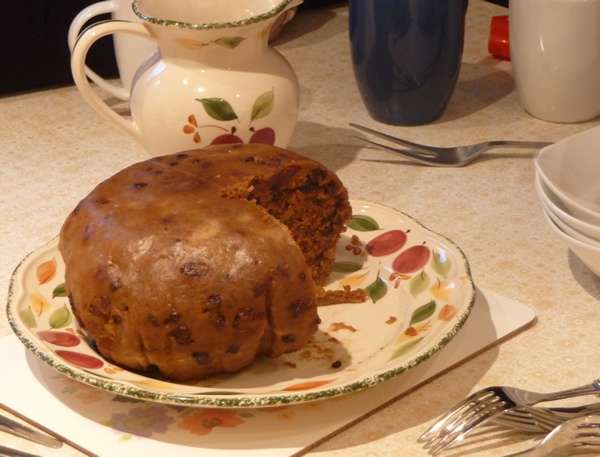
stir_upThe Christmas pudding is traditionally made on Stir Up Day, the last Sunday before Advent. All family members of a household take a turn in the stirring with a special wooden spoon, which represents the Christ Child’s crib and the stable. Stirring in a clockwise direction with his eyes closed, each person makes a secret wish during his turn at the spoon – very much as one might do before blowing out the candles on a birthday cake.

In country houses, the occupants hung decorations on Christmas Eve. These remained in place until the Epiphany on January 6, when they were removed. One might hang holly, ivy, rosemary, evergreen, hawthorn and hellebore (Christmas rose). As for the mistletoe/kissing ball, it became quite elaborate during the Victorian Period. However, many believe the tradition remained below stairs in the servants’ quarters during the Regency Period. Yet, the kissing ball and the removal of the berries for each kiss “stolen” from a lovely heroine is often found in Regency-based romances. pudding3

ye-old-yule-logA Yule Log to burn throughout the festive days would have been common, as well as a Christmas candle. The kindling from the previous year’s Yule Log would be used to light the current year’s find. Groups – mummers whose origins date back to the Middle Ages – sang and performed short plays, customarily on Boxing Day (December 26). The actors often mixed bits of history with the heroes of the British Napoleonic Wars in their tales. Of course, Saint George remained a staple of the plays.

Parlor games entertained houseguests, but  caroling (except possibly in Wales), decorated trees, stockings hung by the chimney with care, and  Christmas cards were not part of the celebrations. Gifts were few and often took the form of charitable acts by the aristocracy. A landowner’s cottagers might bestow a gift symbolizing their devotion to his generosity or representing the bounty of the estate’s harvest on the main house. A Regency Christmas was a time to reflect upon one’s religious beliefs and to enjoy the companionship of friends and family. It was not the commercialized holiday we of this century would expect.regency-christmas-4

In creating my Austenesque novel, Christmas at Pemberley, the challenge was to tell a tale of “Christmas” for a modern audience, but to stay true to the Regency Period’s practices. In the novel, Christmas arrives on a Sunday. It is 25 December 1814, the time period between Napoleon’s arrival on Elba and his escape in March 1815. I shifted the story’s emphasis from the expected symbols of Christmas (gifts, carols, trees, etc.) to the birth of two children and how each child’s entrance into this world changes the family into which he is introduced. I used the holiday’s practices as the framework through which the story is told. [Leaving a comment below will enter you into a giveaway of a signed copy of “Christmas at Pemberley.” – Deadline midnight 26 December 2014]

Christmas at Pemberley
A Pride and Prejudice Holiday Sequel
By Regina Jeffers
9781569759912-011A festive holiday novel in which personal rivalries are resolved, generosity rediscovered, and family bonds renewed.

It’s Christmastime at Pemberley and the Darcys and Bennets have gathered to celebrate. With such a mix of eclectic characters under one roof, bitter feuds, old jealousies, and intimate secrets quickly rise to the surface. Stubborn Lady Catherine seeks forgiveness, shallow Caroline Bingley finds love, and immature Kitty pursues a vicar. Forced into playing hostess, Georgiana Darcy tries desperately to manage the chaos while wishing Darcy and Elizabeth would return from their journey.

Enroute home, Darcy and Elizabeth are waylaid by blizzard-like conditions that forces them to take shelter in a nearby inn. Elizabeth is tormented with the prospect of their spending Christmas away from their families, but when a young couple arrives at the inn in need of a place for the night, Elizabeth’s concern turns to the pregnant girl. As Elizabeth and Darcy comfort and soothe the stranger through a long and painful labor, they’re reminded of the love, family spirit, and generosity that lie at the heart of Christmas and which serve as the basis of what they have built at Pemberley.

Excerpt: 

“A small gift from Nan,” Elizabeth said as she handed the hastily-made dressing gown to Mary. With Mrs. Washington’s assistance, Elizabeth had assisted Mary into fresh clothes. Now, the new mother rested once more in the bed. She held the sleeping child in the bend of her arm.

“I will thank the girl properly,” Mrs. Joseph assured.

Elizabeth patted the back of the lady’s hand. “Why do you not rest?”

“You require your rest  as much as I,” Mrs. Joseph protested.

Elizabeth shook off the suggestion. “First, I believe I shall go downstairs and have a proper supper with Mr. Darcy. My back is tight.” She stretched her arms over her head. “I shall send Mr. Joseph to sit with you.”

“It is not necessary for someone to watch me sleep.” Mary’s eyelids closed, but then sprung open again. “That is unless you require private time with Mr. Darcy.’

Elizabeth smiled knowingly. “I never tire of the man’s company. Even after two years.”

“Then by all means send Mr. Joseph up. A woman of your great heart should have her every wish.” She caught Elizabeth’s hand in a tight grasp.

Elizabeth  touched the sleeping child’s hair with her fingertip. “My wish is to possess what you have, Mary,” she whispered.

“You will, Elizabeth,” Mrs. Joseph insisted. “You shall have your own special happiness…you and Mr. Darcy.” The woman paused to suck in what appeared to be a deep steadying breath. “My child’s birth…I was never afraid, because God placed the incomparable Elizabeth Darcy in my life. My prayers, those I recited before Matthew and I departed Stoke-on-Trent, were for God to send an angel to protect my child, and on the third day of our journey, I walked into this out-of-the-way inn; and there you were. My own angel!”

Elizabeth snorted. “I have been called many things, but ‘angel’ has rarely been used in the same sentence as my Christian name.”

“That is where the world remains in error, Elizabeth. They see the defenses you erect to protect yourself from those who would think to know you. They do not see your magnificent heart…your indomitable spirit…the purity of your soul.”

Elizabeth laughed self-consciously. “Do not bestow too many exemplary qualities upon my shoulders. If I am to be known as an ‘angel,’ I shall be forced to find something of merit to say of Miss Bingley.”

Mary’s eyebrow rose in curiosity. “Miss Bingley?”

Elizabeth chuckled. “My sister Jane is married to Mr. Charles Bingley. Miss Bingley is the youngest of the gentleman’s sisters. Before Jane and Bingley were married, Miss Bingley did my poor, sweet Jane a major disservice, and the lady once had her sights set on Mr. Darcy. I am often at my wit’s end when I am called upon to be civil to the woman.”

“Angels may feel jealousy, Elizabeth.” Mary squeezed the back of Elizabeth’s hand in companionship.

“So, you believe there are ‘shades’ of angelic behavior?” Her voice rose in bemusement.

Mary smiled, a twist of her lips turning upward. “Absolutely,” she declared without a telling blink of her eyes. “God’s love is pure, but mankind’s benevolence may vary.” An appreciative leap of sardonic humor flashed in Mary’s eyes. “An ‘angel’ may have moments of weakness.”

Elizabeth puzzled over the point Mary Joseph meant to make. “You believe I have God’s attention?” The woman’s rather cryptic utterances had mystified Elizabeth.

“We all possess God’s attention, and it is up to each of us to determine how best to serve Him. That being said, it is my opinion our Maker has chosen you among His favorites.”

Before she could stifle the words, Elizabeth defensively asked, “Then how could a loving God permit my children to die before I could know them? Before I could tell them of my love?” Tears trickled from her eyes to cascade down her cheeks.

Mrs. Joseph swallowed hard. “That is the question which most frightens you, is it not? You wonder how, if you serve God faithfully, He could not honor you with a child of your own. How the rest of the world can know the happiness you have been denied? How no one other than Mr. Darcy understands the depth of your fears?”

“Yes.”

“I have no answer which will satisfy your heart: God gives us what we require when we require it. My husband holds different ideas on such matters, but I believe that when the Bible says God created man in His image, the passage means God has His foibles, as well. He, for example, is a bit selfish. God wishes to surround himself with the most magical sound in the world, the sound of a child’s freely-given laugh. Therfore, sometimes He acts upon his selfishness and calls the child home early. It is the only explanation which makes any sense.”

Elizabeth brushed away her tears. “I shall endeavor to accept your explanation, Mary. It will serve me as well as any other.”

“You cannot argue with a woman named ‘Mary’ on the occasion of the anniversary of the Lord’s birth,” the woman teasingly reasoned.

“No. I suppose, I cannot.”

Thank you for joining my party; now, have a look at equally enjoyable entertainments…

1. Helen Hollick: “You are Cordially Invited to a Ball” (plus a giveaway prize) 
http://ofhistoryandkings.blogspot.co.uk/2014/12/you-are-invited-to-party_17.html

2. Andrea Zuvich: “No Christmas For You! The Holiday Under Cromwell”  http://www.andreazuvich.com/history/no-christmas-for-you-the-holiday-under-cromwell

3. Debbie Young:  “Good Christmas Housekeeping” + a Giveaway of a Virtual Party Bag Giveaway  http://authordebbieyoung.com/2014/12/20/christmas/

4. Lauren Johnson:  ‘”Farewell Advent, Christmas is come” – Early Tudor Festive Feasts’  http://laurenjohnson1.wordpress.com/2014/12/19/farewell-advent-christmas-is-come-early-tudor-festive-feasting-christmas-party-blog-hop/

5. Ann Swinfen: Christmas 1586 – Burbage’s Company of Players Celebrate  http://annswinfen.com/2014/12/christmas-party/

 6. Richard Abbott: The Hunt – Feasting at Ugarit
http://richardabbott.authorsxpress.com/2014/12/19/the-hunt-feasting-at-ugarit/

 7. Edward James: AN ACCIDENTAL VIRGIN  https://busywords.wordpress.com/an-accidental-virgin/

and 

AN UNINVITED GUEST  https://busywords.wordpress.com/the-birthday-party/

8.  Derek Birks: The Lord of Misrule – A Medieval Christmas Recipe for Trouble https://dodgingarrows.wordpress.com/2014/12/19/christmas-blog-hop-the-lord-of-misrule-a-medieval-christmas-recipe-for-trouble/

9. Jude Knight: Christmas at Avery Hall in the Year of Our Lord 1804 + Giveaway of “Candle’s Christmas Chair” (novella)  http://judeknightauthor.com/2014/12/20/christmas-at-avery-hall-in-the-year-of-our-lord-1804/

10. Nancy Bilyeau: “Christmas After the Priory”    http://nancybilyeau.blogspot.com/2014/12/blog-hop-christmas-after-priory.html

11. Fenella J. Miller:  ‘Christmas on the Home front + GIVEAWAY of “Barbara’s War.”
http://fenellamiller.blogspot.co.uk/2014/12/christmas-on-home-front-and-giveaway.html

12. Clare Flynn: A German American Christmas http://www.clareflynn.co.uk/blog/a-german-american-christmas

13. Sarah Etter: Christmas Pudding — Part of the Christmas Feast!  http://saraleeetter.wordpress.com/2014/12/19/christmas-pudding-part-of-the-christmas-feast/

14. Suzanne Adair: “The British Legion Parties Down for Yule 1780” + Giveaway of “Camp Follower: A Mystery of the American Revolution.” http://www.suzanneadair.net/2014/12/19/the-british-legion-parties-down-for-yule-1780/

15. J L Oakley: Christmas Time in the Mountains 1907 + Giveaway of an audioboook of “Tree Soldier” (US and UK)
https://historyweaver.wordpress.com/2014/12/19/christmas-time-in-the-mountains-1907/

16. Anna Belfrage:  All I want for Christmas + Giveaway  https://annabelfrage.wordpress.com/2014/12/20/all-i-want-for-christmas-the-christmas-party-blog-hop/

17. Carol Cooper: How To Be A Party Animal  http://pillsandpillowtalk.com/2014/12/19/how-to-be-a-party-animal/

18. Julian Stockwin: Join the Party   http://tinyurl.com/n8xk946  

19. Juliet Greenwood: Christmas 1914 on the Home Front (plus a giveaway)   http://julietgreenwoodauthor.wordpress.com/2014/12/19/christmas-1914-on-the-home-front/

20. Lucienne Boyce:  A Victory Celebration   http://tinyurl.com/ovl4sus

21. Nicola Moxey: The Feast of the Epiphany, 1182  http://nickymoxey.com/2014/12/19/the-feast-of-the-epiphany-1182/

22. Peter St John:  Dummy’s Birthday   http://jennospot.blogspot.fr/2014/12/dummys-party.html

23. Stephen Oram : Living in your dystopia: you need a festival of enhancement… (plus a giveaway prize)  http://stephenoram.wordpress.com/2014/12/19/living-in-your-dystopia-13-you-need-a-festival-of-enhancement/

24.  Alison Morton: “Saturnalia surprise – a winter party tale” + Giveaway of “Perfiditas” – http://alison-morton.com/2014/12/20/saturnalia-surprise-a-winter-party-tale-and-giveaway/

25. Lindsay Downs : O Christmas Tree, O Christmas Tree + Giveaway 
http://lindsaydowns-romanceauthor.weebly.com/lindsay-downs-romance-author/o-christmas-tree-o-christmas-tree

26. A Bonus Post from Ann Swinfen: The Real Richard (Dick) Whittington               http://the-history-girls.blogspot.co.uk/2014/12/turn-again-whittington-by-ann-swinfen.html

Posted in book excerpts, British history, Great Britain, Jane Austen, Living in the Regency, Regency era | Tagged , , , , , | 59 Comments