Question from Reader: During the early 1800’s, did Debrett’s list marriages? I have a hero who is the younger son to an earl. He married quite young as part of an arranged marriage, then took off leaving his wife behind. So far I have him playing the rake around London, but he does not tell anybody that he’s married and has been so for ten years. Would others know of his marriage even if he doesn’t mention it?
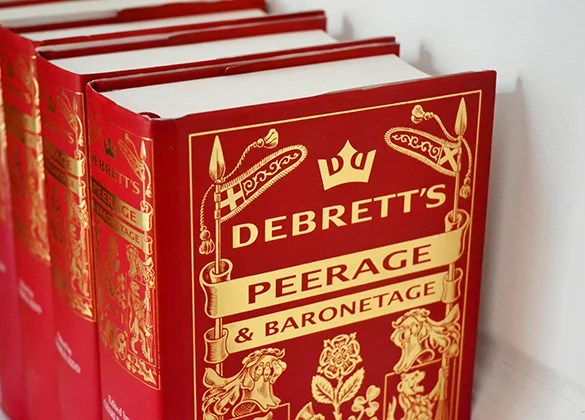
Debrett gathered their information from the deaths, births, and marriage columns in the newspaper and from announcements sent to it so if no one reported the marriage, it would not necessarily be included. The 1802 Debrett did not know that Lord Byron had died in 1798 and been succeeded by a 10-yearold great grandson, for example.
Your hero can be addressed by whichever epithet he prefers: Captain Lord Pennyworth or just Lord Pennyworth.
From Debrett’s 1816 –
If an officer has a title, or a courtesy title or style, he is addressed in the opening of a letter and in speech in exactly the same way as any other title-holder. It should be noted, however, that some titled officers prefer to be addressed by their Service rank.
If Admiral Sir Guy Jones expresses his preference to be addressed ‘Dear Admiral Jones’ instead of ‘Dear Sir Guy’, this should of course be observed.
On an envelope the service rank appears before the title, except ‘His Excellency’.
The one aspect of Debrett’s that has to be taken into account (in the historical sense as far as authoring historical novels goes), is that Debrett’s has continually updated its etiquette in relation to modern day rules of engagement. Take medieval and early post medieval forms of address – verbal and written – and one can see a differing theme in respect of titles. After all, a prince was referred to as his grace, so too monarchs who were also referred to as Sire/Majesty, et al.) Slowly changes came about as medieval squires (servants) seemingly vanished somewhere along the way and county squires (landowners) who had their own servants are the only reference to squires. What a turn-around in social standing that is?
Prior, during, and post English Civil War and stretching to the Georgian era, names came before title and in many aristocratic circles remained thus until the reign of William IV & the Victorian era, i.e. Charles Standish, Duke of Wherever. Letters were thus addressed to the duke by a fellow aristocrats as Charles Standish, The Duke of Wherever. Whilst lesser persons in society (knowing their place) would address a letter to The Duke of Wherever, and head the letter with Dear Duke. On the other hand, in private letters between aristocrats, one may address the duke as Dear Standish, and if close or related another may use, Dear Charles, or plain Charles.
By the Georgian era, Squires (county gentlemen) would become magistrates wielding lesser judicial power than county court circuit judges, but nonetheless, these squire magistrates were greatly feared by poachers and livestock rustlers. I do not think I need to enlighten any of you as to why that was so, except local knowledge added greatly to a squire’s intelligence networking. What other interesting aspects of Historical Britain post English Civil War strikes a note with you?
Debrett’s was a publishing books with another before 1800. In 1803 Debrett put out its first Peerage of England, Scotland, and Ireland. The books were not with a red binding as you see in the image above. They were the size of a regular paperback book with the peerage of each country in a separate volume.
Burke’s Peerage was started after the Debrett’s. Before either there were other publishers who published the information Dods and Lodge.
In the past, peerage dictionaries have appeared frequently, not only from the publishers of Burke and Debrett’s, but under such editorial names as Collins, Dod, Foster, Lodge and Whitaker, and any of these will include details of peerages extant at the time of their publication; however, the Second World War brought all but the first famous pair to an end, and even Burke and Debrett’s appear on an occasional rather than an annual basis nowadays. Apart from these two, the editors of the great ‘Complete Peerage’ make reference to a number of other printed peerage works which, in view of this usage, might be considered of more than average authenticity:
- Collins’ Peerage of England, edited by Sir E. Brydes, 9 volumes (1812). – The first edition, edited by Arthur Colins was published in one volume in 1709.
- Compendium English Peerage, 1718-69, 13 volumes; Compendium Scottish Peerage 1720-64, 7 editions; Compendium Irish Peerage, 1722*-56, 5 editions
- Crawfurd’s Peerage of Scotland, 1716 (with 2nd and 3rd editions in 17190.
- Crossley’s Peerage of Ireland, 1725.
- Douglas’s Peerage of Scotland, 2nd edition, ed. J. P. Wood, 2 volumes, 1813 (The 1st edition, in one volume, was published in 1764).
- Dugdale’s Baronage of Scotland, 2 volumes, 1675-76*.
- Hewlett’s Dignities in the Peerage of Scotland which are dormant or forfeited, 1882.
- Lodge’s Peerage of Ireland, 2nd edition, ed. M. Archdall, 7 volumes, 1789, (The 1st edition in 4 volumes was published in 1752.)
- Selden’s Titles of Honour, 3rd edition, 1672 (The 1st edition was published in 1614).
Ranks and Privileges of the Peerage
Image of Nancy Lawrence’s website from English Peerage,
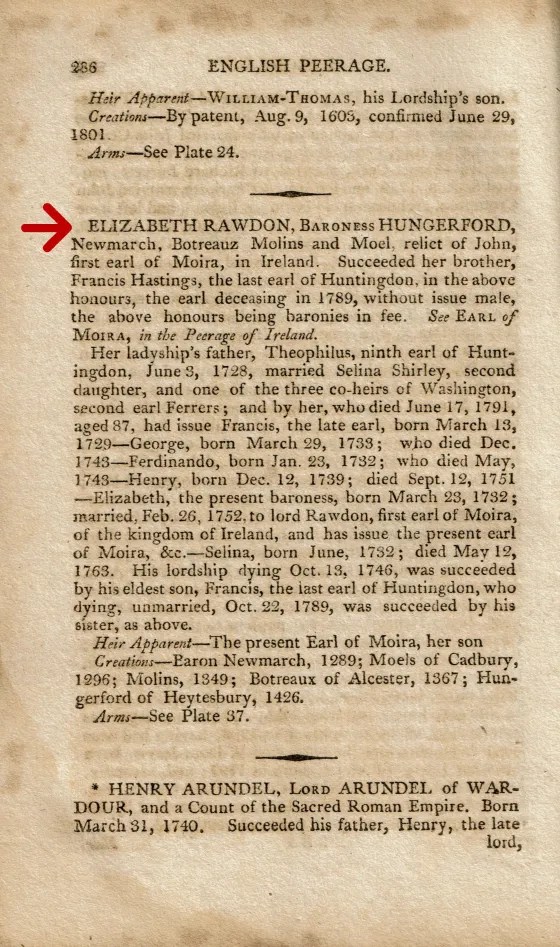
This is what Debrett’s say it handles nowadays, but I cannot guarantee such was so for the Regency Era.
A Debrett’s entry for a peerage provides comprehensive genealogical and biographical details for a peer, including the current title holder, their family, and the history of the peerage itself. It is considered a definitive record of the British aristocracy and includes information concerning all living members of a titled family in the male line.
Information on the current peer
For the current holder of a peerage, an entry typically includes:
- Full name: The peer’s complete name, including all forenames.
- Rank of dignity: Specifies the rank of the peerage, such as duke, marquess, earl, viscount, or baron.
- Birth date: The date of the peer’s birth.
- Personal and professional life: Information about the peer’s career, education, and social activities, such as club memberships.
- Correct style of address: Guidance on the proper formal etiquette for addressing the peer in correspondence or conversation.
Genealogical information
Debrett’s provides a detailed family history for the peerage, including:
- Spouse: The name of the peer’s wife or husband.
- Children: Names of all children in the male line, along with their birth dates and details of any marriages.
- Other relatives: Information on collateral branches of the family, such as siblings, nephews, and nieces in the male line.
- Hereditary succession: Details about the heir apparent or heir presumptive to the title.
- Adoption and parentage: Listings may also include adopted and illegitimate children of a surviving parent.
Information on the peerage itself
The entry also includes the history and particulars of the title:
- Place and date of creation: The specific Peerage (e.g., England, Scotland, Great Britain) in which the dignity was created and the date of its creation.
- Status of the title: Mentions if the peerage has become extinct, dormant, abeyant, or disclaimed.
- Armorial bearings: Many entries are illustrated with the armorial bearings (coat of arms) of the title-holding family.


 Every Woman Dreams...