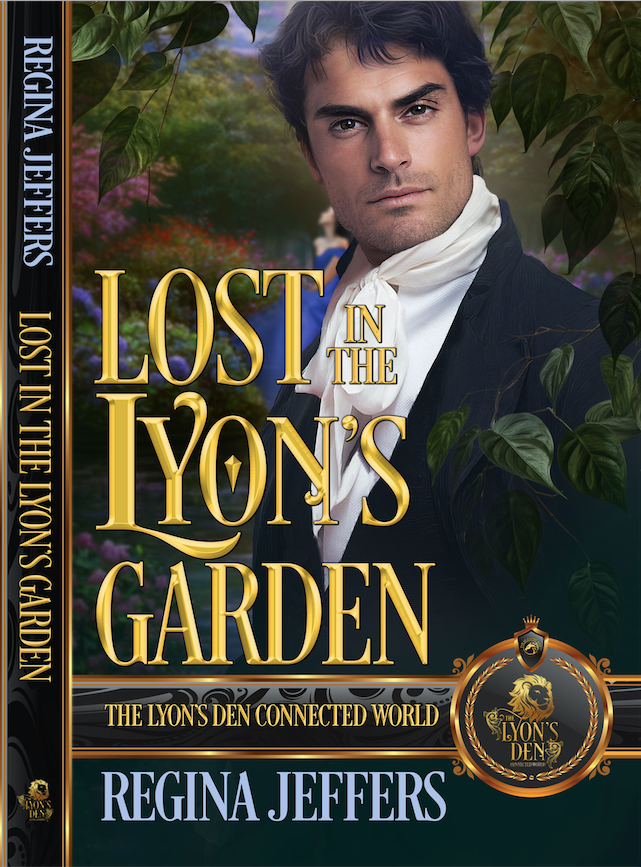
In this story, the hero and heroine take on tending to her missing sister’s baby. The boy is fascinated by the sound of the hero’s voice. In this shorty scene, Lord Benjamin Thompson is reading Shakespeare to the infant.
from Chapter Seventeen:
She did not know how long she slept—not long enough to be refreshed fully, but enough that her mind was no longer a pot of gruel. “Where is the boy?” she asked when she found Mrs. Sullivan alone in one of the sitting rooms.
“His lordship took the boy with him into his study. Lord Thompson said he did not want the boy waking you up.”
“That was sweet of him,” she replied. “Perhaps I shall join them for a few minutes. His lordship is a busy man with many interests and should not be expected to tend to a babe not of his family.”
“As you say, miss,” Miss Sullivan said as she set her next row of stitches.
Victoria caught up her shawl and ran her damp hands across the wrinkles of her day dress to smooth them out. Her head was still more than fuzzy with having had only a bit over four hours of sleep, but she was exceedingly eager to learn how his lordship would treat her now that they had shared a kiss.
In reality, she was losing track of how long she had been at Macalhey House. Though she had unconsciously begun to feel as if the sparse second part of Lord Thompson’s terrace house was the home she never knew she required. She was living in a dream. “What woman did not wish to encounter a strong and caring man and a sweet babe nestled together as a family, while knowing security under one roof.”
She paused briefly before entering his half of the house. “You must not consider his life as yours,” she silently warned her heart. “Lord Duncan’s sons are not your family. Lord Thompson is not your husband nor even your betrothed. Yet, could they be?”
Despite a renewal of her qualms, Victoria was still eager to look upon her two favorite people in the world: his lordship and the child. Therefore, she placed her doubts aside to experience one more cherished memory. She found the pair in his lordship’s study. Lord Thompson was at his desk, the boy laid out on a cloth mat before him. His lordship was reading aloud, but she was not confident “what” he was reading, for she had never heard the passage before, though she thought it might be Shakespeare. Yet, it was no Shakespeare of which she was aware. The baby batted the air with his fists to the timbre of his lordship’s voice.
Ladies, if we have been merry,
And have pleased ye with a derry,
And a derry, and a down,
Say the Schoolmaster’s no Clown
Duke, if we have pleased thee too,
And have done as Boys should do,
His lordship ran his finger along the page of the book he was holding out of the child’s reach. Meanwhile, the boy followed his lordship’s reading. Gurgling. And swinging his hands about to the rhythm of Lord Thompson’s recitation.
Give us but a tree or twain
For a Maypole, and again
Ere another year run out,
We’ll make thee laugh and all this rout.
“You are reading him what sounds of Shakespeare, but not the Shakespeare I know,” she said from the open door’s portal.
“You said the child appears to like the sound of my voice. Should not the boy enjoy what many believe to be a John Fletcher and William Shakespeare collaboration? This one would be near the end of the Bard’s career.”
“And what is the name of this play?” she asked. “I am most curious.”
“‘The Two Noble Kinsmen,’” he responded. “First published in 1634 with the names of John Fletcher and William Shakespeare on the title page.” He held up the book for her to see. “However, most scholars believe, because parts are borrowed from Beaumont’s 1613 masque and referred to in 1614’s Bartholomew Fair, it was written earlier and was revised merely by Fletcher.”
“Both the boy and I learned something new today,” she said softly, while marveling at the man who possessed a heart of gold and was a champion for those, like her, who required a hand up.
She circled the desk to look down upon the child, whose eyes were opening and slowly closing as sleep called his name.
<<<>>>
The Two Noble Kinsmen is a Jacobean tragicomedy, first published in 1634 and attributed jointly to John Fletcher and William Shakespeare. Its plot derives from “The Knight’s Tale” in Geoffrey Chaucer’s The Canterbury Tales (1387–1400), which had already been dramatised at least twice before, and itself was a shortened version of Boccaccio’s epic poem Teseida. This play is believed to have been originally performed in 1613–1614, making it William Shakespeare’s final play before he retired to Stratford-upon-Avon, where he died in 1616.
Formerly a point of controversy, the dual attribution is now generally accepted by scholarly consensus. [Erdman, David V.; Fogel, Ephim G., eds. (1966). Evidence for Authorship: Essays on Problems of Attribution. Ithaca, New York: Cornell University Press. pp. 486–494, 433–435, 467–469.]
“Links between The Two Noble Kinsmen and contemporaneous works point to 1613–1614 as its date of composition and first performance. A reference to Palamon, one of the protagonists of Kinsmen, is contained in Ben Jonson’s play Bartholomew Fair (1614). In Jonson’s work, a passage in Act IV, scene iii, appears to indicate that Kinsmen was known and familiar to audiences at that time.
“In Francis Beaumont’s The Masque of the Inner Temple and Gray’s Inn (1613), the second anti-masque features this cast of rural characters: pedant, May Lord and Lady, servingman and chambermaid, tavern host and hostess, shepherd and his wench, and two “bavians” (male and female baboon). The same cast slightly simplified (minus wench and one “bavian”) enacts the Morris dance in Kinsmen, II, v, 120–138. A successful “special effect” in Beaumont’s masque, designed for a single performance, appears to have been adopted and adapted into Kinsmen, indicating that the play followed soon after the masque.” [Stone, John (September 2020). “The Two Noble Kinsmen and Eighteen Other Newly Discovered Early Modern English Quartos in an Hispano-Scottish Collection”. Notes and Queries. 67 (3): 367–374.]


 Every Woman Dreams...