In the Church of England, the archbishop of Canterbury is considered the principal leader. He is also the bishop of the diocese of Canterbury.
The first archbishop was Augustine of Canterbury, who was sent to England by Pope Gregory the Great. Ausgustine arrived in 597. He was to establish Christianity in southern England. He is often referred to as the “Apostle to the English”. Augustine converted King Æthelberht of Kent to Christianity, which led to the establishment of the English Church and the first archbishopric in England.
The position is currently vacant following the resignation of Justin Welby, the 105th archbishop, effective 7 January 2025. [Orders in Council, 18 December 2024, page 42.] At this time, Stephen Cottrell, the Archbishop of York, is overseeing the majority of the Archibishop’s duties.
The position stayed a Catholic one from the time of Augustine to that of William Warham. Catholic Encyclopedia tells us, “In 1509 he crowned Henry VIII and Katherine of Aragon, and under the new king he enjoyed the same confidence as under Henry VII till he was overshadowed by the growing influence of Wolsey. In 1512 he became involved in a controversy with his suffragans, who considered that he pushed the metropolitan prerogative too far, and the matter was finally settled by a compromise. When Wolsey was created cardinal in 1515 Warham conferred the hat upon him in Westminster Abbey, and thereafter he was forced into the second place. Before Christmas he resigned the office of Lord Chancellor, as he had long wished to do, being out of sympathy with the king’s anti-French policy, and Wolsey received the Great Seal in his stead. Warham’s power was still further diminished in 1517 when Wolsey was appointed papal legate, and from that time forward there were constant official differences between them, though their private relations continued friendly. Wolsey as legate continually interfered with the action of the archbishop as metropolitan of the southern province and not infrequently overruled his decisions. In state affairs, especially in the raising of subsidies, he supported Wolsey, though he incurred the contempt of the cardinal’s enemies for doing so. When the divorce question was first raised in 1527 he was Wolsey’s assessor in the secret inquiry into the validity of the king’s marriage. About this time his health began to fail, and he was no longer equal to taking an effective part in the important affairs that ensued. Being selected as the chief of the counsel appointed to assist Queen Katherine he did nothing on her behalf, but when she appealed to him for advice, replied that he would not meddle in such matters. He steadfastly refused to oppose the king’s wishes, and in the summer of 1530 signed the petition to the pope begging him to allow the divorce. This course he pursued under threats from the king that unless he was complaisant all ecclesiastical authority in England would be destroyed.”
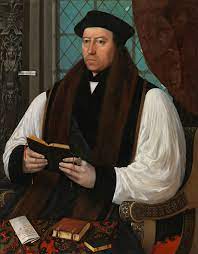
After King Henry VIII broke away from the Catholic Church and proclaimed himself the head of the Church of England, Thomas Cranmer was appointed Archbishop in 1533. He wad the first Archbishop of Canterbury. He was very influential in the development of Anglicanism.
The archbishop is appointed by the British monarch on the advice of the prime minister of the United Kingdom and formally elected by the college of canons of Canterbury.
In addition to supervising the Province of Canterbury, the archbishop has a ceremonial provincial court, consisting of some of the senior bishops of their provinces. Those include London. The Archbishop of Canterbury oversees 30 of the 42 dioceses of the Church of England. The other 12 come under the supervision of the Archbishop of York Up and until 1920 there were also 4 provinces in Wales, but they were transferred to the disestablish Church in Wales in that year.
“The archbishop of Canterbury has a ceremonial provincial curia, or court, consisting of some of the senior bishops of their province. [“Order of Service from the Enthronement of the 104th Archbishop in 2003” (PDF)]. The bishop of London — the most senior cleric of the church with the exception of the two archbishops — serves as Canterbury’s provincial dean, the bishop of Winchester as chancellor, the bishop of Lincoln as vice-chancellor, the bishop of Salisbury as precentor, the bishop of Worcester as chaplain and the bishop of Rochester as cross-bearer.”
The most well-known Archbishop of Canterbury to die in December was Thomas Becket, who was murdered on this day on December 29, 1170. He was assassinated by knights loyal to King Henry II, and his death is a significant event in English history and religious lore according to history.com.
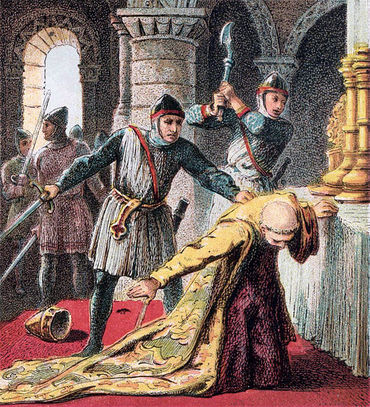
Here’s more details about his death:
- The Conflict: Becket and King Henry II had a strained relationship due to disputes over the power of the Church versus the Crown.
- The Murder: Becket was murdered in Canterbury Cathedral by four knights who were believed to be acting on the King’s displeasure.
- Consequences: Becket’s death caused outrage across Europe and led to his eventual canonization as a saint.
- Commemoration: The anniversary of his death is marked annually with services and commemorations.


 Every Woman Dreams...