For those of you who are interested in using or avoiding the use of this deadly yet popular shade of green, here is an interesting article from an art magazine.
The Paris Review tells us a bit to the history of the color in its article, “Scheele’s Green, the Color of Fake Foliage and Death.”
“Invented in 1775 by Carl Wilhelm Scheele, the artificial colorant was made through a process of heating sodium carbonate, adding arsenious oxide, stirring until the mixture was dissolved, and then adding a copper sulfate to the final solution. According to the color historian Victoria Finlay, Scheele invented this green “almost accidentally.” It wasn’t his first trip around the color wheel either; in the 1770s, Scheele created a bright-yellow paint from chlorine and oxygen that was later named Turner’s patent yellow after the British manufacturer who stole the patent. I can only assume Scheele was thrilled to have discovered yet another bright hue (one that he could name after himself, no less), but “there was something that troubled him,” Finlay writes. A year before the color went into production, he wrote to a friend that he thought users might want to know about its poisonous nature. “But what’s a little arsenic when you’ve got a great new color to sell?” Finlay quips.
“Despite its character flaws, Scheele’s green was striking and profitable. The color was not only cheap to produce, it accurately mimicked the hues found in nature. It wasn’t too yellow, nor was it too teal. It was a middle green with full saturation—no gray tints, no underlying hint of brown. It was a vegetal green, the color of fiddleheads and ivy vines. It was a garden color, and for city dwellers, the allure of Scheele’s green was impossible to resist (even though the Victorians were well aware of the toxic effects of ingesting arsenic). This was a time when Londoners and Parisians alike were concerned with the dandification of modern society. The Industrial Revolution had turned their streets ugly and gray with smog. It had also (supposedly) turned their men into simpering weenies who didn’t do God’s honest work, like toiling in the fields, but instead hung out around bars and smoked and worked white-collar positions. Some Victorians (those with the most selective memories or a rather tenuous grasp of recent history) longed to return to that fabled pastoral Eden where men were men and women wore wreaths of fragrant flowers. And since fresh flowers didn’t last long enough for multiple wears, cloth reproductions would have to do. (Unsurprisingly, this was also a time when the English—and their counterparts in Europe—became very interested in protecting green spaces within the urban landscapes. Many of London’s finest public gardens date back to this era.)”
As to rumors of Napoleon’s exposure to the pigment, it has already been established that there were high levels of arsenic in his remains. Scientists can not determine, however, whether that was due to Napoleon’s exposure to the pigment on St. Helena, or whether it might have been the result of efforts to preserve his body.
An Overview:
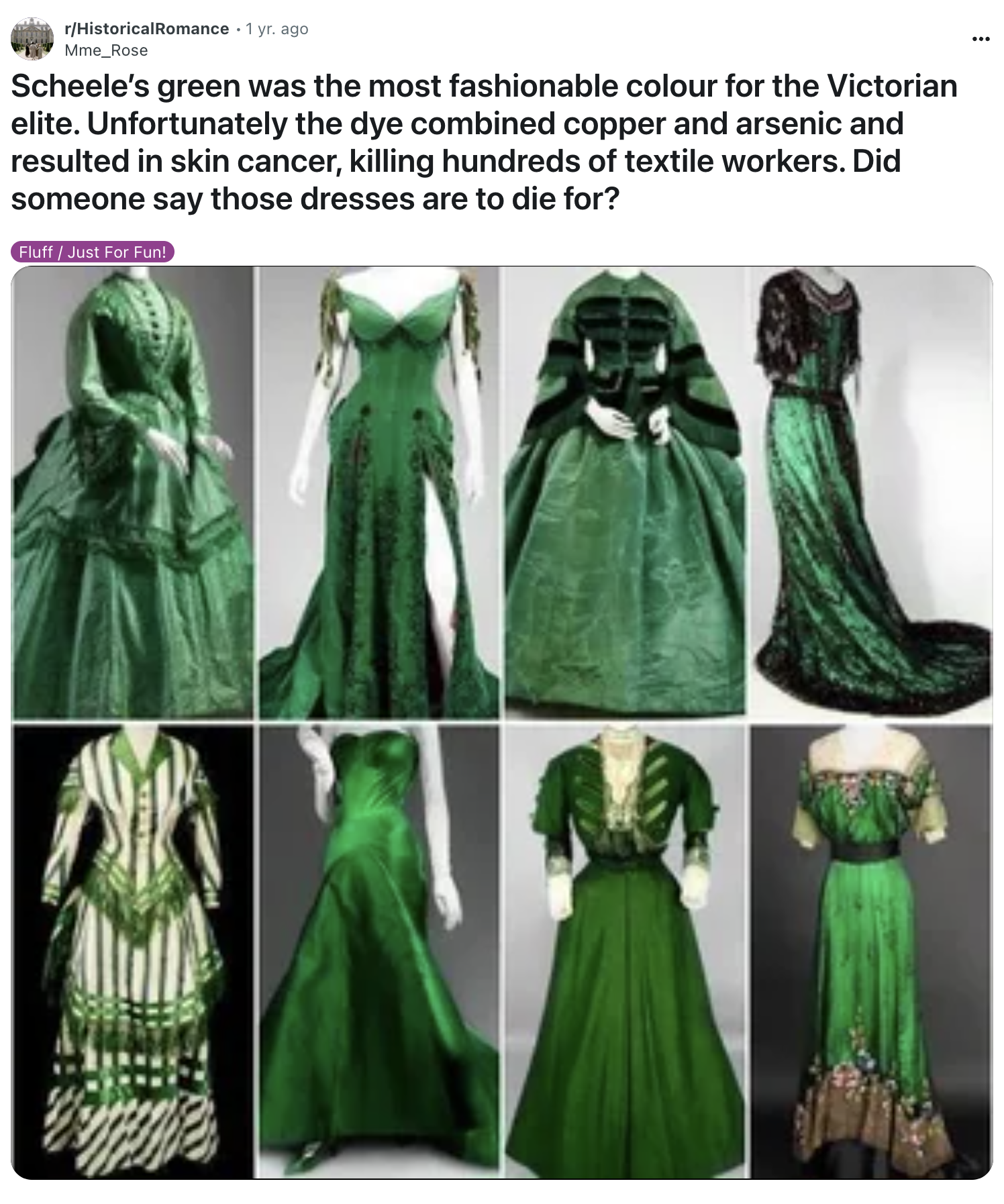
Scheele’s green is a bright, yellowish-green pigment made from copper arsenite. It was invented in 1775 by Carl Wilhelm Scheele and became popular in the 19th century, particularly in Europe. While prized for its vibrant color and cheap production, it gained notoriety for its toxicity due to the arsenic content.
Here’s a more detailed explanation:
- Composition: Scheele’s green is chemically known as cupric hydrogen arsenite, CuHAsO3. It is a compound of copper and arsenic.
- History: It was invented by Carl Wilhelm Scheele in 1775 and became widely used in the 19th century. It replaced older green pigments based on copper carbonate.
- Uses: Scheele’s green was used in various applications, including paints, wallpapers, textiles (including clothing), and even children’s toys.
- Toxicity: The presence of arsenic in Scheele’s green made it a hazardous material. It could cause skin irritation, vomiting, abdominal cramps, and other severe health issues.
- Decline in Use:By the late 19th century, the toxicity of Scheele’s green became widely known, leading to its gradual phasing out.
Now to another article…
Green Death | The Art History of Arsenic
“As to the arsenic scare a greater folly is hardly possible to imagine: the doctors were bitten as people bitten by witch fever.” ~William Morris, The Collected Letters of William Morris, Vol. 2
The discovery of a deep, vivid green by Swedish chemist Carl Wilhelm Scheele in 1775 led to a fashion craze lasting for more than a century. From the start, Scheele knew that the pigment he had developed was highly poisonous. But he also realized it was unlike any other green pigment available on the market. The lucrative lure of bringing this deadly hue to manufacturers, cloth dyers, artists, and more worldwide proved irresistible to Scheele.
Scheele’s Green became incredibly popular. It all but completely replaced older green pigments based on copper carbonate that had been used up until Scheele’s discovery. So popular was the hue that even after it became common knowledge that the paint was toxic, it was still used.
“Its vibrant color could be found in clothing, wallpaper, toys, candles, dyes and more through the end of the 19th century. Gowns, hats, gloves and socks were dyed with it, sometimes making the wearer ill through touch alone. Children in green rooms were documented as “wasting away.” Women in green dresses were struck ill, swooning in droves. The ingredient that made the color in Scheele’s Green so vibrant was also responsible for its deadliness: Arsenic.”
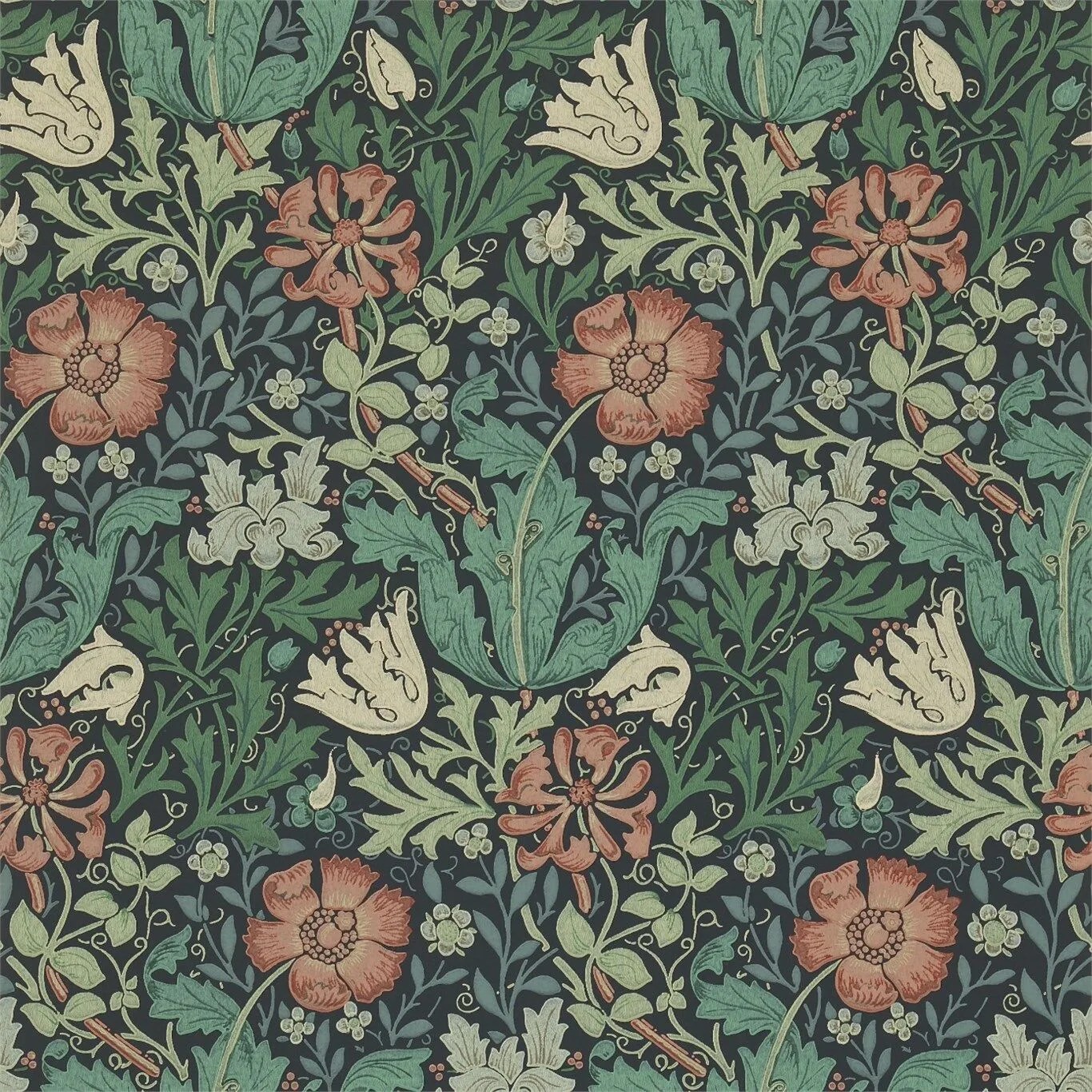
Arsenic green 19th century wallpaper designed by William Morris
“


 Every Woman Dreams...
Nicole Rudolph did a fantastic YouTube video on the history of arsenic.
Thank you, Jason. I will have to check it out.