Question from a Reader/Writer – Were mews actually kept behind London’s great houses or were there a, for lack of another word, a group barn for the people along a street?
Okay, I admit I am not an expert in this area. My editor often corrects my ignorance in these matters. I rode some when I was young, but not enough to know all the ins and outs of riding, saddles, barns, etc. Below is a hodgepodge of tidbits I picked up from writing Regency.

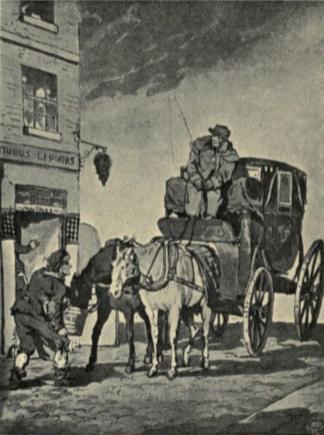
Many large houses in Mayfair had their own mews along the back of the property, opening onto an alley behind. You can see these spaces on the The A to Z of Regency London 1819 maps. It was important to keep the carriages separate from the horses because manure let off gases that harmed carriages, so one configuration would be 4-6 stalls perpendicular to the alley, which were separated by a wall from a carriage house on the other side of the space. The upper floor would contain rooms for grooms and a coachman plus storage for hay. It took time to fetch a carriage for use because it would have to be hitched up, then exit the alley and drive around to the front door. If one did not have his own stabling facilities, he could rent/let space at public mews, which were located all over the place. So a family might use a mews on the next street, which did not add much time to fetching a carriage in an emergency. Most uses of a carriage were pre-arranged so it would be at the front door when wanted. Or one could use hired horses/carriages to move to London and then rent horses and carriages as needed once arriving in the City.

DESCRIPTION
The London Topographical Society A to Z series consists of seven books, which provide fully-indexed maps of London at roughly 100 year intervals. Each reproduces a key map of the period. The indexes allow users to identify the position of streets and buildings, in some cases right down to small courts and alleys.
They appeal to anyone interested in the development of London and are invaluable for those researching family history.
This publication reproduces at two-thirds actual size the 4th and last edition of Richard Horwood’s map of London.
As a guide to the topography of early-nineteenth-century London it is unequalled. The 40 sheets of the map are accompanied by an introductory essay describing its making, assessing its qualities, and casting new light on the life of the map-maker, as well as indexes to streets and buildings showing the juxtaposition of residential and industrial premises.
***************************************
There is a good article on the cost of maintaining a horse in London–always follow the money. It covers stabling (which includes feed, water, and getting rid of the manure).
https://janeaustensworld.wordpress.com/2009/06/18/cost-of-maintaining-a-horse-in-regency-london/
There is also information worth noting on the Royal Mews —
http://www.royal.gov.uk/TheRoyalHousehold/RoyalAnimals/Workinganimals/TheRoyalMews/History.aspx
Also some good information on stabling arrangements here:
http://regencywriter-hking.blogspot.com/2014/08/stabling-in-nineteenth-century_22.html
One could stable horses at local inns; however, that would be both expensive and would not guarantee a well maintained horse. So … either one is rich enough to have one’s own mews for his horses, or he opts for hiring horses (for riding and driving) as he needs them from London stables, or he walks. This was one reason why driving one’s own horse in Hyde Park was a sign of wealth.
“Hackneys, or public carriages for hire made their first significant appearance in the early 17th century. By 1694, these vehicles had increased to such a number that a body of Hackney Coach Commissioners was established in London. The commissioners dealt out licences, which was a bit of a joke, for a mere four inspectors were responsible for over 1,000 vehicles.

“Most of these licensed hackney coaches were purchased second hand. All that an enterprising person needed to establish his own hackney coach business was enough money for a used carriage and three horses, two that worked in rotation, and one that could be used as a replacement in case of injury or illness. The death of a horse could lead to a cab owner’s financial ruin. Another important ingredient was housing for the horses.”

“By, 1823, the lighter horse cabs began to replace cumbersome hackney coaches in great quantity, and by the mid 1830’s, the hansom cab set the new standard for modern horse cabs. Aloysius Hansom, an architect, designed the first carriage. When Hansom went bankrupt through poor investments, John Chapman took over, designing an even lighter, more efficient cab, one whose framework did not strike the horses on their backs or sides whenever a carriage ran over an obstacle in the road.
“It is also why hansome cabs took off in the Victorian era as the city’s middle class boomed–the population created the need for more carriage for hire for those who could afford to pay but who could not afford to keep their own horses and carriages. “The hansom cab is a kind of horse-drawn carriage designed and patented in 1834 by Joseph Hansom, an architect from York. The vehicle was developed and tested by Hansom in Hinckley, Leicestershire, England. Originally called the Hansom safety cab, it was designed to combine speed with safety, with a low centre of gravity for safe cornering. Hansom’s original design was modified by John Chapman and several others to improve its practicability, but retained Hansom’s name.”


 Every Woman Dreams...