
Often when one reads a Regency tale, the hero is a “lord” of some kind and sits in Parliament in the House of Lords, but what happens if the hero is, say, a younger son or a man like Mr. Fitzwilliam Darcy, who has a fortune and owns a great deal of land, but has no title? That is where the House of Commons comes in. Where the House of Lords was filled by a men with titles, the House of Commons could be filled with younger sons of said lords, or gentlemen, or members of the gentry.
The House of Commons is the lower house of the Parliament of the United Kingdom. Like the upper house, the House of Lords, it meets in the Palace of Westminster in London, England. The House of Commons is an elected body consisting of 650 members known as members of Parliament (MPs), who are elected to represent constituencies by the first-past-the-post system and hold their seats until Parliament is dissolved.
The House of Commons of England began to evolve in the 13th and 14th centuries. In 1707 it became the House of Commons of Great Britain after the political union with Scotland, and from 1801 it also became the House of Commons for Ireland after the political union of Great Britain and Ireland.
Although the House of Commons does not formally elect the prime minister, by convention and in practice, the prime minister is answerable to the House, and therefore must maintain its support. In this way, the position of the parties in the House is an overriding importance. Thus, whenever the office of prime minister falls vacant, the monarch appoints the person who has the support of the house, or who is most likely to command the support of the house—normally the leader of the largest party in the house—while the leader of the second-largest party becomes the leader of the Opposition.
The Commons may indicate its lack of support for the government by rejecting a motion of confidence or by passing a motion of no confidence. Confidence and no confidence motions are phrased explicitly: for instance, “That this House has no confidence in His Majesty’s Government.” Many other motions were until recent decades considered confidence issues, even though not explicitly phrased as such: in particular, important bills that were part of the government’s agenda. The annual Budget is still considered a matter of confidence. When a government has lost the confidence of the House of Commons, the prime minister is expected either to resign, making way for another MP who can command confidence, or request the monarch to dissolve Parliament, thereby precipitating a general election.
The British parliament of today largely descends, in practice, from the Parliament of England, although the 1706 Treaty of Union, and the Acts of Union that ratified the Treaty, created a new Parliament of Great Britain to replace the Parliament of England and the Parliament of Scotland, with the addition of 45 MPs and sixteen Scottish representative peers. Later still the Acts of Union 1800 brought about the abolition of the Parliament of Ireland and enlarged the Commons at Westminster with 100 Irish members, creating the Parliament of the United Kingdom of Great Britain and Ireland.
The Middle English word common or commune, which is derived from the Anglo-Norman commune, meant “of general, public, or non-private nature” as an adjective and, as a substantive, “the common body of the people of any place; the community or commonalty” in the singular; “the common people, the commonalty; the lower order, as distinguished from those of noble or knight or gentle rank”, or “the burgers of a town; the body of free citizens, bearing common burdens, and exercising common rights; (hence) the third estate in the English constitution; the body of people, not ennobled, and represented by the Lower House of Parliament” in the plural. [Oxford English Dictionary. Second edition, volume III: Cham – Creeky. Clarendon, Oxford 1989, pp. 564–567]. The word has survived to this day in the original Anglo-Norman phrase soit baillé aux communes, with which a bill is transmitted from the House of Lords to the House of Commons. [Companion to Standing Orders UK Parliament]
Observations on the House of Commons During the Regency:
**I do not believe the MPs had offices, but I would be happy if someone else could prove me wrong. Remember, most of the MPs were aristocratic younger sons. Most members of the House of Commons were gentlemen. They might go en mass to Parliament from their club with their chums, almost all of whom served. For most, serving was more of a hobby than a responsibility to their country.
As a point of reference, I found this book had some merit in answering my questions on the House of Commons, but there are not any I have discovered that would provide me the information I might need as a writer of historicals set in the early 1800s.
This work has been selected by scholars as being culturally important, and is part of the knowledge base of civilization as we know it. ~ It is in the public domain.
**You did know that because these were, for the most part, idle rich who slept so late that Parliament did not begin until late afternoon?
**A parliamentary borough was a town or former town that had been incorporated under a royal charter, giving it the right to send two elected burgesses as Members of Parliament (MPs) to the House of Commons. It was not unusual for the physical boundary of the settlement to change as the town developed or contracted over time, for example due to changes in its trade and industry, so that the boundaries of the parliamentary borough and of the physical settlement were no longer the same.
**For centuries, constituencies electing members to the House of Commons did not change to reflect population shifts, and in some places the number of electors became so few that they could be bribed or otherwise influenced by a single wealthy patron. In the early 19th century, reformists scornfully called these boroughs “rotten boroughs” because they had so few inhabitants left, or “pocket boroughs”, because their MPs were elected by the whim of the patron, thereby being “in his pocket”; the actual votes of the electors were a mere formality since all or most of them voted as the patron instructed them, with or without bribery. These were often referred to as “rotten boroughs” or “pocket buroughs.”
**Among the most notorious of these “rotten boroughs” were Old Sarum, which had only six voters for two MPs, and Dunwich, which had largely collapsed into the sea from coastal erosion. At the same time, large cities such as Manchester received no separate representation (although their eligible residents were entitled to vote in the corresponding county seat). Also notable were the pocket boroughs, small constituencies controlled by wealthy landowners and aristocrats, whose “nominees” were invariably elected.
**In the 17th century Members of Parliament (MPs) were often elected against their will. On 2 March 1624, a resolution was passed by the House of Commons making it illegal for an MP to quit or willfully give up his seat, though I have had others tell me this was an incorrect assumption, so if you wish to know yea or nay, then check the specific time period. However, under the constitutional Act, the Act of Settlement of 1701, and subsequent legislation, any Member of Parliament accepting an office of profit under the Crown would be disqualified from his or her seat. This became the basis for the current legal practice of using sinecure posts such as the Chiltern Hundred to effect resignation.
**It did not matter if the borough is full of corrupt politics or not. All elections were official and set by the government. A parliament was generally about 7 years, but sometimes there needed to be an election between those dates because the prime minister died, the king died, or the member from a county or borough died. A member could nor resign his seat. Voting took several days and was in the open—no secret ballot. Before taking his seat in the House of Commons — or House of Lords for that matter– the member had to take an oath of allegiance to the king and opposing the Pope and Roman Catholic religion.
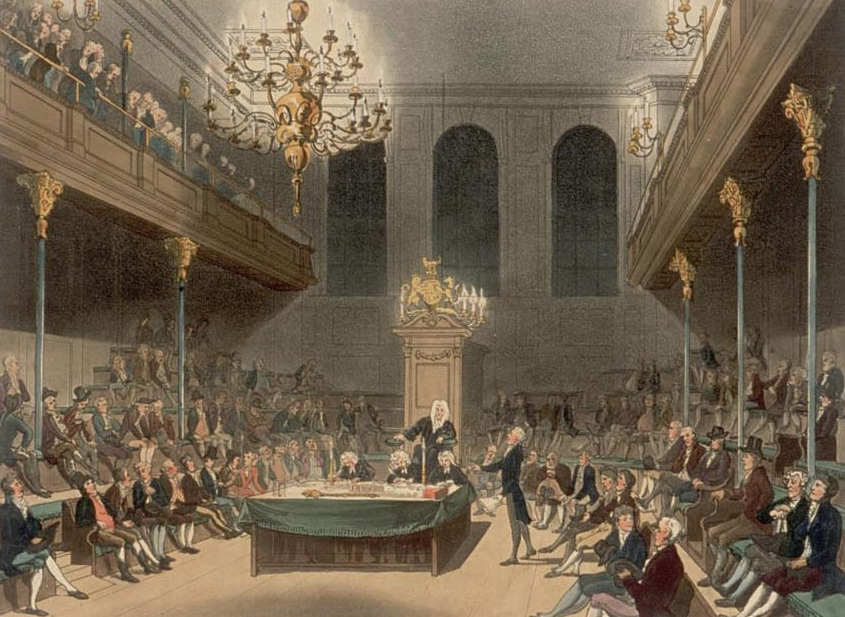
**There were some by-elections when a man died or succeeded to a peerage. William Pitt the younger might even have been a minor when he was first elected to the House of Commons. In any event he was young and was prime minister at 24.
**The young man’s father or his uncle or his mother’s brother or his mother’s uncle probably had a borough under his control. There were quite a few of these in Cornwall alone. These rotten boroughs were safe seats for sprigs of the aristocracy.
**Earl Spencer sent his oldest son into politics in the House of Commons. The father could be on some committees and hire the son to be a clerk. Some young men preferred learning to manage the estates to playing politics.
**Would he be geographically restricted in running for a seat? Like Congress? No. They were not restricted to the county in which they lived.
** Unless one is dead or is made a peer, one could not resign from the House of Commons. One had to say one was taking the Chiltern Hundreds to resign from the House of Commons between elections.
**First off, a seat in the House of Commons was a lifetime position, and there were MPs who found themselves therein against their will and until the early 1700s, they could not resign.
**Things changed in 1701 with the Act of Settlement (and some subsequent legislation) which made it illegal for any MP who accepted an office of the Crown for profit to remain in the House of Commons. I think it was John Pitt who first used this mechanism to resign – i.e., taking the Chiltern Hundreds. Pitt used the Place Act of 1742.
**The Chiltern Hundreds refers to the three ‘hundreds’ (administrative areas in Buckinghamshire) of Burnham, Desborough and Stoke. These ‘hundreds’ (the whole country was divided into ‘hundreds’ for administrative purposes), are located around the geographical area known as the Chiltern Hills. Note that only Desborough was actually in the Chiltern Hills. Anyway, the Crown office for profit involved in the Chiltern Hills instance was the (by then) nominal post of Crown Steward and Bailiff of the three Chiltern Hundreds of Stoke, Desborough and Burnham. But at this time, an MP could also resign from the House of Commons if he was given the Stewardship of the Manor of Old Shoreham (about a dozen MPs used this one in the latter half of the 18th century), and in the mid 19th century, the Stewardship of the Manor of Hempholme was used, as have a number of offer Crown offices from time to time.
**A ‘Parliament’ refers to the full term served by an elected government (after a national election to fill all seats in the House of Commons).
**A new Parliament does not commence if a sitting member dies (or a member succeeds to a title and leaves the House of Commons to take his seat in the House of Lords). In those cases, a by-election is held to fill the casual vacancy, but it does not ‘re-start’ the life or term of the Parliament.


 Every Woman Dreams...