Often, I am asked what might people of the Regency Era celebrate during the year. Now, these are some of the ones I know, though I cannot speak to the types of celebrations for all. Many were related to the Church of England, so “celebrations” as some of you might think were more subdued and a simple acknowledgement of the day.
For example, many who first read Jane Austen’s Pride and Prejudice do not understand the quote: “”Why, my dear, you must know, Mrs. Long says that Netherfield is taken by a young man of large fortune from the north of England; that he came down on Monday in a chaise and four to see the place, and was so much delighted with it, that he agreed with Mr. Morris immediately; that he is to take possession before Michaelmas, and some of his servants are to be in the house by the end of next week,” meaning, Mr. Bingley came to Netherfield Park before Michaelmas, which would be September 29. Have a look at the Timeline for Pride and Prejudice for more insights to that particular tale.
“There were four holidays of importance in the Regency Era: Lady Day, which celebrated the angel Gabriel’s visit to Mary (March 25), St. John’s Day, which coincided with Midsummer (June 24), Michaelmas (September 29), and Christmas (December 25). The four days were known as quarter days and were important celebrations on the English calendar. Of these, only Michaelmas and Christmas are named in Jane’s writings, with Michaelmas mentioned twelve times in five out of six novels, Northanger Abbey excepted, and Christmas referenced at least once or more per novel. But although named, Jane never describes Michaelmas or its traditions, and Christmas, for the most part, is only briefly referenced.” [Jane Austen Literacy Foundation]
1 January – New Year’s Day is observed on 1 January. The festivities begin a day before on 31 December when parties are held to bring in the new year. Public events are also organised where firework displays are arranged.
According to Whistler (2015), during the 18th century, first footing was not known in the South of England. Instead, “glasses were raised at quarter to twelve to “the Old Friend-Farewell!Farewell!Farewell!” and then at midnight to “the New Infant” with three ‘ Hip, hip horrahs!'”. Other customs included dancing in the New Year. In the North of England, first footing has been traditionally observed involving opening the door to a stranger at midnight. The guest is seen as a bringer of good fortune for the coming year.
6 January (or thereabouts) – Plough Monday is the traditional start of the English agricultural year. Plough Monday is the first Monday after Epiphany, 6 January. References to Plough Monday date back to the late 15th century. The day before Plough Monday is referred to as Plough Sunday, in which a ploughshare is brought into the local Christian church (such as the Catholic, Lutheran, and Anglican traditions) with prayers for the blessing of human labour, tools, as well as the land. In the fifteenth century, churches lit candles called “plough lights” to bless farmworkers. Some parishes kept a plough in the church for those who did not own one, and in some parishes, the plough was paraded around the village to raise money for the church. This practice seems to have died out after the Reformation.
13 January – The feast of St Hilary began the Hilary term at schools and law courts–at least, it was called Hilary term, though sometimes it started a week or so later than the actual day on the calendar.
30 January – martyrdom of King Charles I – King Charles the Martyr, or Charles, King and Martyr, is a title of Charles I, who was King of England, Scotland and Ireland from 1625 until his execution on 30 January 1649. The title is used by high church Anglicans who regard Charles’s execution as a martyrdom. His feast day in the Anglican calendar of saints is 30 January, the anniversary of his execution in 1649. The cult of Charles the Martyr was historically popular with Tories. The observance was one of several “state services” removed in 1859 from the Book of Common Prayer of the Church of England and the Church of Ireland. [“Worship > Common Worship > The Calendar > Holy Days”. Prayer & Worship. Church of England.]
2 February – Candlemas, also known as the Feast of the Presentation of Jesus Christ, the Feast of the Purification of the Blessed Virgin Mary, or the Feast of the Holy Encounter, is a Christian feast day commemorating the presentation of Jesus at the Temple by Joseph and Mary.
Falling Between 3 February and 9 March – Shrove Tuesday or “Moveable Feast” (also known as Pancake Tuesday or Pancake Day) is the final day of Shrovetide, marking the end of pre-Lent. Lent begins the following day with Ash Wednesday. Shrove Tuesday is observed in many Christian countries through participating in confession; the ritual burning of the previous year’s Holy Week palms; finalizing one’s Lenten sacrifice; as well as eating pancakes and other sweets. Many Christians, including Anglicans, Lutherans, Methodists and Roman Catholics, make a special point of self-examination, of considering what wrongs they need to repent, and what amendments of life or areas of spiritual growth they especially need to ask for God’s help.
14 February – Saint Valentine’s Day, also known as the Feast of Saint Valentine,[9] is celebrated annually on 14 February. Originating as a Western Christian feast day honouring one or two early saints named Valentinus, Saint Valentine’s Day is recognized as a significant cultural, religious, and commercial celebration of romance and romantic love, although it is not a public holiday.
25 March – Lady’s Day – In the Western liturgical year, Lady Day is the common name in some English-speaking and Scandinavian countries of the Feast of the Annunciation, celebrated on 25 March to commemorate the annunciation of the archangel Gabriel to the Virgin Mary that she would bear Jesus Christ, the Son of God.
Late March – The Church also had some days like Mothering Sunday. (Mothering Sunday is a day honouring mother churches, the church where one is baptised and becomes “a child of the church”, celebrated since the Middle Ages in the United Kingdom, Ireland and some Commonwealth countries on the fourth Sunday in Lent.] The date varies but it is, generally, in the latter part of March.
April 23 – St George Day – In the calendar of the Lutheran Churches, those of the Anglican Communion, and the General Calendar of the Roman Rite, the feast of Saint George is normally celebrated on 23 April. Common Worship (meaning the Church of England) says “When St George’s Day … falls between Palm Sunday and the Second Sunday of Easter inclusive, it is transferred to the Monday after the Second Sunday of Easter,” but it does not say what to do if that day is 25 April – normally St Mark’s Day. This will next occur in 2033.
Hocktide is a very old term used to denote the Monday and Tuesday in the second week after Easter. It was an English mediaeval festival; both the Tuesday and the preceding Monday were the Hock-days. Together with Whitsuntide and the twelve days of Christmastide, the week following Easter marked the only vacations of the husbandman’s year, during slack times in the cycle of the year when the villein ceased work on his lord’s demesne, and most likely on his own land as well. Although the Hocktide celebrations take place over several days, the main festivities occur on the Tuesday, which is also known as Tutti Day. The Hocktide Council, which is elected on the previous Friday, appoints two Tutti Men whose job it is to visit the properties attracting Commoner’s Rights. Formerly they collected rents, and they accompanied the Bellman (or Town crier) to summon commoners to attend the Hocktide Court in the Town Hall, and to fine those who were unable to attend one penny, in lieu of the loss of their rights.
These dates vary within a few days each calendar year:
Ash Wednesday
Easter and Easter Monday and Tuesday
Whitsunday and Monday ( Pentecost)
Mid May – Rush Sunday – Before churches had paved floors, rushes were strewn to keep the earth floors sweet ,and it was common to make a special occasion from their annual renewal. The festival was widespread in Britain from the Middle Ages and well established by the time of Shakespeare, but had fallen into decline by the beginning of the 19th century, as church floors were flagged with stone. The custom was revived later in the 19th century, and is kept alive today as an annual event in a number of towns and villages in the north of England. Nowadays, Rushcart is a tradition of rushbearing that originated in north-west England, whereby decorated carts were loaded with rushes and taken to the local church, accompanied by Morris dancers and other entertainment.
Historically, on May Day Eve, fires were lit and sacrifices offered to obtain a blessing on the newly-sown fields. According to Hutton (2001), England did not observe May Day Eve or May Day fires on a wide scale. There are however isolated instances of such fires in Nottinghamshire and Lincolnshire. However, the exceptions are Cumbria, Devon and Cornwall where May Day Eve or May Day fires were lit.[35] May-Day Eve night was also called ” Mischief night”. According to Roud (2006), people in Lancashire, Yorkshire and surrounding counties played tricks on May Day Eve. Roud also states that there are isolated examples of an English folk belief that May Day Eve was connected to fairies. At the turn of the twentieth century, people in Herefordshire at Kingstone and Thruxton left “trays of moss outside their doors for the fairies to dance upon”.
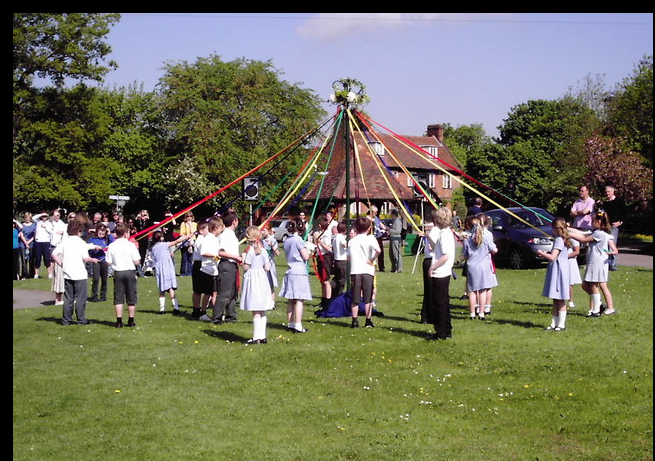
Start of Summer on the first day of May, the traditional English May Day rites and celebrations include crowning a May Queen and celebrations involving a maypole. Historically, Morris dancing has been linked to May Day celebrations. Much of this tradition derives from the pagan Anglo-Saxon customs held during “Þrimilci-mōnaþ”(the Old English name for the month of May meaning Month of Three Milkings) along with many Celtic traditions. May Day has been a traditional day of festivities throughout the centuries, most associated with towns and villages celebrating springtime fertility (of the soil, livestock, and people) and revelry with village fetes and community gatherings. Seeding has been completed by this date and it was convenient to give farm labourers a day off. Perhaps the most significant of the traditions is the maypole, around which traditional dancers circle with ribbons. The spring bank holiday on the first Monday in May was created in 1978; May 1 itself is not a public holiday in England (unless it falls on a Monday).
Jack in the Green, also known as Jack o’ the Green, is an English folk custom associated with the celebration of May Day. It involves a pyramidal or conical wicker or wooden framework that is decorated with foliage being worn by a person as part of a procession, often accompanied by musicians. Jack in the Green emerged within the context of English May Day processions, with the folklorist Roy Judge noting that these celebrations were not “a set, immutable pattern, but rather a fluid, moving process, which combined different elements at various times”. Judge thought it unlikely that the Jack in the Green itself existed much before 1770, due to an absence of either the name or the structure itself in any of the written accounts of visual depictions of English May Day processions from before that year.
The Jack in the Green developed out of a tradition that was first recorded in the seventeenth century, which involved milkmaids decorating themselves for May Day. In his diary, Samuel Pepys recorded observing a London May Day parade in 1667 in which milk-maids had “garlands upon their pails” and were dancing behind a fiddler. A 1698 account described milk-maids carrying not a decorated milk-pail, but a silver plate on which they had formed a pyramid-shape of objects, decorated with ribbons and flowers, and carried atop their head. The milk-maids were accompanied by musicians playing either fiddle or bag-pipe, and went door to door, dancing for the residents, who gave them payment of some form. In 1719, an account in The Tatler described a milk-maid “dancing before my door with the plate of half her customers on her head”, while a 1712 account in The Spectator referred to “the ruddy Milk-Maid exerting herself in a most sprightly style under a Pyramid of Silver Tankards”. These and other sources indicate that this tradition was well-established by the eighteenth century.
Revivals of the custom have occurred in various parts of England; Jacks in the Green have been seen in Bristol, Oxford and Knutsford, among other places. Jacks also appear at May Fairs in North America. In Deptford the Fowler’s Troop and Blackheath Morris have been parading the tallest and heaviest modern Jack for many decades, either in Greenwich, Bermondsey and the Borough or at Deptford itself.

19 May (or thereabouts) – Queen Charlotte’s Ball was conducted in celebration of the Queen’s birthday on May 19. The Queen Charlotte’s Ball is an annual British debutante ball. The ball was founded in 1780 by George III as a birthday celebration in honour of his wife, Charlotte of Mecklenburg-Strelitz, for whom the ball is named. The Queen Charlotte’s Ball originally served as a fundraiser for the Queen Charlotte’s and Chelsea Hospital. The annual ball continued after Queen Charlotte’s death in 1818, but was criticised by the British royal family in the 1950s and 1960s and folded in 1976.

29 May – Also known as Restoration Day, Oak Apple Day or Royal Oak Day, was an English public holiday, observed annually on 29 May, to commemorate the restoration of the English monarchy in May 1660.[48] In some parts of the country the day is still celebrated. In 1660, Parliament passed into law “An Act for a Perpetual Anniversary Thanksgiving on the Nine and Twentieth Day of May”, declaring 29 May a public holiday “for keeping of a perpetual Anniversary, for a Day of Thanksgiving to God, for the great Blessing and Mercy he hath been graciously pleased to vouchsafe to the People of these Kingdoms, after their manifold and grievous Sufferings, in the Restoration of his Majesty…” The public holiday was formally abolished in the Anniversary Days Observance Act 1859, however, events still take place at Upton-upon-Severn in Worcestershire, Marsh Gibbon in Buckinghamshire, Great Wishford in Wiltshire (when villagers gather wood in Grovely Wood), and Membury in Devon. The day is generally marked by re-enactment activities at Moseley Old Hall, West Midlands, one of the houses where Charles II hid in 1651. Celebrations include marching at Fownhope in Herefordshire holding flower and oak leaf decorated sticks. At All Saints’ Church, Northampton, a statue of Charles II is garlanded with oak leaves at noon every Oak Apple Day, followed by a celebration of the Holy Communion according to the Book of Common Prayer.
4 June – King George III’s birthday
23/24 June – Midsummer Eve/Saint John’s Eve – The name ‘midsummer’ is attested in Old English as midsumor, and refers to the time around the summer solstice. Astronomically, the solstice falls on 20, 21 or 22 June, but traditionally, in northern Europe, the solstice and midsummer was reckoned as the night of 23–24 June, with summer beginning on May Day. In England, the earliest reference to this custom occurs in the 13th century AD, in the Liber Memorandum of the parish church at Barnwell in the Nene Valley, which stated that parish youth would gather on the day to light fires, sing songs and play games. A Christian monk of Lilleshall Abbey, in the same century, wrote: In the worship of St John, men waken at even, and maken three manner of fires: one is clean bones and no wood, and is called a bonfire; another is of clean wood and no bones, and is called a wakefire, for men sitteth and wake by it; the third is made of bones and wood, and is called St John’s Fire.
June – Each June, Appleton Thorn hosts the ceremony of “Bawming the Thorn”. The current form of the ceremony dates from the 19th century, when it was part of the village’s “walking day”. It involved children from Appleton Thorn Primary School walking through the village and holding sports and games at the school. Bawming means “decorating” – during the ceremony the thorn tree is decorated with ribbons and garlands. According to legend, the hawthorn at Appleton Thorn grew from a cutting of the Holy Thorn at Glastonbury, which was itself said to have sprung from the staff of Joseph of Arimathea, the man who arranged for Jesus’s burial after the crucifixion.

12 August – The Prince of Wales’ birthday (later known as King George IV)
Mid August – Lammas, also known as Loaf Mass Day, is a Christian festival in the liturgical calendar to mark the blessing of the First Fruits of harvest, with a loaf of bread being brought to the church for this purpose. Lammas is celebrated on 1 August, annually.] The name originates from the word “loaf” in reference to bread and “Mass” in reference to the Christian liturgy in which Holy Communion is celebrated. It marks the annual wheat harvest, and is the first harvest festival of the year. On this day it is customary to bring to church a loaf made from the new crop. The loaf is blessed, and in Anglo-Saxon England, lammas bread was broken into four bits, which were to be placed at the four corners of the barn, to protect the garnered grain. Christians also have church processions to bakeries, where those working therein are blessed by Christian clergy. The term Lammas “is a contraction of the ninth-century Anglo-Saxon expression Hláf mæsse, “from the hallowed bread [hláf—hence “loaf”] which is hallowed on Lammas Day”] According to Wilson (2011), “at Lammas, the fruits of the first cereal harvest were baked and used as an offering to make the grain storage barn safe”.
22/23 September – Harvest Festival ~ Thanks have been given for successful harvests since pagan times. Harvest festival is traditionally held on the Sunday near or of the Harvest Moon. This is the full Moon that occurs closest to the autumn equinox (22 or 23 September). The celebrations on this day usually include singing hymns, praying, and decorating churches with baskets of fruit and food in the festival known as Harvest Festival.
29 September – Michaelmas was the beginning of school and law court terms.
October 31 – Allhallowtide is celebrated. The festival begins on 31 October. The term Halloween is derived from the phrase All Hallows Even which refers to the eve of the Christian festival of All Saint’s held on 1 November. It begins the season of Allhallowtide, the time in the liturgical year dedicated to remembering the dead, including saints (hallows), martyrs, and all the faithful departed.
October 31 – The practice of Souling originates in the medieval era of Christian Europe, in which soul cakes are given out to soulers (mainly consisting of children and the poor) who go from door to door during the days of Allhallowtide singing and saying prayers “for the souls of the givers and their friends”. The customs associated with Souling during Allhallowtide include or included consuming and/or distributing soul cakes, singing, carrying lanterns, dressing in disguise, bonfires, playing divination games, carrying a horse’s head and performing plays. Souling is still practised in Cheshire and Sheffield. In England, historically Halloween was associated with Souling which is a Christian practice carried out during Allhallowtide and Christmastide.

5 November – Guy Fawkes Day or Bonfire Night – Guy Fawkes Night, also known as Guy Fawkes Day, Bonfire Night and Firework Night, is an annual commemoration observed on 5 November, primarily in the United Kingdom. Its history begins with the events of 5 November 1605, when Guy Fawkes, a member of the Gunpowder Plot, was arrested while guarding explosives the plotters had placed beneath the House of Lords. Celebrating the fact that King James I had survived the attempt on his life, people lit bonfires around London; and months later, the introduction of the Observance of 5th November Act enforced an annual public day of thanksgiving for the plot’s failure.
23 November – St Clement’s Day – St Clement’s Day is celebrated on 23 November. Modern observances include a gathering of blacksmiths at the National Trust’s Finch Foundry in Sticklepath “where they practise their art and celebrate their patron saint, St Clement.” Historically, the festival was celebrated in many parts of England and involved the playing of divination games with apples. The festival was known as Bite-Apple night in places such as Wednesbury (Sandwell) and Bilston (Wolverhampton) when people went “Clementing” in a similar manner to Souling.
25 December to 5 January – the Twelve Days of Christmas or Christmastide
25 December – Christmas – Christmas is an annual commemorating the birth of Jesus Christ, observed on 25 December. A feast central to the Christian liturgical year, it is preceded by the season of Advent or the Nativity Fast and initiates the season of Christmastide, which historically in England lasts twelve days and culminates on Twelfth Night.
December 31 – New Year’s Eve or First Footing – According to Whistler (Whistler, Laurence (5 October 2015). The English Festivals. Dean Street Press. ISBN 9781910570494 – via Google Books), during the 18th century, first footing was not known in the South of England. Instead, “glasses were raised at quarter to twelve to “the Old Friend-Farewell!Farewell!Farewell!” and then at midnight to “the New Infant” with three ‘ Hip, hip horrahs!'”. Other customs included dancing in the New Year. In the North of England, first footing has been traditionally observed involving opening the door to a stranger at midnight. The guest is seen as a bringer of good fortune for the coming year.
Also, during the years of the war, especially, the government would announce certain days as fast or thanksgiving days when people were to go to church to either mourn or rejoice.
~~~~~~~~~~~~~~~~~~~~~~~~~~~~~~~~~~~~~~~~~~~~~~~~~~~~~~~~
HOLIDAYS kept at the Exchequer, Bank, East India and South Sea House. (1817)
January 1, 6, 18, 25, 30. July 25. February 2, 18, 19, 24. August 1, 12, 24.
March 1, 25. Sept. 2, 21, 22, 29.
April 4, 8, 23, 25. October 18, 25, 26, 28.
May 1,15, 17, 26, 27, 29. Nov. 1, 4, 5, 9, 30.
June 3, 4, 11, 24, 29. December 21, 25, 26, 27, 28.
‘Note. Besides the above, Feb. 14, March 1, July 15, Sept. 14, and Nov. 2, are kept at the Exchequer.
At the Custom House, Excise Office, and Stamp Office, Jan. 18, Good Friday, May 29, June 4, August 13, Sept. 22, Dec. 25, are the only Holidays kept.
~~~~~~~~~~~~~~~~~~~~~~~~~~~~~~~~~~~~~~~~~~~~~~~~~~~~~~~~~~~~
These were the dates for the 1817 Moveable feasts:
Septuagesima Sun. Feb. 2
Sexagesima Sunday, Feb. 9
Shrove Sunday……Feb.16
Lent begins ………Feb. 19 Ash Wednesday
Good Friday …….April 4
Easter Day ……. April 6
Rogation Sunday, May 11
Ascension Day…. May 15
Whit Sunday…… May 25
Trinity Sunday … June 1
Advent Sunday… Nov. 30
~~~~~~~~~~~~~~~~~~~~~~~~~~~~~~~~~~~~~~~~~~~~~~~~~~~~~~~~~~~~~~~~~
Another writer some of you might know is Shannon Donnelly. She has in the past recommend getting a copy of a Book of Days for your research shelf—it’s a very useful source, It is also quite expensive coming in at $135 for a copy, but I thought I would mention it here. I can attest that it does give far more details than raw dates. But one must know which raw dates to look up for religious days, Quarter Days and Lady Day, etc. More than fifty dates are listed in different places as days where various offices were closed. It is not always easy to tell which date is celebrated as a royal birthday, for instance. I guess what I am saying is the book is useful, but one must have a “working knowledge” of the typical dates/celebrations/tax days, etc., common to the period.
The Book of Days does not explain all the dates named as holidays in 1819.
That being said, please check out Ms. Donnelly’s post on Regency Holiday Traditions. It gives more than a list of dates, including some insights into the celebrations themselves, food served, etc. Well worth the read.
NOTE: Many of the descriptions for the holidays were served via Wikipedia.


 Every Woman Dreams...
Thank you for the mention, and good news—Chambers’ Book of Days is online (and searchable) at https://www.thebookofdays.com/
A help to all of us who write about the past.
Thank you for the link. I keep a long list of items I might need. I am adding this information to the list. Happy holidays!