
Frederick William Herschel was a German born astronomer and composer, residing in England during the late 1750s. He was nineteen when he came to live in England. In 1774, Herschel constructed the first of his large telescopes.
On 13 March 1781, while making observations he saw something “unusual” in the constellation of Gemini, Herschel noticed an object appearing as a disk. Initially, he thought it might be a comet or some sort of stellar disc. He reported his find to the Astronomer Royal, one Nevil Maskelyne, while he continued to make additional observations of the object. Afterwards, Anders Lexell, a Russian Academician, computed the orbit and determined it was likely planetary.
Herschel’s find was the planet Uranus. His find was the first planet to be discovered and confirmed by other astronomers since antiquity, meaning the ancient past and before the Middle Ages. Herschel became famous immediately, and King George III appointed him Court Astronomer. He was elected a Fellow of the Royal Society and was presented with funds to construct new and better telescopes.
Initially, Herschel called the planet the “Georgian star,” in honor of King George III, but, needless to say, not all liked the name, especially the French, who called the discovery after Herschel. Eventually, all involved agreed to call the planet “Uranus.”
Herschel received the Copley Medal [The Copley Medal is the most prestigious award of the Royal Society, conferred “for sustained, outstanding achievements in any field of science”. It alternates between the physical sciences or mathematics and the biological sciences and was elected a Fellow of the Royal Society. ]
In 1782, he was appointed as the “King’s Astronomer,” not to be confused with the “Astronomer Royal.” [Astronomer royal is a senior post in the Royal Households of the United Kingdom. There are two officers, the senior being the astronomer royal dating from 22 June 1675; the junior is the astronomer royal for Scotland dating from 1834.The post was created by King Charles II in 1675, at the same time as he founded the Royal Observatory, Greenwich.]
From 1782 to 1802, and most intensively from 1783 to 1790, Herschel conducted systematic surveys in search of “deep-sky” or non-stellar objects with two 20-foot-focal-length (610 cm), 12-and-18.7-inch-aperture (30 and 47 cm) telescopes (in combination with his favoured 6-inch-aperture instrument). Excluding duplicated and “lost” entries, Herschel ultimately discovered over 2,400 objects defined by him as nebulae. [Barentine, John C. (2015). The Lost Constellations: A History of Obsolete, Extinct, or Forgotten Star Lore. Springer. p. 410.]
We now know that Uranus is one of coldest of the planets. It was named after the Greek God of the Sky. Uranus is the seventh planet from the Sun and is considered an ice giant because it is largely made up of water, ammonia, and methane in solid form. Like all the other planets, Uranus was likely formed in a massive, ancient cloud of gas, dust, and ice that collapsed into a spinning disc. The planet is often dubbed an ice giant, since at least 80% of its mass is a fluid mix of water, methane and ammonia ice. Unlike the other planets of the solar system, Uranus is tilted so far that it essentially orbits the sun on its side, with the axis of its spin nearly pointing at the star.

Herschel and his sister Caroline (also a noted astronomer) moved to Datchet, England, to continue his work as an astronomer and telescope maker. His reputation along those lines was well-known and he sold over completed reflector telescopes to British and Continental astronomers.
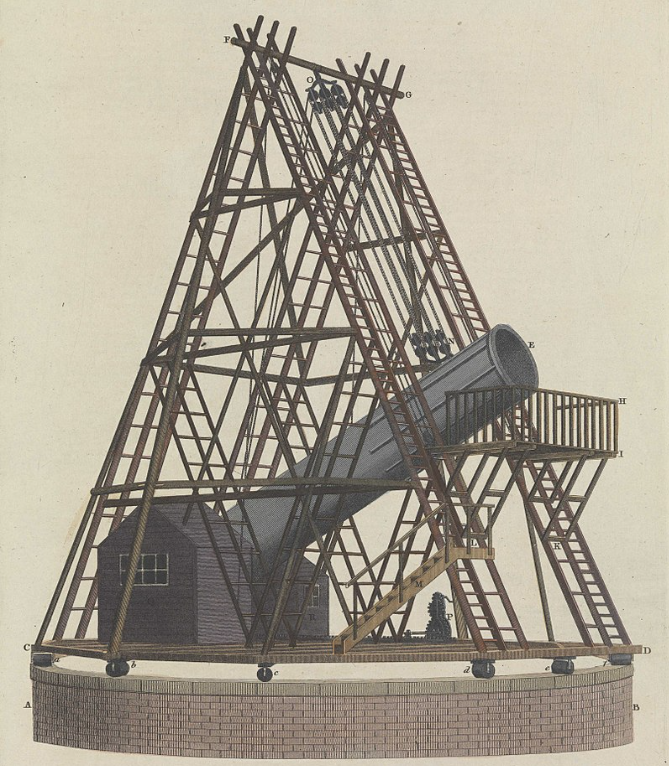
Herschel pioneered the use of astronomical spectrophotometry, using prisms and temperature measuring equipment to measure the wavelength distribution of stellar spectra. In the course of these investigations, Herschel discovered infrared radiation. [“Herschel discovers infrared light”. Cool Cosmos.] Other work included an improved determination of the rotation period of Mars, [“Mars in the Classroom”. Copus.] the discovery that the Martian polar caps vary seasonally, the discovery of Titania and Oberon (moons of Uranus) and Enceladus and Mimas (moons of Saturn). Herschel was made a Knight of the Royal Guelphic Order in 1816. He was the first President of the Royal Astronomical Society when it was founded in 1820. He died in August 1822, and his work was continued by his only son, John Herschel.
In addition to his scientific studies, Herschel was a well-known musician, playing both oboe and violin and following in the footsteps of his father. He was amazingly talented.
Herschel’s complete musical works were as follows:
- 18 symphonies for small orchestra (1760–1762)
- 6 symphonies for large orchestra (1762–1764)
- 12 concertos for oboe, violin and viola (1759–1764)
- 2 concertos for organ
- 6 sonatas for violin, cello and harpsichord (published 1769)
- 12 solos for violin and basso continuo (1763)
- 24 capriccios and 1 sonata for solo violin
- 1 andante for two basset horns, two oboes, two horns and two bassoons.
Various vocal works including a “Te Deum”, psalms, motets and sacred chants along with some catches.
Keyboard works for organ and harpsichord:
- 6 fugues for organ
- 24 sonatas for organ (10 now lost)
- 33 voluntaries and pieces for organ (incomplete)
- 24 pieces for organ (incomplete)
- 12 voluntaries (11 now lost)
- 12 sonatas for harpsichord (9 extant)
- 25 variations on an ascending scale
- 2 minuets for harpsichord


 Every Woman Dreams...