In the singular form the lexicon of a particular subject is all the terms associated with it. The lexicon of a person or group is all the words they commonly use. As a plural noun, a lexicon is an alphabetical list of the words in a language or the words associated with a particular subject. To distinguish lexicon from a dictionary, it is an alphabetical list of the words in a language or the words associated with a particular subject.
These examples are a mix of what one might hear upon the lips of the aristocracy, as well as examples of Cant used upon London’s streets and those terms used by farmers and like in the country.
crabbed – ill-tempered; difficult
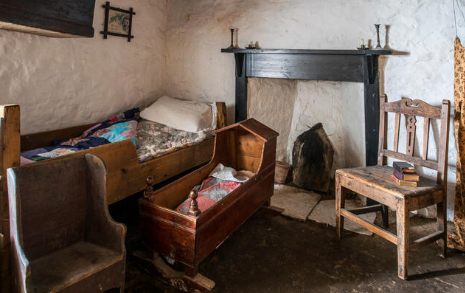
cradles – Cradles have been around for centuries. The ancient Britons wove cradles in the tree-tops for both children and old men (do we all now Hush-a-bye baby, on the three top; when the wind blows, the cradle will rock…?) It was the custom of weaving an infant’s cradle in the branches of a tree, out of harm’s way, to be rocked by wind power, that spawned the lullaby. The traditional wood for a cradle is birch the tree of inception, which the ancients believed drove away evil spirits.
The first time the future George IV received company, he was twelve days old and securely ensconced in a gold cradle surmounted with a gold coronet. He lay under a canopy of state, enveloped in crimson velvet and gold lace, in a nest of white satin. On either side stood ‘a fair mute, employed as occasion required, to rock the infant to sleep.’ The public were admitted in batches of forty. The daily bill for cake was 40 pound sterling, and for wine, ‘more than could have been conceived’.
crape – a black silk used for mourning clothes
cravat – a long fine cloth tied about a gentleman’s neck in a variety of “bows”
cribbage – Cribbage, or crib, is a card game, traditionally for two players, that involves playing and grouping cards in combinations which gain points. Cribbage has several distinctive features: the cribbage board used for score-keeping; the crib, box, or kitty (in parts of Canada and New England); two distinct scoring stages; and a unique scoring system, including points for groups of cards that total 15. It has been characterized as “Britain’s national card game.”
Both cribbage and its close relative costly colours are descended from the old English card game of noddy. Cribbage added the distinctive feature of a crib and changed the scoring system for points, whereas costly colours added more combinations but retained the original noddy scoring scheme.

cribbage-faced – marked with small pox, the pits bearing a resemblance to the holes in a cribbage board

cribbey or cribbey islands – blind alleys, courts, or bye-ways; perhaps from the houses built there being “cribbed” out of the common way or passage
criminal conversation – adultery, especially as formerly constituting grounds for the recovery of legal damages by a husband from his adulterous wife’s partner.
crim con money – damages directed by a jury to be paid to the convicted adulterer to the injured husband, for the criminal conversation with his wife
cripple – sixpence, that piece being commonly much bent and distorted
crony – an intimate companion or comrade
crop – a nickname for a Presbyterian, for they cropped their hair, trimmed close to a bowl dish placed on the head; latter they were called “roundheads” [The name “roundheads” was originally given to the supporters of the Parliament of England during the English Civil War. Also known as Parliamentarians, they fought against Charles I of England and his supporters, the Cavaliers or Royalists, who claimed rule by absolute monarchy and the divine right of kings. England’s many Puritans and Presbyterians were almost invariably Roundhead supporters, as were many smaller religious groups such as the Independents.]
crops and animals – (I am basically using Yorkshire for my example, but it would apply to most shires with the exception of cold versus warmer climates) In the 1800s, Yorkshire produced corn, cattle, deer, sheep, goats, very fine horses, river and sea fish, game, fowls, copper, brass, lead, iron, coal, wood, liquorice, rape-seed, freestone, limestone, jet, alum, black amber, marble, coppers and kelp, with the “manufactur of woollen”, alum, coppers, malt, fine ale, pins, bone lace, stockings, cutlery wares and iron work which employed at least 40,000 people (the manufacturing).
For wheat, East Riding. Within this area – and in particular the area south of the Derwent river, East Riding produced far more grain products (including wheat) than could be consumed so it was a primary exporter of grains to London.
For Cattle – in addition to East Riding, North Riding where lean cattle were raised in the worst parts, but on the sides of the hills and in the valleys and plains it has rich pastures where large cattle were raised. Also the valleys in West Riding which was famous for its fine horses, where excellent cattle were also raised.
So for those who did not comprehend the reference correctly, the use of the word ‘corn’ in the opening paragraph was my way of describing generally the grains produced within the entire region known as Yorkshire. Please remember, in North America and Australia corn is often used for maize, but in England and Wales it can refer to wheat or barley, and in Scotland and Ireland to oats.
Dairy cows from the midlands (Staffordshire, Cheshire, Wiltshire, etc) through Buckinhamshire, Bedforshire, Berkshirem Middlesex and down to the southern counties – Somerset, Devonshire, Kent, Dorset). Also Suffolk, Sussex, Norfolk etc.
http://www.britannica.com/EBchecked/topic/700965/England/44523/Major-crops All that being said, it sounds in this article as if Yorkshire is too wet for wheat. It says the southern and eastern parts of England are better suited for wheat. So, I suppose I am saying, do your research.

cross writing – fill a page of writing normally and then turn it at a 90 degree angle and write between the open spaces; postage was very expensive
crowdy – oatmeal and walk or milk; much eaten in the north
crump – one who helps solicitors to affidavit men or false witnesses
crusty fellow – someone who is surly
cuckolding – perhaps the best known of these words, and it has many synonyms, including (but by no means restricted to) cornute, cornuto, hoddy-doddy, hoddypoll, horn, ram, and wittol (a man who is aware of his wife’s infidelity and acquiesces to it). What of a woman whose husband is unfaithful? For that our language appears to have but a single word, and an obscure one at that: cuckquean. Lady Caroline Lamb was married to William Lamb but carried on a very public affair with Lord Byron.
cull – an honest man; a “bob cull” is a good-natured fellow (Cant)
cur – a cur or curtailed dog; According to the forest laws, a man who had no right to the privilege of the chase was obliged to cut or law his dog. Among othere modes of disabling him from disturbing the game, one was by depriving him of his tail: a dog so cut was called a “cut” or “curtailed dog,” and by contraction a “cur.” Used figuratively, it meant a surly fellow.
curmudgeon – a covetous old fellow, supposedly derived from the French term cæur mechant
curry – to curry favor; to obtain the favour of a person by coaxing or servility
Curse of Scotland – the nine of diamonds; diamonds, it is said, imply royalty, being ornaments of the imperial crown, and every 9th king of Scotland was considered for many ages to be a tyrant and the “curse of Scotland.”
Others say the phrase is from it similarity to the arms of Argyle. The Duke of Argyle was considered very instrumental in bringing about the union of England and Scotland, which, by some Scottish patriots’ estimation is detrimental to their country.
To cut – to renounce acquaintance with any one is to “cut him.” There are several species of the cut: the direct cut, the cut indirect, the cut sublime, the cut infernal, etc. To cut direct is to make a public display of avoiding someone, as in going a different direct when you see their approach or purposely turning one’s back on the person. The cut indirect is to look another way and pass him without observing him. The cut sublime is to admire the top of King’s College Chapel or the beauty of the passing clouds, etc., until the person is out of sight. The cut infernal is to analyze the arrangement of one’s shoe strings or boot polish for the same purpose.
Curricle – a two-wheeled carriage; pulled y two horses; could seat two people, who of
Other Sources:


 Every Woman Dreams...
.jpg)