In my latest novel, the heroine, Lady Cora Midland, is a bit of what we nowadays would call a “tomboy.” She likes to fish, is not afraid of using a knife to gut them or to shave a rough piece of wood, and bemoans the loss of her beloved father, who was a collector of pocket watches and snuff boxes, which her step-brother has claimed and refuses to share even a few with her. Earlier, I did a piece on snuff boxes of the day. Yet, what of pocket watches and John Elliott, both mentioned in the story?
Fob watches date back to the 15th Century, originally made in Germany. Fob pocket watches found their footing in the mid 1700s in England and were very popular by the late 1700s. Originally, they were made of gold and silver, but, eventually even the common man looked to carry one, those made of nickel and cheaper metals. Fob pockets watches became quite popular in the 19th Century. Women could even wear one as a necklace or attached to a belt about her waist. (The History of the Pocket Watch)
“Pocket watches have a long and fascinating history that traces their development for use by the upper classes to their eventual status as a compulsory tool for the working classes over the period of a few centuries. Pocket watches were first referred to in correspondence between craftsmen and members of the upper class in the fifteenth century, and it is believed that an early prototype of the pocket watch was worn in this era around the neck, rather than on a pocket watch chain, like an Albert T Bar chain. Historical figures such as the Duke of Modena, the Marchese di Manta and Meshur Sheyh Dede were all known to have used the first pocket watch designs.
“The famous German watch-maker, Peter Henlein, furthered the growth of the pocket watch when he took his spring-loaded design to England in the 1520”s, from which point the fad of the pocket watch truly took off. Manufacturers in Germany, Italy and England supplied the rest of Europe and eventually the designs began to appear in brass, gold and silver instead of the less desirable steel. The seventeenth and eighteenth centuries saw great innovation in the realm of watch-making. While pocket-watches had originally only had an hour-hand, new developments with the inner spring-workings allowed for a minute-hand to be introduced. The number of wheels within the watch mechanism was increased, thus decreasing the number of times the watch had to be wound up each day (previously it had to be wound twice). Another clever design feature was the use of jewels, generally rubies, for use as bearings within the watch; reducing the drag and wear on the mechanical parts and allowing for a smoother, more accurate time-piece. Oil was also used to maintain the regularity of watches and to stop the parts from freezing up.” (History of Pocket Watches)
A Regency gentleman might carry a watch in a pocket inside the waistband of his breeches/trousers. Sometimes a VERY fashionable man might wear two fobs kept tucked away in two welted pockets. Customarily the fob was engraved with a monogram or the family’s coat of arms. Accessories for the Regency Gentleman website tells us, ” The fob was either made entirely of metal (steel, gold, silver, pinchbeck, etc.) or with a carved gemstone as the seal. In some examples, the base swiveled to lie flat against the body when worn. Watches were usually open-faced as opposed to the flip-open cover of Victorian watches. They were wound with a separate key suspended from the ribbon alongside the fob. The very fashionable wore two fobs on matching ribbons, one from each fob pocket. Usually the very wealthy and conspicuously wealthy carried more than one watch. The second fob was usually attached to something else. I find that the remote entry widget for my car works well, and enables me to carry that modern accessory non-obviously.
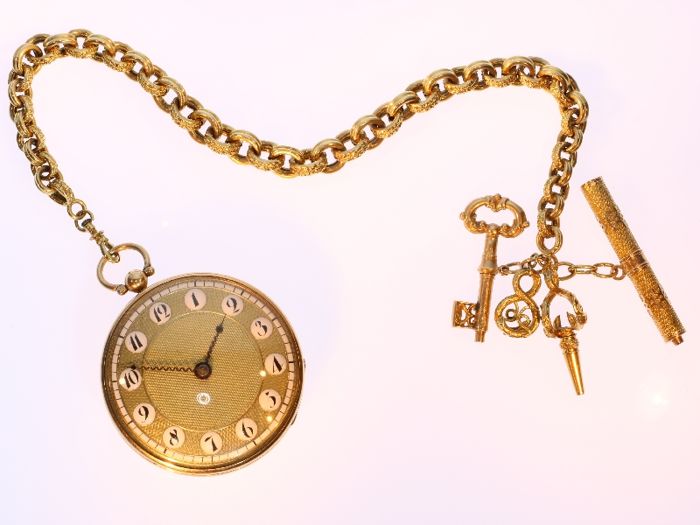
John Elliott & Son was listed as working between 1802-51. The Kentish Gazette in January 1803 records him as a Watchmaker, Silversmith, Stationer & Bookseller. He was trading from premises opposite the White Hart Inn, High Street, Ashford. The Old Watch Word tells us, “John Elliott seems to have managed to evade the Censuses from 1841 onwards. A John Elliott was apprenticed to James Roberts, watchmaker of Ashford, Kent on 17 April 1794 for 5 years from 1 January 1794. Loomes notes: Elliott John (& Son) Ashford 1802-51. Elliot(t) & Son of Ashford appears in a 1855 trade directory at High Street, Ashford. John was listed as a watchmaker, silversmith, stationer and bookseller, trading from premises opposite the White Hart Inn, High Street, Ashford. In a 1858 directory the listing is: Elliott, John and son, booksellers, stationers, printers, circulating library, jewellers, watch and clock manufacturers, agent to the Phoenix Fire Office, High Street, Ashford.”

BOOK BLURB…
LADY CORA TAKES SOCIETY BY STORM . . .
Lady Cora Midland, a highly-spirited country beauty, offers no pretensions, which win her many admirers, despite her lack of knowledge on how to manage the beau monde. However, Matthew Harrington believes she is taking advantage of his elderly grandmother, and he means to put a stop to the girl.
LORD MATTHEW LINDMORE IS IN DENIAL . . .
Lindmore reluctantly assists his grandmother in bringing Lady Cora out in Society. Yet, what appeared to be a daunting task becomes a transformation the earl does not expect. He finds the woman as delightful as do others in the haut ton. Yet… When Lady Cora is on the the verge of marrying another, Lindmore fears time will expire before he can speak his own proposal.

Loving Lord Lindmore is currently on PreOrder with a release date on February 21, 2024. Purchase links are below.
Kindle https://www.amazon.com/dp/B0CTFSRB7R?ref_=pe_93986420_775043100
Upon Release Available to Read on Kindle Unlimited
Amazon https://www.amazon.com/dp/B0CTLY847C?ref_=pe_93986420_774957520
To Enter the Giveaway, leave a comment below. Winners will be chosen the weekend of February 17, and prizes will be delivered on February 21, 2024, the book’s release date.


 Every Woman Dreams...
How much watches have changed over the years ~ Glory
Very true, Glory. There were once pieces of art.
I love this history of pocket watches! My grandfather had one. My husband’s grandfather worked for the railroad and gave my husband his pocket watch after our son was born.
Thanks for sharing, Glenda. I have a “railroad” one belonging to a distant uncle and another from my great-grandfather that he used when overseeing a school during the early 1900s.
Very Nice! My brother received my grandfather’s pocket watch. I admit to being a bit jealous over that.
Would love to get a free copy of your new book for an honest review on goodreads. I’ve thoroughly enjoyed all your novels and love the premise of this one!