To write “Mr. Darcy and the Designing Woman,” I had to learn the “technical” architectural terms for many architectural effects I enjoy viewing in historic houses and buildings. Two such terms are “trompe L’oeil,” and the other is “grisaille.”
Trompe-l’œil (French for ‘deceive the eye’) is an artistic term for the highly realistic optical illusion of three-dimensional space and objects on a two-dimensional surface. Trompe l’œil, which is most often associated with painting, tricks the viewer into perceiving painted objects or spaces as real. Forced [Forced perspective is a technique that employs optical illusion to make an object appear farther away, closer, larger or smaller than it actually is.] perspective is a related illusion in architecture. If you have ever seen one of those pictures of a person “supposedly” holding up the Leaning Tower of Pisa, then you have experienced “forced perspective.”
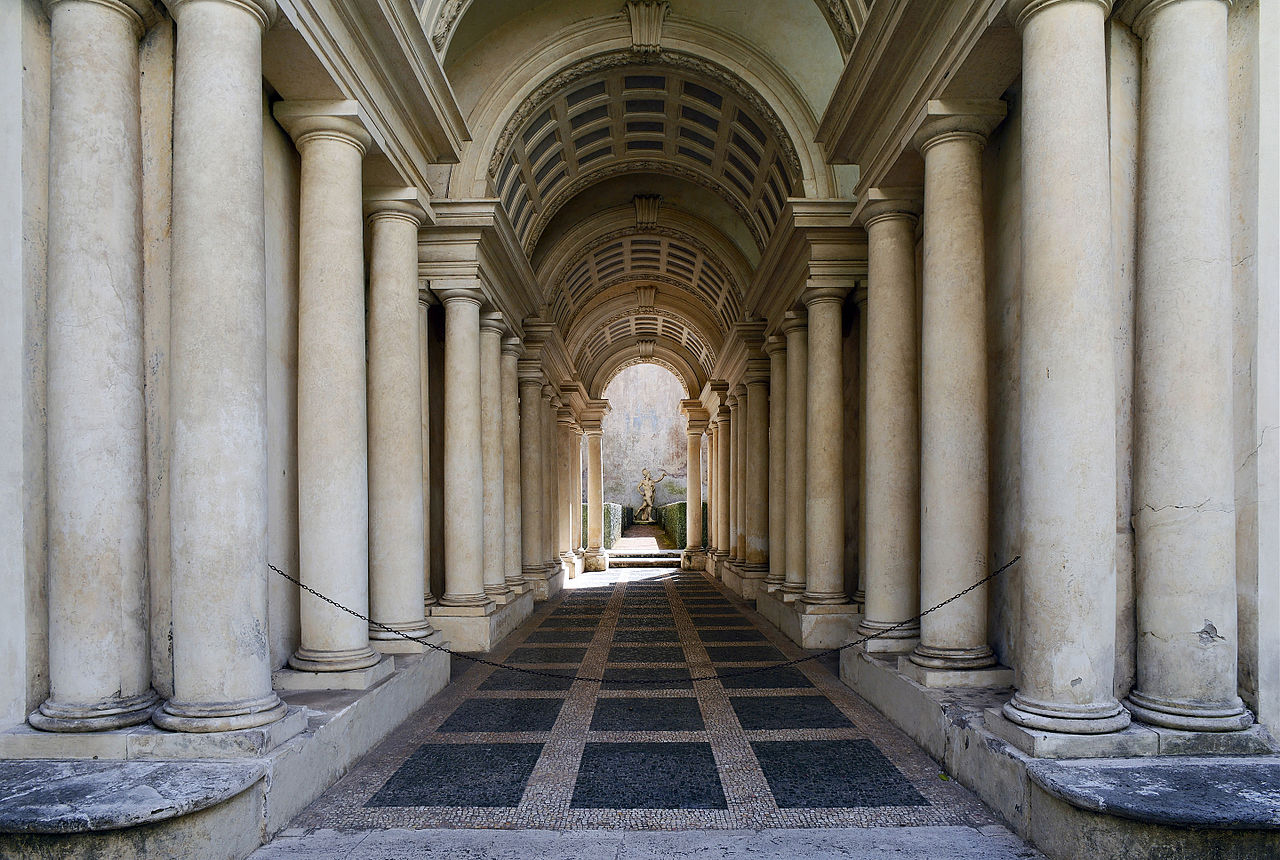
The John Canning Perfect Preservation website tells us, “The technique to develop seemingly three-dimensional objects with paint requires information from the room itself and skill from years of experience. The shadows simulated in the paint composition must mirror the real shadows in the room. The shadow itself must be unique to the object. For instance, colored glass transmits a shadow diffused with colors of the glass where as an opaque object will create grey shadows. This use of shadow, color, and light is called chiaroscuro. Proper perspective in the composition is required if the painted object is going to appear real. Shadows are composed of primary characteristics: the shape following the object; the most direct light source, and the closer the shadow to the object, the greater detail. The rules of perspective apply, meaning; the horizon line of the composition is most convincing at the eye level of the viewer. Trompe l’oeil often fails because the improper attention to dimensions and to the real shadows in the space. But knowing when to add in highlights and mid-tones in the illusionistic painting process is just as important as adding shadows. The most effective trompe l’oeil compositions are convincing from many perspectives in the space, not just at close distance or straight on.
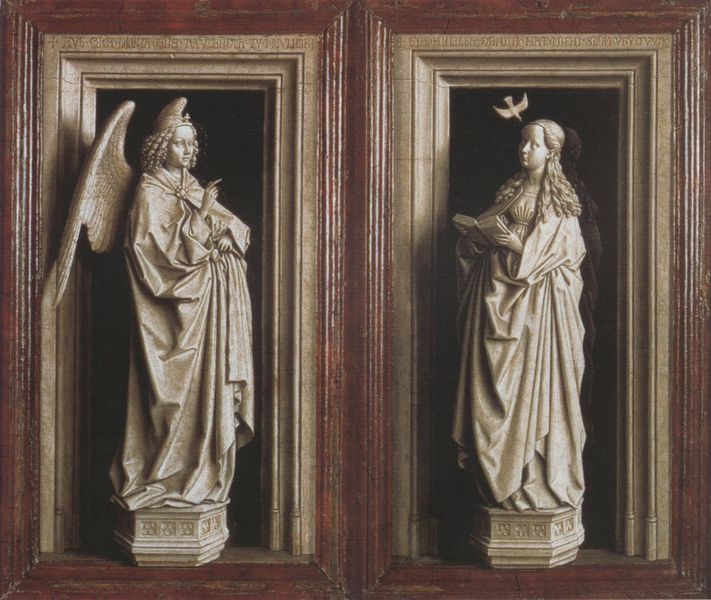
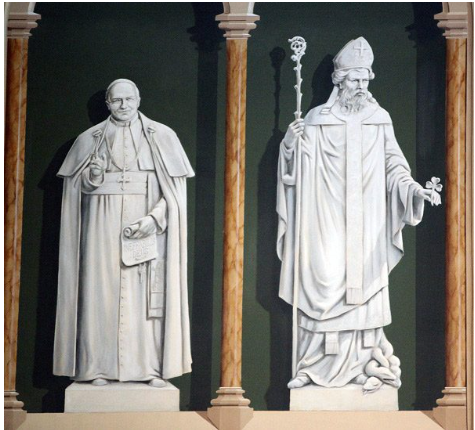
Widewalls goes on to tell us, “Originating from the French word “gris” meaning “gray”, the term grisaille stands for a monochrome painting or underpainting usually created in shades of gray or neutral grayish colors. These ash tone values can range from dark to light, transparent to opaque, flat to reflective, and sometimes from warm to cool. This method is commonly used in oil and acrylic painting.”
“Grisaille has two primary uses. When properly master, the technique might be used to imitate sculpture and architectural details making it the most complex form of trompe l’oeil. Grisaille may also be used during the preparation and planning stages of a mural. To create a three-dimensional illusion, very much the same as trompe l’oeil, light and shade are painted into the composition utilizing different shades of grey. The shadows of a real object in the same place must be thoroughly studied in order to properly convey truth in the shadows. When grisaille is intended as trompe l’oeil, the simulated form is usually that of an architectural element.” [John Canning Perfect Preservation]

Book Blurb:
“You do not know your place!” Elizabeth Bennet had heard those words time and time again from every man she encountered, with the exception of Mr. Thomas Bennet. Her dear father encouraged her unusual education, especially her love of architecture.
Fitzwilliam Darcy finally could name the day his beloved Pemberley would know its renewal. For five years, he had denied himself the pleasures afforded the landed gentry in order to view Pemberley House rebuilt after a questionable fire had left it in ashes. He would now choose a wife as the next mistress of Pemberley and raise a family.
When Darcy hires Elizabeth’s relation as his architect, they are thrown together in unexpected ways. He requires a proper Georgian manor to win the hand of an equally proper wife, but Elizabeth is determined only the house she has designed will do. The house of her heart for the man of her heart, even though she will never spend a day within.
Excerpt from the latter part of the book where Elizabeth and Darcy discuss these techniques:
The following day, they gathered with Jacob Ericks and Mr. Campbell around the supper room table in the dower house so they might spread out Ericks’s original drawings, as well as Elizabeth’s larger version of her sketch in order to mull over what was and was not possible. “We all are still in agreement to keep the ground floor rusticated, while the upper floors are of smooth dressed stone?” Ericks asked.
Darcy nearly laughed when all three men looked to Elizabeth to lead. It was quite ironic considering how Ericks initially set Elizabeth’s ideas aside. Last evening, in preparation for an argument, Darcy had had an honest talk with his wife, suggesting she would be called upon to know compromise on some points of her house’s design. “Any successful negotiation requires a person to stand firm on essential points, but be more adaptable on others.”
“It would be frivolous of us to choose a different stone at this point,” Darcy declared. “Do you not agree, my dear?”
“I adore the possibility of the grey bricks,” Elizabeth announced. Both Ericks and Campbell breathed easier. She pointed to the central and most imposing block on her drawing and then to Ericks’s plan. “The central corps de logis will be the center of entertaining. Mr. Darcy has said the formal supper room and ballroom will ‘lead’ into this wing.” She traced the lines on the paper. “Could not either the supper room or the ball room extend into this wing? Because of lighting issues, there will be no interior guest rooms. Does this not become wasted space? From what I can perceive by studying this diagram is some space is not designated. Storage? Large sitting for each guest quarters? To me, a larger sleeping quarters and storage for a lady’s gowns and so forth is more important than sitting rooms. Will not guests spend the majority of their spare time with their hosts or others of their party? Mark my words, Jacob, within a dozen or so years, women will again be wearing larger skirts. Women’s fashions, like that of gentlemen, runs in cycles.”
Darcy watched as Ericks and Campbell exchanged skeptical looks, but Darcy lightened the mood by saying, “I may again accept laces on my sleeves, but never again will I wear a powered wig.” He looked to Ericks. “Is Mrs. Darcy’s suggestion not feasible?”
“Absolutely, I can make the necessary adjustments. Doing so means only the large rooms, meaning the drawing rooms or suites with a sitting room, will have more than one hearth.”
“Thank you, Jacob,” Elizabeth said. “I am fully aware you cannot divide a room with two hearths into three rooms without creating a useless space, but it seems foolish to have a three-storey open space in this wing. Even with the hallways for the guest rooms, there is more than enough space for a ballroom. Perhaps a portrait gallery on the third floor and a games room for Mr. Darcy and, later, the children.” She reached for his hand, and Darcy accepted it in solidarity.
“Neoclassical, do you not think, Mrs. Darcy?” he asked.
“The entrance and the accents throughout the house, but not everywhere,” Elizabeth agreed with a happy smile.
“I knew you would bring Robert Adam into your design,” Ericks said with a matching grin. “What think you of niches in the wall of the grand hall or the entranceway to house the statues?”
“With grisaille panels,” his wife said, “where the simulated form is part of the architectural element. Capture the shadows and the light to imitate the sculpture. A complex form of trompe l’oeil. We could also include a mural sometime in the future and use the technique there also.”
“None of my men can create what you describe,” Campbell admitted. “I must see whether such an artist can be located in the area. It would be unique and breath-taking, ma’am, if it can be done.”
A moment of respect passed between Campbell and Elizabeth, before Darcy asked, “Can we keep the marble floor already in the main hall?” Darcy asked. “It is marked by generations of Darcys. I wish some traditions to remain intact. Mine and Elizabeth’s names will complete the first circle of the hall, and our children’s names and their mates will begin the second row.”
Tears rushed to Elizabeth’s eyes. “How wonderful,” she murmured as a few tears trickled down her cheeks. “If someone means to destroy the Darcy tradition, they must come through me. You are on notice, Mr. Campbell.”
“I understand, Mrs. Darcy. When Mrs. Campbell permits others to view her tears, I know not to cross or disappoint her. I imagine you are much of the same nature.”
Ericks suggested. “Instead of four, we will require at least six, perhaps eight, columns for support.”
“You have our permission to make the necessary adjustments,” Darcy guaranteed Mr. Ericks. “Elizabeth and I have agreed we would keep the former majesty of Pemberley, while softening the stark lines to demonstrate that the house is not only the manor of a grand estate, but also the ‘home’ of the Darcy family.”
Ericks smiled. “I owe you a great debt, sir. I expected our Elizabeth and I would require fisticuffs to settle our differences.”
Darcy jovially slapped Ericks on the back. “I have the advantage of being the lady’s husband, but she did demand that I remind you if you had previously agreed to consider her suggestions, mind you, with an open mind, rather than to assume a woman had no place in architecture, we might now be anticipating the end of Pemberley’s repairs, rather than restarting the project.” He grinned at Elizabeth. “Did I say it correctly, my dear?”
His wife playfully shook her finger at both him and Ericks. “You forgot to mention my brilliance, sir.”
“Duly noted, Mrs. Darcy.” He looked at Ericks’s plans. “Now that we have begun so well, we should settle other matters so you might draw up new plans.” He consulted Elizabeth, “I pray you do not object to the two sets of steps leading to the front door, my dear? I am one who believes in a balance of form.”
She frowned, “I suppose as Lord and Lady Parrish approved of the dual stairs,” she said with a lift of her brows, “I must agree. After all, the aristocracy possesses a refined taste we in the gentry do not.” One evening recently, Darcy had described the house party and his misery.
“It also had Lady Ester’s approval,” he teased before his wife pinched the back of his hand. To Ericks and Campbell, he said, “My favorite fishwife agrees. A large recessed arch over the entrance door to keep out the weather. Perhaps some sort of garland or a Latin phrase carved over the door.”
“Would you like to provide the quote?” Ericks asked.
“I must think upon it,” Darcy said.
“Something you learned at university which impressed you,” his wife suggested.
“What makes you think anything at university impressed me?” Darcy challenged. He could not say why he felt so lighthearted, but he suspected the woman beside him had something to do with it. He now understood why his father was a much easier man with which to live when Lady Anne was still alive.
“I was not there,” his wife countered, “but I know you to be a learned man, Mr. Darcy.”
“Really?” he asked. “How so?
“You were intelligent enough to realize how important I could be to your existence,” she answered smartly.
Both Campbell and Ericks broke into laughter. “Walked into that one, Darcy,” Ericks said. “You must recall you married a woman who adores verbal swordplay.”
Elizabeth handed her original sketch to Jacob. “Such is enough for today. Either Mr. Darcy or I will be available when you reach a point where our input is required. We are calling on the tenants and such, and I am hiring several seamstresses to create drapes and bed clothing and the like. When you are finished, we wish to be prepared to occupy the house.”
Purchase Links:
Kindle https://www.amazon.com/dp/B0CL2RKQK5
Available to Read on Kindle Unlimited
Amazon https://www.amazon.com/dp/B0CLKM4RV7
Giveaway! Comment below to be a part of the giveaway of TWO eBooks of Mr. Darcy and the Designing Woman. Winners will be contacted by email.


 Every Woman Dreams...

Glad you included the architectural terms you learned about in the excerpt. I was intrigued to learn how you put your research to use in the story. I took an architecture course in college but sadly don’t remember much from it, perhaps, this book will help jog my memory. Congrats on the release!
The research and learning new things is one of the delights of writing historicals.
Benifitting from your research and learning new things is also part of the delight of reading historicals.
So interesting! Thanks for the article and the chance to win a copy!
Love your books! Can’t wait to read this one!
I enjoyed writing this one, Nancy.