In researching something on another piece on William Blake, I came across a letter from Blake to Reverend John Trusler, who I will address in a moment. Yet, for those not familiar with William Blake (remember I spent many years of my life teaching British Literature so forgive me if I forget some people do not read poetry), William Blake was an English poet, painter, and printmaker, living from 1757 to 1827, part of the Georgian Era. His prophetic works were not very well read until the later part of the 1900s. His visual artistry is often proclaimed as coming from “the greatest artist Britain has ever produced.” Many of his contemporaries thought him mad, for he was more than a bit idiosyncratic. He was a committed Christian, but despised the Church of England and all forms of organized religion.


The Reverend John Trusler commissioned a pair of watercolors centered around the concept of “malevolence.” The artist hired was the poet William Blake. According to Write Science, “As a philosophical construct, we often regard concepts such as malevolence as being aspects of human behaviour that are part of our free will, not as natural phenomena that are able to exist independent of our free thinking. Does malevolence exist outside of humans, in Nature itself? Philosophers may differ, and certainly artists’ interpretations may vary widely. Perhaps not surprisingly, Trusler was not happy with the first painting he received. The two shared a contentious exchange in a pair of letters that month about Blake’s depiction. In a letter on August 23, Blake admonished Tusler that we all see the world differently, writing: “The tree which moves some to tears of joy is in the eyes of others only a green thing that stands in the way. Some see Nature all ridicule and deformity…and some scarce see Nature at all. But to the eyes of a man of Imagination, Nature is Imagination itself.” Blake’s exhortations to Trusler dance around an interesting and lovely conundrum — what is Nature and how do we separate what Nature is from what we perceieve or think of it?”
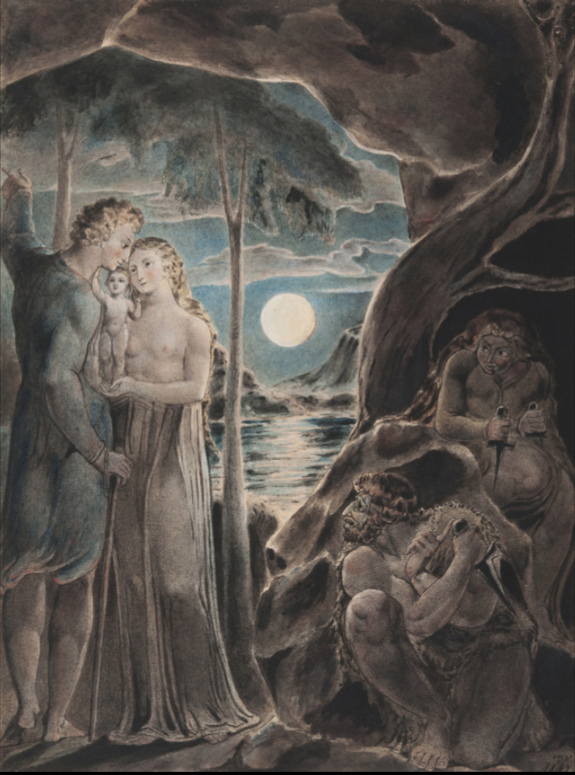
1799
William Blake (English, 1757–1827)
Blake himself described the subject of this watercolor in a letter of 16 August 1799, to the man who commissioned it, the Reverend Dr. John Trusler: “A Father, taking leave of his Wife & Child, Is watch’d by Two Fiends incarnate, with intention that when his back is turned they will murder the mother & her infant. If this is not Malevolence with a vengeance, I have never seen it on Earth.” Defending himself against Trusler’s criticism of an unnatural use of fantasy in the work, Blake stated that in this composition he was “compell’d by my Genius or Angel to follow where he led,” which was to an original and independent style. In the end Trusler rejected the watercolor, and Blake accused him of having “fall’n out with the Spiritual World” and of having an eye “perverted by caricature prints.”
This is the transcript of the letter I mentioned above. The letter sent me looking for more on Reverend Trusler, which I will discuss below:
Rev d Sir
I really am sorry that you are falln out with the Spiritual World Especially if I should have to answer for it I feel very sorry that your Ideas & Mine on Moral Painting differ so much as to have made you angry with my method of Study . If I am wrong I am wrong in good company . I had hoped your plan comprehended All Species ‘ of this Art & Especially that you would not reject that Species which gives Existence to Every other. namely Visions of Eternity You say that I want somebody to Elucidate my Ideas. But you ought to know that What is Grand is necefsarily obscure to Weak men. That which can be made Explicit to the Idiot is not worth my care. The wisest of the Ancients considered what is not too Explicit as the fittest for Instruction because it rouzes the faculties to act. I name Moses Solomon Esop Homer Plato
But as you have favord me with your remarks on my Design permit me in return to defend it against a mistaken one, which is . That I have supposed Malevolence without a Cause. – Is not Merit in one a Cause of Envy in another & Serenity & Happinefs & Beauty a Cause of Malevolence . But Want of Money & the Distrefs of A Thief can never be alledged as the Cause of his Thievery. for many honest people endure greater hard ships with Fortitude We must therefore seek the Cause elsewhere than in want of Money for that is the Misers pafsion not the ThiefsDear Cumberland
I ought long ago to have written to you to thank you for your kind recommendation to Dr Trusler which tho it has faild of Succefs is not the lefs to be remembered by me with Gratitude.
I have made him a Drawing in my best manner he has sent it back with a Letter full of Criticisms in which he says It accords not with his Intentions which are to Reject all Fancy from his Work . How far he expects to please I cannot tell . But as I cannot paint Dirty rags & old Shoes where I ought to place Naked Beauty or simple ornament. I despair of Ever pleasing one Clafs of Men. Unfortunately our authors of books are among this Clafs how soon we Shall have a change for the better I cannot Prophecy . Dr. Trusler says “Your Fancy from what I have seen of it . & I have seen variety at Mr Cumberland, seems to be in the other world or the World of Spirits . which accords not with my Intentions . which whilst living in This World Wish to follow the Nature of it” I could not help Smiling at the difference between the Doctrines of Dr Trusler & those of Christ .
Now, something of John Trusler. At age 10, Trusler was sent to Westminster School, but transferred to the seminary at Marylebone at age 15. He next attended Emmanuel College, Cambridge. He took orders in 1759. He was curate at a number of churches between 1759 and 1761, before being employed as assistant to Dr Bruce at Somerset House, where Bruce procured for him the chaplaincy to the Poultry Compter, a small prison at Poultry in Cheapside. The prison was used to house minor criminals and was finally closed in 1815. Trusler also held a lectureship in the city at this time.

Trusler was not satisfied with performing clerical work. In 1762, he established an academy for teaching oratory ‘mechanically,’ but, as it did not pay, he soon gave it up. To acquire a knowledge of physic he admitted himself a perpetual pupil of Drs Hunter and Fordyce. He then went to Leyden University to take the degree of M.D., but his name does not appear in the catalogue of graduates in that university. However, he either obtained or assumed the title of doctor, and he is frequently styled LL.D. He superintended for some time the Literary Society established in 1765 with the object of abolishing publishers.
In 1769, Trusler came up with another “scheme,” of sorts. He sent circulars to every parish in England and Ireland with a proposal to print in script type about 150 sermons at the price of one shilling each. This would save the clergy both study and the trouble of transcribing.
Trusler next established a printing and bookselling business, which proved quite lucrative. He not only resided in multiple housing in London, but, for a time, he lived at Bath and, later, on his own estate at Englefield Green, Middlesex. He published the first half of his autobiography, The Memoirs of the Life of the Revd. Dr. Trusler in 1806. Only part i. appeared, and, it is said, the author sought to suppress it.The remainder of the memoirs in Trusler’s autograph were in 1851 in the possession of James Crossley of Manchester. Trusler died in 1820 at the Villa House, Bathwick, Bath.

The Works of William Hogarth
Rev John Trusler
Published by J Sharpe, London & R Griffin, Glasgow, 1821 ~ A two volume set of The Works of William Hogarth, in very attractive contemporary green morocco binding. Containing one hundred and fifty-nine engraved plates by Messrs Cooke and Davenport. The work contains descriptions of “many beauties that have hitherto escaped notice with a comment on their moral tendency by the Rev. John Trusler”.
The Buzzy’s Bonnet Live Journal tells us something about Trusler efforts in commenting on The Works of William Hogarth, “This (meaning the comments by Trusler) was little more than an excuse to illustrate and discuss the licentiousness of the work. The book does contain the occasional moral lesson, but what is more obvious is the florid prose and vivid imagery. ‘Entered into the path of infamy, the next scene exhibits our young heroine the mistress of a rich Jew, attended by a black boy, and surrounded with the pompous parade of tasteless profusion. Her mind being now as depraved, as her person is decorated, she keeps up the spirit of her character by extravagance and inconstancy.’ … Trusler is not a preacher driven by his passionate faith to bring the true teachings of moral behavior to the people. He’s a silver-tongued huckster out for a buck, writing for the popular market.”


TRUSLER, John (1735-1820). Proverbs Exemplified, and Illustrated by Pictures from Real Life. Teaching Morality and a Knowledge of the World. John BEWICK (1760-1795), illustrator. London: 1 May 1790.


This last book, I will discuss in more detail when we meet again.


 Every Woman Dreams...
