In my first post of August, a reader asked about a means for a female to go about the estate to paint scenery, etc. In my response, among my suggestions, I mentioned the use of dog carts as a possibility for the story. Naturally, I should have considered my response. I, most assuredly, did not mean I condoned the use of dogs for transporting people about. I was simply speaking of the history of the era and the use of dog carts being an appropriate means for a young lady who had a fear of horses. See the previous post HERE.
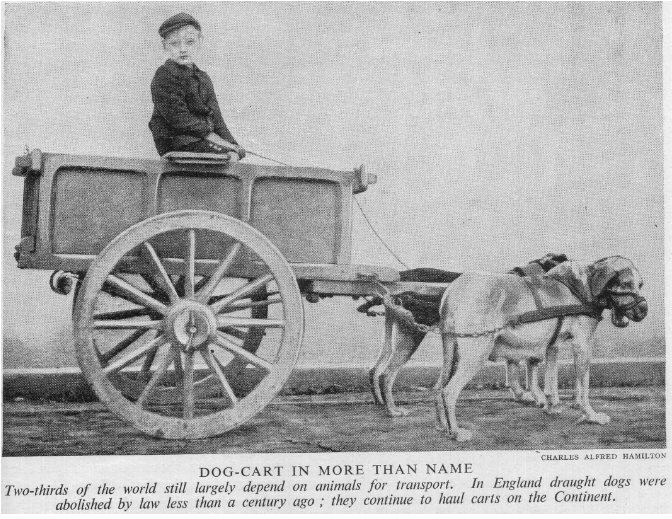
It was 1839 before dog carts were abolished in London, but such does not mean they were abolished everywhere in England and certainly not on the Continent.
The Metropolitan Police Act of 1839 ordered dog carts were not to be used within fifteen miles of Charing Cross:
“XXXIV. [Prohibition of Dog Carts.] And be it further enacted, That after the First Day of January next every Person who within the City of London and the Liberties thereof shall use any Dog for the Purpose of drawing or helping to draw any Cart, Carriage, Truck, or Barrow, shall be liable to a Penalty not more than Forty Shillings for the First Offence, and not more than Five Pounds for the Second or any following Offence.”
Now, some of you are likely praising this ordinance, but it was not completely based on the cruelty to the animals. Some dogs were expected to carry too heavy of a load. Obviously, it was cheaper to keep a dog in London that a horse or a pony. The problem was the weight of the load was not reduced.
In 1822, Parliament banned cruel treatment of horses and cattle.
1835 saw the Cruelty to Animals Act, banning animal-baiting and animal fighting styled bloodsports.
The banning of dog-carts had other motives beyond the cruelty to animals. The dog-carts often caused a traffic jam when horse-drawn carts/carriages were involved. The dogs nipped at the horses, etc. There was also the issue of rabies among the dogs. Over-worked dogs were thought to contract the disease easily. “According to the medical journal ‘The Lancet’ in 1841, there had been a decline in the number of cases of rabies in London since the act was passed: “Whether the police or the Dog-Cart Act have had anything to do with the decline of hydrophobia, we cannot say”. [Dogcarts and Lioncarts] – Note: You can find some of the “discussion” of this bill on this site.
One point of the discussion was if the license for a donkey was the same cost as one for dogs, then donkeys would quickly replace the dogs. The elimination of dog-carts would remove the employment of persons of small means to make a living. If size was the issue, they should also eliminate Shetland ponies from the street.
Other members of Parliament argued a dog was not meant to be a beast of draught.
Another argument stated by protecting the dogs in London they discriminated against the animals in the countryside. A man could move his business to one of the larger cities outside of London and not be restricted, where people in London would lose services as part of the ban.
Part of the argument included the dog’s feet and what they had to cross. The terrain was different. One member of Parliament argued that a dog’s feet are not designed to enable them to bear heavy weights.
“The dogcart nuisance was not only offensive to humanity, but was oftentimes productive of serious consequences. Only within the last few months the Lynn coach had been overturned by a dogcart, and much mischief was the result. He hoped, therefore, that the House would allow the bill to be proceeded with. An outright ban would also have been easier and cheaper to implement than rules and restrictions on the loading of dog-carts, the correct fitting of harness, the number of hours a dog could work before needing a rest and the provision of drinking facilities (in the same way that horse troughs were provided) etc. It was a case of using a legislative sledgehammer to crack a nut.”
Even with the London ban, the use of dogs to pull a variety of carts and products continued well into the 1900s in Europe.
There was a passage in one of Charles Dickens’s books—I think it was Barnaby Rudge, but I could not find it to quote it here, where the dog carts used to transport people were so heavy the paws of the dogs left bloody prints on the pavement. I read the story as a serial years ago when I was prepping to teach Advanced Placement Language courses.
Resources:


 Every Woman Dreams...
It’s interesting that both of us posted articles concerning dogs in the 19th Century and the horrible treatment that they suffered. Here is the link to my article which I posted in late July on New York City’s “war against dogs” – yes, that was a real thing: https://dinosaursandbarbarians.com/2023/07/22/new-york-citys-war-against-dogs-1811-1894/.
Great minds and all that, Jason. Thanks for sharing this. I learned something new today.