CARRIAGE CHOICES:
New Question from a Familiar Follower:
I have a character in the book I am writing who prefers to keep her distance from horses, but she enjoys painting and walking quite long distances to sketch outdoors. Her husband notices and arranges for her to have a vehicle at her disposal, so she would have more flexibility. Unfortunately for me, I am not assured what would be the best choice. I was thinking a dogcart since it would have nice cargo space and she wouldn’t need anything more to rattle around the countryside, but wouldn’t she drive it herself? I’d rather she had someone else doing the driving for her, perhaps, a groom, since she’s not a horse woman. But then, if she had a servant for a driver, they would not sit side by side on the same bench, would they? A carriage is too much. She needs only a relatively small and open vehicle for driving in good weather. What would be a plausible choice?
Perhaps, a phaeton might work. Those of us familiar with Jane Austen’s know a bit about phaetons for they are mentioned twice in Pride and Prejudice. First, we have the one for Miss de Bourgh and then the one mentioned in her letter from Mrs. Gardiner to Elizabeth upon learning of Mr. Darcy’s proposal.
“Miss de Bourgh’s phaeton was of the low-slung variety, especially as it is being pulled by ponies. It would have a lower center of gravity and be very safe and secure, and the ponies easy for a woman to control and unlikely to run away with the vehicle. Mrs. Gardiner seems to think a phaeton and ponies just the thing for a woman to drive, especially on sightseeing expeditions:
Pray forgive me if I have been very presuming, or at least do not punish me so far as to exclude me from P. I shall never be quite happy till I have been all round the park. A low phaeton, with a nice little pair of ponies, would be the very thing.” [Margaret Sullivan]

However, though a phaeton might work, if one is afeared of horses, one still has an issue.
Phaetons did not have a place for a servant to ride behind, and the likelihood of the mistress of a great house wishing to sit on the bench with a groom would be slim. I can view Elizabeth Bennet doing so, but not Miss Anne de Bourgh or Miss Caroline Bingley.
And any carriage can overturn, even one though to have great stability. One hits a rough enough bump (side of a deep ditch will do nicely) and boom the carriage can go over.
As to the horses, the act of overturning usually breaks the harness. If the harness does not break with the accident itself, it is possible the horses will pull the vehicle around and around, attempting to break free.
Overturning a carriage does not guarantee fatal–or even serious–injuries. Such depends on luck. It is possible to jump free of an open carriage such as a gig or curricle, or even a phaeton. Then it all depends, too, on what you hit when you land. Rocks and rock walls will not be your friend.
Finally, the buckboard brake you speak of comes from mid to late 1800’s–it’s not around in the Regency. In the Regency, there is no brake that you can set from the seat. (That’s invented in 1835.)
As noted by this account from the Sporting Magazine (English, circa 1820s), for heavier stages and coaches, one of the coachmen had to get out to set a “drag” that would slow the carriage when going down a hill:
“Some few years past I was travelling to Brighton, I think by the ” Alert,” at the time driven by a coachman named Pattenden. On pulling up at the extreme point of Reigate Hill, and being anxious to get the drag on, he did not do it securely. On starting rather brisk, whether it came in contact with a stone, or from what cause I know not, but it flew from the wheel it was placed on to the opposite one, and fixed as properly and securely as if placed by hand, in which manner we proceeded down the hill, in my opinion, a providential and singular circumstance, which perhaps, prevented a serious accident.“
Remember: all vehicles of the time period were custom made. Some curricles had a step on the back. Some had a seat on the back. If no tiger was up back, a box of scrap metal was placed there to adjust the balance so the curricle harness did not weigh too heavily on the horses.
Okay, back to the question at hand.
The fussy part of me would suggest, if she wants to travel around, I would suggest she have a landau and a driver. If her husband/father can afford the vehicle, he can likely afford a driver. It is really hard to deal with a horse (or pony) and do other things. Despite what every Western you ever viewed with a horse and carriage, horses do not “park” very easily. Her assigned driver would sit up front for this, and she could use the vehicle for visiting as well.
You could also use a gig, or sometimes called a whisky, which are nice small sporting type carts. Gig carts are constructed with the driver’s seat sitting higher than the level of the shafts. Traditionally, a gig is more formal than a village cart or a meadowbrook cart, and more comfortable, usually being sprung.A light gig can be used for carriage racing. The Oxford English Dictionary gives the date of first known reference to a horse-drawn gig as 1791, and they were ubiquitous by the early 1800s. [Gig]
Reference for More Information: Felton, W. (1796). A Treatise on Carriages: Comprehending Coaches, Chariots, Phaetons, Curricles, Gigs, Whiskies… Together with Their Proper Harness. In which the Fair Prices of Every Article are Accurately Stated (Vol. 2). Debrett.
She would have to sit next to her driver/groom, but these carriages often had a space under the seat where she could put her gear. Even the most plodding horse can spook or shy or generally cause problems, and if she wants to stop, she really does need someone to look after the horse and carriage while she’s painting. She might prefer the fold up top of the landau for more protection–even the nicest days in England can turn fast on a person. Rain is always predictable.
A pony cart might work. It would be less intimidating, the lady could have a young groom take her about – maybe like a child of 10 to 12 years, to stay with the pony, fetch the animal water, assist in carrying her things, etc. She could even teach the young man how to draw as one of the plot points. [Gee! I think I have already written a similar scene.] Her doing so could provide a good opportunity for characterization or to draw out some backstory, etc.
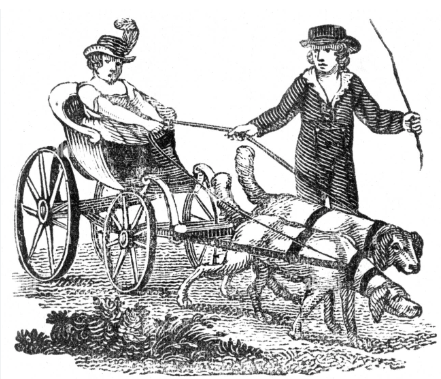
Naturally, she would not need to be a horse person to drive a dog cart. Someone could instruct her on how to tether the animal when she reaches the place she wants to paint.
Such is basically all she would need to know. There would be grooms to hick the horse or pony or dog(s) to the vehicle and to unhitch him when she returns.


 Every Woman Dreams...
Pingback: Use of Dog Carts in Regency England | Every Woman Dreams…