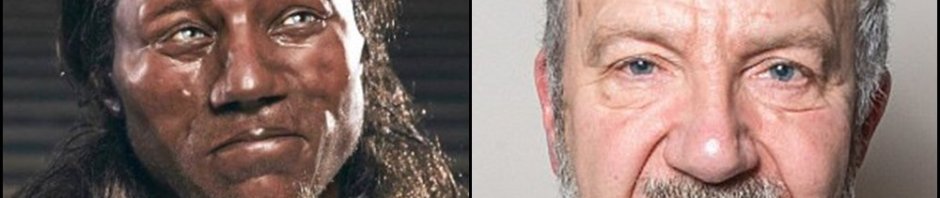
Okay, today, I am not talking about cheese, though the “gentleman” in question is associated with Cheddar, England, which is famous for its cheese. Cheddar is also famous for Cheddar Gorge and a line of limestone caves found there. Rather, Cheddar Man is a Mesolithic hunter-gatherer man with dark skin and blue eyes. In 1903, his Stone Age skeleton was discovered in one of the caves. At the time, improvements to drainage in Gough’s Cave was going on. Although originally thought to be older by 4 times his actual “dating,” it has been suggested through radiocarbon dating that he lived around 10,000 years ago. According to the National History Museum site, he was about 166 centimeters tall
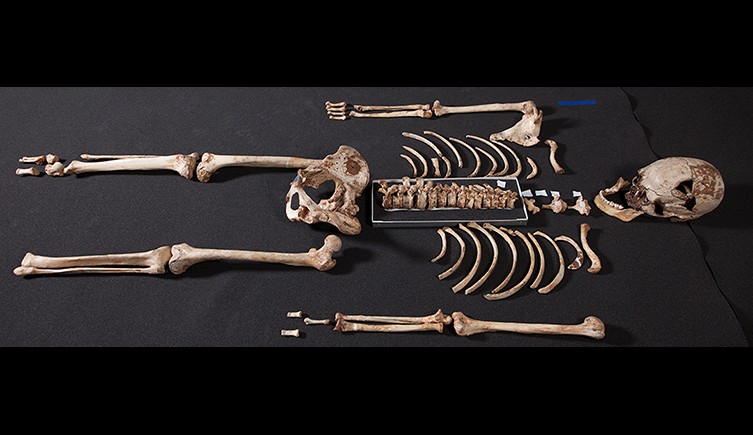
Cheddar Man – reassembled skeleton – two column thumb ~ https://www.nhm.ac.uk/discover/cheddar-man-mesolithic-britain-blue-eyed-boy.html ~ Reassembled skeleton of Cheddar Man. The skeleton is on loan to the Museum from the Longleat Estate.
The Natural History Museum also provides us these tidbits about the time Cheddar Man lived:
“His skeleton shows a narrow pelvis shape. It’s uncertain whether a hole in his forehead was from an infection or from damage at the time of excavation.
“Like all humans across Europe at the time, Cheddar Man was lactose intolerant and was unable to digest milk as an adult.
“At the time Cheddar Man was alive, Britain was attached to continental Europe and the landscape was becoming densely forested.
‘”Cheddar Man belonged to a group of people who were mainly hunter gatherers,’ … ‘They were hunting game as well as gathering seeds and nuts and living quite complex lives.’
“In addition to seeds and nuts, his diet would have consisted of red deer, aurochs (large wild cattle) along with some freshwater fish.”

The Archaeologist tells us, “Ancient DNA from Cheddar Man, a Mesolithic skeleton discovered in 1903 at Gough’s Cave in Cheddar Gorge, Somerset, has helped Museum scientists paint a portrait of one of the oldest modern humans in Britain. This discovery is consistent with a number of other Mesolithic human remains discovered throughout Europe. Cheddar Man is the oldest complete skeleton to be discovered in the UK, and has long been hailed as the first modern Briton who lived around 7,150 BC. He remains are kept by London’s Natural History Museum, in the Human Evolution gallery.
“Analysis of his nuclear DNA indicates that he was a typical member of the Western European hunter-gatherer population at the time, with lactose intolerance, probably with light-coloured eyes (most likely green but possibly blue or hazel), dark brown or black hair, and dark/dark-to-black skin, although an intermediate skin colour cannot be ruled out. There are a handful of genetic variants linked to reduced pigmentation, including some that are very widespread in European populations today. However, Cheddar Man had ‘ancestral’ versions of all these genes, strongly suggesting he would have had ‘dark to black’ skin tone.“
Even more interesting is the fact a teacher of history living in England was discovered to be one of his descendants. In 1977, Britain’s HTV network set about producing a documentary on the cave. The filmmakers got it in their heads to obtain a DNA sample from Cheddar Man’s bones and compare it to like samples of the children attending school in Cheddar. Great idea! But . . .
To prove the process of obtaining DNA was safe, history teacher Adrian Targett also provided a DNA sample. I do not have to tell most of you what occurred. None of the children were connected by DNA to Cheddar Man, but Mr. Targett was.

“‘I do feel a bit more multicultural now,’ he [Targett] laughs. ‘And I can definitely see that there is a family resemblance. That nose is similar to mine. And we have both got those blue eyes.’
“The initial scientific analysis in 1997, carried out for a TV series on archaeological findings in Somerset, revealed Mr Targett’s family line had persisted in the Cheddar Gorge area for around nine millennia, their genes being passed from mother to daughter through what is known as mitochondrial DNA which is inherited from the egg. To put it simply, Adrian Targett and Cheddar Man have a common maternal ancestor.
“It is only Cheddar Man’s skin colouring that marks the difference across this vast space of time. It was previously assumed that human skin tones lightened some 40,000 years ago as populations migrated north out of the harsh African sunlight where darker skin had a protective function.
“At less sunny latitudes, lighter skin would have conferred an evolutionary advantage because it absorbs more sunlight which is required to produce vitamin D, a nutrient vital for preventing disabling illnesses such as the bone disease rickets. Later, when farming crops began to replace hunter-gatherer lifestyles and communities ate less meat, offal and oily fish — a dietary source of vitamin D — paler skins would have conferred an even greater advantage and accelerated the spread of relevant genes.” [The Archaeologist]
How is that for a Family Tree? I am simply blown away to find ancestors back in the 1500s. What about you? Do you also have an interesting bit of ancestral history?


 Every Woman Dreams...
Interesting ancestral history? Hopefully one day I’ll uncover some!
There is a quote in the book, “Naked Statues, Fat Gladiators, and War Elephants,” by Garrett Ryan that took me by surprise when I first read it. It comes from a paragraph about tracing one’s ancestry. It reads, “The entire human family, in fact, is impressively inbred. Statistical models estimate that all humans share at least one common ancestor born sometime in the past 3,500 years. And genetic sampling indicates that any European alive a thousand years ago is now – if he or she left descendants – likely an ancestor of almost ‘every’ living European. If some branch of your family is rooted in the Mediterranean world, in short, you are all guaranteed to be a much-displaced cousin of any Greek or Roman.”