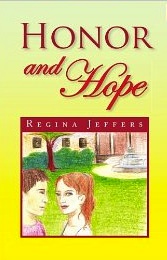
Honor and Hope, a Contemporary Romantica based on Jane Austen’s Pride and Prejudice

by Regina Jeffers

During March, we at AustenAuthors.net will be looking at Jane Austen’s influence on contemporary romance, as well as to look back at those who have written contemporary romances based on Austen’s tales. One of the key issues in the publishing business is that the author of a romance must have a strong, sympathetic believable character as the heroine. Elizabeth Bennet is the model for the romantic heroine. What we admire in Elizabeth is what we admire in most romance novels. She is a keen observer of human nature and society’s peculiarities, but she is also quite willing to own up to her own failings. All Elizabeth’s quirks and flaws add up to a heroine to which readers of any century can relate. Elizabeth’s quest to learn how to open herself up to romance when it comes along is the pattern we see repeated again and again in modern romances.

Austen is a thematic master. Of course, there is the biting humor and delving insights, but it is her development of theme that prevails. I call her thematic technique a “broccoli” because Austen expertly develops the plot by using strong story lines that branch out like a head of a broccoli. She builds gradation upon gradation of a single idea, which encases a central truism. There is a repetitive pattern that sucks the reader into the theme. One finds timbre and connections. Theme explains why Austen’s pieces work so well. There is a permanence of purpose.

Recently, I have pulled out my modern Pride and Prejudice novel and have given it a good once over. Honor and Hope is leaner; I removed some 20 pages from the original. I also revisited some of the scenes to make them read smoother. Honor and Hope is not a book I have ever publicly promoted because I knew it needed another look before I did anything with it. This book came about as a transition piece between Darcy’s Passions and its sequel Darcy’s Temptation (originally entitled Darcy’s Dreams). I had hit a wall with the sequel, not a “wall” of ideas, but a “wall” about the direction the piece would take. I had a vision for Darcy’s Temptation, but I questioned whether I had “forced” the story line. There was nothing to do but to abandon the book for a time. Therefore, I took up the writing of Honor and Hope.

First, I needed a setting upon which to base the book. For my birthday several friends had taken me to visit a North Carolina winery. I thought it would be the perfect setting for a story line. Next came the main characters. An Alpha male hero with an obsession for one particular woman and a strong, independent heroine developed. I started Honor and Hope, but I quickly realized I had broken the cardinal rule for romance novels–I brought the lovers together too quickly. As a former theatre teacher, I had related the old adage of boy gets girl, boy loses girl, boy gets girl as the romantic story line. So, I rewrote a major portion of the book, but it didn’t work for this couple. They desired each other completely and would risk anything to be together; I didn’t envision them as being the type to wait–to play the “teasing” games often found in contemporary romance.

A third time I reworked the piece. Originally, Will and Liz met by accident and quickly fell into a physically dependent relationship. Now, the task became creating a “history” for them. I changed the current physical relationship to one begun in college with an extended separation and then an accidental meeting where they discovered each other once more. Of course, I tossed in several “challenges” before they can know happiness.

Mountain State University is based on Western Carolina University. My son attended school there, and it has a beautiful campus. My son is a distance runner, and I love the pro football season. They were natural backdrops for Will and Liz’s relationship. I live in the Charlotte, North Carolina, area, giving me a basic knowledge of places involved in the story line. I’m originally from West Virginia; we often joke that it is part of our cultural heritage to vacation at Myrtle Beach. From Charlotte, the trip is less than three hours to Myrtle. Therefore, I added Myrtle Beach to the story line. I love the Resort at Glade Springs outside of Beckley, West Virginia; it became an integral part of the scenes of the book–a perfect romantic destination. Visits to England and to Tuscany complement the action; they are two of my “dream” itineraries.

Before I go further, I must extend my apologies to Jane Austen. I love her works more than any other literature. Miss Austen creates drama out of morality–her works are perfect. She knows how to describe a man because she doesn’t exploit her feminine daydreams. This book is loosely–VERY loosely–based on Pride and Prejudice. My second “apology” goes to the Jane Austen Society in Bath, England. I do know they celebrate their annual convention in September. However, for this book’s purposes, I moved it to the last part of February or early March. I also included my own convoluted “name game” to advance my story line.

This book is contemporary romantica–a couple hopelessly in love–and also sexually attracted to each other–a sexy romance focused on the relationship between Will and Liz. I write scenes–connected scenes–such as one finds in a play or a movie. My theatre background makes me prefer telling the story through dialogue rather than description. The “scenes” play in my head; I see the hero and heroine acting out the events. My dialogue is used to create the connection between the characters–the intimate relationship between a man and a woman.

Will and Liz must resolve their own character flaws and their “secrets” before making a permanent commitment. The plot isn’t simply their love affair. The events are obvious in some places and surprising in others. I use backward plotting in designing the story’s frame–starting with scenarios I wanted to create–and then figuring out what I needed in place beforehand to make the scenarios believable. The plot says “happily ever after” has a price to pay.

Within weeks, Honor and Hope will reappear from a different publisher and will be available on Kindle. Right now, it sports a cover drawn by one of my students for the book. I am excited to have the book finally out there for readers who keep asking more about it.

ABOUT THE BOOK: Liz Bennet’s flirtatious nature acerbates Will Darcy’s controlling tendencies, sending him into despair when she fiercely demands her independence from him. How could she repeatedly turn him down? Darcy has it all – good looks, a pro football career, intelligence, and wealth. Pulled together by a passionate desire, which neither time nor distance can quench, Will and Liz are destined to love each other and to misunderstand each other until Fate deals them a blow from which they cannot escape. Set against the backdrop of professional sports and the North Carolina wine country, Honor and Hope offers a modern romance loosely based on Jane Austen’s Pride and Prejudice.

To read an excerpt from Honor and Hope, visit my website, www.rjeffers.com

Posted in Uncategorized | Tagged , , | 2 Comments

Eagle Cam Brings Us an Up Close Look at Nature at Its Best

I admit it. I’m hooked on the Carolina Raptor Center’s EAGLE CAM. I have watched Savannah and Derek (the “parent” eagles) sit endlessly on their nest to hatch the newest eaglet. Take a look for yourself.

by NewsChannel 36 Staff

Posted on February 27, 2012 at 8:44 AM

Updated yesterday at 8:51 AM

HUNTERSVILLE, N.C. — An eaglet hatched at the nest of Savannah and Derek on Saturday at the Carolina Raptor Center and the first feeding was caught on camera.


WATCH THE EAGLE CAM LIVE

http://www.wcnc.com/news/local/eagle-cam


Around 1:15 p.m. the first eaglet broke through the egg. Folks at the Carolina Raptor Center said Savannah and Derek had been very restless for a few days, turning the eggs often.  As soon as the first egg hatched, Derek got very attentive, wanting to switch off with Savannah more often.

A second egg is still in the nest.  Eggs hatch in the order they were laid.  It can take from 12-48 hours to hatch after an eaglet makes the first break in the shell.

At Carolina Raptor Center, neither parent has to hunt for food.  The staff immediately adds another “portion” of food to the daily feeding. Eagle Cam watchers will notice that Derek brings food to the nest and that the pair shares feeding duty.

Eagles feed their young by shredding pieces of meat from their prey with their beaks. The female gently coaxes her tiny chick to take a morsel of meat from her beak. She will offer food again and again, eating rejected morsels herself, and then tearing off another piece for the eaglet.

One of the first Eaglet pictures

Savannah feeding the new eaglet

Posted in Uncategorized | Tagged , , | Comments Off on Eagle Cam Brings Us an Up Close Look at Nature at Its Best

YA Literature and eBooks???

Are Teens Embracing E-books?
The Digital Divide
By Karen Springen
Feb 20, 2012

A recent PubTrak survey from R.R. Bowker indicated that teens remain reluctant when it comes to e-books. Accustomed to social media, they find that electronic stories have “too many restrictions,” according to the report. But many industry players—agents, booksellers, publishers, and authors—are saying just the opposite: digital sales are booming for YA fiction.

As evidence, over the recent holiday season Barnes & Noble sold five times as many YA e-titles as print ones online, says Jim Hilt, VP of e-books for the chain. And at Amazon, there was a similar trend: “YA e-books are growing even faster than e-books overall in the Kindle Store,” Russ Grandinetti, v-p of Kindle Content, told PW in an e-mail.

As for the dreaded cannibalization of print, it does not appear to be happening in YA. “The whole pie grows,” says Hilt. “There’s a lot more evidence that users are going back and forth between digital and physical. People are now buying more books when they become digital readers. The key is to have the book available in all formats.”

Publishers are waiting for new statistics coming out at the end of this month from Ypulse, the youth market research group, but they expect to see more signs of growth in teen e-commerce. In its February 2011 study, the company found that 10.7% of 14–24-year-old students owned e-readers, and just 6% owned tablets. With Amazon selling a rumored six million Kindles over the recent holiday season, Melanie Shreffler, editor-in-chief of Ypulse, confidently says, “It definitely went up.”

Teenagers are a demographic perfectly poised to consume digital content. “They are on their devices all the time,” says Cristina Gilbert, executive director of trade marketing and publicity for Bloomsbury. “They’re so mobile, so digital. E-reading is an extension of how they live.” And they are already old hands at accessing digital content—downloading movies, TV shows, and music. “Getting book content online is a natural for teens,” says Andrew Smith, v-p and deputy publisher of Little, Brown Books for Young Readers.


And there is plenty of content out there. Hot print books—including Stephenie Meyer’s Twilight saga, Rick Riordan’s Lightning Thief series, and Suzanne Collins’s Hunger Games trilogy—have become hot e-books. “The category just has a massive, huge catalogue to sell from, so inherently it’s always going to sell more than what you’d see, say, in the picture book space,” says Hilt. (Unlike YA titles, picture books are almost exclusively bought by adults, who prefer print for the youngest of children.) “With big books, movie tie-ins, and more tech-savvy kids getting e-readers,” Hilt says, “it’s kind of a perfect storm.”(The three Hunger Games titles are among B&N’s top five bestselling e-books even before the March 23 release of what is expected to be a blockbuster movie.)

To read the complete article and to hear the opinions of many YA writers on the subject, visit Publishers Weekly at http://www.publishersweekly.com/pw/by-topic/childrens/childrens-industry-news/article/50707-are-teens-embracing-e-books-.html 

Bestselling YA Titles in the Kindle Store

There are seven YA books in Kindle’s 100 top-selling e-books.

1. Twilight (Book 1) by Stephenie Meyer  (#2 rank overall)

2. The Hunger Games by Suzanne Collins (#3 rank overall)

3. Catching Fire (Hunger Games #2) by Suzanne Collins (#4 rank overall)

4. MockingJay (Hunger Games #3) by Suzanne Collins (#5 rank overall)

5. Hunger Games Trilogy by Suzanne Collins (#7 rank overall)

6. The Borrowers by Mary Norton   (#36 rank overall)

7. Breaking Dawn (Twilight #4) (#63 rank overall)

Posted in Uncategorized | 2 Comments

Shutting Down Piracy Site

International publisher alliance shuts down piracy site

15.02.12 | Katie Allen

This article comes from The Bookseller.com. For the complete article, visit http://www.thebookseller.com/news/international-publisher-alliance-shuts-down-piracy-site.html

An international alliance of publishers, including Cambridge University Press, Elsevier and Pearson Education Ltd, has served successful cease-and-desist orders on a piracy operation with an estimated turnover of £7m.An international alliance of publishers, including Cambridge University Press, Elsevier and Pearson Education Ltd, has served successful cease-and-desist orders on a piracy operation with an estimated turnover of £7m.

The two platforms, sharehoster service www.ifile.it and link librarywww.library.nu, had together created an “internet library” making more than 400,000 e-books available as free illegal downloads. The operators generated an estimated turnover of €8m (£6.7m) through advertising, donations and sales of premium-level accounts, according to a report by German law firm Lausen which helped co-ordinate the alliance.

The other publishers involved also comprised Georg Thieme; HarperCollins; Hogrefe; Macmillan Publishers Ltd; Cengage Learning; John Wiley & Sons;the McGraw-Hill Companies; Pearson Education Inc; Oxford University Press; Springer; Taylor & Francis; C H Beck; and Walter De Gruyter. The alliance was also co-ordinated by the German Publishers and Booksellers Association (Börsenverein) and the International Publishers Association (IPA), Jens Bammel, secretary general of the IPA, said: “Today, the international book industry has shown that it continues to stand up against organised copyright crime.

Alexander Skipis, Börsenverein c.e.o., added: “This case demonstrates, in particular in the context of current debates, that systematic copyright infringement has developed into a highly criminal and lucrative business.”

Posted in Uncategorized | 5 Comments

The Value of the Cover Art in Romance Sells

Perhaps no publisher taps into amorous fantasies as thoroughly as Harlequin, which over more than six decades has become synonymous with romance. The Toronto-based company, founded in 1949, publishes about 110 fiction and non-fiction titles per month in 31 languages and is one of the leading publishers of books for women. The content of these romance novels can be as fantastic as their covers, which feature a fair share of windswept heroes (yes, Fabio) and heated embraces. As society’s views on gender and sex have evolved, so has Harlequin’s cover art, going from vaguely suggestive to unabashedly erotic over the decades. “Love may be essential to the narratives inside these books but it is lust that is imaged on the covers,” states a company history. Margie Miller, Harlequin’s creative art director, says readers “want to feel uplifted, lifted and carried out of their own lives. Not that their lives are bad, but it’s a happiness hit.” The covers are designed to help transport them.

To read the complete article and to see how Harlequin’s romance covers have evolved over the years, visit Bloomberg Businessweek at http://images.businessweek.com/slideshows/20120210/under-the-covers-harlequin-s-images-of-romance. They are really quite spectacular. There is also a link for Harlequin’s most memorable covers. You’ll enjoy seeing how much has changed and how much has stayed the same.

Posted in Uncategorized | 2 Comments

Unrestricted Lending of Library eBooks? Will It Happen?

Never has a price increase been such good news for libraries. At a meeting with ALA leaders this week in New York, Random House officials said the “terms of sale” for Random House e-books to libraries will change, with a price increase coming. But the publisher reiterated its commitment to library e-book lending, saying they would continue to enable e-book lending of their entire list for both adult and children’s titles, backlist and frontlist, without restriction. “No change,” Random House spokesman Stuart Applebaum told PW in a briefing this morning, when asked about Random Houses’s current policy of not limiting lends (such as HarperCollins) or title availability (such as Penguin, Hachette) or not lending at all (Macmillan and Simon & Schuster).

Applebaum could not say how much the price of e-books would change, noting that pricing for libraries would be an ongoing discussion between the publisher and its customers. The reason for the price change? E-books are simply different, he explained, and the publisher is seeking to establish a fair balance that allows for both library use without restriction, and a fair rate of return for its authors.

The news comes as a delegation of ALA officials, including executive director Keith Fiels and ALA president Molly Raphael, met this week with publishers over e-books. Currently, of the “big six” publishers, only Random House allows for unrestricted lending of library e-books. Even though the net effect of Random House’s announcement is that the price of library e-books will rise—never a good thing in a time of budget stress—the news is nevertheless positive. At a time when some major publishers have pulled back from selling e-books to libraries, Appleabaum said Random House clearly sees the value libraries add to the ecosystem of reading, and to its bottom line. And as talks between libraries and reluctant publishers grind on, the Random House stance establishes that there is a path forward. Applebaum said Random House is committed to keeping libraries in the business of lending e-books, and that its commitment to libraries reaches to the top of the organization, including CEO Markus Dohle.

For the complete Publishers Weekly, February 2, 2012, article, read http://www.publishersweekly.com/pw/by-topic/digital/content-and-e-books/article/50478-fair-trade-random-house-will-raise-library-e-book-prices-but-commits-to-e-book-lending.html

Posted in Uncategorized | Comments Off on Unrestricted Lending of Library eBooks? Will It Happen?

The Romance Genre Endures Because It Offers More than “Happily Ever After”

from Suzy Parker, USA TODAY

Affection for the romance genre hasn’t faltered even as the rest of the book industry has struggled since the economic crisis began. Sales of romance novels have held steady at about $1.4 billion every year since 2008, according to Romance Writers of America’s 2011 Romance Book Consumer survey.
A large part of the genre’s enduring appeal? The happy-ever-after endings.

“I read romance because, for me, it’s real life on steroids,” says Kara Conrad, 43, a teacher near Little Rock. “In a really good romance, the characters are true to life enough that I recognize myself or others in the characters.” Bad things can happen in the books, she says, but she knows everything will work out fine by the end.

Romances also equal escape. “Between the economy, politics, and bad tidings on the news, romance novels offer a respite, a chance to relax, and the opportunity to step into another world,” says Jenny B. Jones, author of There You’ll Find Me.

Reading a romance can even be life-changing. Romance author Cindy Gerard says a soldier who had done two tours in Iraq wrote to tell her that when he went back a third time, “he planned to die.” While there, he picked up her novel To the Edge.

That soldier, David Drennan, who is on active duty in the U.S. Army National Guard, says he could relate to the book’s hero, who was also struggling with his transition back to society. “It made me feel like I could turn things around for myself if only I had the courage to just get out there and do it,” Drennan told USA TODAY. “Romance novels aren’t just for women.”

Romances show women that they are the heroines of their own lives and that achieving a so-called happy ever after takes hard work.

To read the complete article, please visit USA Today http://www.usatoday.com/life/books/story/2012-02-13/Readers-hearts-remain-true-to-romance-novels/53083074/1 and be sure to tell us below why you read romance?

Posted in Uncategorized | Tagged | 3 Comments

What Is an Author to Do? Caught in the Middle of Seller Wars

The cold war between north American booksellers and Amazon has hotted up this week, with the booksellers joining together to announce that they will not be selling any of the titles published by the online retailer.

The opening salvo was fired last week by America’s biggest book chain Barnes & Noble, when it announced that it would not be stocking Amazon Publishing’s books. The website publishes a large range of titles, with imprints covering everything from romance to thrillers, and major authors including Deepak Chopra and self-help guru Timothy Ferriss.

“Our decision is based on Amazon’s continued push for exclusivity with publishers, agents and the authors they represent,” said Jaime Carey, chief merchandising officer, in a statement. “These exclusives have prohibited us from offering certain ebooks to our customers. Their actions have undermined the industry as a whole and have prevented millions of customers from having access to content. It’s clear to us that Amazon has proven they would not be a good publishing partner to Barnes & Noble, as they continue to pull content off the market for their own self-interest.”

Barnes & Noble’s 705 stores were quickly joined by Canada’s 247-shop Indigo Books and Music, with vice-president Janet Eger saying to Canadian press that the retailer would also not be stocking Amazon’s books on the grounds that “Amazon’s actions are not in the long-term interests of the reading public or the publishing and book retailing industry, globally”. The US’s second largest bricks and mortar book retailer Books-A-Million followed suit, entering the fray late last week when it told Publishers Weekly that its 200 stores would not carry Amazon Publishing’s titles either.

For the complete article, visit February 9, 2012, article on The Guardian:
http://www.guardian.co.uk/books/2012/feb/09/amazon-publishing-bookshop-boycott-grows

Posted in Uncategorized | Tagged , , , | 2 Comments

Edward the Confessor, the Last of the Anglo-Saxon Kings

Edward the Confessor also known as St. Edward the Confessor (Old English: Ēadƿeard se Andettere; French: Édouard le Confesseur; 1003–05 to 4 or 5 January 1066), son of Æthelred the Unready and Emma of Normandy, was one of the last Anglo-Saxon kings of England and is usually regarded as the last king of the House of Wessex, ruling from 1042 to 1066.
He has traditionally been seen as unworldly and pious, and his reign as notable for the disintegration of royal power in England.
He had succeeded Cnut the Great’s son Harthacnut, restoring the rule of the House of Wessex after the period of Danish rule since Cnut had conquered England in 1016. When Edward died in 1066 he was succeeded by Harold Godwinson, who was defeated and killed in the same year by the Normans under William the Conqueror at the Battle of Hastings.
Edward was canonized in 1161 by Pope Alexander III, and is commemorated on 13 October by the Catholic Church of England and Wales and the Church of England. He was regarded as one of the national saints of England until King Edward III adopted Saint George as patron saint in about 1350.

Edward’s position when he came to the throne was weak. Effective rule required keeping on terms with the three leading earls, but loyalty to the ancient house of Wessex had been eroded by the period of Danish rule, and only Leofric was descended from a family which had served Æthelred. Siward was probably Danish, and although Godwin was English, he was one of Cnut’s new men, married to Cnut’s former sister-in-law. However, in his early years Edward restored the traditional strong monarchy, showing himself, in Frank Barlow’s view, “a vigorous and ambitious man, a true son of the impetuous Æthelred and the formidable Emma.”

Modern historians reject the traditional view that Edward mainly employed Norman favourites, but he did have foreigners in his household, including a few Normans, who became unpopular. Chief among them was Robert, abbot of the Norman abbey of Jumièges, who had known Edward from the 1030s and came to England with him in 1041, becoming bishop of London in 1043. According to the Vita Edwardi, he became “always the most powerful confidential adviser to the king.”

In the 1050s, Edward pursued an aggressive, and generally successful, policy in dealing with Scotland and Wales. Malcolm Canmore was an exile at Edward’s court after Macbeth killed his father, Duncan I, and seized the Scottish throne. In 1054 Edward sent Siward to invade Scotland. He defeated Macbeth, and Malcolm, who had accompanied the expedition, gained control of southern Scotland. By 1058 Malcolm had killed Macbeth in battle and taken the Scottish throne. In 1059 he visited Edward, but in 1061 he started raiding Northumbria with the aim of adding it to his territory.

Historians have puzzled over Edward’s intentions for the succession since William of Malmesbury in the early twelfth century. One school of thought supports the Norman case that Edward always intended William the Conqueror to be his heir, accepting the medieval claim that Edward had already decided to be celibate before he married, but most historians believe that he hoped to have an heir by Edith at least until his quarrel with Godwin in 1051. William may have visited Edward during Godwin’s exile, and he is thought to have promised William the succession at this time, but historians disagree how seriously he meant the promise, and whether he later changed his mind.

Edmund Ironside’s son, Edward Ætheling, had the best claim to be considered Edward’s heir. He had been taken as a young child to Hungary, and in 1054 Bishop Ealdred of Worcester visited the Holy Roman Emperor, Henry III to secure his return, probably with a view to becoming Edward’s heir. The exile returned to England in 1057 with his family, but died almost immediately. His son Edgar, who was then about five years old, was brought up at the English court. He was given the designation Ætheling, meaning throne worthy, which may mean that Edward considered making him his heir, and he was briefly declared king after Harold’s death in 1066. However, Edgar was absent from witness lists of Edward’s diplomas, and there is no evidence in the Domesday Book that he was a substantial landowner, which suggests that he was marginalised at the end of Edward’s reign.

After the mid-1050s, Edward seems to have withdrawn from affairs as he became increasingly dependent on the Godwins, and may have become reconciled to the idea that one of them would succeed him. The Normans claimed that Edward sent Harold to Normandy in about 1064 to confirm the promise of the succession to William. The strongest evidence comes from a Norman apologist, William of Poitiers. According to his account, shortly before the Battle of Hastings, Harold sent William an envoy who admitted that Edward had promised the throne to William but argued that this was overridden by his deathbed promise to Harold. In reply, William did not dispute the deathbed promise, but argued that Edward’s prior promise to him took precedence.

In Richard Baxter’s view, Edward’s “handling of the succession issue was dangerously indecisive, and contributed to one of the greatest catastrophes to which the English have ever succumbed.”

Edward is depicted as the central saint of the Wilton Diptych (c. 1395–99), a devotional piece made for Richard II, but now in the collection of the National Gallery. The reverse of the piece carries Edward’s arms; and Richard’s badge of a white hart. The panel painting dates from the end of the 14th century.

In Act 3, Scene VI of Shakespeare’s Macbeth (c. 1603–06) Lennox refers to Edward as “the most pious Edward,” and in Act 4, Scene III, Malcolm describes his powers of healing those afflicted with “the evil”, or scrofula.

He is the central figure in Alfred Duggan’s 1960 historical novel The Cunning of the Dove.

He is featured in Sara Douglass’ novel God’s Concubine.

On screen he has been portrayed by Eduard Franz in the film Lady Godiva of Coventry (1955), George Howe in the BBC TV drama series Hereward the Wake (1965), Donald Eccles in the two-part BBC TV play Conquest (1966; part of the series Theatre 625), Brian Blessed in Macbeth (1997), based on the Shakespeare play (although he does not appear in the play itself), and Adam Woodroffe in an episode of the British TV series Historyonics entitled “1066” (2004). In 2002, he was portrayed by Lennox Greaves in the Doctor Who audio adventure Seasons of Fear.

Posted in Uncategorized | Tagged , , | 2 Comments

Canute, England’s Viking King

Coin of Cnut the Great from the British Museum

With Aethelred’s death in 1016, two men stepped forward to claim the throne: Aethelred’s son, Edmund Ironside, and Sweyn Forkbeard’s (King of Denmark) son, Canute. The two fought for control (The Saxons favored Edmund and the Danes chose Canute) of England, but when Edmund died, Canute became King.

Cnut the Great (Old Norse: Knútr inn ríki; c. 985 or 995 – 12 November 1035), also known as Canute, was a king of Denmark, England, Norway and parts of Sweden. Though after the death of his heirs within a decade of his own and the Norman conquest of England in 1066, his legacy was largely lost to history, historian Norman F. Cantor has made the paradoxical statement that he was “the most effective king in Anglo-Saxon history.”

According to the Peterborough manuscript of the Anglo-Saxon Chronicle, early in September 1015 “[Cnut] came into Sandwich, and straightway sailed around Kent to Wessex, until he came to the mouth of the Frome, and harried in Dorset and Wiltshire and Somerset”, beginning a campaign of an intensity not seen since the days of Alfred the Great.

From 1016 to 1035, Canute was the King of England, the King of Denmark, and the King of Norway.True, he was a Viking, but despite that fact, he led the way in the development of municipal government and the encouragement of the arts. He was known for his strong sense of justice – treating Dane and Saxon alike. He appointed many Englishmen to the Court.

A 13th century portrait of Cnut the Great. It shows him as a king of Christendom.

Cnut died in 1035, at the Abbey in Shaftesbury, Dorset. His burial was in Winchester, the English capital of the time, and stronghold of the royal house of Wessex, whom the Danes had overthrown more or less two decades before.

In Denmark he was succeeded by Harthacnut, reigning as Cnut III, although with a war in Scandinavia against Magnus I of Norway, Harthacnut was “forsaken (by the English) because he was too long in Denmark”, and his mother Queen Emma, previously resident at Winchester with some of her son’s housecarls, was made to flee to Bruges, in Flanders; under pressure from supporters of Cnut’s other son – after Svein – by Ælfgifu of Northampton. Harold Harefoot – regent in England 1035–37 – succeeded to claim the throne, in 1037, reigning until his death in 1040. Eventual peace in Scandinavia left Harthacnut free to claim the throne himself, in 1040, and regain his mother her place. He brought the crowns of Denmark and England together again, until his death, in 1042. Denmark fell into a period of disorder with the power struggle between the pretender to the throne Sweyn Estridsson, son of Ulf, and the Norwegian king, until Magnus’ death in 1047 and restoration of the Danish sovereignty. And the inheritance of England was briefly to return to its Anglo-Saxon lineage.
The house of Wessex was to reign again in Edward the Confessor, whom Harthacnut had brought out of exile in Normandy and made a treaty with. Like in his treaty with Magnus, it was decreed the throne was to go to Edward if Harthacnut died with no legitimate male heir. In 1042, Harthacnut died, and Edward was king. His reign meant Norman influence at Court was on the rise thereafter, and the ambitions of its dukes finally found fruition in 1066, with William the Conqueror’s invasion of England, and crowning, fifty years after Cnut was crowned in 1016.

Had the sons of Cnut not died within a decade of him, and his (only known) daughter Cunigund – set to marry Conrad II’s son Henry III eight months after his death – not died in Italy before she became empress, Cnut’s reign may well have been the foundation for a complete political union between England and Scandinavia.

With Canute’s death in 1035, his two sons (Harold and Harthacanute) assumed the throne. Eventually, it passed to Edward the Confessor (1042), who reigned until 1066.

Posted in Uncategorized | Tagged , , | 2 Comments