The Rame Head or Cornwall’s “Forgotten Corner”

Rame Head is a coastal headland, southwest of the village of Rame in southeast Cornwall, United Kingdom. The area plays a prominent role in my Regency romance, The First Wives’ Club, which recently received an honorable mention in SOLA’s Seventh Annual Dixie Kane Awards.

The site was used for a hill fort in the Iron Age. The headland has a prominent chapel, dedicated to St Michael, accessible by a steep footpath. The chapel was first licensed for Mass in 1397 and is probably on the site of a much earlier, Celtic, hermitage. It remains as an intact shell. Earl Ordulf, who was the owner of vast estates in the West Country and was the uncle of King Ethelred, gave Rame to Tavistock Abbey (which Ordulf had founded) in 981. 

The headland is prominent to sailors and fishermen leaving Plymouth through Plymouth Sound. It is often the last piece of land they see leaving England, and the first they see when returning home; Rame Head thus appears in the sea shanty “Spanish Ladies.”
Due to its exceptionally high and panoramic vantage point, there is a volunteer National Coastwatch Institution lookout on the top of the headland. 

Posted in British history, gothic and paranormal, real life tales, writing | Tagged , , , , | 2 Comments

Regency Era Lexicon – Continues with the Letter “S”

s. – the abbreviation for shilling (a shilling is a English silver coin worth twelvepence; 20 shillings = one pound)

Sabbatarians – VERY strict observers of the Sabbath

sack – a dry white wine from Spain

St. Giles – a notorious London slum with a large Irish and Jewish population; a center for prostitution

St. James Palace – the official residence (until 1837 when Queen Victoria moved the royal residence to Buckingham Palace)

“Saint Jane” myth (not necessarily a Regency  term, but important to the era) – When Henry Austen wrote his biography of his sister Jane, he presented a “saint” to the world, which is in sharp contrast to the Jane Austen we meet in her letters.

saloon or salon – a large room, such as a drawing room, used for receiving and entertaining guests; this room often doubled as a picture gallery in a fine house

salver – a silver tray which held calling cards; either placed on a table in the hallway or delivered by the head servant to his master/mistress; also used by servants to passing around biscuits during social gatherings

sal volatile – smelling salt (made with ammonium carbonate)

sandals – used by ladies in the early part of the century; slipperlike shoes that fastened over the instep with a strap

sash – worn by little girls as a complement to the muslin frock

schoolroom – where children received their lessons in a wealthier home; large enough for dancing lessons and to accommodate games indoors; “in the schoolroom” meant a young lady had not made her “Come Out”

scout – a man servant at Oxford

Scottish reel – a folk dance with gliding steps and jumps; a quick-stepping dance

scullery – place where dishes were washed and stored

sealing wax or sealing wafer – a drop of wax (dropped wet over the fold of a letter and allowed to dry) or a sealing wafer (a thin disk of dried paste used to seal a document) was used to seal a letter (There were NO envelopes.); a signet ring or seal pressed into the wax secured the paper seal; usually made of beeswax; red wax was used only for business; other colors for social correspondence; black wax indicated mourning

seals – small ornament on a watch chain, including a seal to set the wax on a letter

sedan Chair – a rickshaw-like enclosed chair with two poles, carried by two men, one at the front of the poles, another at the back of the chair holding the rear poles

seedcake – a sweet cake usually made with caraway seeds

sell up – selling all of a person’s worldly goods to settle his debts

seminary – the most fashionable, educational, and expensive institution for young ladies; girls learned sewing (“work”), reading, writing, mathematics, French, and history, along with dancing, music (instrument and singing), and art (although these fine arts often cost extra)

senior wrangler – in Cambridge’s math honors exams, the top students were called “wranglers”; the highest ranked student was the “senior wrangler”

sennight – a contraction of “seven nights” = one week

sent down – expelled from a university

servants’ hall – a special room where the servants of a household ate and socialized

servants’ quarters – servants (both male and female) had their bedrooms in the manor house’s attic, basement, or a separate wing of the house (The lady’s maid often had a room near her mistress.)

set – the name given to a group of dancers in a dance, as well as the series of dances they perform

settee – an indoor chair on which two people could sit

settle – a wooden bench with a high back on which several people could sit; usually found in taverns and rustic homes; often faced the fireplace

settlement – the legal arrangement of property; marriage settlements involved ensuring that a woman would receive pin money, a jointure and portions for her future children;  strict settlements ensured that a landed estate remained entailed against the possibility of a male heir selling or mortgaging it; settlement under the Poor Law meant a person could not receive financial relief in a parish without being born in the parish, been apprenticed in the parish, or being married to a parish resident

Seven Deadly Sins – pride, greed, lust, anger, gluttony, envy, sloth (Unfortunately, these characteristics often defined members of the aristocracy.)

Seven Dials– an infamous criminal district in London; it was the seven streets that converged upon St. Giles (see above)

sexton – the man who rang the bells and dug the graves at a churchyard

shaking hands – was a sign of real friendship, not generally part of an introduction as it is in current times; occurred less frequently between members of the opposite sex; was considered improper

shawl – worn by women throughout the century

sheriff – in previous centuries the High Sheriff was the king’s representative in the shire (i.e., the Sheriff of Nottingham); by the 1800s, the “sheriff” was a country gentleman who entertained the assize justices when they made their judicial circuit; in some areas, the sheriff also carried out official county business

shift– a long kind of nightgown type of material which women wore as underwear, along with the corset (“drawers” did not become popular until the 1860s); “shift” replaced the word “smock”; eventually, “shift” was replaced by the word “chemise”

shilling number – a monthly installment of a serialized novel (very popular in the mid and later part of the century)

ship-of-the-line – a warship usually of 60+ guns; one that could take its place in the “line” of battle

shire – unit of regional government run by the earl and the sheriff (shire reeve) in the monarch’s name; the Normans substituted the word “county” for “shire”; “The shires” in foxhunting groups referred to the Midland shires, including Rutland, Northamptonshire, and Leicestershire

shivaree – a noisy mock serenade (made by banging pans and kettles) to a newly married couple (also referred to as belling, charivari, chivaree, callathump, and callithump in regional areas of the US and UK)

shorts – knee breeches

shove-halfpenny– a children’s game similar to shuffleboard, but played on a table and with coins

sideboard – dining room furniture that held extra dishes; later, it became a storage place for plate, silverware, etc.

Sir – the title by which baronets and knights are addressed

sitting room – used for morning activities (reading, letter writing, cards, painting, sewing, etc.); in smaller manor houses the husband would have his study at one end while the wife had her sitting room

sizar – scholarship students at Cambridge

skittles – similar to bowling (nine pens or skittles)

small clothes – knee breeches

smock frock – an outer garment worn by the agricultural working poor

snob – meant someone of no social standing, the opposite of a “nob”

snuffers – scissorlike instruments used to trim the wicks of tallow candles

Social Season – London’s fashionable high life; ran from February to June and September to pre-Christmas

solicitor – a lawyer who dealt in wills and estate issues; they could not appear in court; therefore, solicitors would hire a barrister to represent his client in court matters

Somerset House– housed various government offices, most notably the tax office (Board of Inland Revenue); located on the Strand in London

Southwark – the “Borough”; located across the Thames south of London

sovereign – a gold coin worth a pound (first came into circulation in 1817)

spatterdashes – long gaithers to protect the legs from water and mud

spencer – a short jacket worn by ladies of the day; for men, a spencer was an overcoat without tails

sponging house – a house run by a sheriff’s officer where debtors were housed while they repaid their debts

Sprezzatura – Though dating from the Renaissance, Castiglione’s sprezzatura remained in place during the Regency. Taught from childhood, “gracefulness” became a way of life. A member of the gentry should speak and act with modest confidence; maintain emotional control; use proper language; and be well educated in literature, the arts, history, and dancing.

squire – a term of courtesy for a member of the gentry whose family lved for generations in an area and who had tenants on his property; often served as the justice of the peace in the area

stagecoach – public transportation, generally for the lower classes; the Royal Mail coaches were quicker and more expensive than the regular stagecoaches (Note: Jane Austen’s house in Chawton was located beside a main stagecoach route; therefore, the noise of the carriages was commonplace for Austen in those days.)

stair rod – metal rods clamped along the base of a riser to hold the carpet in place

stall – metonymy at work; a position a prebendary held (i.e., Dr. Grant in Austen’s “Mansfield Park” succeeds to a stall in Westminster.)

stand up – to dance with someone

stanhope – a light carriage with no top; could have 2 or 4 wheels; named for the Honourable and Reverend Fitzroy Stanhope (1784-1864)

Statute of Wills – passed by Henry VIII in 1540, the statute allowed a person to leave his property to anyone he wanted, provided he had stated his desires in a will; unfortunately, Parliament had not abolished the “Statute of Uses” from 1536, which supported the concept of primogeniture, so primogeniture remained the preferred inheritance method

stay – one of the two halves of a corset

staylace – one of the laces used to tighten a corset

steeplechase – a horseback ride or race across country; originally the gentlemen raced toward a distant steeple; therefore, it was a straight course, but that did not mean the race lacked obstacles

steward – managed the estate for the owner so that the owner did not have to deal directly with tenant farmers; the steward would oversee the estate’s accounts, settle tenant squabbles, purchase seed and animals, etc.

stile – a set of three or four wooden steps built to help people over a wall or fence constructed in a field to keep animals enclosed

stillroom – where preserves and wine were kept in a house; also where coffee and tea was made

stock – a tight, stiff collar worn by men, especially soldiers; it was also the black shirtfront over which the white bit of collar was fastened for clerical dress

stone – a measurement of weight = 14 pounds

strand – shore of a river or ocean

stud – horses raised for breeding or racing

stuff – name for different kinds of fabrics, but generally applied to those commonly made of wool

sugarloaf– the hard, crusty form in which sugar was available; usually shaped like a cone

sugarplum – a round piece of flavored candy made chiefly of sugar

surgeon – a man who tended to external injuries (broken bones, wounds, etc.) “Physicians” never bloodied their hands. Physicians were addressed as “doctor,” whereas surgeons were referred to as “mister.”

surtout – a man’s overcoat, very much like a frock coat

swallowtail coat – a man’s coat, which had long tails that tapered down the gentleman’s back

sweetbread – the thymus gland or pancreas of a young animal, especially a calf or lamb, used for food

sweetmeat – a candy, such as a candied fruit

swing glass – a mirror similar to a cheval glass

Posted in British history, Jane Austen, Regency era | Tagged , , | 3 Comments

King George III’s Children – Part 2

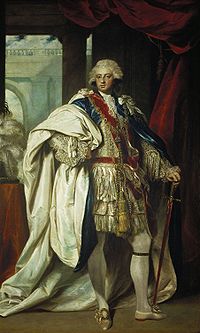
Duke of York

Before succumbing to his illness, George III had a sometime tempestuous relationship with members of his family.

The king’s second son, Prince Frederick, Duke of York, found himself in a scandal, along with his mistress, Mary Ann Clarke. They were both accused of profiting from the sale of army promotions during the Napoleonic campaign. The Duke was found not guilty of corrupt practices, but he was relieved of his duties as Commander-in-Chief of the Army. As the king’s favorite, this was a great blow to the Royal family. Earlier in his career, Frederick had fought a duel in defense of his brother, the Crown Prince. One of the queen’s ladies had insulted both Frederick and Prince George. Frederick gave the woman a good set down. Then the lady’s son challenged Frederick to a duel. His opponent came within an inch of placing his bullet in the prince’s head.

Ernest, Duke of Cumberland

Ernest, Duke of Cumberland, was once brought under suspicion of murder. He was the least likeable of the king’s sons. Ernest was said to be vain and easily rowed to anger. He had an war injury, which caused his left eye to have a sunken look. Ernest often spread malicious gossip about his family members. Some felt that Ernest was “too fond” of his sister Sophia. Many thought the prince to be bisexual or homosexual. When the duke’s valet (Joseph Sellis) was found in the ducal apartments with his throat slit, people believed the two had had a homosexual relationship, and that the valet was blackmailing Ernest. Sellis’s death was ruled a suicide, but the finding was questioned. For the wound to be self-inflicted, Sellis would have had to be right handed. Ironically, the man was left-handed.

Frederick, Duke of York

King George preferred Frederick to his heir, Prince George. The king found his eldest son too effeminate. By the Golden Jubilee, the king was 72 years old, and the Crown Prince was 50. By this time, the two very much despised each other…more than likely wishing the other would “meet his Maker.”

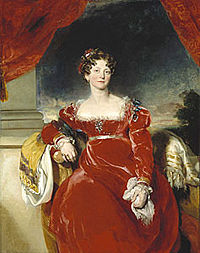
As George III prepared for his Golden Jubilee, his daughter, the Princess Amelia (age 27) lay dying within the palace. Amelia was George III’s youngest daughter. The girl had given her father a keepsake by which to remember her. It was a ring containing one of her jewels and a lock of her hair. The inscription read: “Remember Me.” Amelia had fallen in love with Charles Fitzroy, one of the king’s equerries, but had not been allowed to marry him. Ironically, she left everything to Fitzroy in her will.

Princess Amelia

By the Golden Jubilee, only Princess Charlotte had married. The king’s other daughters were approaching middle aged (for that time period). They were not “attractive” women, and they found few prospects.

Princess Charlotte

The family spent a great deal of time trying to hide from the king the fact that Princess Sophia had borne an illegitimate child. Ironically, the child’s father was an ugly, dwarf, some 33 years older than Sophia.

Princess Sophia

Posted in Uncategorized | Tagged , | 3 Comments

The Children of King George – Part I

George III’s and Charlotte of Mecklenburg-Strelitz’s many children and grandchildren included:

(1) George Augustus Frederick, Prince of Wales (and later King George IV) was the heir apparent (1762-1830). George IV married Caroline of Brunswick.  Princess Charlotte Augusta of Wales was their only child (1796-1817).

(2) Frederick Augustus, Duke of York (1763-1827), who married Fredericka of Prussia had no legitimate children.

(3)William Henry, Duke of Clarence (and later King William IV) (1765-1837) married Adelaide of Saxe-Meiningen. Their children included Princess Charlotte Augusta Louisa, who was born in 1819 but who did not survive, and Princess Elizabeth Georgina Adelaide, who suffered a similar fate.

(4) Charlotte Augusta Matilda, Princess Royal (1766-1828) married Frederick I of Wurtemburg. They had no children.

(5) Edward Augustus, Duke of Kent (1767-1820) married Victoria Mary of Saxe-Coburg-Saalfield. These were the lucky parents of the future queen, Alexandrina Victoria of Kent. QUEEN VICTORIA (1818-1901) married Albert of Saxe-Coburg-Gotha.

(6) Princess Augusta Sophia (1768-1840) did not marry.

(7) Princess Elizabeth (1770-1840) married Frederick of Hesse-Homberg, but they had no children.

(8) Ernest Augustus, Duke of Cumberland (and later King Ernest of Hanover) (1771-1851) married Fredericka of Mecklenberg-Strelitz. King George V of Hanover was their son.

(9) Augustus Frederick, Duke of Sussex (173-1843) first married Lady Augusta Murray, by whom he sired Augustus Frederick d’Este (1794-1848) and  Augusta Emma d’Este (1801-1866). Later, he married Lady Cecilia Letitia Buggin. Lady Cecilia presented Augustus with no children.

(10)Adolphus Frederick, Duke of Cambridge (1774-1850) married Augusta of Hesse-Cassel. Their children included George, Duke of Cambridge (1819-1904), Princess Augusta of Cambridge (1833-1927), and Princess Mary Adelaide of Cambridge (1837-1897).

(11) Mary (1776-1857) married William Frederick, Duke of Gloucester of Edinburgh. They had no children.

(12) Princess Sophia  (1777-1848) never married.

(13)Prince Octavius  (1779-1786) died in infancy.

(14) Prince Alfred  (1780-82) died in infancy.

(15) Princess Amelia  (1783-1810) died in infancy.

Tomorrow, we will take a closer look at the intrigues surrounding the Royal family and the “madness” of King George III.

Posted in Uncategorized | Tagged , | Comments Off on The Children of King George – Part I

Jane Austen and The British Royal Navy

In referring to the cult-like following of those who extolled all things involving Admiral Horatio Nelson, Jane Austen once wrote, “I am sick of Lives of Nelson.” Yet, the author always appreciated the lives of men in the Royal Navy. Two of her brothers served thusly. The British Navy at the time of the Napoleonic War was divided into “ships of the line,” those carrying between 60 and 100 guns, and “cruisers,” which were frigates, sloops, and brigs with fewer guns. In 1810, British naval strength was estimated to be 150+ ships of the line and near 400 cruisers. Documents on the naval history sites say that the Navy employed 800+captains, 600+ commanders, and nearly 3300 lieutenants.

During the Napoleonic Wars, the size of the British fleet was greater than all the other sea-faring nations put together.

The British Isles remained safe behind the “Wooden Walls” of the Royal Navy, and Britain was able to continue its world trade and empire building. They controlled English Channel and trading routes with size of their fleet, but Britain also actively sent its vessels out to attack enemy warships. With its strength in numbers and its developing naval industry, Britain could risk losing a ship or two to protect the British people.

In 1797, 1801, and 1807, the British navy sailed to destroy the neutral or French-allied vessels of Holland and Denmark. At Camperdown in 1797, Admiral Duncan pitted his 16 ships against 16 Dutch warships under Admiral de Winter and destroyed the enemy fleet – capturing seven Dutchmen and allowing the rest to flee.

In April 1801, the Admirality sent an expedition against Denmark to break up a northern European agreement, the Armed Neutrality of the North, that threatened British trade and shipbuilding materiel – wood, rope, grain and tar – in the Baltic Sea.

The naval Battle of Copenhagen was a British victory that saw 12 of 18 Danish vessels captured and ended the threat to its trade. In 1807, Britain again moved against Denmark when it became known there was a French move to grab the Danish fleet. Admiral Gambier took 20 ships of the line and an infantry force of some 20,000 men – including Arthur Wellesley (yes, that is the Duke of Wellington) – to prevent the vessels falling into French hands. A two-week siege began and a Danish military move to break the blockade was ended by Wellesley’s infantry. The bombardment of the capital by the Royal Navy forced neutral Denmark to hand over its 18 ships to London.

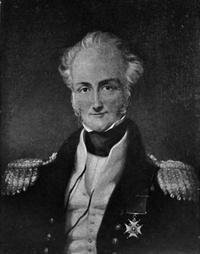
Sir Charles Austen

Jane Austen’s brothers entered the navy at the age of 12 and first went to sea at age 15. Naval life was a hard one, and many believed it necessary “to toughen up the boys.” Unlike in the army, naval commissions could not be bought. It was necessary to succeed in a naval career to have the patronage of an influential personage. If one recalls Admiral Crawford in Mansfield Park, this makes more sense. A man earned his future in prize money. Do we not recall Captains Wentworth, Benwick, and Harville in Persuasion? The captain would receive one-fourth of the value of the captured ship. His officers would receive graduated proportions, and ordinary seamen divided the final quarter among themselves. In Persuasion, Wentworth has earned 20,000 pounds in his eight years of service. Men learned to look forward to another war so they might continue their winning ways.

Posted in British history, Jane Austen, real life tales, Regency era, Uncategorized | Tagged , | 4 Comments

Regency Era Lexicon – “R” Is Next on Our List

R. A. – member of the Royal Academy, which was founded by George III

Radcliffe, Ann – was an English author, and a pioneer of the Gothic novel. Her style is romantic in its vivid descriptions of landscapes, and long travel scenes, yet the Gothic element is obvious through her use of the supernatural. It was her technique of explained Gothicism, the final revelation of inexplicable phenomena, that helped the Gothic novel achieve respectability in the 1790s.

radical – extreme liberals who demanded governmental reforms leading to the Reform Act of 1832

rag-and-bone shop – a shop that bought and sold rags that could be made into paper, as well as bones the could be ground up into manure

ragbag – servants had the privilege to place discarded rags from their master’s household in a ragbag to be sold later for a profit

rank – a person’s social standing

ranker – an officer who had advanced to his position from the ordinary soldiers instead of purchasing his commission; gentlemen rankers were the opposite situation as they were gentlemen who sought anonymity among the ranks of the ordinary soldiers, likely due to some disgrace or scandal from which they wished to escape

rasher – a thin slice of ham or bacon

rate – the rate of a ship-of-war was based on the number of guns; first-rates carried 100+ guns; second-rates carried between 75-100, etc., down to sixth-rates

rate – a local parish tax

read himself in – the incumbent reads the Thirty-nine Articles aloud to his congregation upon assuming his new office

recusant – a person who refused to attend Church of England services (originally used only for Catholics and Dissenters)

Red Book – a list of everyone who worked for the government

reddle – a red chalk used for marking the sheep’s owners before they are sheared

reel – a Scottish dance that involved a series of figure 8s

Reform Act of 1832 – brought about to eliminate the underrepresentation of the lower classes (especially the middle class) by redistributing the parliamentary seats among the boroughs

regent – a person who reigned on behalf of a monarch (George IV became the Prince Regent when his father was declared permanently insane in 1810)

register – a record of the births, deaths, and residents of a parish

regular – the enlisted army of the British government as opposed to the irregulars (militia and volunteers)

repeater – an old-fashioned watch that struck the last hour or quarter hour when a person pushed the handle on it; very useful in the dark in providing the time

resurrectionist – a body snatcher (Before 1833, only the bodies of criminals could be used in medical schools for the teaching of anatomy.)

retainer – a servant who had been with a family for extended years

Reticule – (sometimes called a “ridicule”) a Regency purse in which ladies carried their essential calling cards, handkerchief, comb, etc.; held about the wrist with a long drawstring closure

Right Honourable – the formal way to address earls, viscounts, barons, and privy councillors; also used for a peer’s eldest son bearing as a “courtesy title”

Riot Act – (originally the Riot Act of 1714) a justice of the peace would, literally, read a troublesome crowd “the riot act,” meaning he would read his instructions to disperse to the group; after an hour, if more than 12 remained those arrested would be guilty of a felony

Robin Redbreast – the colloquial name for the Bow Street Runners because of their vests

rotten borough – a parliamentary borough with few inhabitants; part of the Reform Act of 1832 was to eliminate such boroughs

Rotten Row – a walkway for horses in the southern part of Hyde Park

Royal Crescent (Bath)

Royal Exchange – where the various trades met in London; each trade met with others of a like trade and were allotted a particular area in the Royal Exchange; Lloyd’s of London was also house in the Exchange

Royal Naval College – The Royal Naval Academy (1733 – 1837) was established at Portsmouth Dockyard as a facility to train officers for the Royal Navy. The founders’ intentions were to provide an alternative means to recruit officers and to provide standardised training, education and admission. The officers learned not only military strategies, but were taught social skills such as dancing.

In 1733, a shore side facility was established in the dockyard for 40 recruits. A comprehensive syllabus provided theoretical and practical experience in the dockyard and at sea. Graduates of the Academy could earn two years of sea time as part of their studies, and would be able to take the lieutenant’s examination after four years at sea instead of six. The Academy did not, however, achieve the objective of becoming the preferred path to becoming a naval officers. The traditional means of a sea-going ‘apprenticeship’ remained the preferred alternative. The vast majority of the officer class was still recruited in this manner based on family ties, and patronage. Family connections, ‘interest’ and a sincere belief in the superiority of practical experience learned on the quarterdeck ensured that the officer class favoured the traditional model. William IV summed up this view when he remarked that “there was no place superior to the quarterdeck of a British man of war for the education of a gentleman.”

There was a clear prejudice against Academy graduates. The then rating of midshipman-by-order, or midshipman ordinary,  was used specifically for graduates of the Royal Naval Academy, to distinguish them from midshipmen who had served aboard ship, who were paid more. After two years at sea, graduates of the academy were eligible to be promoted to midshipman.

The college closed as a young officer training establishment in 1837 meaning that from that date all youngsters setting out on a naval career proceeded directly to sea. Two of Jane Austen’s brothers, Francis and Charles, attended the Academy in 1786 and 1791 respectively. Both went on to become Admirals.

Royal Navy – The Royal Navy (RN) is the principal naval warfare service branch of the British Armed Forces. Tracing its origins to the 16th century, it is the oldest service branch and is known as the Senior Service. From the end of the 17th century until well into the 20th century it was the most powerful navy in the world.

rubber – required gamers to win two out of three or three out of five hands of whist, etc.

rushlight – ordinary rushes, which have been dipped in drippings of oil or grease, so they can be easily set alight; used in place of candles by the poor

Posted in British history, Jane Austen, Regency era | Tagged , , | 4 Comments

Writing Essentials: What is Plagiarism? Paraphrasing? Homage?

I loved this article!! After having taught English for 40 years, I know how hard it is to teach students the differences between plagiarism and paraphrasing. If you time, read the entire article from the Editor’s Blog. http://theeditorsblog.net/2012/11/01/sampling-borrowing-homage-and-plagiarism-writing-essentials/

Sampling, Borrowing, Homage, and Plagiarism (Writing Essentials)

on November 1st, 2012 by Fiction Editor Beth Hill and last modified on November 1, 2012

This article is part of Writing Essentials,
in-depth coverage of the elements of fiction and writing basics.

~~~~~~~~~~~~~~

I once assumed that everyone who made it through junior high (middle school) understood what plagiarism was and also understood that you don’t do it. Ever. Not at all. Not one sentence.

But if reports out of our schools and newsrooms are any indication, then plagiarism is thriving.

I’m not going to make you wait until you get to the end of the article for the conclusion on this one. The conclusion is, you don’t take the work of others and pass it off as your own. You don’t borrow or sample. You don’t write in the style of another author—not even one that you love, love, love—by using her phrasings. No, it’s not an homage or a tribute. It’s theft. And that author, as well as everyone else, knows it’s theft. And if you borrow or sample or steal the words or ideas of another, you are a thief.

Was that clear enough?

If you’re a student, please take this as your notice—you can’t take even one line from someone else and present it as your own. If you’re writing fiction, the story must be your words. If you’re writing an essay, you canrefer to the work of another using either direct or indirect quotes, but you must include attributions in your essay. Whether your footnotes are in the body of the text or included at the end, you have to provide references for your source materials.

And if you do refer to the works of others, those references should only bolster your own words. That is, you are the author of a report or essay, so the major part of any writing project should be your words—your questions, musings, and conclusions. Quote only short sections of someone else’s work, not paragraph after paragraph.  (There are limits to how much can be quoted of a single work, even for non-profit educational purposes. For more information, check the Fair Use provision of copyright law.)

If you quote directly, without a paraphrase, you must use quotation marks. And include citations.

If you paraphrase, using indirect quotes, you don’t use quotation marks but you still include citations.

If a thought isn’t original to you and is not common knowledge, you must cite your source.

This one should be easy, but apparently it isn’t. So I’ll find another way to say it.

If you use someone else’s words, no matter where you got them, you must put them in quotation marks and report the source. (The format for reporting source information depends on what you’re writing. Reference info typically includes author name, title of book or article, publication name, publisher’s name, date of publication, and page number. Internet sources have their own requirements. Make sure you know what’s required and the format you should follow.)

Posted in Industry News/Publishing, writing | 3 Comments

Northanger Horrid Novels

I wanted to introduce our visitors to what are known as the Northanger Horrid Novels, seven early Gothic examples of fiction. These books were among the many published by Minerva Press in the late 1700s and early 1800s. William Lane established Minerva Press at No. 33 Leadenhall Street, London, when he moved his circulating library there in 1790. The seven books, which comprise the Northanger Horrid Novels, were once thought to be creations of Jane Austen’s imagination, but research in the early 1900s by Michael Sadleir and Montague Summers proved that the stories did exist. In Northanger Abbey, Isabella Thorpe tells Catherine Morland …

“Dear creature! How much I am obliged to you; and when you have finished Udolpho, we will read The Italian together; and I have made out a list of ten or twelve more of the same kind for you.”

“Have you, indeed! How glad I am! – What are they all?”

“I will read you their names directly; here they are, in my pocket-book. Castle of Wolfenbach, Clermont, Mysterious Warnings, Necromancer of the Black Forest, Midnight Bell, Orphan of the Rhine, and Horrid Mysteries. Those will last us some time.”

“Yes, pretty well; but are they all horrid, are you sure they are all horrid?”

“Yes, quite sure; for a particular friend of mine, a Miss Andrews, a sweet girl, one of the sweetest creatures in the world, has read every one of them.”

Some years back, Valancourt Books began a project to bring these titles and many others from around the world to the reading public. Along with those found on Valancourt, most of the titles are available from online book sources. Some are even available in their entirety at internet reading sites. So, what are the stories in each of these books? And would Jane Austen have read them?

The Castle of Wolfenbach (1793) by Eliza Parsons
A lecherous and incestuous uncle forces Matilda Weimar to flee her home and to seek refuge in the ancient Castle of Wolfenbach. Horrifying mysteries also dwell in the castle, including that of the missing Countess of Wolfenbach. Matilda must unravel the clues before her uncle tracks her down and takes her away with him.

The Mysterious Warning (1796) by Eliza Parsons
When the much revered Count Renaud dies, his degenerate heir, Rhodophil, assumes his father’s title. The count has disowned his son Ferdinand, who has married without his father’s permission. Rhodophil swears he will share his riches with Ferdinand and the younger brother’s wife, Claudina, but a “mysterious warning” from the grave sends Ferdinand fleeing for his life. To make matters worse, Claudina has aligned herself with Rhodophil. Ferdinand’s quest for his own fortune and adventure brings him to the doorstep of a recluse, who has a horrible secret. Later, he becomes imprisoned by the Turkish army and then encounters one of Gothic literature’s most depraved female characters, Fatima. If he survives all his meanderings, Ferdinand must then return to Renaud Castle to uncover the ghostly truth about his wife and his brother.

Clermont (1798) by Regina Maria Roche
Madeline lives in seclusion with her father Clermont, who holds a mysterious past. That seclusion is interrupted by one of Clermont’s former friends, a Countess. Madeline is allowed to reside with the Countess, with whom she will receive an education. However, the Countess is attacked by unknown assailants, and Madeline is assaulted in a ghostly crypt. Compounding their problems, a sinister stranger appears to claim Madeline as his bride. The stranger knows Clermont’s secret and threatens to ruin Madeline’s father. Madeline must avoid her pursuers, solve the mystery of her father’s past, and win the love of De Sevignie.

The Orphan of the Rhine (1798) by Eleanor Sleath
Sleath is very much an Ann Radcliffe wannabe, and she models many of her pieces on Radcliffe’s works, using several of Radcliffe’s signature plot devices: mysterious monks, ruined towers, assumed names for the characters, last-minute rescues, and death-bed scenes. In this novel, Julie de Rubine discovers that her marriage to the Marchese de Montferrat is a sham. Unfortunately, this news is not delivered until after Julie gives birth. Julie takes her child and an orphan by the name of Laurette to live in a half-ruined castle on the Rhine. She remains there under the Marchese’s threats until Laurette becomes old enough to “stir the passion” of other key characters. Then things get very interesting!

The Necromancer; or, The Tale of the Black Forest (1794) by Karl Friedrich Kahlert

This book is a series of interconnected stories, each of which deals with the enigmatic character Volkert the Necromancer. This is a very strange novel. It is filled with murder, dark magic, and plenty of ghosts. The plot takes too many twists and turns to describe in so short of a space, but for the true Gothic fan, it is a must.

The Midnight Bell: A German Story, Founded on Incidents in Real Life (1798) by Francis Lathom
Alphonsus Cohenburg finds his mother covered in blood. She tells him that his uncle has murdered Alphonsus’s father, and he must flee for his life. He is never to return to Cohenburg castle. Alphonsus’s adventures include being a soldier, a miner, and a church sacristan. He meets and weds Lauretta, but she is kidnapped by a group of ruffians. Alphonsus must solve the mystery of his wife’s disappearance and the question of his mother’s strange pronouncement. Add to those dilemmas the news of ghosts haunting his family’s castle and the sound of great bell each night at midnight, and one has a complete Gothic delight.

The Horrid Mysteries: A Story from the German of the Marquis of Grosse (a translation of the German Gothic novel Der Genius) (1796) by Carl Grosse
The Marquis of Grosse is a member of “a secret revolutionary society, which advocates murder and mayhem in pursuit of an early form of communism. He creates a rival society to combat them and finds himself hopelessly trapped between the two antagonistic forces. The book has been both praised and lambasted for its lurid portrayal of sex, violence, and barbarism.”

Posted in British history, gothic and paranormal, Jane Austen, legends and myths, Regency era, Uncategorized | Tagged , , | 2 Comments

Regency Era Lexicon – The Letters “P” and “Q”

packet – a ship carrying mail (and occasionally passengers) along a regularly defined route

packman – a peddler of ladies’ goods (linen and cotton)

paddock – a horse pasture

page – a boy hired to run errands, etc.

palace – name given to the home of a bishop in the Church of England

Pall Mall – the site of many fashionable men’s clubs in the West End of London

palsy – any type of paralysis

pamphlets and tracts – very popular with readers of the 17th Century; held true accounts of murders, fires, and robberies, as well as exotic places; often these were “sensational” journalism at its worst; the 19th Century saw a resurgence of these types of story lines in early novels and the Gothic influence

pannier – a large round basket used for market days; slung over a horse

pantalettes – worn from about 1820 to 1850 by little girls; undergarments with frilled bottoms and descending below the level of skirt and petticoat to be visible

pantaloon – pants worn from the beginning of the 1800s

parish – the local unit of ecclesiastical jurisdiction in the Church of England

park – an enclosed area with trees and lawns and sometimes sheep and deer for the purpose of artistic views, rather than for profit or cultivation

Park Lane – an upscale address in Mayfair; ran along the eastern border of Hyde Park

parlor – the formal room in a modest home

parlormaid – hired in families who could not afford a male servant to perform duties similar to a butler

parsonage – the house given to the local parson as part of the “living” presented to him by his patron; the land attached to the parsonage often remained the property of the local landowner

parterre – different-sized plots of flower connected by various walkways and paths in a formal garden

pastille – a roll of paper that could be set afire to disinfect or fumigate a room

patent – given by the monarch to his subjects; a “letter patent” was an open letter that could be read by anyone, which permitted the holder certain privileges; a “patent of nobility” was a royal grant of noble status

patience – a card game of solitaire

patriarchal society – a society where women’s rights are ignored; men hold the rights and the decision making powers

pattens – worn by women to keep their shoes from getting muddy or wet in the outdoors; circular rings that could be strapped onto the shoe’s bottom to raise the foot up a few inches

Peeler – nickname given to the members of the new Metropolitan Police Force (Scotland Yard, etc.), which replaced the Bow Street Runners; founded in 1829 by Sir Robert Peel

peer – a nobleman (duke, marquis, earl, viscount, baron); hereditary title; owner of a seat in the House of Lords

pelisse – a long, dress-like coat, which was often lined with fur

Pembroke – a four-legged table with two sides that could be swung up for additional space

pence – the plural of penny

Peninsular War – the campaign fought by the Duke of Wellington from 1808-1814 in Spain and Portugal against Napoleon’s forces

pensioner – an ex-soldier or sailor; in-pensioners resident at the Royal Hospital at Chelsea (army) or Greenwich (navy); out-pensioners lacked an official residence; at Cambridge University, the term meant a nonscholarship student

perpetual curate – a parish clergyman equivalent to a vicar; distinguished from an ordinary curate

personal guide book – books that define proper conduct; highly popular in the early 18th century; people of the upwardly mobile middle class sought these self-help books to learn how to conduct themselves properly in Society

petticoat – part of a woman’s intimate clothing; had a decorative binding at the bottom and sometimes extended a bit below the woman’s gown’s hemline; the chemise went over the petticoat; made of linen; its purpose was to protect the hem of the lady’s dress

phaeton – a light, open carriage with 4 wheels and pulled by 1 or 2 horses and used for pleasure driving; usually had a convertible top; a low phaeton had seats lower to the ground than the high phaeton, which young gentlemen preferred; the high phaeton was more dangerous to drive as the height made it easy to tip over; women often drove low phaetons around restricted areas (i.e., an estate), rather than on public roads

physician – the most distinguished of the medical professions; dealt only with internal disorders (illnesses for which a physic could be given); surgeons handled broken bones, wounds, etc.; physicians were referred to as “Doctor,” while surgeons were “Mr.”

pianoforte – a predecessor of the modern piano

Piccadilly – an upscale street in the West End of London; said to be called as such because an 1600s tailor in the area made high ruff collars called piccadillies

pier glass – a long mirror placed between two windows; used for ornamentation purposes

pin money – an allowance given to a woman as part of the marriage settlements

pipe – wine was sold by the “pipe,” or a unit of 105 gallons

piquet – a card game for two people played with 32 cards (no 2s, 3s, 4s, 5s, and 6s); players must earn the highest number of cards in one suit

plate – silverward

Plough Monday – first Monday after Twelfth Day; a new agricultural season began on this day

plums – in the Christmas plum pudding, plums were raisins

pluralist – holding more than one benefice or living in the Church of England

pocket borough – a parliamentary borough under the control of a powerful individual; outlawed in 1832 by the Reform Bill; in the man’s “pocket,” so to speak

pocket pistol – a flask for alcohol carried in a pocket

pony – slang for £25

poorhouse – publicly supported homes for the poor

port – a favorite after-dinner drink for gentlemen; a sweet Portuguese red wine

portmanteau – a traveling bag

post – the system by which the king’s horses were provided; later the system for delivering the mail

postboy – boys who delivered the mail on foot or horseback before the mail coaches replaced them in the late 1700s

post captain – title to distinguish captains in the Royal Navy who held permanent positions as captains of ships with at least 20 guns

post chaise – a chaise used with rented horses; on long journeys, it was necessary to change horses periodically; travelers would send their horses home after a long journey and travel on with rented ones

postilion – the person who rides and guides the horses that is pulling a carriage

potboy – a youth who delivered drinks at a tavern

pound – a unit of money = 240 pence or 20 shillings

preferment – a job or position that was a step upward financially or socially

primogeniture – meant that a family’s property and wealth went directly to the eldest son; ensured that property stayed with the family and the paternal surname survived

Prince Consort – a prince married to a reigning queen

Princess Royal – the oldest daughter of a reigning monarch

private ball – given by the owner of a large country house or an upscale home in London’s more prestigious districts; attendance came by invitation only; the evening followed a particular schedule: began at 8 P.M. with mingling and dancing; dancing the supper set with a lady meant a gentleman escorted her in to supper at midnight; departure came between 3-4 A.M.

prize money – a manner of earning a fortune in the British Navy; money or loot obtained from capturing a vessel and dividing the proceeds among the capturing crew

public ball – also referred to as assemblies; open to anyone who could afford a ticket; the ball ticket also included supper; were generally held on a monthly basis to coincide with the full moon (to expedite travel at night)

public school – a particularly English phenomenon with a long history; public schools were actually private schools such as Eton, Harrow, and Rugby; founded by wealthy donors as “independent schools” for ordinary boys to learn Greek and Latin, but, eventually, the schools took in boys from aristocratic and even royal families and became “private” schools; government supported public education did not begin until the 19th century in England; Winchester College was the original English public school

publishing banns – a means to marry in the Church of England; the couple requested the local clergyman to announce their upcoming wedding from the pulpit for three successive Sundays during the service; a bride and groom who lived in different church parishes had the banns read in both; if no one objected to the wedding then the couple could marry within 90 days of the final announcement of the banns; because publishing the banns cost nothing, it was the preferred method of the poorer classes

Pump Room (Bath) – where Society in Bath gathered to ‘take the waters’ (drink the thermal spa water for medicinal purposes); also the place to meet and socialize, and, of course, to ‘promenade’ about the room

purse – used by a gentleman to hold his coins

putrid fever – Typhus

quadrille – a dance performed by four couples in a square formation; had 5 sets of movements; originally the word “quadrille” was a card game played by 4 people with 40 cards, similar to whist

quality – how the lower classes referred to the upper classes

quarter days – four days which marked when rents were due: Lady Day (March 25), Midsummer (June 24), Michaelmas (September 29) and Christmas (December 25)

quarto – a sheet of paper that had been folded twice to yield 4 leaves (8 pages)

quid – money slang for a sovereign

quinsy – tonsillitis

quiz – someone who mocks others or acts peculiarly

Quorn – one of the oldest and most prestigious of the fox-hunting packs in England; named for Quorn Hall in the Midlands where the pack was first bred in the mid 1700s

Posted in British history, Jane Austen, real life tales, Regency era | Tagged , | 1 Comment

Adder Stones, Hag Stones, Witch Stones…Do You Know These?

Adder stones are usually glass stones with a naturally occurring stone in them. Archaeologists have found them in both Britain and Egypt. In Britain, they stones are also called hag stones, witch stones, serpent’s eggs, or snake’s eggs. In Wales, they are called glain neidr, while in Corwall, adderstanes is the word of choice. The southern provinces of Scotland use the word Gloine nan Druidh (“Druids’ glass).

Believed to have magical powers, the stones have been used to cure eye diseases, preventing nightmares, curing whooping cough, or snakebites. Superstition says they can aid the holder by giving a person the ability to see through fairy or witch disguises.

There are many legends that define the origin of the stones. Among the most popular include: (1) the stones are the hardened saliva of large numbers of serpents massing together; (2) the stones are from the head of a serpent or are made by the sting of an adder; and (3) the stones can be any rock with a hole bored through the middle by water.

Druids highly esteemed Adder stones. There is a passage in Pliny’s Natural History, book xix, minutely describing the nature and the properties of this amulet. The following is a translation of it:

“There is a sort of egg in great repute among the Gauls, of which the Greek writers have made no mention. A vast number of serpents are twisted together in summer, and coiled up in an artificial knot by their saliva and slime; and this is called “the serpent’s egg”. The druids say that it is tossed in the air with hissings and must be caught in a cloak before it touches the earth. The person who thus intercepts it, flies on horseback; for the serpents will pursue him until prevented by intervening water. This egg, though bound in gold will swim against the stream. And the magi are cunning to conceal their frauds, they give out that this egg must be obtained at a certain age of the moon. I have seen that egg as large and as round as a common sized apple, in a chequered cartilaginous cover, and worn by the Druids. It is wonderfully extolled for gaining lawsuits, and access to kings. It is a badge which is worn with such ostentation, that I knew a Roman knight, a Vocontian, who was slain by the stupid Emperor Claudius, merely because he wore it in his breast when a lawsuit was pending.”

Posted in British history, gothic and paranormal, legends and myths, real life tales | Tagged , , , | Comments Off on Adder Stones, Hag Stones, Witch Stones…Do You Know These?