(This post and excerpt first appeared on My Jane Austen Book Club on March 11, 2013.)
With the onset of the French Revolution and the Napoleonic Wars, the idea of a European Grand Tour for English aristocratic class lost its appeal. Instead, English men and women turned their sights on popular British destinations, such as Brighton, Margate, Lyme, and Weymouth. In England, inland spas, such as Bath, were the models of health spas like Lourdes. Among the early fashionable Georgian-Regency resorts (from approximately 1789 – 1815) was one favored by King George III, but Mudeford never achieved the popularity of the other tourist destinations.
Some jokingly account the lack of development to the Christchurch district’s name. Mudeford was then part of southwest Hampshire. The idea of “mud” was likely not very appealing to the public. Also to the area’s detriment, Highcliffe was not adopted as a village name until 1892. Before that time, the local hamlets were known as Chuton, Newtown, and Slop Pond. The district’s other name was Sandhills.
In the summer of 1789, George III arrived in Weymouth to partake of the healing waters, a good sign for a concerned English population, which saw its King as a man going slowly mad. Each day, during his visit, as the King partook of his royal plunge into the salt waters, a band played “God Save the King.” Dips in the “curative waters” at Weymouth helped popularize the idea of “spa” towns.
At the time, Mudeford had caught the attention of other members of the aristocracy when a former British Museum curator and retired director of the Bank of England purchased large tracts of land in the area and began to invite members of the aristocracy to visit the area. Gustavus Brander (1720-1787) built a house on the grounds of Christchurch Priory and a summerhouse on Hengistbury Head. Later, the Brander family sold High Cliff estate to Pitt’s retiring Prime Minister, John Stuart, Lord Bute.

Highcliffe today
Bute retired to High Cliff in 1770. A botanist (co-founder of Kew Gardens), Bute hired the most famous landscape designer of the time, Capability Brown, to redesign the parkland on the High Cliff estate. The original house, built in a mediaevalist style to a Robert Adam design, set upon the cliff top “to command the finest outlook in England.” In fact, the house was so close to the cliff that it was necessary to dismantle it brick by brick when the cliff side crumbled away. Most of the estate was sold off following Bute’s death.
Bute Homage was the only house remaining on the estate. Lord Stuart de Rothesay, the 4th Earl of Bute, bought back the much of the estate in 1807 and began to build a grander manor than the former High Cliff. Not completed until 1835, the restored Highcliffe Castle sported stained glass windows from Rouen and other French art treasures “rescued” from the aftermath of the French Revolution.
In 1790, George Rose (1744-1818) became a MP for Christchurch. First, Rose, who owned Cuffnells Park in the New Forest near Lyndhurst, had been a Member of Parliament for Lymington (1788). He was a strong supporter of William Pitt the Younger. His youngest son, William Stewart Rose, became the second MP to serve Christchurch. George Rose resided at Cuffnells, where he wrote books on finance and policy and from where he attempted to run his cabinet post of Treasurer of the Navy. He also entertained both Pitt and King George in his home. George III stayed at Cuffnells in 1789, 1801, and 1803.

Sandhills
In 1785, Rose built a seaside house just east of Mudeford Quay, which he named Sandhills. The two Roses used Sandhills as their summer residences when not serving in Parliament. Rose’s eldest son, Sir George Henry Rose, lived at Sandhills House while George Rose occupied Cuffnells, and William Stewart Rose lived in a row of seaside cottages (completed in 1796 on the Sandhills estate and just east of the main house). The house and the row of whitewashed seafront cottages would be named “Gundimore.”
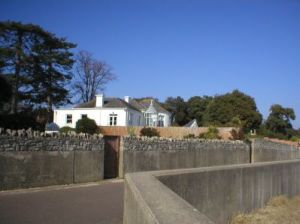
Gundimore
The house sported one room designed to resemble a Persian tent and another room in Arabian Nights style because many of the Romantic poets of the time used exotic Eastern references in their poems. WS Rose was an amateur poet and translator. Robert Southey was among the many poets who visited the area and stayed in the cottages. So, while George Rose invited Pitt, Nelson, and the King to Gundimore, WS Rose held an interest in art and literature. Sir Walter Scott worked on “Marmion” while visiting at Gundimore, as well as on Waverley, Scott’s first historical novel. Samuel Taylor Coleridge (Southey’s brother-in-law) visited in 1816. Coleridge planned a poem about the house, but his various ailments prevented him from working on it. Instead, WS Rose wrote a poem commemorating the visits of these writers, appropriately entitled “Gundimore.”
From “Our Forgotten English Resort,” we learn, “When Southey later became Poet Laureate, his mandatory memorial poem for his late patron George III was ridiculed by Byron and others, who felt Southey might just as well depict the King entering Heaven in a bathing machine. While George III’s favourite seaside resort had been Weymouth, he did visit Sandhills en route at George Rose’s bidding. Rose had him stop over at Cuffnells on his first journey to Weymouth, on 29 June 1789, and some sources say he also stopped at Sandhills. He also visited Sandhills on 3 July 1801, but better known is his 1803 official visit. In 1803 Rose arranged an official Royal ‘inspection’ style visit to Mudeford, complete with military parade, on another stopover by the royal yacht en route to Weymouth. The Christchurch Artillery fired a 3-volley salute echoed by another on Wight opposite, while detachments of the Scots Greys and the local Volunteers stood lined up on the beach. So that the King should not get his feet wet as he re-embarked on the royal barge, the pier-less resort’s three new bathing machines were laid end to end in the shallows. Sir Arthur Mee adds in his The King’s England guidebook series, ‘After that Mudeford brightened and increased the number of its bathing machines’ (apparently from three to seven). ‘…A picturesque little story which will, no doubt, ever be told of Mudeford,’ commented the Bournemouth Times & Directory.
“Despite these claims, that was the end of George’s public patronage. The Prince Regent seems not to have visited either: generally, he tended to steer clear of anywhere his disapproving father might be found. The Prince had privately married the Catholic widow of the owner of Lulworth Castle, but in 1795 he had to put aside his secret Catholic wife and remarry to help pay off his debts. This arranged marriage was disastrously unhappy for both parties. His new Princess Of Wales, Caroline Of Brunswick, did stay at Sandhills in 1796 before she moved back to the Continent. The King’s brother, HRH Duke of Cumberland, also stayed with Rose on New Year’s Eve 1803 to inspect, and thank for their service, the Christchurch Volunteers who had lined up for his brother, although in the event rain cancelled the official parade. However after he became King, the former Regent did visit Gundimore and Mudeford, in the 1820s.
“An early Cooke’s guidebook of circa 1835 refers to this visit: ‘the admired spot, the favourite summer residence of numerous families of distinction … Muddiford, a beautiful village on the sea-shore, possessing every convenience for a watering-place, having good bathing machines, and a fine sandy beach. His late Majesty, George IV, honoured this spot with a visit, and his admiration of its scenery. The air here is salubrious…. These qualities were appreciated and emphatically remarked on by his Majesty George III, who with the royal family honoured Mr Rose with a visit at Sandhills.’”
________________________________________________________
 The Mysterious Death of Mr. Darcy
by Regina Jeffers
Available from Ulysses Press
A thrilling story of murder and betrayal filled with the scandal, wit and intrigue characteristic of Austen’s classic novels
Fitzwilliam Darcy is devastated. The joy of his recent wedding has been cut short by the news of the sudden death of his father’s beloved cousin, Samuel Darcy. Elizabeth and Darcy travel to Dorset, a popular Regency resort area, to pay their respects to the well-traveled and eccentric Samuel. But this is no summer holiday. Danger bubbles beneath Dorset’s peaceful surface as strange and foreboding events begin to occur. Several of Samuel’s ancient treasures go missing, and then his body itself disappears. As Darcy and Elizabeth investigate this mystery and unravel its tangled ties to the haunting legends of Dark Dorset, the legendary couple’s love is put to the test when sinister forces strike close to home. Some secrets should remain secrets, but Darcy will do all he can to find answers—even if it means meeting his own end in the damp depths of a newly dug grave.
With malicious villains, dramatic revelations and heroic gestures, The Mysterious Death of Mr. Darcy will keep Austen fans turning the pages right up until its dramatic conclusion.
_________________________________________________________
Excerpt from Chapter 7 of The Mysterious Death of Mr. Darcy
Elizabeth shivered involuntarily. As Darcy had directed, she had met with the Woodvine cook regarding the weekly menu. They had finished their task when dread had physically rocked Elizabeth’s spine. Despite the feeling of dizziness drowning her senses in its sweep, she desperately pushed the swirling sensation away.
“Is something amiss, Mrs. Darcy?” the cook asked with what sounded of true concern.
Elizabeth shook her head in denial. “Just one of those intuitive moments we women experience daily. Likely, Mr. Darcy has turned his ankle or one of my sisters have has spotted a snake along the road to Meryton.” She laughed at her foolish nature.
The gray-haired woman with the sparkling, equally gray, eyes pushed her spectacles further up her nose. “It be the way of women,” she said sympathetically. “Me boy, Arnie, be one of Mr. Darcy’s grooms. We both have served the old master for many years. Whenever Arnie gets himself kicked by one of them ‘ornery beasts, I knows before he ever shows himself on me doorstep and looking for some of my herbs to ease the pain.”
Elizabeth again wondered if something had happened to Darcy. Her husband had spoken of the possibility that the gypsy band had posed an unknown threat. At home, at Pemberley, she had often sensed Darcy’s presence before he appeared on the threshold of her sitting room, but this was different. The lingering dread which currently wrapped itself about her shoulders had nothing to do with the pleasant anticipation she often experienced when her husband surprised her in the middle of the day. This was a warning of danger. Bravely, she said, “I am certain it is nothing. Mr. Darcy’s cousin, a seasoned military commander, as well as Mr. Cowan, accompanied my husband. I am being foolish.”
Mrs. Holbrook’s eyebrow rose in sharp denial, but the lady wisely said, “If that be all, Mrs. Darcy, I’s best return to me duties.”
Elizabeth gathered her notes. “Remember, Mrs. Holbrook, no sauces on the meats. The colonel prefers his dishes plain. Serve the dressings in a separate dish.”
“Yes, Ma’am. I understand.”
Elizabeth stood slowly to follow the woman to the door. “I expected Mrs. Ridgeway to join us,” she said as nonchalantly as she could muster. In reality, the housekeeper’s absence had irritated Elizabeth. It was another affront to Darcy’s authority, and she planned to express her anger over the woman’s slight.
Mrs. Holbrook paused in her speech, as well as her step. The woman looked about quickly—as if she suspected someone could be eavesdropping on their conversation. “Mrs. Ridgeway sent word, Ma’am, that she be experiencing a megrim.”
“I see,” Elizabeth said knowingly. “I suppose a headache might keep Mrs. Ridgeway from her duties.”
Mrs. Holbrook smiled wryly. “I suspect that be true, Mrs. Darcy.” The woman disappeared into Woodvine’s apparently empty halls.
Elizabeth stood silently by the still open door and listened carefully to what were obviously exchanged whispers. Someone, or several people, concealed themselves in Woodvine’s late afternoon shadows. The thought of others watching her every move, on one hand, shook her resolve, but on the other, it irritated her. She would permit no one to intimidate her. After all, had she not withstood the imperious Lady Catherine De Bourgh? “We shall see how they perceive their positions when I have my say,” she said privately to fortify her resolve.
Then she was on the move, climbing to the house’s third level again. As she turned the corner, Elizabeth declared boldly aloud, “I know you have hidden yourself from my view, but I am aware of your presence. If you have any sense of self-preservation, you will disperse immediately and attend to your duties.” As she climbed, Elizabeth did not turn her head to observe which of Woodvine’s staff broke from his hidden security, but she was well aware of the sound of scrambling feet and the quick opening and closing of doors. “They have chosen to make me their enemy,” she declared. “But they do not know that I am well seasoned in the comings and goings of servants.”
She thought immediately of how Darcy had early on complimented her on her quick assimilation into the role of Pemberley’s mistress. Little had her husband known that at Longbourn, Elizabeth and Jane had equally shared in the running of their parents’ estate. Their mother had taught all her daughters of the responsibilities of an estate’s mistress. As she and Jane had matured, Mrs. Bennet had relinquished more and more of her duties to her eldest children.
Elizabeth had arrived on Pemberley’s threshold well versed in preparing menus, balancing expenses, and settling service disputes. Her transition into the role of Pemberley’s mistress had come easily.
She paused at the top of the stairs and set her shoulders in a stubborn slant. “You mean to frighten me, but I will not be alarmed. There is a stubbornness about me that never can bear to be frightened at the will of others. My courage always rises with every attempt to intimidate me,” she declared to the empty passageway.
With renewed determination, Elizabeth entered Mrs. Ridgeway’s quarters unannounced. “I believe I requested to speak to you this morning,” she said tersely.
It did not surprise Elizabeth to find the woman dressed and working on an embroidery pattern. The housekeeper sprang to her feet. “Mrs. Darcy, I…I had…I had a severe headache,” she stammered. She tucked her sewing hoop behind her, but Elizabeth had observed the meticulous work of the pattern.
Taking a satisfyingly slow breath, Elizabeth’s mouth set in a tight line. “Evidently, you have recovered remarkably.” She gestured to the tea set upon a low table. “That being said, I will see you in my chambers in a quarter hour.” Elizabeth turned on her heels to leave.
However, Mrs. Ridgeway’s offer slowed Elizabeth’s retreat. “Why do we not share tea here?”
Elizabeth turned haltingly to the woman. “I think not. You will attend me. It is not acceptable for the mistress to attend those she employs. You did understand my husband has assumed control of this household?”
“Yes, Ma’am.” Mrs. Ridgeway dropped her eyes.
The act infuriated Elizabeth. “Do not offer me a false face.” She turned again for the door. “A quarter hour, Mrs. Ridgeway.” To emphasize her indignation, Elizabeth launched the door against the wall. The sound echoed throughout the dark passageway.
Returning to her quarters, Elizabeth fought hard to rein in her temper. “It would not do to permit Mrs. Ridgeway to know how much I dread this interview,” she declared as she punched one of the pillows decorating the bed. “Concentrate, Elizabeth,” she chastised her image in the cheval mirror. “You must see this through for Fitzwilliam’s sake.” The thought of her husband brought an immediate smile to Elizabeth’s lips. “Everything he has done he had has done for me,” she thought.
When Lydia had inadvertently disclosed Mr. Darcy’s part in bringing about her sister’s match to Mr. Wickham, Elizabeth could not fathom how his regard for her had allowed him to act without pride. The vague and unsettled suspicions which uncertainty had produced of what Mr. Darcy might have been doing to forward her sister’s match, which Elizabeth had feared to encourage as an exertion of goodness too great to be probably, and at the same time dreaded to be just, from the pain of obligation, were proved beyond their greatest extent to be true: Darcy had followed Lydia and Mr. Wickham purposely to Town; he had taken on himself all the trouble and mortification attendant on such a research; in supplication had been necessary to a woman whom he abominated and despised, and where he was reduced to meet—frequently meet, reason with, persuade, and finally bribe—the man whom he always most wished to avoid, and whose very name it was punishment to Darcy to pronounce. He had done it for her. For a woman who had already refused him.
Even as she considered her husband’s benevolence in the matter, Elizabeth blushed with embarrassment. Every kind of pride must have revolted from the connection. She was ashamed to think how much. Though, at the time, she could not place herself as his principal inducement, she had perhaps believed in Darcy’s remaining partiality for her might have assisted his endeavors in a cause where her peace of mind must be materially concerned. “If Fitzwilliam could place his qualms aside, then I will follow his lead.” Darcy’s ability to overcome a sentiment so natural as abhorrence would serve as her model.
When Mrs. Ridgeway arrived, Elizabeth bade the woman’s entrance in a perfectly calm voice. She motioned the woman to a chair across from where she sat at the small desk before setting the ledger, which she had used as a “stage prop” to make herself appear not to be awaiting the housekeeper’s appearance, aside. In reality, to compose her erratic heart and to soften her anger, Elizabeth had retrieved several of the notes, which Darcy had left for her over their few months of marriage. Beginning with the morning following their first night as man and wife, her husband had periodically presented her an eloquent reminder of their time together: a reminder of their one month anniversary and again to mark their first half year of marital bliss; one for the night they would spent apart when Darcy had been called away on business; and the one where he consoled her during the loss of the child she had not known she carried. Her magnificent husband had grieved silently for their lost child while she openly nursed her broken heart. Today, Elizabeth had read the two “anniversary” letters. They were full of love’s awe, and they had bolstered her spirits immensely.
Elizabeth did not permit Mrs. Ridgeway to speak. Instead, she had assumed the offensive. “I had expected better of you, Ma’am. When we first met, I presumed you to be a woman possessed of kindness, but also a woman well aware of her place in the world. I thought you possessed of an independent nature and capable of overcoming adversity.”
Mrs. Ridgeway asked earnestly, “And you no longer hold the same opinion, Mrs. Darcy?”
Elizabeth’s forthright nature never faltered. “You have proven yourself, Ma’am, to be a coward.”
“Do not think ill of me, Mrs. Darcy,” the woman challenged.
“How may I not?” Elizabeth asked aristocratically. She considered the possibility that Darcy’s air had found a new home in her. “Mr. Darcy gave specific orders for you to present yourself in the role of Woodvine’s housekeeper; yet, last evening, you made no appearance after our arrival, nor did you sit with me and Mrs. Holbrook this morning.”
“And did you find something lacking in your quarters? In Mrs. Holbrook’s attention to your needs?” Mrs. Ridgeway asked confidently.
Elizabeth’s chin rose with the challenge. This was her first real test as Darcy’s wife. Her transition at Pemberley had gone smoothly: partly because of her mother’s training, but partly because of Mrs. Reynolds’ guidance. Pemberley’s long-time housekeeper had brought Elizabeth along and had instilled the confidence of a fine lady in a country miss. “Do you dare claim to be the source of efficiency I have observed from certain members of the late Mr. Darcy’s staff?” Elizabeth would not mention those she suspected had found hiding places to shirk their duties.
Mrs. Ridgeway’s countenance betrayed a momentary lapse of confidence, but the woman quickly schooled her features. “And why should I not? Mr. Darcy blamed me for the deficiencies he discovered among those Mr. Samuel had hired. Why should I not glory in the household’s successes?”
If the older woman thought Elizabeth’s age would provide the housekeeper an advantage, Mrs. Ridgeway would discover otherwise. Elizabeth’s shoulders shifted, and she presented the Woodvine housekeeper with a look of scorn she had once seen displayed upon the countenance of Lady Catherine De Bourgh when the grand lady had instructed Mr. Collins on the state of the cleric’s gardens. “I am pleased to hear it, Mrs. Ridgeway.” The housekeeper’s forehead crinkled with disappointment, and Elizabeth knew satisfaction. She would definitely share her “disapproving” glower with Darcy when they were alone. She would ask her husband’s opinion of its effectiveness as compared to the one of his imperious aunt. “Then you will have no difficulty in overseeing a thorough cleaning of each of Woodvine’s rooms. I shall not have the Earl and Countess of Rardin finding Woodvine lacking. Lady Cynthia holds her uncle in loving regard. I will not tolerate having Her Ladyship’s memories of the late Mr. Darcy tarnished by finding Samuel Darcy’s home in anything but pristine condition.”
Elizabeth noted how the housekeeper recoiled, but the lady held her tongue. Elizabeth continued, “Every shelf will be dusted. Every rug beaten. Every piece of silver polished.” Elizabeth snarled her nose in disgust. “Cousin Samuel’s propensity for clutter will create additional responsibilities, but with your discipline, the staff shall rise to the challenge. You must inform me immediately if any of our current employees choose to seek other positions. As I have noted several among the staff who appear less than enthusiastic about fulfilling their duties, I assume we shall need to replace them. If you do not feel comfortable in making those decisions, I assure you I hold no such qualms. At home in Hertfordshire, I often dispensed with the servants.” That was a stretch of the truth, but Elizabeth would never permit the woman an advantage.
She stood to end the conversation. “I am pleased that we have had the opportunity to address Mr. Darcy’s perceived grievances. It shall make our stay more agreeable. Now, as I know you have many duties to which to attend, I shall excuse you.” Mrs. Ridgeway looked on dismay, but she managed a proper curtsy. Elizabeth led the way to the door. “Is this not more pleasant?” she asked sweetly. “To have a complete understanding between us?”
Mrs. Ridgeway spoke through tight lips, “As you say, Mrs. Darcy.”
* * *
Darcy had resumed his seat in the chariot. His cousin had pocketed the shell fragment, and they had reluctantly returned to their ride. Silence reigned as Mr. Stalling set the horses in motion.
Edward’s cross expression spoke of his cousin’s frustration. “Could the gypsy leader be sending you a message, Darcy? That if he cannot have the horse then neither can you.”
Darcy rubbed a weary hand across his face to clear his thinking. “Obviously, we should examine the American connection?” They did not speak for several minutes, each man lost in his thoughts. Finally, Darcy cautioned, “I would prefer Mrs. Darcy possessed no knowledge of today’s events. I would not worry my wife with news of this attack.” Another elongated silence followed. “I am thankful no one was hurt in this folly,” Darcy said sadly.
Cowan warned, “You must not permit your guard to become lax, Mr. Darcy.”
Darcy frowned noticeably. “I do not understand. Surely, you do not think this was more than a dispute about a horse’s ownership.”
The former Runner’s eyes scanned the passing countryside. “I believe, Mr. Darcy, that your insistence on discovering the disposition of your cousin’s estate has brought a warning. We might think the shooter made an unfortunate shot, but the bullet was placed in the animal’s neck. It was a admonition that a skilled marksman could easily achieve a smaller target. Say a man’s head.”
“You are saying someone wants me dead!” Darcy said incredulously. He felt the air rush from his lungs.
“I am saying, Sir, that someone knows desperation, and he holds no reservations about exercising mayhem in order to relieve himself of your interference.”