Happenings During the Reign of William IV: The Merthyr Rising of 1831

The Merthyr Rising of 1831 was the violent climax to many years of simmering unrest among the large working class population of Merthyr Tydfil in South Wales and the surrounding area.

Beginnings

Throughout May 1831, the coal miners and others who worked for William Crawshay took to the streets of Merthyr Tydfil, calling for reform, protesting against the lowering of their wages and general unemployment. Gradually the protest spread to nearby industrial towns and villages and by the end of May, the whole area was in rebellion, and for the first time in the world the red flag of revolution was flown.

Events
After storming Merthyr town, the rebels sacked the local debtors’ court and the goods that had been collected. Unpaid debts were taken and given back to their original owners. Account books containing debtors’ details were also destroyed. Among the shouts were cries of Caws a bara (cheese and bread) and I lawr â’r Brenin (down with the king).

On 1 June 1831, the protesters marched to local mines and persuaded the men on shift there to stop working and join their protest. In the meantime, the British government in London had ordered in the army, with contingents of the Argyll and Sutherland Highlanders dispatched to Merthyr Tydfil to restore order. Since the crowd was now too large to be dispersed, the soldiers were ordered to protect essential buildings and people.

On 2 June, while local employers and magistrates were holding a meeting with the High Sheriff of Glamorgan at the Castle Inn, a group led by Lewsyn yr Heliwr (also known as Lewis Lewis) marched there to demand a reduction in the price of bread and an increase in their wages. The demands were rejected, and after being advised to return to their homes, attacked the inn. Engaged by the 93rd (Highland) Regiment, after the rioters seized some of their weapons, the troops were commanded to open fire. After a protracted struggle in which hundreds sustained injury, some fatal, the Highlanders were compelled to withdraw to Penydarren House, and abandon the town to the rioters.

Some 7,000 to 10,000 workers marched under a red flag, which was later adopted internationally as the symbol of the working classes. For four days, magistrates and ironmasters were under siege in the Castle Hotel, and the protesters effectively controlled Merthyr.

For eight days, Penydarren House was the sole refuge of authority. With armed insurrection fully in place in the town by 4 June, the rioters had commandeered arms and explosives, set up road-blocks, formed guerrilla detachments, and had banners capped with a symbolic loaf and literally dyed in blood. Those who had military experience had taken the lead in drilling the armed para-military formation, and created an effective central command and communication system.
This allowed them to control the town and engage the formal military system, including:
** Ambushing the 93rd’s baggage-train on the Brecon Road, under escort of forty of the Glamorgan Yeomanry, and drove them into the Brecon hills
** Beating off a relief force of a hundred cavalry sent from Penydarren House
** Ambushing and disarming the Swansea Yeomanry on the Swansea Road, and throwing them back in disorder to Neath
** Organising a mass demonstration against Penydarren House

Having sent messengers, who had started strikes in Northern Monmouthshire, Neath and Swansea Valleys, the riots reached their peak. However, panic had spread to the family oriented and peaceful town folk, who had now started to flee what was an out of control town. With the rioters arranging a mass meeting for Sunday 6th, the government representatives in Penydarren House managed to split the rioters council. When 450 troops marched to the mass meeting at Waun above Dowlais with levelled weapons, the meeting dispersed and the riots were effectively over.

Outcome
By 7 June the authorities had regained control of the town through force. Twenty-six people were arrested and put on trial for taking part in the revolt. Several were sentenced to terms of imprisonment, others sentenced to penal transportation to Australia, and two were sentenced to death by hanging – Lewsyn yr Heliwr (also known as Lewis Lewis) for robbery and Dic Penderyn (also known as Richard Lewis) for stabbing a soldier (Private Donald Black of the Highland Regiment) in the leg with a seized bayonet.

Lewsyn yr Heliwr had his sentence downgraded to a life sentence and penal transportation to Australia when one of the police officers who had tried to disperse the crowd testified that he had tried to shield him from the rioters. He was transported aboard the vessel John in 1832 and died 6 September 1847 in Port Macquarie.

Following this reprieve the British government, led by Lord Melbourne, was determined that at least one rebel should die as an example of what happened to rebels. The people of Merthyr Tydfil were convinced that Dic Penderyn, a 23-year-old miner, was not responsible for the stabbing, and 11,000 signed a petition demanding his release. The government refused, and Penderyn was hanged at Cardiff market on August 13, 1831. In 1874 it was discovered that another man named Ianto Parker, not Dic Penderyn, had stabbed Donald Black and then fled to America fearing capture by the authorities, and also that rebuttal witness James Abbott, who had testified at Penderyn’s trial, admitted that he had lied under oath, under the orders of Lord Melbourne, in order to secure a conviction.

Posted in British history, Living in the Regency, South Wales, William IV | Tagged , , , | 1 Comment

Regency Celebrity: Maria Theresa Kemble, Actress and Playwright

220px-Kemble_as_Catherine_-_Garrick_Production Maria Theresa Kemble (1774–1838), née Marie Thérèse Du Camp, was an actress on the English stage and wife of Charles Kemble. She wrote a number of comedies.

Early Life
The daughter of George De Camp, real name possibly De Fleury, she was born in Vienna 17 January 1774 into a family of musicians and dancers. Brought to England, she appeared when six years old at the Opera House, as Cupid in a ballet by Jean-Georges Noverre. After playing at the age of eight in a theatre directed by M. Le Texier Zélie in a translation of La Colombe by Madame de Genlis, she was engaged for the Royal Circus.

George Colman took her for the Haymarket Theatre. Her first performance at the Haymarket was in The Nosegay on 14 June 1786 with James Harvey D’Egville in the presence of the royal family. On 21 June she danced in The Polonaise, and on 7 July she appeared in a ballet entitled Jamie’s Return with James Harvey and his brother George D’Egville.

She was then secured by Thomas King for the Drury Lane Theatre, where on 24 October 1786, she played Julie, a small part in John Burgoyne’s Richard Cœur de Lion. Her father had left her in England for Germany, where he died while she was still young; she picked up English, and played juvenile and small parts.

Stage Success
She first caught the public taste 15 August 1792 at the Haymarket, when, in a travestied Beggar’s Opera she performed Macheath to the Polly of John Bannister and the Lucy of John Henry Johnstone. Biddy in Miss in her Teens (David Garrick), Adelaide in The Count of Narbonne adapted from the Castle of Otranto, Gillian in the Quaker, and Lucy in The Recruiting Officer were then assigned her; and she played some original parts, including Lindamira in Richard Cumberland’s Box Lobby Challenge.

In singing parts she was allowed at times to replace Nancy Storace and Anna Maria Crouch. She was the original Judith in The Iron Chest (George Colman the Younger), and Florimel in Kemble’s Celadon and Florimel (from The Maiden Queen). Miranda in the Busybody, Page (Cherubin) in Follies of a Day, (Figaro), Le Mariage de Figaro, and Kitty in High Life Below Stairs (James Townley) followed.

At the Haymarket, 15 July 1797, she was the original Caroline Dormer in The Heir-at-Law (George Colman the Younger), and in the same year she played Portia and Desdemona, followed at Drury Lane by Katherine in Katherine and Petruchio, and Hippolito in Kemble’s alteration of The Tempest.

For her benefit, 3 May 1799, she gave at Drury Lane her own unprinted play of First Faults. In 1799 William Earle printed a piece called Natural Faults, and accused Miss De Camp in the preface of having stolen his plot and characters. In a letter to the Morning Post of 10 June, she denied the charge, and asserted that her play was copied by Earle from recitation. John Genest considered that Earle’s statement ‘has the appearance of truth.’ Lady Teazle, Miss Hoyden, Lady Plyant in The Double Dealer (William Congreve), Hypolita in She would and she would not, Little Pickle, and Dollalolla in Tom Thumb were some of the other parts she played before her marriage to Charles Kemble, which took place 2 July 1806.

As a Kemble
Accompanying the Kembles to Covent Garden, she made her first appearance there, 1 October 1806, as Maria in the Citizen, and remained there for the rest of her acting career. Her comedy, The Day after the Wedding, or a Wife’s First Lesson, 1808, was played at Covent Garden for the benefit of her husband, who enacted Colonel Freelove (18 May 1808), while she was Lady Elizabeth Freelove. Match-making, or ‘Tis a Wise Child that knows its own Father was played for her own benefit on the 24th; it is also assigned to her. It was not acted a second time, nor printed.

She also assisted her husband in the preparation of Deaf and Dumb. Among the parts now assigned her were Ophelia, Mrs. Sullen, Violante, Beatrice in Much Ado about Nothing, Mrs. Ford, and Juliana in the Honeymoon, and the like. In 1813–14 and 1814–15 she was not engaged. On 12 December 1815, she made an appearance as Lady Emily Gerald in her own comedy Smiles and Tears, or the Widow’s Stratagem.

Last Years
She then disappeared from the stage until 1818–19, when she played Mrs. Sterling, and was the original Madge Wildfire in Daniel Terry’s musical version of Heart of Midlothian. For her own and her husband’s benefit she played Lady Julia in ‘Personation,’ 9 June 1819, when she retired. A solitary reappearance was made at Covent Garden on the occasion of the début as Juliet of her daughter Fanny Kemble, 5 October 1829, when she played Lady Capulet.

She died at Chertsey, Surrey, on 3 September 1838.

Family Members
Besides Fanny Kemble, her daughter Adelaide Kemble was known on the stage. A son John Mitchell Kemble was a classical scholar.

Her brother occasionally acted fops and footmen at Drury Lane and the Haymarket, and was subsequently an actor and a cowkeeper in America. Her sister Adelaide, an actress in a line similar to her own, was popular in Newcastle upon Tyne.

Posted in acting, British history, Great Britain, Living in the Regency, real life tales, Regency era, Regency personalities | Tagged , , , | 3 Comments

Regency Celebrity: James Harvey D’Egville, English Dancer and Choreorgrapher

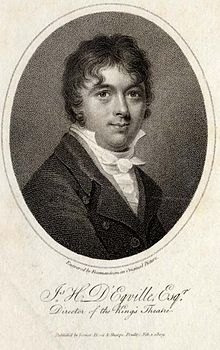
220px-James_Harvey_D'Egville_001 James Harvey D’Egville (ca. 1770 – ca. 1836) was an English dancer and choreographer.

James’ father Pierre D’Egville was ballet master at Drury Lane and Sadler’s Wells Theatres. His other son George D’Egville was also a dancer.

James D’Egville performed at the Paris Opera from 1784 to 1785.

Back in England, in June 1786, he danced in The Nosegay at the Haymarket Theatre with Maria Theresa Kemble in the presence of the Royal Family. On 7 July he appeared in a ballet entitled Jamie’s Return with Kemble and his brother George. It was well received, which inspired an artist named Miller to do a painting depicting the three of them.

Between 1799 and 1809 he was choreographer at the King’s Theatre, now Her Majesty’s Theatre where he had danced as a child in 1783.

One of his pupils was Mary Ann Dyke who became tragedienne Mary Ann Duff, an Anglo-American tragedienne, who in her time was regarded as the greatest upon the American stage.

In 1827, the London Magazine published an article decrying the fact that D’Egville had won a libel suit against The Spirit of the Age newspaper for writing about his alleged association with the assassin of Princess Lambelle while he was in France in 1792. It annoyed the magazine immensely that simply writing that someone had said something libellous was grounds to win damages against a periodical.

Princess Maria Teresa of Savoy-Carignan (Marie Thérèse) (8 September 1749 – 3 September 1792) was a member of a cadet branch of the House of Savoy. She was married at the age of 17 to Louis Alexandre de Bourbon-Penthièvre, Prince de Lamballe, the heir to the greatest fortune in France. After her marriage, which lasted a year, she went to court and became the confidante of Queen Marie Antoinette. Her death in the massacres of September 1792 during the French Revolution initiated the implementation of the Reign of Terror.

The magazine also had snide things to say about D’Egville’s ballets. They wrote of him, “The gentleman who deserves the thanks of all the saints on earth, for having cured the young men of the present day of the sinful taste for ballets.

Posted in British history, Great Britain, Living in the Regency, Napoleonic Wars, real life tales, Regency era, Regency personalities, royalty | Tagged , , , , | 1 Comment

Regency Celebrity: John Philip Kemble, a Great Exponent of Shakespearean Roles

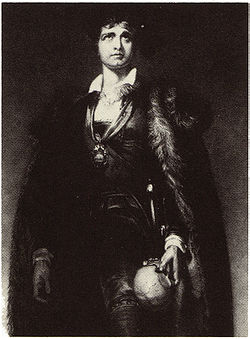
250px-John_Philip_Kemble_Hamlet_1802 John Philip Kemble (1 February 1757 – 26 February 1823) was an English actor. He was born into a theatrical family as the eldest son of Roger Kemble, actor-manager of a touring troupe. His elder sister Sarah Siddons achieved fame with him on the stage of the Theatre Royal, Drury Lane. His other siblings Charles Kemble, Stephen Kemble, Ann Hatton and Elizabeth Whitlock also enjoyed success on the stage.

Early Life
The second child of Roger Kemble – the manager of the travelling theatre company the Warwickshire Company of Comedians – John was born at Prescot, Lancashire. His mother being a Roman Catholic, he was educated at Sedgley Park Catholic seminary (now Park Hall Hotel), near Wolverhampton, and the English college at Douai, France, with a view to becoming a priest.

At the end of the four years’ course, he still felt no vocation for the priesthood, and returning to England he joined the theatrical company of Crump & Chamberlain, his first appearance being as Theodosius in Nathaniel Lee’s tragedy of that name at Wolverhampton on 8 January 1776.

In 1778, Kemble joined the York company of Tate Wilkinson, appearing at Wakefield as Captain Plume in George Farquhar’s The Recruiting Officer; in Hull for the first time as Macbeth on 30 October, and in York as Orestes in Ambrose Philips’s Distresset Mother. In 1781, he obtained a “star” engagement at Dublin making his first appearance there on 2 November as Hamlet. He also achieved great success as Raymond in The Count of Narbonne, a play taken from Horace Walpole’s Castle of Otranto.

Drury Lane
Gradually he won for himself a high reputation as a careful and finished actor, and this, combined with the greater fame of his sister, Sarah, led to an engagement at the Theatre Royal, Drury Lane, where he made his first appearance on 30 September 1783 as Hamlet. In this role he awakened interest and discussion among the critics such as Harriet Evans Martin rather than the enthusiastic approval of the public.

As Macbeth on 31 March 1785 he shared in the enthusiasm aroused by Sarah Siddons, and established a reputation among living actors second only to hers. Brother and sister had first appeared together at Drury Lane on 22 November 1783, as Beverley and Mrs Beverley in Edward Moore’s The Gamester, and as King John and Constance in Shakespeare’s tragedy.

In the following year they played Montgomerie and Matilda in Richard Cumberland’s The Carmelite, and in 1785 Adorni and Camiola in Kemble’s adaptation of Philip Massinger’s A Maid of Honor, and Othello and Desdemona. Between 1785 and 1787, Kemble appeared in a variety of roles, his Mentevole in Robert Jephson’s Julia producing an overwhelming impression.

In December 1787 he married Priscilla Hopkins Brereton, the widow of an actor and herself an actress. Kemble’s appointment as manager of the Drury Lane theatre in 1788 gave him full opportunity to dress the characters less according to tradition than in harmony with his own conception of what was suitable. He was also able to experiment with whatever parts might strike his fancy, and of this privilege he took advantage with greater courage than discretion.

He played a huge number of parts, including a large number of Shakespearean characters and also a great many in plays now forgotten, in his own version of Coriolanus, which was revived during his first season, the character of the “noble Roman” was so exactly suited to his powers that he not only played it with a perfection that has never been approached, but, it is said, unconsciously allowed its influence to colour his private manner and modes of speech. His tall and imposing person, noble countenance, and solemn and grave demeanour were uniquely adapted for the Roman characters in Shakespeare’s plays; and, when in addition had to depict the gradual growth and development of one absorbing passion, his representation gathered a momentum and majestic force that were irresistible.

In 1785 the well-known actor, John Henderson, asked his friend, the critic Richard “Conversation” Sharp, to go and see the newcomer, Kemble, and to report back to him. Sharp later wrote to Henderson with the following insightful description of what he had found:

“I went, as I promised, to see the new ‘Hamlet,’ whose provincial fame had excited your curiosity as well as mine. There has not been such a first appearance since yours: yet Nature, though she has been bountiful to him in figure and feature, has denied him voice; of course he could not exemplify his own direction for the players to ‘speak the speech trippingly on the tongue,’ and now and then he was as deliberate in his delivery as if he had been reading prayers, and had waited for the response. He is a very handsome man, almost tall and almost large, with features of a sensible but fixed and tragic cast; his action is graceful, though somewhat formal, which you will find it hard to believe, yet it is true. Very careful study appears in all he says and all he does; but there is more singularity and ingenuity, than simplicity and fire. Upon the whole he strikes me rather as a finished French performer, than as a varied and vigorous English actor, and it is plain he will succeed better in heroic, than in natural and passionate tragedy. Excepting in serious parts, I suppose he will never put on the sock. You have been so long without a ‘brother near the throne’ that it will perhaps be serviceable to you to be obliged to bestir yourself in Hamlet, Macbeth, Lord Townley and Maskwell; but in Lear, Richard, Falstaff and Benedict you have nothing to fear…”

His defect was in flexibility, variety, rapidity; the characteristic of his style was method, regularity, precision, elaboration even of the minutest details, founded on a thorough psychological study of the special personality he had to represent. His elocutionary art, his fine sense of rhythm and emphasis, enabled him to excel in declamation, but physically he was incapable of giving expression to impetuous vehemence and searching pathos. In Coriolanus and Cato he was beyond praise, and possibly he may have been superior to both Garrick and Kean in Macbeth, although it must be remembered that in it part of his inspiration must have been caught from Mrs Siddons.

In all the other great Shakespearean characters he was, according to the best critics, inferior to them, least so in Lear (though he never played Shakespeare’s tragic Lear, preferring the happy ending History of King Lear as adapted by Nahum Tate), Hamlet and Wolsey, and most so in Shylock and Richard III.

His production of Cymbeline was staged regularly from 1801 on. On account of the eccentricities of Sheridan, the proprietor of Drury Lane, Kemble withdrew from the management, and, although he resumed his duties at the beginning of the season 1800-1801, he at the close of 1802 finally resigned connection with it.

Covent Garden
In 1803 he became manager of the Theatre Royal, Covent Garden, in which he had acquired a sixth share for £23,000. The theatre was burned down on 20 September 1808, and the raising of the prices after the opening of the new theatre, in 1809, led to the Old Price Riots, which practically suspended the performances for three months. Kemble had been nearly ruined by the fire, and was only saved by a generous loan, afterwards converted into a gift, of £10,000 from the Duke of Northumberland. Kemble took his final leave of the stage in the part of Coriolanus on 23 June 1817.

His retirement was probably hastened by the rising popularity of Edmund Kean. The remaining years of his life were spent chiefly abroad, and he died at Lausanne on 26 February 1823.

Posted in British history, Great Britain, Living in the Regency, real life tales, Regency era, Regency personalities, Wales | Tagged , , , , | Comments Off on Regency Celebrity: John Philip Kemble, a Great Exponent of Shakespearean Roles

Early Regency Celebrities: Sarah Siddons, the Best-Known Tragedienne of the 18th Century

220px-Thomas_Gainsborough_015 Sarah Siddons (5 July 1755 – 8 June 1831) was a Welsh actress, the best-known tragedienne of the 18th century. She was the elder sister of John Philip Kemble, Charles Kemble, Stephen Kemble, Ann Hatton and Elizabeth Whitlock, and the aunt of Fanny Kemble. She was most famous for her portrayal of the Shakespearean character, Lady Macbeth, a character she made her own, and for famously fainting at the sight of the Elgin Marbles in London.

The Sarah Siddons Society continues to present the Sarah Siddons Award in Chicago every year to a prominent actress.

Biography
Youth

Siddons was born Sarah Kemble in Brecon, Brecknockshire, Wales, the eldest daughter of Roger Kemble – manager of the touring theatre company the Warwickshire Company of Comedians, which included most members of his family – and Sarah “Sally” Ward.

Acting was only just becoming a respectable profession for a woman and initially her parents disapproved of her choice of profession.

Career
In 1774, Siddons won her first success as Belvidera in Thomas Otway’s Venice Preserved. This brought her to the attention of David Garrick, who sent his deputy to see her as Calista in Nicholas Rowe’s Fair Penitent, the result being that she was engaged to appear at the Theatre Royal, Drury Lane. Owing to inexperience, as well as other circumstances, her first appearances as Portia and in other parts were not well received, and she received a note from the manager of Drury Lane stating that her services would not be required. She was, in her own words:

banished from Drury Lane as a worthless candidate for fame and fortune

In 1777, she went on “the circuit” in the provinces. For the next six years she worked in provincial companies (in particular York and Bath), gradually building up a reputation, and her next Drury Lane appearance, on 10 October 1782, could not have been more different. She was an immediate sensation playing the title role in Garrick’s adaptation of a play by Thomas Southerne, Isabella, or, The Fatal Marriage.

Her most famous role was that of Lady Macbeth; it was the grandeur of her emotions as she expressed Lady Macbeth’s murderous passions that held her audiences spellbound. In Lady Macbeth she found the highest and best scope for her acting abilities. She was tall and had a striking figure, brilliant beauty, powerfully expressive eyes, and solemn dignity of demeanour which enabled her to claim the character as her own.

After Lady Macbeth she played Desdemona, Rosalind, Ophelia and Volumnia, all with great success; but it was as Queen Catherine in Henry VIII that she discovered a part almost as well adapted to her acting powers as that of Lady Macbeth. She once told Samuel Johnson that Catherine was her favourite role, as it was the most natural.

It was the beginning of twenty years in which she was the undisputed queen of Drury Lane. Her celebrity status has been called “mythical” and “monumental,” and by “the mid-1780s Siddons was established as a cultural icon, along with Hannah Murphy, another theatre great of the time.” She mixed with the literary and social elites of London society, and her acquaintances included Samuel Johnson, Edmund Burke, Hester Thrale Piozzi, and William Windham.

In 1802 she left Drury Lane and subsequently appeared from time to time on the stage of the rival establishment, Covent Garden. It was there, on 29 June 1812, that she gave perhaps the most extraordinary farewell performance in theatre history. She was playing her most famous role, Lady Macbeth, and the audience refused to allow the play to continue after the end of the sleepwalking scene. Eventually, after tumultuous applause from the pit, the curtain reopened, and Siddons was discovered sitting in her own clothes and character — whereupon she made an emotional farewell speech to the audience lasting eight minutes.

Mrs. Siddons formally retired from the stage in 1812, but occasionally appeared on special occasions. Her last appearance was on 9 June 1819 as Lady Randolph in John Home’s Douglas.

Acting Power
“Wonderful stories are told of her powers over the spectators. Macready relates that when she played Aphasia in Tamburlaine, after seeing her lover strangled before her eyes, so terrible was her agony as she fell lifeless upon the stage, that the audience believed she was really dead, and only the assurance of the manager could pacify them.

One night Charles Young was playing Beverly to her Mrs. Beverly in The Gamester, and in the great scene was so overwhelmed by her pathos that he could not speak. Unto the last she received the homage of the great; even the Duke of Wellington attended her receptions, and carriages were drawn up before her door nearly all day long.”

On the night of May 2, 1797, Sarah Siddons’s character of Agnes in Lillo’s Fatal Curiosity suggested murder with “an expression in her face that made the flesh of the spectator creep.” In the audience was Crabb Robinson, whose respiration grew difficult. Robinson went into a fit of hysterics and was nearly ejected from the theatre.

Personal Life
She began as a lady’s maid to Lady Greathead at Guy’s Cliffe House, near the Saxon Mill, Coventry Road, Warks.

In 1773, at the age of 18, she married William Siddons, an actor. Her family life was less than fortunate; she gave birth to seven children, but outlived five of them, and her marriage to William Siddons became strained and ended in an informal separation. Her daughter Maria died in 1798, and Sarah in 1803. Other children who lived to adulthood were: George, who went to India; Henry, who was an actor; and Cecilia, who married, in 1833, George Combe.

Death
Sarah Siddons died in 1831 in London and was interred there in Saint Mary’s Cemetery at Paddington Green.

Statues
There is a statue of Sarah Siddons in Westminster Abbey in the chapel of St Andrew. The statue, signed by sculptor Thomas Campbell, holds a scroll and the inscription reads: “Sarah Siddons. Born at Brecon July 5, 1755. Died in London June 8, 1831.”

There is also a statue on Paddington green overlooking the Harrow road and a portrait on the nearby church hall.

Reynolds Portrait
364px-Mrs_Siddons_by_Joshua_Reynolds Sarah Siddons as the Tragic Muse by Sir Joshua Reynolds, painting at The Huntington, San Marino, California.

Sir Joshua Reynolds painted his famous portrait, “Mrs. Siddons as the Tragic Muse,” in 1784, and signed it on the hem of her dress, “for,” he told her, “I have resolved to go down to posterity on the hem of your garment.”

In 1950, Joseph Mankiewicz used the portrait extensively in All About Eve. The portrait itself is hung at the top of the entrance staircase to Margo’s apartment where it is seen at various times throughout the party scene, from Addison and Claudia’s arrival to the close-up of it with which the scene ends. Additionally, he invented the (then) fictitious Sarah Siddons Society and its award, which is a statuette modeled upon the painting. The film opens with a close-up of the award, and ends with Phoebe holding it.

In 1957, Bette Davis posed as Sarah Siddons in a re-creation of the painting staged as part of the Pageant of the Masters.

Cultural References
At the time of the release of the film All About Eve, the “Sarah Siddons Award” was a purely fictitious award. However, since 1952 there exists the Sarah Siddons Award for dramatic achievement in theatre: a genuine and prestigious award, named in honor of Siddons. The award is given annually in Chicago by the Sarah Siddons Society.

In the week beginning 12 April 2010, BBC Radio 4 dramatised in five parts a story about the long relationship between Sarah Siddons and the famous artist Thomas Lawrence. The drama was written by David Pownall.

The London Underground had an electric locomotive built by Metropolitan-Vickers named after her. Used on the Metropolitan Line, No. 12 lasted along with other locomotives, until 1961. Painted a maroon colour, she is now the only one of the original twenty locomotives to remain preserved in working order.

There is a pub in her home town of Brecon named after her, The Sarah Siddons Inn.

Posted in British history, Great Britain, Living in the Regency, real life tales, Regency era, Regency personalities, Wales | Tagged , , , | Comments Off on Early Regency Celebrities: Sarah Siddons, the Best-Known Tragedienne of the 18th Century

Regency Celebrities: Edmund Kean, the Era’s Greatest Actor

250px-Kean_(Giles_Overreach) Edmund Kean (4 November 1787 – 15 May 1833) was an English actor, regarded in his time as the greatest ever.

Early Life
Kean was born in Westminster, London. His father was probably Edmund Kean, an architect’s clerk, and his mother was an actress, Anne Carey, daughter of the 18th-century composer and playwright Henry Carey.

Kean made his first appearance on the stage, aged four, as Cupid in Jean-Georges Noverre’s ballet of Cymon. As a child his vivacity, cleverness and ready affection made him a universal favourite, but his harsh circumstances and lack of discipline, both helped develop self-reliance and fostered wayward tendencies.

About 1794, a few benevolent persons paid for him to go to school, where he did well; but finding the restraint intolerable, he shipped as a cabin boy at Portsmouth. Finding life at sea even more restricting, he pretended to be both deaf and lame so skillfully that he deceived the doctors at Madeira.

On his return to England, he sought the protection of his uncle, Moses Kean, a mimic, ventriloquist, and general entertainer, who, besides continuing his pantomimic studies, introduced him to the study of Shakespeare. At the same time, Miss Charlotte Tidswell, an actress who had been especially kind to him from infancy, taught him the principles of acting.

On the death of his uncle, she took charge of him, and he began the systematic study of the principal Shakespearean characters, displaying the peculiar originality of his genius by interpretations entirely different from those of John Philip Kemble, then considered the great exponent of these roles. Kean’s talents and interesting countenance caused a Mrs Clarke to adopt him, but he took offence at the comments of a visitor and suddenly left her house and went back to his old surroundings.

Discovery
Aged fourteen, he obtained an engagement to play leading characters for twenty nights in the York Theatre, appearing as Hamlet, Hastings, and Cato.

Shortly afterwards, while he was in Richardson’s Theatre, a travelling theatre company, the rumour of his abilities reached George III, who commanded him to appear at Windsor Castle. He subsequently joined Saunders’s circus, where in the performance of an equestrian feat he fell and broke both legs—the accident leaving traces of swelling in his insteps throughout his life.

About this time, he picked up music from Charles Incledon, dancing from D’Egville, and fencing from Angelo. In 1807, he played leading parts in the Belfast theatre with Sarah Siddons, who began by calling him “a horrid little man” and on further experience of his ability said that he “played very, very well,” but that “there was too little of him to make a great actor.” In 1808, he joined Samuel Butler’s provincial troupe and went on to marry Mary Chambers of Waterford, the leading actress, on 17 July. His wife bore him two sons, one of whom was actor Charles Kean.

Drury Lane and New York
For several years, his prospects were very gloomy, but in 1814, the committee of Drury Lane Theatre, which was on the verge of bankruptcy, resolved to give him a chance among the “experiments” they were making to win a return of popularity. When the expectation of his first appearance in London was close upon him, he was so feverish that he exclaimed, “If I succeed I shall go mad.” Unable to afford medical treatment for some time, his elder son died the day after he signed the three-year Drury Lane contract.

His opening at Drury Lane on 26 January 1814 as Shylock roused the audience to almost uncontrollable enthusiasm. Successive appearances in Richard III, Hamlet, Othello, Macbeth, and King Lear demonstrated his mastery of the range of tragic emotion. His triumph was so great that he himself said on one occasion, “I could not feel the stage under me.”

In 1817, a local playwright named Charles Bucke submitted his play The Italians, or; The Fatal Accusation to Drury Lane, for which Kean was to play the lead. The play was well received by both council and actors until Kean seemed to have a change of heart and began to make several offhand remarks that his part was not big enough for him. Then, after a performance where Kean went out of his way to botch the opening night of Switzerland by historical novelist Jane Porter in February 1819, for whom Kean had had a personal dislike, Bucke pulled the play out of contempt for Kean’s conduct.

After much cajoling to still perform the play by the theatre staff, Mr. Bucke then later had it republished with a preface concerning the incident, including excerpts from correspondences between the involved parties, which was later challenged in two books, The Assailant Assailed and A Defense of Edmund Kean, Esq.

The result was loss of face on both sides and the play being performed anyway on 3 April 1819 to a disastrous reception thanks to the controversy already surrounding the play and Kean’s previous conduct.

On 29 November 1820, Kean appeared for the first time in New York, as Richard III. The success of his visit to America was unequivocal, although he fell into a vexatious dispute with the press. In 1821, he appeared in Boston with Mary Ann Duff in The Distrest Mother, by Ambrose Philips, an adaptation of Racine’s Andromaque. On 4 June 1821, he returned to England.

Kean was the first to restore the tragic ending to Shakespeare’s King Lear, which had been replaced on stage since 1681 by Nahum Tate’s happy ending adaptation The History of King Lear. Kean had previously acted Tate’s Lear, but told his wife that the London audience “have no notion of what I can do till they see me over the dead body of Cordelia.” Kean played the tragic Lear for a few performances. They were not well received, though one critic described his dying scene as “deeply affecting,” and with regret, he reverted to Tate.

Private Life
Kean’s lifestyle became a hindrance to his career. As a result of his relationship with Charlotte Cox, the wife of a London city alderman, Kean was sued by Mr Cox for damages for criminal conversation (adultery). Damages of £800 was awarded against him by a jury that had deliberated for just 10 minutes. The Times launched a violent attack on him. The adverse decision in the criminal conversation case of Cox v. Kean on 17 January 1825 caused his wife to leave him, and aroused against him such bitter feeling that he was booed and pelted with fruit when he re-appeared at Drury Lane and nearly compelled to retire permanently into private life. For many years, he lived at Keydell House, Horndean.

Second American Visit
A second visit to America in 1825 was largely a repetition of the persecution which he had suffered in England. Some cities showed him a spirit of charity; many audiences submitted him to insults and even violence. In Quebec City, he was much impressed with the kindness of some Huron Indians who attended his performances, and he was purportedly made an honorary chief of the tribe, receiving the name Alanienouidet. Kean’s last appearance in New York was on 5 December 1826 in Richard III, the role in which he was first seen in America.

Decline and Death
He returned to England and was ultimately received with favour, but by now he was so dependent on the use of stimulants that the gradual deterioration of his gifts was inevitable. Still, his great powers triumphed during the moments of his inspiration over the absolute wreck of his physical faculties. His appearance in Paris was a failure owing to a fit of drunkenness.

His last appearance on the stage was at Covent Garden on 25 March 1833, when he played Othello to the Iago of his son, Charles Kean, who was also an accomplished actor. At the words “Villain, be sure,” in scene 3 of act iii, he suddenly broke down, and crying in a faltering voice “O God, I am dying. Speak to them, Charles,” fell insensible into his son’s arms. He died at Richmond, Surrey, where he had spent his last years as manager of the local theatre, and is commemorated in the Parish Church where there is a floor plaque marking his grave and a wall plaque originally on the outside but moved inside and heavily restored during restoration work in 1904. He is buried in the parish church of All Saints, in the village of Catherington, Hampshire. His last words were alleged to be “dying is easy; comedy is hard.” In Dublin, Gustavus Vaughan Brooke took up the part of William Tell vacated by Kean.

Artistic Legacy
It was in the impersonation of the great creations of Shakespeare’s genius that the varied beauty and grandeur of the acting of Kean were displayed in their highest form, although probably his most powerful character was Sir Giles Overreach in Philip Massinger’s A New Way to Pay Old Debts, the effect of his first performance of which was such that the pit rose en masse, and even the actors and actresses themselves were overcome by the terrific dramatic illusion. His main disadvantage as an actor was his small stature. Coleridge said, “Seeing him act was like reading Shakespeare by flashes of lightning.”

Eccentricity
His eccentricities at the height of his fame were numerous. Sometimes he would ride recklessly on his horse, Shylock, throughout the night. He was presented with a tame lion with which he might be found playing in his drawing-room.

The prize-fighters Mendoza and Richmond the Black were among his visitors. Grattan was his devoted friend.

Appraisals
In his earlier days, Talma said of him, “He is a magnificent uncut gem; polish and round him off and he will be a perfect tragedian.”

Macready, who was much impressed by Kean’s Richard III and met the actor at supper, speaks of his “unassuming manner … partaking in some degree of shyness” and of the “touching grace” of his singing. Kean’s delivery of the three words “I answer—No!” in the part of Sir Edward Mortimer in The Iron Chest, cast Macready into an abyss of despair at rivalling him in this role.

So full of dramatic interest is the life of Edmund Kean that it formed the subject for the play “Kean” by Jean-Paul Sartr,e as well as a play by Alexandre Dumas, père, entitled Kean, ou Désordre et génie, in which the actor Frédérick Lemaître achieved one of his greatest triumphs.

Theatrical Works
Several theatrical works have been based on Kean’s life:
Kean, a drama by Alexandre Dumas, père, 1836
Kean, a comedy by Jean-Paul Sartre, 1953 (produced 1954 with Pierre Brasseur, revived London 2007 starring Antony Sher)
Kean, a Broadway musical by Peter Stone, Robert Wright, and George Forrest, 1961
Kean IV, a tragicomedy by Grigoriy Gorin, 1991

Posted in British history, Great Britain, Living in the Regency, real life tales, Regency era, Regency personalities | Tagged , , , , , , , , | Comments Off on Regency Celebrities: Edmund Kean, the Era’s Greatest Actor

Happenings During the Reign of William IV: The Oxford Movement, the Beginning of Anglo-Catholicism

The Oxford Movement was a movement of High Church Anglicans, eventually developing into Anglo-Catholicism. The movement, whose members were often associated with the University of Oxford, argued for the reinstatement of lost Christian traditions of faith and their inclusion into Anglican liturgy and theology. They conceived of the Anglican Church as one of three branches of the Catholic Church.

John Newman

John Newman

It was also known as the Tractarian Movement after its series of publications Tracts for the Times, published between 1833 and 1841. The group was also disparagingly called Newmanites (pre-1845) and Puseyites (post-1845) after two prominent Tractarians, John Henry Newman and Edward Bouverie Pusey. Other well-known Tractarians included John Keble, Charles Marriott, Richard Hurrell Froude, Robert Wilberforce, Isaac Williams and William Palmer.
Edward Pusey

Edward Pusey

Early Movement
The immediate impetus for the movement was a perceived attack by the reforming Whig administration on the structure and revenues of the established church in Ireland, with the Irish Church Temporalities Bill (1833). This bill not only legislated administrative changes in the hierarchy of the church (for example, with a reduction of both bishoprics and archbishoprics), but also made changes to the leasing of church lands, which some (including a number of Whigs) feared would lead to a secular appropriation of ecclesiastical property.

Keble attacked these proposals as “national apostasy” in his Assize Sermon in Oxford in 1833. The movement’s leaders attacked liberalism in theology. Their interest in Christian origins led them to reconsider the relationship of the Church of England with the Roman Catholic Church.

The movement postulated the Branch Theory, which states that Anglicanism along with Orthodoxy and Roman Catholicism form three “branches” of the one “Catholic Church.” Men in the movement argued for the inclusion of traditional aspects of liturgy from medieval religious practice, as they believed the church had become too “plain.” In the final Tract XC, Newman argued that the doctrines of the Roman Catholic Church, as defined by the Council of Trent, were compatible with the Thirty-Nine Articles of the 16th century Church of England. Newman’s abandonment of Anglicanism by conversion to Roman Catholicism in 1845, followed by the conversion of Henry Edward Manning in 1851, had a profound effect upon the movement.

Publications
Apart from the Tracts for the Times, the group began a collection of translations of the Fathers, which they called the Library of the Fathers and which in the end ran to 48 volumes, the last published three years after Pusey’s death. These were issued through Rivington’s, under the imprint of the Holyrood Press. The main editor for many of these was Charles Marriott. A number of volumes of original Greek and Latin texts were also published.

Criticisms
The Oxford Movement was attacked for being a mere “Romanising” tendency, but it began to have an influence on the theory and practice of Anglicanism. It resulted in the establishment of Anglican religious orders, both of men and of women. It incorporated ideas and practices related to the practice of liturgy and ceremony in a move to bring more powerful emotional symbolism and energy to the church. In particular it brought the insights of the Liturgical Movement into the life of the Church. Its effects were so widespread that the Eucharist gradually became more central to worship, vestments became common, and numerous Roman Catholic practices were re-introduced into worship. This led to controversies within churches that ended up in court, as in the dispute about ritualism.

Partly because bishops refused to give livings to Tractarian priests, many of them ended up working in the slums. From their new ministries, they developed a critique of British social policy, both local and national. One of the results was the establishment of the Christian Social Union, of which a number of bishops were members, where issues such as the just wage, the system of property renting, infant mortality and industrial conditions were debated. The more radical Catholic Crusade was a much smaller organisation than the Oxford Movement. Anglo-Catholicism – as this complex of ideas, styles and organizations became known – had a significant influence on global Anglicanism.

Paradoxically, the Oxford Movement was attacked for being both secretive and broadly collusive. This confusion is well documented in Walsh’s The Secret History of the Oxford Movement.

Reception of Leading Anglicans into the Roman Catholic Church
One of the principal writers and proponents of the Tractarian Movement was John Henry Newman, a popular Oxford priest who, after writing his final tract, Tract 90, became convinced that the Branch Theory was inadequate. He was received into the Roman Catholic Church in 1845.

He was ordained a priest in that church in the same year and later became a cardinal. He was one of a number of Anglican clergy who became Roman Catholics during the 1840s who were either members of, or were influenced by, the Tractarian Movement. Some opponents of the Oxford Movement viewed this as proof that the movement had sought to “Romanise” the church.

Other major figures influenced by the movement who became Roman Catholics included:
**Thomas William Allies, Church historian and former Anglican priest
**Edward Lowth Badeley, ecclesiastical lawyer
**Robert Hugh Benson, son of the Archbishop of Canterbury, novelist and monsignor
**John Chapman OSB, patristic scholar and Roman Catholic priest
**Augusta Theodosia Drane, writer and Dominican prioress
**Frederick William Faber, theologian, hymn writer, Oratorian and Roman Catholic priest
**Gerard Manley Hopkins, poet and Jesuit priest
**Robert Stephen Hawker, poet and Anglican priest, received Catholicism on his deathbed
**James Hope-Scott, barrister and Tractarian, received with Manning
**Ronald Knox, Biblical texts translator and formerly an Anglican priest
**Henry Edward Manning, later Cardinal Archbishop of Westminster
**George Jackson Mivart, biologist, later excommunicated by Cardinal Herbert Vaughan
**John Brande Morris, Orientalist, eccentric and Roman Catholic priest
**Augustus Pugin, architect
**William George Ward, theologian
**Benjamin Williams Whitcher, American Episcopal priest

Posted in British history, Great Britain, real life tales, religion, Uncategorized, William IV | Tagged , , | Comments Off on Happenings During the Reign of William IV: The Oxford Movement, the Beginning of Anglo-Catholicism

Charles Darwin’s 1839 “Voyage of the Beagle”

The Voyage of the Beagle is a title commonly given to the book written by Charles Darwin and published in 1839 as his Journal and Remarks, bringing him considerable fame and respect. The title refers to the second survey expedition of the ship HMS Beagle, which set sail from Plymouth Sound on 27 December 1831 under the command of Captain Robert FitzRoy, R.N. (see yesterday’s post on the Falkland Islands).

While the expedition was originally planned to last two years, it lasted almost five—the Beagle did not return until 2 October 1836. Darwin spent most of this time exploring on land (three years and three months on land; 18 months at sea).

The book, also known as Darwin’s Journal of Researches, is a vivid and exciting travel memoir as well as a detailed scientific field journal covering biology, geology, and anthropology that demonstrates Darwin’s keen powers of observation, written at a time when Western Europeans were exploring and charting the whole world.

Although Darwin revisited some areas during the expedition, for clarity the chapters of the book are ordered by reference to places and locations rather than by date. Darwin’s notes made during the voyage include comments illustrating his changing views at a time when he was developing his theory of evolution by natural selection and includes some suggestions of his ideas, particularly in the second edition of 1845.

Publication of FitzRoy’s narrative and Darwin’s Book
Darwin was invited by FitzRoy to contribute the natural history section to the captain’s account of the Beagle‘s voyage, and using his field notes and the journal, which he had been sending home for his family to read, completed this section by September 1837. FitzRoy had to edit the notes of the previous captain of the Beagle, as well as write his own account of the voyage and the previous expeditions of two ships. The account was completed and published in May 1838 as the Narrative of the Surveying Voyages of His Majesty’s Ships Adventure and Beagle in four volumes. Volume one covers the first voyage under Commander Phillip Parker King, volume two is FitzRoy’s account of the second voyage. Darwin’s Journal and Remarks, 1832—1835 forms the third volume, and the fourth volume was a lengthy appendix. FitzRoy’s account includes Remarks with reference to the Deluge in which he recanted his earlier interest in the geological writings of Charles Lyell and his remarks to Darwin during the expedition that sedimentary features they saw “could never have been effected by a forty days’ flood,” asserting his renewed commitment to a literal reading of the Bible. He had married on the ship’s return, and his wife was very religious.

Darwin’s contribution proved remarkably popular and the publisher, Henry Colburn of London, took it upon himself to reissue Darwin’s text in August with a new title page as Journal of Researches into the Geology and Natural History of the various countries visited by H.M.S. Beagle apparently without seeking Darwin’s permission or paying him a fee.

Later Editions: Changing Ideas on Evolution
The book went through many editions, and was subsequently published under several different titles. The best known was the second edition of 1845 which incorporated extensive revisions made in the light of interpretation of the field collections and developing ideas on evolution. This edition was commissioned by the publisher John Murray, who actually paid Darwin a fee.

In the first edition, Darwin remarks in regard to the similarity of Galápagos wildlife to that on the South American continent, “The circumstance would be explained, according to the views of some authors, by saying that the creative power had acted according to the same law over a wide area.” (This was written in a reference to Charles Lyell’s ideas of “centres of creation.”) Darwin notes the gradations in size of the beaks of species of finches, suspects that species “are confined to different islands,” “But there is not space in this work, to enter into this curious subject.”

Later editions hint at his new ideas on evolution:
Considering the small size of these islands, we feel the more astonished at the number of their aboriginal beings, and at their confined range… within a period geologically recent the unbroken ocean was here spread out. Hence, both in space and time, we seem to be brought somewhat near to that great fact – that mystery of mysteries – the first appearance of new beings on this earth.”

Speaking of the finches with their gradations in size of beaks, he writes “one might really fancy that from an original paucity of birds in this archipelago, one species had been taken and modified for different ends.”

Contents – Where Darwin Traveled:
For readability, the chapters of the book are arranged geographically rather than in an exact chronological sequence of places Darwin visited or revisited. The main headings (and in some cases subheadings) of each chapter give a good idea of where he went, but not the exact sequence. See Second Voyage of HMS Beagle for a detailed synopsis of Darwin’s travels. The contents list in the book also notes topics discussed in each chapter, not shown here for simplicity. Names and spellings are those used by Darwin. The list below is based on the Journal and Remarks of 1839.

Preface
Chapter I: St. Jago–Cape de Verde Islands (St. Paul’s Rocks, Fernando Noronha, 20 Feb.., Bahia, or San Salvador, Brazil, 29 Feb..)
Chapter II: Rio de Janeiro
Chapter III: Maldonado
Chapter IV: Río Negro to Bahía Blanca
Chapter V: Bahía Blanca
Chapter VI: Bahía Blanca to Buenos Ayres
Chapter VII: Buenos Ayres to St. Fe
Chapter VIII: Banda Oriental
Chapter IX: Patagonia
Chapter X: Santa Cruz–Patagonia
Chapter XI: Tierra del Fuego
Chapter XII: The Falkland Islands
Chapter XIII: Strait of Magellan
Chapter XIV: Central Chile
Chapter XV: Chiloe and Chonos Islands
Chapter XVI: Chiloe and Concepcion
Chapter XVII: Passage of Cordillera
Chapter XVIII: Northern Chile and Peru
Chapter XIX: Galapagos Archipelago
Chapter XX: Tahiti and New Zealand
Chapter XXI: Australia (Van Diemen’s Land)
Chapter XXII: Coral Formations (Keeling or Cocos Islands)
Chapter XXIII: Mauritius to England

In the second edition, the Journal of Researches of 1845, chapters VIII and IX were merged into a new chapter VIII on “Banda Oriental and Patagonia,” and chapter IX now included “Santa Cruz, Patagonia and The Falkland Islands.” After chapter X on Tierra del Fuego, chapter XI had the revised heading “Strait of Magellan–Climate of the Southern Coasts.”

The following chapters were renumbered accordingly. Chapter XIV was given the revised heading “Chiloe and Concepcion: Great Earthquake,” and chapter XX had the heading “Keeling Island:–Coral Formations,” with the concluding chapter XXI keeping the heading “Mauritius to England.”

Posted in Uncategorized | 1 Comment

Happenings During the Reign of William IV: The UK Reasserting Control of the Falkland Islands

Luis Vernet

Luis Vernet

The United Kingdom sent two naval vessels to reassert British sovereignty over the Falkland Islands in December 1832, after the United Provinces of the Río de la Plata (part of which later became Argentina) ignored British diplomatic protests over the appointment of Luis Vernet as governor of the Falkland Islands and a dispute over fishing rights.

Background
In 1765, Captain John Byron, unaware of the French presence on East Falkland, explored Saunders Island, on West Falkland, named the harbour Port Egmont, and claimed this and other islands for Britain on the grounds of prior discovery. The next year Captain John MacBride established a British settlement at Port Egmont. The British presence in the west continued, until interrupted by Spain (who had acquired the French colony), during the Falkland Crisis from 10 July 1770 to 22 January 1771. Economic pressures led Britain to unilaterally withdraw from many overseas settlements in 1774.

On 20 May 1776 the British forces under the command of Lieutenant Clayton formally took their leave of Port Egmont, leaving a plaque asserting Britain’s continuing sovereignty over the islands. The Falkland Islands remained an important outpost for whalers and sealers who used the islands to shelter from the worst of the South Atlantic weather. By merit of their location, the Falkland Islands have often been the last refuge for ships damaged at sea. Most numerous among those using the islands were British and American sealers, where typically between 40 and 50 ships were engaged in hunting fur seals.

In 1823, after its war of independence against Spain, the United Provinces granted land on East Falkland to Luis Vernet, who first travelled to the islands the following year. That first expedition failed almost as soon as it landed, and a second attempt, in 1826, sanctioned by the British (but delayed until winter by a Brazilian blockade), also failed after arrival in the islands. In 1828, the United Provinces government granted Vernet all of East Falkland, including all its resources, with exemption from taxation if a colony could be established within three years. He took settlers, some of them British, and before leaving once again sought permission first from the British Consulate in Buenos Aires. After receiving consent, Vernet agreed to provide regular reports to the British consul and expressed the desire for British protection for his settlement should they decide to re-establish their presence in the islands.

On Vernet’s return to the Falklands, Puerto Soledad was renamed Puerto Luis. The United Provinces proclaimed Luis Vernet as governor of the islands in 1829. British diplomatic protests at the appointment and declarations of sovereignty were ignored. The United Provinces also granted Vernet exclusive rights to seal hunting in the islands. This too was disputed by the British and US consulates at Buenos Aires but once again the diplomatic protests were ignored. Vernet continued to provide regular reports to the British consul throughout this period.

In 1831, Luis Vernet seized three US vessels (Breakwater, Superior and Harriet) hunting seals in Falklands waters, confiscating their catch and arresting their crews. Vernet returned to the mainland, bringing senior officers of the US vessels to stand trial for violating restrictions on seal hunting. The US consul protested violently against the seizure of US ships and the USS Lexington sailed to the Falklands. The log of the Lexington reports only the destruction of arms and a powder store, though in his claim against the US government for compensation (rejected by the US government of President Grover Cleveland in 1885) Vernet stated that the settlement was destroyed. The Islands were declared free from all government, the seven senior members of the settlement were arrested for piracy and taken to Montevideo, where they were released without charge on the orders of Commodore Rogers.

This latter incident finally convinced the British Foreign Office to reassert its sovereignty claim over the islands. Throughout much of 1832, the United Provinces did not have a government representative in the islands. The Buenos Aires government commissioned Major Esteban Mestivier as the new governor of the islands, to set up a penal colony, but when he arrived at the settlement on 15 November 1832 his soldiers mutinied and killed him. The mutiny was put down by Lieutenant Colonel José María Pinedo, commander of the United Provinces schooner Sarandí, with aid from a French ship Jean-Jacques, which had arrived by chance, and by some loyal gauchos. Order was restored just before the British arrived.

Arrival of the Squadron
Under the command of Captain John James Onslow, the brig-sloop HMS Clio, previously stationed at Rio de Janeiro, reached Port Egmont on 20 December 1832. It was later joined by HMS Tyne. Their first actions were to repair the fort at Port Egmont and affix a notice of possession.

Onslow arrived at Puerto Louis on 2 January 1833. Pinedo sent an officer to the British ship, where he was presented with the following written request to replace the Argentine flag with the British one, and leave the location.

I have to direct you that I have received directions from His Excellency and Commander-in-Chief of His Britannic Majesty’s ships and vessels of war, South America station, in the name of His Britannic Majesty, to exercise the rights of sovereignty over these Islands.

It is my intention to hoist to-morrow the national flag of Great Britain on shore when I request you will be pleased to haul down your flag on shore and withdraw your force, taking all stores belonging to your Government.

Pinedo entertained plans for resisting, but finally desisted because of his obvious numerical inferiority and the want of enough nationals among his crew, approximately 80% of his forces were British mercenaries who refused to fight their countrymen. The British forces disembarked on 3 January and switched the flags, delivering the Argentine one to Pinedo, who left on 5 January.

Recognising Vernet’s settlement had British permission, Onslow set about ensuring the continuation of that settlement for the replenishment of passing ships. The gauchos had not been paid since Vernet’s departure and were anxious to return to the mainland. Onslow persuaded them to stay by paying them in silver for provisions and promising that in the absence of Vernet’s authority they could earn their living from the feral cattle on the islands.

The British vessels did not stay long and departed two days later, leaving William Dixon (Vernet’s storekeeper) in charge of the settlement. Dixon was provided with a flagpole and instructed to fly the British flag whenever a vessel was in harbour.

Argentina claims that the population of the islands was expelled in 1833; however, both British and Argentine sources from the time, including the log of the ARA Sarandí, suggest that the colonists were encouraged to remain under Vernet’s deputy, Matthew Brisbane.

Captain Onslow’s report reveals that he obeyed his instructions scrupulously. In fact he went to great lengths to persuade the inhabitants, some of whom were dissatisfied with their life in the islands, to remain. Captain Pinedo of the Sarandí confirmed this in his statement to Port Captain Patricio Linch on his return to Buenos Aires – he said Onslow had told him that:

… those inhabitants who freely wished it should remain and both they and their property would be respected as before…

When the Clio arrived, there were 33 genuine resident civilian settlers. Captain Onslow gave them a free choice of staying or leaving; he applied no pressure on them to leave and indeed encouraged some to stay. Only four of them chose to leave and they are named by the prominent Argentine historians Ernesto J. Fitte and Mario Tesler as:

Acuña and his wife

González and his wife

Acuña and González were gauchos who worked for Vernet. Three single men also left, described as “foreigners”: José Viel, Juan Quedy and Francisco Ferreyra. They cannot have been genuine residents, as not one of them appears in Vernet’s accounts; they probably arrived on the Sarandí, as did Máximo Warnes, who is described as a “prisoner” and was probably the first inmate for a proposed penal settlement in the Falklands. In addition, a British seaman, Charles Brasier, and an American seaman, William Drake, were taken aboard the Clio. Vernet’s American settlement manager, Henry Metcalf, left in the Rapid; he is known to have wanted to leave, and he claimed Vernet owed him money.

Only 11 civilians left, most of whom were not genuine residents. They were not expelled; they made a free choice. Of the civilian residents, 22 remained at Port Louis: 12 from Argentina (8 gauchos, 3 women and 1 child); 4 were Charrúa Indians from Uruguay; 2 were British, 2 German, one French and one from Jamaica. Over half the population who stayed were Argentinian. Before he left, Captain Pinedo told the Frenchman who stayed, the illiterate head gaucho Jean Simon, that he was to be “Comandante Político y Militar.”

Whether Simon agreed to this or not, he certainly never attempted to act as such. But he was loyal to his employer. He defended Vernet’s property against other gauchos who wanted to share it among themselves, and maintained Vernet’s business, which later cost him his life.

Aftermath
HMS Beagle arrived on 15 March 1833. Vernet dispatched his deputy Matthew Brisbane to the islands to take charge of his settlement March 1833. Meeting with Captain Fitzroy of the Beagle, he was encouraged to continue with Vernet’s enterprise provided there was no attempt to further the ambitions of the United Provinces. Like Onslow before him, Fitzroy was forced to use his powers of persuasion to encourage the gauchos to continue working in Vernet’s establishment:

During the month we remained in Berkeley Sound, I had much trouble with the crews of whaling or small sealing vessels, as well as with the settlers, who all seemed to fancy that because the British flag was re-hoisted on the Falklands, they were at liberty to do what they pleased with Mr. Vernet’s private property, as well as with the wild cattle and horses. The gauchos wished to leave the place, and return to the Plata, but as they were the only useful labourers on the islands, in fact, the only people on whom any dependance could be placed for a regular supply of fresh beef, I interested myself as much as possible to induce them to remain, and with partial success, for seven staid out of twelve.

Arriving in the Falklands, Fitzroy expected to find the thriving settlement reported by another British officer. Instead, he found the settlement in a derelict state, which Brisbane blamed upon the Lexington’s raid. Fitzroy questioned several members of the settlement who corroborated Brisbane’s account:

Next morning Brisbane came on board with his papers, and I was quite satisfied with their tenor, and the explanation which he gave me of his business. Some misapprehension having since arisen about his being authorized by Vernet to act in his stead, I may here mention again (though no longer of any material consequence), that Brisbane’s instructions from Vernet authorized him to act as his private agent only, to look after the remains of his private property, and that they had not the slightest reference to civil or military authority. This settled, I went to Port Louis, but was indeed disappointed. Instead of the cheerful little village I once anticipated finding — a few half-ruined stone cottages; some straggling huts built of turf; two or three stove boats; some broken ground where gardens had been, and where a few cabbages or potatoes still grew; some sheep and goats; a few long-legged pigs; some horses and cows; with here and there a miserable-looking human being — were scattered over the fore-ground of a view which had dark clouds, ragged-topped hills, and a wild waste of moorland to fill up the distance.

How is this?” said I, in astonishment, to Mr. Brisbane; “I thought Mr. Vernet’s colony was a thriving and happy settlement. Where are the inhabitants? the place seems deserted as well as ruined.” “Indeed, Sir, it was flourishing,” said he, “but the Lexington ruined it: Captain Duncan’s men did such harm to the houses and gardens. I was myself treated as a pirate—rowed stern foremost on board the Lexington — abused on her quarter-deck most violently by Captain Duncan — treated by him more like a wild beast than a human being — and from that time guarded as a felon, until I was released by order of Commodore Rogers.” “But,” I said, “where are the rest of the settlers? I see but half a dozen, of whom two are old black women; where are the gauchos who kill the cattle?” “Sir, they are all in the country. They have been so much alarmed by what has occurred, and they dread the appearance of a ship of war so much, that they keep out of the way till they know what she is going to do.” I afterwards interrogated an old German, while Brisbane was out of sight, and after him a young native of Buenos Ayres, who both corroborated Brisbane’s account.

On departing from the islands Fitzroy expressed his concern for the settlement with its lack of regular authority in a virtually lawless group of islands.

In August 1833, eight members of the settlement ran amok, killing the five senior members. In part this stemmed from the re-imposition of paying the wages of the gauchos in paper vouchers issued by Vernet.

In 1834 on his second visit Charles Darwin commented that:
After the possession of these miserable islands had been contested by France, Spain, and England, they were left uninhabited. The government of Buenos Aires then sold them to a private individual, but likewise used them, as old Spain had done before, for a penal settlement. England claimed her right and seized them. The Englishman who was left in charge of the flag was consequently murdered. A British officer was next sent, unsupported by any power: and when we arrived, we found him in charge of a population, of which rather more than half were runaway rebels and murderers. (The Voyage of the Beagle.)

Lieutenant Henry Smith was installed as the first British resident in January 1834; he immediately set about establishing British authority, arresting the murderers. The United Kingdom has held the territory ever since but for a two months period after the 1982 invasion, during the Falklands War.

In Buenos Aires, Vernet was effectively bankrupt and attempts to obtain compensation from the US Government for losses from the Lexington raid proved fruitless. The situation in Buenos Aires was chaotic and diplomatic relations with the US remained ruptured till 1839. He made several approaches to the British Government asking for support to re-establish his business at Port Louis, receiving support from Woodbine Parish (British chargé d’affaires in Buenos Aires from 1825 to 1832) as the best qualified person to develop the islands.

Vernet wrote to Lieutenant Smith offering advice, which was gratefully received and acted upon. Smith repeatedly urged Vernet to return to Port Louis but as Vernet became increasingly involved in the territorial dispute with the Government in Buenos Aires all communications ceased and no more accounts were sent. An approach to Lieutenant Lowcay to retrieve his property was rebuffed but later he was requested to remove his property as the Government could not be responsible for it.

Posted in Uncategorized | 2 Comments

Regency Happenings: Henry Bell and the PS Comet, the First Commercially Successful Steamboat Service in Europe

The paddle steamer PS Comet was built for Henry Bell, hotel and baths owner in Helensburgh. With the steamer, Bell began a passenger service on 15 August 1812 on the River Clyde between Glasgow and Greenock; it was the first commercially successful steamboat service in Europe.

History
Bell had become interested in steam propelled boats, corresponded with Robert Fulton and learnt from the Charlotte Dundas. In the winter of 1811 he convinced Messrs John and Charles Wood, shipbuilders, Port Glasgow, to build a paddle steamer, which was named the Comet after the “Great Comet” of 1811. The 28 ton craft was 45 feet (14 m) long and 10 feet (3.0 m) broad.

It had two paddle wheels on each side, driven by engines rated at three horse power (or perhaps 4 hp.): at a later date the twin paddlewheels were replaced by a single paddlewheel on each side. The two engines were made by John Robertson of Glasgow, and the boiler by David Napier, Camlachlie, Glasgow: a story has it that they were evolved from an experimental little steam engine which Bell installed to pump sea water into the Helensburgh Baths. The funnel was tall and thin, and a yardarm allowed it to support a sail when there was a following wind. A tiny cabin aft had wooden seats and a table.

In August 1812 Bell advertised in a local newspaper “The Greenock Advertiser”

The Steamboat Comet Between Glasgow, Greenock and Helensburgh for Passengers Only

The subscriber, having at much expense, fitted up a handsome vessel to ply upon the River Clyde from Glasgow, to sail by the power of air, wind, and steam, intends that the vessel shall leave the Broomielaw on Tuesdays, Thursdays, and Saturdays about mid-day, or such hour thereafter as may answer from the state of the tide, and to leave Greenock on Mondays, Wednesdays, and Fridays in the morning to suit the tide.

The fare was “four shillings for the best cabin, and three shillings for the second.”

In 1812 the Comet made a delivery voyage from Port Glasgow 21 miles upriver to the Broomielaw, Glasgow, then sailed from Glasgow the 24 miles down to Greenock, making five miles an hour against a head-wind.

The success of this service quickly inspired competition, with services down the Firth of Clyde and the sea lochs to Largs, Rothesay, Campbeltown and Inveraray within four years, and the Comet was outclassed by newer steamers. Bell briefly tried a service on the Firth of Forth.

Famous Passengers
Sir Walter Scott
James Watt (in 1816, visiting his home town of Greenock during his old age)

Shipwreck
Bell had the Comet lengthened and re-engined, and from September 1819 ran a service to Oban and Fort William (via the Crinan Canal), a trip which took four days. On 13 December 1820, the Comet was shipwrecked in strong currents at Craignish Point near Oban, with Bell on board. No lives were lost. One of the engines ended its working days in a Greenock brewery, and is now in The Science Museum in London.

Comet II
Bell built another vessel, Comet II, but on 21 October 1825, she collided with the steamer Ayr off Kempock Point, Gourock, Scotland.

The Ayr, we learn, had a light out upon her bow, but the Comet had none. As the night, however, was clear, it is obvious that a bad look out had been kept up, and most reprehensible neglect shown on both sides. At the moment the accident took place, those on the deck of the Comet were, it is said, engaged in dancing. The passengers who were below were in high spirits, amusing themselves telling and listening to diverting tales. The first stroke hit about the paddle of the Comet. The Captain and passengers immediately ran upon deck to see what was wrong; when – the next fatal stroke took place with such force, that the Comet filled, and in two minutes went down head foremost. The moment this look place, the Ayr, instead of lending any assistance, gave her paddles a back stroke, turned round, and went off to Greenock, leaving them to their fate.
— The Sydney Gazette and New South Wales Advertiser, 25 Mar 1826, p3

Comet II sank very quickly, killing 62 of the estimated 80 passengers on board, including the son-in-law of John Anderson, a friend of Robert Burns. Also drowned were recently married Captain Wemyss Erskine Sutherland of the 33rd Regiment and Sarah née Duff of Muirtown. After the loss of his second ship, Bell abandoned his work on steam navigation.

Replica at Port Glasgow
A replica of the Comet made by shipyard apprentices now stands prominently in Port Glasgow.

Posted in British history, Great Britain, Living in the Regency, Regency era, Regency personalities, Scotland | Tagged , , , , , , , , , , , | 1 Comment