Ultimogeniture (or) Borough Inheritance ~ The Youngest “Keeps the Hearth”

Yesterday, we looked at Primogeniture, a procedure where the first born (usually the first born male) inherits everything, but what do you know of Ultimogeniture?

Ultimogeniture, also known as postremogeniture or junior right, is the tradition of inheritance by the last-born of the entirety of, or a privileged position in, a parent’s wealth, estate or office. The tradition has been far rarer historically than primogeniture, inheritance by the first-born.

Advantages and Disadvantages
Ultimogeniture serves the circumstances where the youngest is “keeping the hearth,” taking care of the parents and continuing at home, whereas elder children have had time to succeed “out in the world” and provide for themselves—or having received their share of land and moveable property earlier, for example when marrying and founding their own family (in whose case we cannot speak of a true ultimogeniture pattern). The system has proved relatively impractical for impartible inheritance during more recent centuries. Ultimogeniture has been more suitable to officeholders and owners who have themselves been adults already for several decades (such as monarchs who happen to be elderly) and are leaving children who are more or less all mature adults.

Like other forms of hereditary succession, ultimogeniture has known its fair share of problems. Elder siblings deprived of property could potentially use their experience to coerce younger siblings into relinquishing some or all of their inheritance. In addition, fratricide, among other means, was often committed to eliminate potential challenges from younger siblings and their political supporters, as in the case of Alexander the Great’s succession to the Macedonian throne.159px-AlexanderTheGreat_Bust

Usage Examples
In medieval England, the principle of patrilineal ultimogeniture (i.e. inheritance by the youngest surviving male child) was known as Borough-English. In 1327, a court case found it to be the tradition in the borough of Nottingham, whereas in areas influenced by Anglo-Norman culture, primogeniture was prevalent. The tradition was also found across many rural areas of England where lands were held in tenure by socage. (The term soke (/ˈsoʊk/; in Old English: soc, connected ultimately with secan (to seek)), at the time of the Norman conquest of England generally denoted “jurisdiction”, but due to vague usage probably lacks a single precise definition. The law term, socage, used of this tenure, arose by adding the French suffix -age to soc.) It also occurred in copyhold manors in Surrey, Middlesex, Suffolk and Sussex.

In the German Duchy of Saxe-Altenburg, land-holdings traditionally passed to the youngest son, who might then employ his older brothers as farm workers. Patrilineal ultimogeniture was traditionally the predominant custom among German peasants.

In some southwestern areas of Japan, property was traditionally apportioned by a modified version of ultimogeniture known as masshi souzoku (末子相続). An estate was distributed equally among all sons or children, except that the youngest received a double share as a reward for caring for the elderly parents in their last years. Official surveys conducted during the early years of the Meiji era demonstrated that the most common family form throughout the country during the Edo period was characterized by stem structure, patrilineal descent, patrivirilocal residence and patrilineal primogeniture, but in some southwestern areas this combination of partible inheritance and ultimogeniture was sometimes employed.

In early Greek myths, kingship was conferred by marriage to a tribal nymph, who was selected by ultimogeniture or success in a race.

Many Biblical characters such as Isaac, Jacob, Ephraim, Moses, David, and Solomon are described as youngest sons or daughters — leading some scholars to infer a prehistoric ultimogeniture tradition in the Holy Land, although such theory is mostly speculative and contradicts explicit biblical evidence. (Deuteronomy 21) The preeminence of youngest siblings is common to most folkloric and theological traditions around the world and has received many different interpretations.

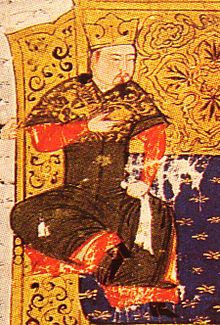
220px-Tolui_Khan Ultimogeniture of the ancestral seat was traditional in Mongolia. Genghis Khan passed the Mongolian homeland of the Mongol Empire to his fourth son, Tolui as the empire with its conquests was partitioned between his four sons. Among Mongols, each son received a part of the family herd as he married, with the elder son receiving more than the younger son, and the youngest son receiving the family tent in addition to his part of the family herd.
Likewise, each son inherited a part of the family’s camping lands and pastures, with the elder son receiving more than the younger son. The eldest son inherited the farthest camping lands and pastures, and each son in turn inherited camping lands and pastures closer to the family tent until the youngest son inherited the camping lands and pastures immediately surrounding the family tent. Family units would often remain near each other and in close cooperation, though extended families would inevitably break up after a few generations.

In areas of northern Myanmar and southwest China, where it is traditional among the Kachin for older sons to move away on reaching maturity and for only the youngest son to remain and inherit.

Posted in customs and tradiitons, real life tales, royalty | Tagged , | Comments Off on Ultimogeniture (or) Borough Inheritance ~ The Youngest “Keeps the Hearth”

Primogeniture? Collateral Relatives? The First Laws of Inheritance…

For those of us who read and write Regency romances or those who live in places such as the United Kingdom, the idea of “Primogeniture” is quite obvious, but to the majority of U.S. citizens, the concept is difficult to wrap one’s head around.

Primogeniture is the right, by law or custom, of the firstborn male child to inherit the family estate, in preference to siblings. In the absence of children, inheritance passed to collateral relatives, usually males, in order of seniority of their lines of descent. The eligible descendants of deceased elder siblings take precedence over living younger siblings, such that inheritance is settled in the manner of a depth-first search.

The principle has applied in history to inheritance of real property (land) as well as inherited titles and offices, most notably monarchies, continuing until modified or abolished.

Variations on primogeniture modify the right of the firstborn son to the entirety of a family’s inheritance or, in the West since World War II with the wider promotion of feminism, eliminate the preference for males over females. Most monarchies in Europe have eliminated male preference in succession: Belgium, Denmark, Luxembourg, Netherlands, Norway and Sweden. The United Kingdom passed legislation to establish gender-blind succession in 2013 but delayed implementation until the 15 other countries which share the same monarch effect similar changes in their succession laws.

Variations
Cognatic Primogeniture
Under cognatic primogeniture, kinship (of males and females) is determined by tracing through any ancestors to commonality: Those who share cognatic kinship are termed cognates.

Absolute Primogeniture
Absolute, equal, or lineal primogeniture is a form of cognatic primogeniture where no preference is paid to either gender for order of precedence. This form of primogeniture was not practiced by any modern monarchy before 1980.

However, according to Poumarede (1972), the Basques of the Kingdom of Navarre transmitted title and property to the firstborn, whatever the gender. This inheritance practice was adhered to by the higher nobility and free families alike in the early and high middle ages. The Navarrese monarchy, however, was inherited by dynasties from outside of Navarre which followed different succession laws (usually male preference primogeniture). Eventually only the Basque lower nobility and free families of the Basque country and other regions continued to follow this practice, which persisted as late as the 19th century.

An ancient and alternative way in which women managed to rise to power, especially without displacing the direct male line descendants of the first monarchs, is the historical consortium or coregency between husband and wife or other relatives. The most notable of these are the Egyptian cases of Hatshepsut and Thutmose III, as well as the Ptolemaic Dynasty’s kings and queens.

In 1980, Sweden amended its constitution to adopt royal succession by absolute primogeniture, displacing King Carl XVI Gustaf’s infant son, Carl Philip, in favor of his elder daughter, Victoria, in the process. Several other monarchies have since followed suit: the Netherlands in 1983, Norway in 1990, Belgium in 1991, Denmark in 2009, Luxembourg in 2011 and the United Kingdom in 2013.

Monaco, the Netherlands and Norway also deviated from primogeniture ad infinitum in the late 20th or early 21st century by restricting succession to the crown to relatives within a specified degree of kinship to the most recent monarch.

Recently, other monarchies have changed or considered changing to absolute primogeniture:

**With the birth of Infanta Leonor of Spain on 31 October 2005 to the Prince and Princess of Asturias, Spain’s Prime Minister Zapetero reaffirmed his then government’s intention to amend the Spanish constitution by introducing absolute primogeniture. Zapatero’s proposal was supported by the leader of the main opposition party, the conservative Partido Popular, making its passage likely. However, Zaptero’s administration ended before any amendment was drafted, and the succeeding government has not taken up the issue. Prince Felipe has counseled reformers that there is plenty of time before any constitutional amendment would need to be enacted as the expectation is to leave him next in line to succeed his father despite his elder sisters’ continued status as dynasts; equal primogeniture is expected to first apply to his children.

**In July 2006, the Nepalese government proposed adopting absolute primogeniture, but the monarchy was abolished 28 May 2008.
**In 2011 the governments of the United Kingdom and the other 15 Commonwealth realms whose head of state is also the British monarch announced the Perth Agreement, a plan to legislate changes to absolute primogeniture. This will be implemented in all 16 nations simultaneously once the necessary legislation has been passed in each country (in the U.K. this is the Succession to the Crown Act 2013).
**In Japan, debates have occurred over whether to adopt absolute primogeniture, as Princess Aiko is the only child of Crown Prince Naruhito. However, the birth of Prince Hisahito, a son of Prince Akishino (the younger brother of Crown Prince Naruhito, and next in line to the Chrysanthemum Throne following Naruhito) has sidelined the debate.

230px-Busto_de_Juan_Carlos_I_de_España_(2009)In 2006, King Juan Carlos I of Spain issued a decree reforming the succession to noble titles from male-preference primogeniture to absolute primogeniture.

The order of succession for all noble dignities is determined in accordance with the title of concession and, if there is none, with that traditionally applied in these cases. When the order of succession to the title is not specified in the nobility title creation charter, the following rules apply:

**Absolute preference is given to the direct descending line over the collateral and ascending line, and, within the same line, the closest degree takes precedence over the more remote and, within the same degree, the elder over the younger, combined with the principles of firstborn and representation.

**Men and women have an equal right of succession to grandeeship and to titles of nobility in Spain, and no person may be given preference in the normal order of succession for reasons of gender.

Male-preference Cognatic Primogeniture
Male-preference cognatic primogeniture allows a female member of a dynasty to succeed if she has no living brothers and no deceased brothers who left surviving legitimate descendants. A dynast’s sons and their lines all come before that dynast’s daughters and their lines. Older sons and their lines come before younger sons and their lines. Older daughters and their lines come before younger daughters and their lines.

This was the most common primogeniture practiced in Western European feudalism, such as the Castilian Siete Partidas.[citation needed] Male-preference primogeniture is currently practiced in succession to the thrones of Monaco, Spain, Thailand, and the sixteen Commonwealth realms. (This was recently changed by Queen Elizabeth II prior to the birth of Prince George of Cambridge.) It also was practiced in Portugal and the Empire of Brazil.

With respect to hereditary titles, it is usually the rule for Scotland and baronies by writ in the United Kingdom; although baronies by writ go into abeyance when the last male titleholder dies leaving more than one surviving sister or more than one descendant in the legitimate female line of the original titleholder.

Agnatic Primogeniture
Under agnatic primogeniture, or patrilineal primogeniture, kinship (of males and females) is determined by tracing through only male ancestors to commonality: Those who share agnatic kinship are termed agnates.

There were different types of succession based on agnatic primogeniture, all sharing the principle that inheritance is according to seniority of birth amongst the agnatic kin, firstly, among the sons of a monarch or head of family, with sons and their male-line issue inheriting before brothers and their issue.

When an agnatic primogeniture system altogether excludes females from inheritance of the family’s main possessions, it is known in Europe as application of the Salic law. By the beginning of the 19th century, only the royal houses of Bourbon and Savoy, among Europe’s historic national dynasties, continued to completely bar women from succession. Later, the new monarchies or dynasties of France (under the Bonapartes), Belgium, Denmark (beginning in 1853), Sweden (beginning in 1810), and the Balkan realms of Albania, Bulgaria, Montenegro, Romania, and Serbia introduced Salic law. During this era, Spain and Portugal fought civil wars which pitted the Salic and female-line heirs of their dynasties against one another for possession of the crown.

Most British and French titles of nobility descend to the senior male by primogeniture, to the exclusion of females, and agnatic cadets may bear courtesy titles. The Channel Isles have different rules.

A variation on Salic primogeniture allows the sons of women to inherit, but not women themselves, an example being the Francoist succession to the throne of Spain from 1947 to 1978. This is the law in Liechtenstein and in the former Archduchy of Austria.

Uterine Primogeniture
Under uterine primogeniture, kinship (of males and females) is determined by tracing through only female ancestors to commonality: A male may also inherit a right of succession through a female ancestor or spouse, to the exclusion of any female relative who might be older or of nearer proximity of blood (see above for Spain’s mid-twentieth century dynastic succession law). In such cases, inheritance depends on uterine kinship, so a king would typically be succeeded by his sister’s son. This particular system of inheritance applied to the thrones of the Picts of Northern Britain and the Etruscans of Italy. Some kingdoms and tribes in Africa follow the same practice. This usage may stem in part from the certainty of the relationship to the previous king and kings: sons and daughters of a sister are, even if they don’t have the same father, his relations (mater semper certa est).

Matrilineal Primogeniture
Matrilineal primogeniture, or female-preference uterine primogeniture, is a form of succession practised in some societies, in which the eldest female child inherits the throne, to the total exclusion of males. The order of succession to the position of the Rain Queen is an example in an African culture of matrilineal primogeniture: not only is dynastic descent reckoned through the female line, but only females are eligible to inherit.

Semi-Salic Law
Another variation on agnatic primogeniture is the so-called semi-Salic law, or “agnatic-cognatic primogeniture”, which allows women to succeed only at the extinction of all the male descendants in the male line. Such were the cases of Bourbon Spain until 1833 and the dominions of Austria-Hungary, as well as most realms within the former Holy Roman Empire, i.e. most German monarchies. This was also the law of Luxembourg until equal primogeniture was introduced on 20 June 2011.

There are various versions of semi-Salic law also, although in all forms women do not succeed by application of the same kind of primogeniture as was in effect among males in the family. Rather, the female who is nearest in kinship to the last male monarch of the family inherits, even if another female agnate of the dynasty is senior by primogeniture. Among sisters (and the lines of descendants issuing from them), the elder are preferred to the younger. In reckoning consanguinity or proximity of blood the dynasty’s house law defines who among female relatives is “nearest” to the last male.

Significance
In Democracy in America, Alexis de Tocqueville argues that the abolition of the laws of primogeniture and entail in the law of inheritance of private property (as opposed to inheritance of a monarchy) result in the more rapid division of land and thus force landed people to seek wealth outside the family estate in order to maintain their previous standard of living, accelerating the death of the landed aristocracy and also quickening the shift to democracy.

Posted in British history, customs and tradiitons, Great Britain, Living in the UK, political stance | Tagged | 1 Comment

UK Real Estate: Rotherhithe

In my current Work in Progress (WIP) Rotherhithe plays a prominent role in the story’s setting. Rotherhithe is a residential district in southeast London, England, and part of the London Borough of Southwark. It is located on a peninsula on the south bank of the Thames, facing Wapping and the Isle of Dogs on the north bank, and is a part of the Docklands area. It borders Bermondsey to the west and Deptford to the south east.

Rotherhithe has a long history as a port, with many shipyards from Elizabethan times until the early 20th century and with working docks until the 1970s. In the 1980s the area along the river was redeveloped as upmarket housing, through a mix of warehouse conversions and new-build developments. Following the arrival of the Jubilee line in 1999 (giving quick connections to the West End and to Canary Wharf) and the London Overground in 2010 (providing a quick route to the City of London), the rest of Rotherhithe is now a rapidly gentrifying residential and commuter area, with current regeneration progressing well around Downtown Road/Rotherhithe Street area and most quickly around Canada Water, where a new town centre with restaurant and retail units as well as new residential developments is emerging around the existing freshwater lake and transport hub.

Etymology
The name “Rotherhithe” derives from the Anglo-Saxon Hrȳðer-hȳð meaning “landing-place for cattle.” The first recorded use of this name was in about 1105, as Rederheia. In the past Rotherhithe was also known as Redriff or Redriffe; however, until the early 19th century, this name was applied to the whole river front from St Saviour’s Dock to Bull Head Dock, this near the entrance to Surrey Water.

The docks were closed and largely filled in during the 1980s, and have now been replaced by modern housing and commercial facilities, but Rotherhithe retains much of its character and its maritime heritage. The largest surviving dock on the south bank, Greenland Dock, is the focal point for the southern part of the district, while there are many preserved wharves along the riverside at the north end of Rotherhithe. St. Mary’s Church is at the centre of the old Rotherhithe village, which contains various historic buildings including the Brunel Engine House at the south end of the Thames Tunnel.St Mary's Church St Mary’s Church

Canada Dock was the dock basin furthest away from the River Thames in the Surrey Docks complex, and it was linked to Albion Dock and Greenland Dock at its northern and south-eastern extremities via the Albion Canal. The dock has been remodelled, and its northwest half retained as an ornamental lake, renamed Canada Water. The canal has remained as a walkway and water feature within the redeveloped area.

Rotherhithe is the former home of the football team, Fisher F.C., who currently ground-share with Dulwich Hamlet. The most popular team in Rotherhithe is Millwall Football Club located nearby in the London Borough of Lewisham.

The sustainable transport charity Sustrans has proposed the construction of a bicycle and pedestrian swing bridge from Rotherhithe to Canary Wharf, and cost-benefit and feasibility studies were undertaken. In January 2009 the London Mayor Boris Johnson said he would not fund the bridge, citing budget cuts due to the credit crunch, with the result that the project is effectively on ice for the time being.

There are two Anglican churches in Rotherhithe St. Mary’s Church,and Trinity Church. There are two Roman Catholic churches: St Peter and the Guardian Angels, and Our Lady of the Immaculate Conception.

King’s Stairs Gardens
King’s Stairs Gardens is a small park on the river towards the Bermondsey boundary. In September 2011 Thames Water announced that they wanted to build an access shaft for the “super-sewer” Thames Tunnel. Due to local action by The Save King’s Stairs Gardens Campaign, which collected over 5000 signatures, it seems as of March 2011 that Thames Water will build the access shaft elsewhere, if the local community agrees.

Severn Islands Leisure Centre occupies the site of the old Rotherhithe Town Hall. The building ceased to be a town hall in 1905 when the former Rotherhithe Council merged with the old Bermondsey Borough Council and the new council used premises in Spa Road. The old Rotherhithe Town Hall became a library and a museum. It was razed to the ground by repeated bomb hits and near misses during the Second World War.

The ancient parish, dedicated to St Mary, was in the Diocese of Winchester until 1877, then the Diocese of Rochester until 1905, and then finally in the Diocese of Southwark. From 1840, as the population of Rotherhithe increased, a number of new parishes were formed:

Christ Church, Rotherhithe in 1840
All Saints, Rotherhithe in 1842
Holy Trinity, Rotherhithe in 1842
St Barnabas, Rotherhithe in 1873
In addition, as the population of neighbouring Deptford increased, parts of Rotherhithe parish were included in the new parish of:

Because much of the former Surrey Docks had strong trade links to Scandinavia and the Baltic region the area is still home to a thriving Scandinavian community. During World War II, in fact, it housed the Norwegian Government-in-Exile. Originally established as seafarers’ missions, Rotherhithe is home to a Norwegian, a Finnish and a Swedish church. The Finnish Church and the Norwegian Church are both located in Albion Street; they were built in 1958 and 1927 respectively (Rotherhithe Library is located between them). There are also a number of “community centres” for the Nordic community in London, including hostels, shops and cafés and even a sauna, mostly linked closely to the churches.

the angel rotherhitheSome of the redeveloped areas were built by Nordic architects, such as the Greenland Passage development by Danish Company Kjaer & Richter. This gives some areas a distinctly “Nordic” feel in terms of house and street design.

The relationship with Scandinavia and the Baltic is also reflected in the names of some of the buildings (such as the King Frederik IX Tower), the street names (e.g. Finland Street, Sweden Gate, Baltic Quay, Norway Gate, Helsinki Square) or other place names (e.g. Greenland Dock). Another major influence factor was trade with Russia and Canada (mainly timber), reflected in names such as Canada Water and the Russia Dock Woodland.

In July 1620, the Mayflower sailed from Rotherhithe for Southampton on the south coast of England, to begin loading food and supplies for the voyage to New England. At that time, the English Separatists, who later became known as the “Pilgrim Fathers,” were mostly still living in the city of Leiden, in the Netherlands. There they hired a ship called the Speedwell to take them from Delfthaven in the Netherlands to Southampton to meet up with the Mayflower.

The ship’s captain, Christopher Jones, died shortly after his return in 1621 and he is buried in an unmarked grave at St Mary’s Church. The Mayflower sailed from near a public house called the Shippe in Rotherhithe Street, which was substantially rebuilt in the 18th century and is now named the Mayflower.

Charity school RotherhitheOn Lower Road, about half way between Surrey Quays and Canada Water stations, is a public house called the China Hall; at one time it was the entrance to a riparian playhouse visited by Samuel Pepys and mentioned in his diary. It is not known how long the theatre remained on the site, but it was reinvigorated in 1777 and during 1778 George Frederick Cooke acted there, but in the winter of 1779 it was destroyed in fire. The site of the theatre became a well known tea-gardens, with the “usual arbours and ‘boxes'” during the Victorian period, but by the 1920s most of the gardens had been absorbed into the Surrey Commercial Docks as part of a timber yard.

Like the rest of the London Docks, the Surrey Commercial Docks were targeted by the Luftwaffe. On 7 September 1940, on the first day of the London Blitz, the deal yards of Surrey Docks were set ablaze. The raid ignited over a million tonnes of timber in Quebec Yard, causing the most intense single fire ever seen in Britain.

Rotherhithe_Tunnel_(northern_entrance)_-_Geograph_-_1214798The bombing of the old Rotherhithe Town Hall during the Second World War gives an indication of how heavy the bombing in Rotherhithe was. The first damage to the building occurred when Luftwaffe bombs landed nearby in April 1941, and there was more bomb damage in February and June 1944. Later the same month (June 1944) the Town Hall was very severely damaged by a direct hit by a V1 doodlebug. In November 1944 it was further damaged by near misses, and it was finally destroyed by one of the last V1s to land on London during the Second World War.

King Haakon VII made many of his famous radio broadcasts to occupied Norway from Saint Olav’s Norwegian Church in Rotherhithe, where the Norwegian Royal Family were regular worshippers during their exile in London.

NOTABLES:
**Marc Isambard Brunel (1769–1849) and his son Isambard Kingdom Brunel built the Thames Tunnel connecting Rotherhithe and Wapping.
**Max Bygraves, entertainer, was born in Rotherhithe.
**Michael Caine, actor, was born Maurice Joseph Micklewhite in Rotherhithe.
**Thomas Coram (1668–1751) a philanthropic sea captain, retired to Rotherhithe where he campaigned for establishment of the Foundling Hospital.
**Eliza Fay (1755 or 1756–1816), author of Original Letters from India (1817), was born in Rotherhithe.
**Malcolm Hardee lived on a houseboat in Greenland Dock, Rotherhithe, owned and ran the Wibbley Wobbley pub-boat on the same dock, and was drowned there in 2005.
**Alfred Hitchcock filmed scenes for his first film as director, Number 13 (1922), in Rotherhithe before it was pulled from production.
**Myleene Klass lived in Rotherhithe in the early 2000s.
**Aaron Manby assembled and launched the world’s first seagoing iron-hulled ship at Rotherhithe in 1822.
**Princess Margaret met her future husband, photographer Tony Armstrong-Jones, in a house in Rotherhithe.
**Billy Mehmet, professional footballer, attended Bacon’s College in Rotherhithe in the 1990s.
**King Mutesa II of Buganda died in exile in his flat in Rotherhithe in 1969 following an interview with journalist John Simpson.
**James Walker worked on the design and construction of Greenland Dock, where a memorial bust of him stands.

Cultural References
**In the popular television drama series Upstairs, Downstairs the character James Bellamy stands as a Conservative Party candidate for the constituency of Rotherhithe East.
**The James Bond film Tomorrow Never Dies used Harmsworth Quays Printing as the scene for Carver’s print works.
**Redriff was the fictional birthplace of Jonathan Swift’s character Lemuel Gulliver, of Gulliver’s Travels fame, and where his family waited for him.
**Rotherhithe is alluded to in the British Sea Power song Carrion and the Elvis Costello song New Amsterdam.
**Adam Carter from Spooks supposedly lives in Canada Wharf on Rotherhithe Street, and much of the series is filmed on locations around Rotherhithe and the Docklands.
**The final chapter of Charles Dickens’s Oliver Twist (1839) provides a lively depiction of a Rotherhithe slum-district of the mid-19th century.
**The famous Gujarati poem, ‘Rajashahi Ghodi,” talks about a bicycle, allegorically a royal steed as it passes by the narrow by-lanes of Rotherhithe every morning, describing landmarks and monuments like the Mayflower Pub, the Picture Library and Southwark Park, along its way.
**A song from the musical Cats, “Growltiger’s Last Stand,” mentions the cottagers of Rotherhithe.
**”The man from Rotherhithe” is an unnamed, recurring character in the long poem In Parenthesis by David Jones.
**A period costumier, picture library and minor film producer Sands Films is located at Rotherhithe Street, close to the Mayflower pub.
**Long-running ITV series London’s Burning was based at local fire station Dockhead for the first few series, with most scenes filmed in Bermondsey and Rotherhithe. For example, leading character ‘Vaseline’ was filmed drowning in Greenland Dock, and another leading character, Bert, campaigned to save the local city farm, filmed at Surrey Docks Farm in Rotherhithe.
**The 2004-2005 ITV drama series The Brief often filmed in Rotherhithe, with internal scenes filmed at the Mayflower pub. Lead character Henry Farmer, played by Alan Davies, lived a few doors away.
**2007 film “The Riddle”, starring Vinnie Jones and Derek Jacobi, was largely filmed on location in Rotherhithe. It features the interior and exterior of the genuine Blacksmiths Arms, Rotherhithe, although the rear of the pub in the film was a temporary set built adjacent to the Downtown nightclub, close to the Surrey Docks Farm.
**In “The Adventure of The Dying Detective,” Sherlock Holmes pretends to Dr. Watson that he has contracted a contagious disease in Rotherhithe, while working on a case.
**The first and last episode of Dempsey & Makepeace was filmed at the Mayflower public house and in the area.

Posted in Living in the Regency, real life tales | Tagged , | Comments Off on UK Real Estate: Rotherhithe

Locating Jane Austen: The Author’s Influence Upon the English Tourism Business

Recently, I partook of a short 4-day bus tour of the home of American Presidents in Virginia. Living in neighboring state of North Carolina, the trip was not exhausting, and so on the first day (before we settled in our hotel for the evening) we visited the home of the 5th President, James Monroe. Ash Lawn-Highland is billed as a “place of comfort and hospitality.” On the succeeding days we traveled to George Washington’s Mount Vernon, James Madison’s Montpelier, Thomas Jefferson’s Monticello, and Woodrow Wilson’s Library and Museum. At each there were the typical tour guides, brochures, souvenirs, and period pieces, some reconstructed and some simply spoken of.

Like any serious writer, I carried my trusty laptop and spiral notebooks with me. Those who know me well know I am likely to carry my notebook to the physician’s office and write while I wait, so naturally, the tendency to write during countless hours upon the road was too much to pass by. As I walked through history, especially that of Thomas Jefferson, who is dangling from my family tree, I was thinking about the many tours of Austen’s England.

Although there are places in England which boast actual connections to Jane Austen, much of what we Austenites enjoy are the moments we share of the fiction Austen wrote rather than actual places she lived or visited. For example, if one travels to Bath, he can view the assembly hall and imagine Anne Elliot and Captain Wentworth from Persuasion having enjoyed their moments together there. A visitor can walk along Milson Street, as did Isabella Thorpe in Northanger Abbey. We can enjoy the fiction and forget how Austen’s spoken dislike of Bath.

We can conjure up images of Pemberley, but which image was the one Austen had? Was it Chatsworth or Cottesbrooke Hall or Lyme Park? Perhaps it was none of those, but we Austenites do not care. We walk into Chatsworth’s foyer and imagine Elizabeth Bennet from the 2005 film or into Wilton House for the Pemberley interior scenes from the same film. We can visit Burghley House in Lincolnshire and think ourselves sitting in Lady Catherine’s drawing room at Rosings Park in Kent. There is also the interior scenes from the 1995 adaptation, which were set in Sudbury Hall in Derbyshire. We can relive the moments at Netherfield Park by visiting Edgcote Hall in Banbury, Oxfordshire.

Those of us who love Austen know there are hundreds of places in England, which claim a connection to the writer. At Steventon, for example, only a pump remains of the rectory where the Austen family lived, but that fact does not stop hundreds of Janeites from making a trek to see that exact spot and to take a multiple pictures to commemorate the moment where they come close to knowing a bit more of Austen.

We crave any connection to our dearest Jane, from the plaque which denotes where the Austen’s former residence once stood in Castle Square in Southampton to the likes of Austen’s writing box, displayed at the British Library. With Austen, the fiction and reality easily combine for her fans. In many ways, I think Austen would find it quite amusing so many of us trudge along lanes and parklands for a glimpse of the fictitious landscapes she described in her six novels. It is a most satisfying experience: we are more than sightseers. We are participants in creating “memories,” we will cherish forever.

Sudbury Hall

Sudbury Hall

Lyme Park

Lyme Park

Posted in British history, buildings and structures, film, Great Britain, Jane Austen, Living in the UK | Tagged , | Comments Off on Locating Jane Austen: The Author’s Influence Upon the English Tourism Business

Queen Elizabeth I and the Sea Beggars, a Guest Post from Author Barbara Kyle

Today, it is with great pleasure that I welcome a colleague, who specializes in the time of Queen Elizabeth I. I know you will find Barbara Kyle’s story of deception and courage very interesting.

The Elizabethan period is considered a golden age. We picture England bursting with confidence and vigor, her queen triumphant and proud. But, in fact, at the beginning of Elizabeth’s reign in 1559 England was a small, weak country, standing alone. Philip II of Spain, the most powerful monarch in Europe, whose empire spanned half the globe, itched to conquer the island nation. By the second year of the young Queen Elizabeth’s reign, Philip set out to destroy her. Within a few years, she was fighting for her life.

The-Queens-Exiles-Final My new novel, The Queen’s Exiles, is set in 1572 when Spain’s armies were feared and triumphant throughout Europe. Nowhere were they more feared than in the Netherlands, which was suffering under Spain’s brutal occupation. To strike at England, Philip’s troops would sail from there, less than a hundred miles off Elizabeth’s shores.

With no standing army and a small and underfunded navy, Elizabeth’s only weapons against her powerful Spanish adversary were her cleverness and courage. Taking a gamble, she extended safe conduct to a motley little fleet of Dutch privateers, who had fled Spain’s occupation. These rebels called themselves the Sea Beggars and carried out raids on Spanish shipping. They play a major role in The Queen’s Exiles when my heroine, Fenella Doorn, joins their fight.

For several years Elizabeth allowed the Sea Beggars to make Dover and the creeks and bays along England’s south coast their home as they continued to harry Spanish vessels. This infuriated Philip. When his fury grew dangerous, Elizabeth ordered the Sea Beggars to quit her realm. It was assumed she expelled them to placate Philip, but it turned out she had struck a powerful blow at Spain: by forcing out these fierce privateers she unleashed their latent power.

For a month, the Sea Beggars wandered the Channel, homeless and hungry. Then, in April 1572, on the verge of starvation, they made a desperate attack on the Spanish-held Dutch port city of Brielle. They astounded everyone, even themselves, by capturing the city. The Sea Beggars’ victory provided the opposition’s first foothold on land and launched a revolution: the Dutch War of Independence against Spain. It took many more years, but the brave Dutch people finally gained their independence.

The rebel Sea Beggars’ fight is the backdrop of The Queen’s Exiles. I hope you enjoy the adventure.

Bio
Mikhail Petgrave Barbara Kyle is the author of the acclaimed Thornleigh Saga novels The Queen’s Exiles, Blood Between Queens, The Queen’s Gamble, The Queen’s Captive, The King’s Daughter and The Queen’s Lady which follow an English middle-class family’s rise through three tumultuous Tudor reigns. She is also the author of the contemporary thrillers Entrapped and The Experiment. Over 450,000 copies of her books have been sold in seven countries.
Barbara has taught writers at the University of Toronto School of Continuing Studies and is known for her dynamic workshops for many writers’ organizations and conferences. Her Fiction Writers Boot Camp and her Master Classes have launched many of her students’ novels to publishing success.
Before becoming an author, Barbara enjoyed a twenty-year acting career in television, film, and stage productions in Canada and the U.S. Visit Barbara Here.

Posted in British history, Elizabethan drama, Great Britain, Living in the UK, political stance, real life tales, Uncategorized, writing | Tagged , , , , | Comments Off on Queen Elizabeth I and the Sea Beggars, a Guest Post from Author Barbara Kyle

What is “Intestacy”?

 Last section of the third side handwritten 1616 will of William Shakspeare - only the signature written by Shakspeare

Last section of the third side handwritten 1616 will of William Shakspeare – only the signature written by Shakspeare

Intestacy is the condition of the estate of a person who dies owning property greater than the sum of their enforceable debts and funeral expenses without having made a valid will or other binding declaration. Alternatively this may also apply where a will or declaration has been made, but only applies to part of the estate, the remaining estate forms the “Intestate Estate.”

Intestacy law, also referred to as the law of descent and distribution, refers to the body of law (statutory and case law) that determines who is entitled to the property from the estate under the rules of inheritance.

History and the Common Law
Intestacy has a limited application in those jurisdictions that follow civil law or Roman law because the concept of a will is itself less important; the doctrine of forced heirship automatically gives a deceased person’s next-of-kin title to a large part (forced estate) of the estate’s property by operation of law, beyond the power of the deceased person to defeat or exceed by testamentary gift. A forced share (or legitime) can often only be decreased on account of some very specific misconduct by the forced heir. In matters of cross-border inheritance, the “laws of succession” is the commonplace term covering testate and intestate estates in common law jurisdictions together with forced heirship rules typically applying in civil law and Sharia law jurisdictions. After the Statute of Wills 1540, Englishmen (and unmarried or widowed women) could dispose of their lands and real property by a will. Their personal property could formerly be disposed of by a testament, hence the hallowed legal merism last will and testament.

Common law sharply distinguished between real property and chattels. Real property for which no disposition had been made by will passed by the law of kinship and descent; chattel property for which no disposition had been made by testament was escheat to the Crown, or given to the Church for charitable purposes. This law became obsolete as England moved from being a feudal to a mercantile society, and chattels more valuable than land were being accumulated by townspeople.

Current Law
In most contemporary common-law jurisdictions, the law of intestacy is patterned after the common law of descent. Property goes first or in major part to a spouse, then to children and their descendants; if there are no descendants, the rule sends you back up the family tree to the parents, the siblings, the siblings’ descendants, the grandparents, the parents’ siblings, and the parents’ siblings’ descendants, and usually so on further to the more remote degrees of kinship. The operation of these laws varies from one jurisdiction to another.

United Kingdom
England and Wales

In England and Wales the Intestacy Rules have been uniform since 1925 and similar rules apply in Northern Ireland, the Republic of Ireland and many Commonwealth countries and Crown dependencies. These rules have been supplemented by the discretionary provisions of the Inheritance (Provision for Family and Dependants) Act 1975 so that fair provision can be made for a dependent spouse or other relative where the strict divisions set down in the intestacy rules would produce an unfair result, for example by providing additional support for a dependent minor or disabled child vis-a-vis an adult child who has a career and no longer depends on their parent.

If a person dies intestate with no identifiable heirs, the person’s estate generally escheats (i.e. is legally assigned) to the Crown (via the Bona vacantia division of the Treasury Solicitor) or to the Duchies of Cornwall or Lancaster when the deceased was a resident of either; in limited cases a discretionary distribution might be made by one of these bodies to persons who would otherwise be without entitlement under strict application of the rules of inheritance.

Under the current rules, the spouse or civil partner of someone who dies intestate will inherit as follows:

If there are no children, grandchildren, or great-grandchildren then the spouse or civil partner inherits all personal belongings of the deceased, the first £450,000 of the estate and half of the amount above £450,000.
If there are children, grandchildren, or great-grandchildren then the spouse or civil partner inherits all personal belongings of the deceased, the first £250,000 of the estate and a lifetime’s interest in half of the amount above £250,000. A lifetime’s interest means that the inheritor cannot sell or dispose of that part of the inheritance, but can draw interest from investing it. The capital amount may then be passed to the descendants on death of the spouse or civil partner.

Scotland
The law on intestacy in Scotland broadly follows that of England and Wales with some variations. A notable difference is that all possible (blood) relatives can qualify for benefit (i.e. they are not limited to grandparents or their descendants). Once a class is ‘exhausted’, succession continues to the next line of ascendants, followed by siblings, and so on. In a complete absence of relatives of the whole or half-blood, the estate passes to the Crown (as ultimus haeres). The Crown has a discretion to benefit people unrelated to the intestate, e.g. those with moral claims on the estate.

United States and Canada
In the United States intestacy laws vary from state to state under the American practice of federalism. Likewise, in Canada the laws vary from province to province. As in England, most jurisdictions apply rules of intestate succession to determine next of kin who become legal heirs to the estate. Also, as in England, if no identifiable heirs are discovered, the property may escheat to the government.

Attempts in the United States to make the law with respect to intestate succession uniform from state to state have met with limited success.

The distribution of the property of an intestate decedent is the responsibility of the administrator (or personal representative) of the estate: typically the administrator is chosen by the court having jurisdiction over the decedent’s property, and is frequently (but not always) a person nominated by a majority of the decedent’s heirs.

Federal law controls intestacy of Native Americans.

Many states have adopted all or part of the Uniform Probate Code, but often with local variations. In Ohio, the law of intestate succession has been modified significantly from the common law, and has been essentially codified. The state of Washington also has codified its intestacy law. New York has perhaps the most complicated law of descent of distribution, having been for many years. Florida’s intestacy statute permits the heirs of a deceased spouse of the decedent to inherit, in the event that the decedent has no other heirs.

In Alberta, under the current law which gives unmarried couples most of the same rights as married couples, the deceased’s family may discover that the surviving husband or wife might receive no part of the estate. Under Alberta’s intestacy legislation, the deceased’s family may discover that a former or “ex” common-law partner may be given the entire estate; ahead of the deceased’s own legally married spouse, parents, or even children.

Rules
Where a person dies without leaving a will, the rules of succession of the person’s place of habitual residence or of their domicile apply. In certain jurisdictions such as France, Switzerland, the US state of Louisiana, and much of the Islamic world, entitlements arise whether or not there was a will. These are known as forced heirship rights and are not typically found in common-law jurisdictions, where the rules of succession without a will (intestate succession) play a back-up role where an individual has not (or has not fully) exercised his or her right to dispose of property in a will.

In England and Wales, the rules of succession are the Intestacy Rules set out in the Administration of Estates Act and associated legislation.

The Act sets out the order for distribution of property in the estate of the deceased. For persons with surviving children and a wealth below a certain threshold (£250,000 as from February 2009), the whole of the estate will pass to the deceased’s spouse or also, from December 2005, their registered civil partner. For persons with no surviving children but surviving close relatives (such as siblings or parents), the first £450,000 goes to the spouse or civil partner (as from February 2009). Such transfers below the threshold are exempt from UK inheritance tax.

In larger estates, the spouse will not receive the entire estate where the deceased left other blood relatives and left no will. They will receive the following:

**all property passing to them by survivorship (such as the deceased’s share in the jointly owned family home);
**all property passing to them under the terms of a trust (such as a life insurance policy);
**a statutory legacy of a fixed sum (being a larger sum where the deceased left no children); and
**a life interest in half of the remaining estate.
The children (or more distant relatives if there are no children) of the deceased will be entitled to half of the estate remaining immediately and the remaining half on the death of the surviving spouse. Where no beneficiaries can be traced, see bona vacantia.

In the United States, each of the separate states uses its own intestacy laws to determine the ownership of its resident’s intestate property.

Posted in Inheritance | Tagged | 4 Comments

Exquisite Excerpt from “Honor and Hope: A Contemporary Romantica Based on Pride and Prejudice”

Jeffers-H&H2Normally, I write Regency based romances, but today, I would like to celebrate my contemporary romantica based on Pride and Prejudice. Honor and Hope was, actually, the second novel I wrote. It came about shortly after I released Darcy’s Passions and served as a segue between Passions and Darcy’s Temptation. In reality, I had hit a wall in Darcy’s Temptation’s development. Therefore, I abandoned DT and took up the writing of Honor and Hope.

In my writing naïveté, I assumed that creating a modern version of Pride and Prejudice would be a simple task. After all, I love Austen’s novel, and with Darcy’s Passions, I had already proved that I could write an Austen sequel. However, reality is a hard taskmaster. I was late to consider the fact that many of the situations in Pride and Prejudice do not translate readily to modern times. For example, Las Vegas negates the idea that a couple cannot marry without permission. The Women’s Movement wiped out Elizabeth’s “spunk” as being an aberration. And in contemporary times, not many take notice of a woman who anticipates her wedding night. (After all, Ashlee Simpson announced her pregnancy two weeks after her marriage to Peter Wentz [from whom she is now divorced], and although she recently gave birth, Simpson’s sister Jessica has yet to marry her fiancé Eric Johnson.) The issue of Darcy saving Elizabeth Bennet’s reputation after Lydia’s elopement was no longer relevant.

So, what was an author to do? Instead of the actual events in Pride and Prejudice, she must take a closer look at the characters’ motivations and their personalities. Those qualities could easily convert to a modern tale. Therefore, I chose to create characters that displayed the same drive and enthusiasm: The same biological and emotional forces that affect behavior.

My Will Darcy is an amazing quarterback, who leads both his college and his professional teams to national titles. He is successful in every aspect of his professional life, but not in his personal life. He is motivated to see to the well being of his family, and he operates with “honor,” a quality found in little use by his nemesis George Wickham. Liz Bennet waltzes into Darcy’s life just as he is coming into his own, and from the first time he sees her, his every thought rests with her.

As one would find in most modern romances, I used the old adage of “Boy gets girl; boy loses girl; boy gets girl.” Will and Liz come together, but outside forces push them apart. They separate for six years (not 6 months, as in the novel) and then meet again, purely by accident, on Highway 501, the main route to Myrtle Beach, South Carolina. At this point in the novel, I should have brought them together again, but I have a twisted sense of humor. So, I did bring them together, but their road to happiness has some major speed bumps.

I probably should add a disclaimer at this point. This is a contemporary romantica, which means Will and Liz have a “love” relationship. However, in my books, my characters are not “players.” The only game Will Darcy plays is football. He is completely devoted to Liz Bennet, and she to him.

So, why have I not promoted this book previously? The answer is simple: It still needed work. Therefore, I allowed one of my students to draw the original cover, and I self published it. However, I was NEVER satisfied with the work. Recently, I found time to rework the story line. I edited out some 30,000 words and executed several major revisions. Now, it has a more professional cover and is ready to face the world on its own. 

Book Blurb:

Liz Bennet’s flirtatious nature acerbates Will Darcy’s controlling tendencies, sending him into despair when she fiercely demands her independence from him. How could she repeatedly turn him down? Darcy has it all: good looks, a pro football career, intelligence, and wealth. Pulled together by a passionate desire, which neither time nor distance can quench, Will and Liz are destined to love, as well as misunderstand, each other until Fate deals them a blow from which they can no longer escape. Set against the backdrop of professional sports and the North Carolina wine country, Honor and Hope offers a modern romance loosely based on Jane Austen’s Pride and Prejudice.

Excerpt:

Chapter 5

“Learn from yesterday, live for today, hope for tomorrow.”

– Albert Einstein

About five miles outside of North Myrtle Beach, the flashing lights of a car parked precariously along the road had caught his attention first, and then Will had seen her standing there, tears streaming down her face, looking frustrated and helpless. He gave a momentary chuckle; the irony of seeing her after six years had played across his lips. Will knew he should drive on and permit someone else to assist her, but he also knew he couldn’t do so. He had sworn years ago always to protect her even when she had refused to have anything to do with him.

“What the hell is she thinking?” he mumbled to himself. The traffic had slowed and edged around her car because the car’s tail end partially blocked the roadway. Without anticipating what he hoped to accomplish, Will whipped his Mercedes to the road’s side and climbed from the driver’s seat. He stood for a moment by his own car engrossed by how scared she appeared.

“Don’t come near me,” she said as Will stepped forward from the shadows of the headlights. She had said those words to him before.

For a brief moment, Will considered getting back in his car and driving away. “To hell with her,” he thought. She didn’t know who he was so he could escape without her knowledge, but Will Darcy could never escape Liz Bennet’s pull. He raised his hands slightly to show her he had no weapon. “I’ll stay here,” he began softly, “but please move away from the car. Someone could clip your car, and it could hit you.” Will had no reason for not identifying himself to Liz right away. He half expected her to recognize him immediately. When she didn’t, a part of him wanted to surprise her and to stride over to her and smother Liz in kisses; another part wanted her to welcome him into her arms.

Liz looked around foolishly, realizing the truth of his words, and edged further away from her Honda Civic. “I understand your caution,” he continued. “I’ll stay here. Are you hurt?” Liz shook her head. The movement reminded him of the video of her freshman races, which still resided on his computer files. “Have you called for assistance?”

“I don’t have my cell phone with me.” She looked as if she should not have told him that. Will wondered how much longer it would be before Liz actually recognized him. He knew from where she stood that Liz would be gazing into the headlights; she’d be able to see his body, but not the distinct features of his face being hidden by the late winter darkness.

“May I call the Auto Club for you?” He nodded his head to assure her, and he saw Liz cock her head as if to discern the familiarity of his voice.

“I don’t have that kind of coverage.” Sobs choked her voice.

“Well, I do. Would you permit me to call someone to assist you?” Will’s thoughts of Liz made him want to move where he could hold her, but he didn’t do so right away so he couldn’t force himself to do so now.

“I can’t,” she began. “I can’t afford to pay you back right away. I’m starting a new job next month if you can wait until then.” Her tears slowed.

“Obviously, I can afford it.” Will gestured towards the Mercedes, and he saw Liz smile knowingly. “Would you permit me to assist you in moving the car before some yahoo hits it?” The humor of the situation began to fill him with mischief.

“I tried to get it off the road before it died,” she explained, looking back at the automobile.

“May I take that as a yes?”

Liz straightened her shoulders and raised her chin; he had missed her tenacity along with every other facet of Liz Bennet’s personality. “I’d appreciate anything you can do.” Liz’s strong voice riveted him in place, and her eyes locked him there momentarily.

Recovering with a steadying breath, Will stepped further into the shadows as he moved around the car to the rear. “Climb in the car, turn it on, and put it in neutral.” He took charge as if he gave orders to teammates. Liz quickly did what he asked, but she got out and helped him push the auto, steering the car from outside the open car door. Will purposely turned his head so she couldn’t see his face in the rear brake lights.

“That should do it,” he said at last. “Now let’s call someone out here to help.” Will turned his back on her, flipped open his cell phone, and made the emergency phone call. When he turned back around to face her, Liz stood within inches of him.

“It’s you!” she exclaimed; then she struck out as if angry at him. Will caught her in a bear hug; and although she struggled against accepting his deceit as being funny, only seconds transpired before she gifted him with a huge smile. “That was a dirty trick!”

“I’m sorry; I couldn’t resist. You told me to stay away from you. I’ve always given you what you wanted,” Will scoffed.

“Then give me a kiss.” Liz tilted her head to meet his mouth. The kiss began innocent enough, but soon his tongue searched her mouth. She pulled away reluctantly. “The media would love this moment,” she laughed.

“Yeah, I can see the headlines now,” he agreed, but he didn’t completely release Liz. “Where are you going?”

“I planned to find a motel for a couple of days and just unwind. Things have been hectic at home lately.” Her words increased her agitation, and Liz walked away a few steps. “Where are you going?”

“I’ve a condo on the beach. I needed a few days away from it all.” Will’s eyes searched Liz’s face trying to determine how she felt about seeing him. Will thought about broaching the subject of their spending time together while at the beach, but the approach of the mechanic’s truck interrupted his thoughts.

“Look,” she pointed to the flashing lights of the tow truck. The man parked, and Will walked over to speak to him, while she waited at safe distance from the car.

Returning to her side, Will said,  “He’ll check it out and give us an idea in a few minutes.” Liz looked away and no longer seemed pleased to see him. “Liz,” he said at last, “do you want me to leave?”

Tears began to stream down her face, and instinctively, he tugged her into his embrace. She left damp trails of tears down his shirt. “Will, I’m sorry; you deserved better treatment than what you have received from me. When we parted after your chamionship game, I meticulously planned on how we could be together again, but then my world imploded. My father had a massive stroke; I went home to run the farm; I just finished my schooling last month. Every day I thought I’d call you, but each day I didn’t, and then it was too late to call. I waited too long; you moved on.” Liz babbled on and on in that adorable way he remembered as characteristic of her nature.

“It’s okay, Liz,” Will stroked her hair. “I knew about your father and the farm.”

“You did?” She looked up at him in disbelief.

“Of course, I knew.”

“Then you don’t hate me?”

Will wanted to tell her he still  loved her. He wanted to say his heart had not beaten for six years. “I could never hate you, Liz,” he said at last, and then there was an awkward pause between them. “Let me check on your car.” He moved away from her before he betrayed his susceptibility to Liz again. His initial kiss had shown her how much he still desired her.

“Your missus’ car ain’t going nowhere. The transmission’s shot,” the repairman started. “I can tow it to the Honda dealer in town. You can make arrangements with them tomorrow morning.”

Will wanted to correct the man’s assumption about Liz being his wife, but the words tugged at his sensibility. “Thanks. Do you have papers for me to sign?” Will put the charges on his credit card and then rejoined Liz. “The news isn’t good. You’ve dropped the transmission.”

“Great! Now what do I do? If I pay for the car, I can’t afford the room, but I have to rent a room to wait for the repair. That’s what I get for treating myself to a celebration of finally graduating. It took me six years to do two years of training. I just wanted to do something spontaneous.” Tears welled in her eyes again.

Will stood there with his arms akimbo wanting to act, but unsure whether to do so. His heart still belonged to the woman standing before him, but that heart felt fragile in her presence. “You’ll say no, I’m certain, but I’m going to offer it anyway. I own a private, multi-bedroom condo at the resort. Would you agree to come with me? You may have your own room; we can celebrate your success together; you know I’d enjoy nothing more. Yet, if you want to be alone, you may come and go as you please, or I’ll pay for a hotel room for you. Add it to what you owe me if you insist on being stubborn and paying me back.” Will intently explored Liz’s expression as he made his offer.

“Will, you know how I feel about a man taking care of me. Plus, with our history, I worry about hurting you again.”

“Then don’t hurt me,” Will pleaded. “If there’s no one else in your life right now, give me one reason why after six years we cannot be together. I’ve waited patiently, Liz, but when do we finally stop tending to everyone else and start finding out if we belong together. I’m tired of not knowing, aren’t you?”

Liz’s eyes rose to meet his. “I love you, Will. Even though I’ve not seen you for years, you’re my best friend; you know me better than anyone else.”

“I’ve always loved you, Liz,” Will whispered.

The moments of silence engulfed them. Finally, she began, “I’m not a kid anymore, and what I once valued has changed, but the one thing which has never changed was my idolized feelings for you. You ruined me for every other man.” Liz half laughed.

Will smiled at her. “I wish I could honestly say I’m sorry about that.”

“You’re too ornery, Mr. Darcy,” Liz teased.

“Then may we start again, Elizabeth? I’ve spent too many nights wondering if we had made different decisions, could our feelings carry us forward. We can start with a few dates if you like.”

“I think our intimate knowledge of each other, even after all these years, puts us past the casual dating stage. Would you be willing to permit us time to learn how much each of us has changed? You knew an eighteen years old girl; I’m twenty-four now; I knew a budding football player, and you’re a national champion twice. We may find all we have in common are our memories.”

“Then if that be so, I want to know so I can quit comparing every woman I meet to you. We’ll take it slow; I promise I won’t approach you until or if you’re ready to give yourself to me. I always told you your company would be enough.”

“You always said my company was enough, but I never held you to the promise.” Liz’s taunt relieved the tension in his shoulders. She seriously considered reconciling. He fought the muscles turning up the corners of his mouth.

“Liz, come with me.” Will’s voice skipped because of the depth of his affection for her. “Allow me to spend my lucrative salary in showing you how proud I am that you stayed with your goals and finished your degree.”

“Our history will make it easier, won’t it?” She took a step closer. “At least we won’t have to spend all that time with ‘Where you from?’ questions.”

Will offered her his hand. “Do you have luggage in your car?” he asked without wishing to sound happy.

“Yeah, my things are in the trunk. I’ll get them. I only planned for a long weekend so I didn’t bring much.” Once Liz had made up her mind, she acted quickly. She pulled the small suitcase from the car along with an athletic bag. He arched an eyebrow but said nothing. “I still like to run,” she explained as she handed him the bag.

Will held the door for her and assiste Liz into the passenger seat of his car. The touch of Liz’s hand in his sent a shock through his arm and into his chest. Walking around the back of the car, Will found himself pulling hard to breathe. When he settled himself in the driver’s seat and placed the key in the ignition, Liz turned to him and said, “Even after all these years, Mr. Darcy,” her eyes sparkled, “you’re still my knight in shining armor. Life sure takes ironic twists!”

“Let’s just enjoy our time, Liz.” Will could barely speak. He often imagined her with him again; reality flooded his emotions.

“Nice car,” Liz joked, “at least, it’s better than what you used to drive.”

“It’s my grown up car,” Will smiled greatly at her. He drove the remainder of the way to the resort in silence. He knew both of them questioned the choices they had just made.

Finally, Liz whispered, “Thank you, Will.”

The dream was close enough to grasp once again. “It’s my pleasure, Liz.”

Posted in book excerpts, Industry News/Publishing, Jane Austen, White Soup Press, writing | Tagged , , , , | Comments Off on Exquisite Excerpt from “Honor and Hope: A Contemporary Romantica Based on Pride and Prejudice”

UK Real Estate: The Twin Villages of Kingsand and Cawsand, Cornwall

FWCCROP2 Kingsand and Cawsand play a major role in the plot of my Regency romance, The First Wives’ Club, book one of the First Wives’ Trilogy. Kingsand (Cornish: Porthruw) and Cawsand are twin villages in southeast Cornwall, United Kingdom. The villages are situated on the Rame Peninsula and in the parish of Maker-with-Rame.

Until boundary changes in 1844 Kingsand was in Devon; Cawsand, however, was always in Cornwall. On the old county boundary between the two villages there is still a house called Devon Corn, which has the marker on the front of the house. The villages are popular with tourists but retain their traditional character.

History
The villages are well known for their smuggling and fishing past. Although the known smuggling tunnels have been sealed up, there are still old fish cellars and boat stores to be seen along the coast.

One notable former resident was John Pollard RN. He was a midshipman (later a Commander) in the Navy who served under Nelson and is the man credited with being “Nelson’s avenger,” since it was he who shot the French sailor who killed the Admiral. Nelson himself has also been said to have visited the village and dined at The Ship Inn (now closed). Other notable residents have included Tabitha Ransome (Arthur Ransome’s daughter) and also Ann Davison who was to become the first woman to sail the Atlantic single handed in 1953 and departing from Mashfords boatyard.

Geography
Kingsand lies on the shores of Cawsand Bay, with the South West Coast Path running through the village. The village coast, as well as the coast 1 km to the east forms the Kingsand to Sandway Point SSSI (Site of Special Scientific Interest), which shows examples of extensive early Permian volcanicity. The South West Coast Path passes through Kingsand.

Transport
Kingsand is connected via the Rame bus link to Plymouth. The Rame bus link runs between Cremyll and goes to Plymouth via Torpoint. In Summer, the Cawsand Ferry runs a passenger service between Cawsand Beach and the Mayflower Steps in Plymouth for visitors to the Barbican. Walkers can reach the village by walking through Mount Edgcumbe Country Park.

Local Landmarks

A key feature of the villages is the Clocktower along the seafront of Kingsand. It was erected to commemorate the coronation of King George V and the building it is attached to (locally referred to as the Institute) is used as a community hall. The Institute also contains a large cross-stitch tapestry picture of the two villages which was made by residents to commemorate the golden jubilee of Queen Elizabeth II.

Churches
Within the parish of Maker-with-Rame, there are three churches. The Church of St Germanus, Rame which is near Rame Head, St Andrews Church in Cawsand, and the Church of St Mary and St Julian, Maker (which is located along the road towards Cremyll). Maker is the largest of the three and is a highly visible position so it can be seen from Torpoint and Plymouth.

Beaches
There are three main beaches in the villages, which are separated by areas of rocks with interesting rockpools. Kingsand Beach is a mixture of sand and shingle which is located along The Cleave. Girt Beach is mainly shingle, but with some sand and can be found along Market Street. Cawsand Beach is mainly sand and is found along The Bound. A swimming beach known as Sandways lies a short walk out of the village across the rocks towards Fort Picklecombe.

The water quality has improved over recent years thanks to extensive sewerage works and so all beaches are safe for swimming.

Culture and Community

The Black Prince Procession is a Mayday custom in the villages of Millbrook, Kingsand and Cawsand. It takes place on Mayday bank holiday. The procession starts in Millbrook in the morning then moves to Kingsand and ends up on the beach at Cawsand where a model boat, The Black Prince, bedecked in flowers is floated out to sea to say goodbye to the harsh weather of Winter and welcome in the warm Summer weather. There are a few shops and five pubs that serve both drinks and food. Accommodation for visitors is usually takes the form of renting one of the cottages or staying in a B&B.

Rame Peninsula Art Community
There is thriving artist community in Kingsand and on the Rame peninsula. The Westcroft Gallery is situated in a converted boat shed, accessed through a courtyard garden just a stone’s throw from the beach in the picturesque seaside village of Kingsand. Unlike St Ives, which is notable for its light, artists are drawn to the Rame peninsula by the quality of light, the unique micro-climate and juxtaposition of dense green woodland, dramatic cliffs, local beaches and tranquillity of Kingsand and Cawsand, which have remained unchanged for many years.

Posted in British history, Great Britain, Living in the UK, mystery, real life tales | Tagged , , , | Comments Off on UK Real Estate: The Twin Villages of Kingsand and Cawsand, Cornwall

Movie Discussion ~ 1987’s Persuasion

Northanger Abbey 1987 – Movie Discussion


When we read our favorite novels, we bring our own imagination to the experience. Film adaptations, however, leave less room for interpretation. We have all, at one time or another, been disappointed in the casting, not inherently evident to us at the time, of a particular actor in a role.

There have been only two film adaptations of Northanger Abbey. I chose the one from 1987, a BBC/A&E production, because I thought many of our readers might be less familiar with it, and our blog visitors would want to add it to their studies of all things Jane Austen. 
Hopefully, our Austen Authors fans will comment on the costumes, the music and sound effects, the sites used in the film, and even some film errors (i.e., The film is set in 1794, but John Thorpe speaks of reading The Monk, which was published in 1796.). I would also love to hear your opinions of the 2007 version within this discussion. Northanger Abbey (1987) starred Katherine Schlesinger as Catherine Morland and Peter Firth (Colin’s brother) as Henry Tilney.

Published, along with Persuasion  in December 1818,Northanger Abbeytakes a satiric look at the Gothic novel. In reality, Northanger Abbeyhas never been a popular choice for modern readers, as Catherine Morland, the 17-year-old heroine, lacks the development we find in Emma Woodhouse or Elizabeth Bennet or Elinor Dashwood. Austen even says that Catherine is “in training for a heroine.” The 1987 cinematic adaptation of Austen’s novel serves as a bridge between those earlier cheaply-made Austen offerings and those of the 1990s. Although bothSense and Sensibilityand Mansfield Parkwere also released in the 1980s, they mimicked the style of the earlier works, especially lacking on location filming.Northanger Abbey(1987) was one of the first to use on-location settings effectively.
This particular adaptation takes a number of liberties with the original text, most obviously the opening scene. Austen’s novel introduces us to Catherine Morland, chronicling her short life and her lack of accomplishments. The film, however, begins with a feeling of sexual awakening in the young Catherine. The viewer sees the girl reclining on a tree limb while reading a Gothic novel. We see Catherine’s “scandalous” white stocking-clad leg. We hear the female voice over reading aloud from the book: “the horrors of that evil chamber.” Sketches from the novel show us a dead body on the stairs and a male figure carrying a supinated woman’s body. Add the eerie sound effects and choral chanting, and we make the assumption that Austen discussed these Gothic images in her book, which is not true. 

So, what else do we see in this adaptation that is not found in Austen’s novel?

* the character of the Marchioness de Thierry, General Tilney’s friend and confidant – Her back story of a husband being guillotined reminds us of Austen’s cousin’s story. The lady is the general’s source of gossip.
* a soft criticism of Ann Radcliffe and the Gothic premise for its sexual pandering – As opposed to the movie, in the novel, Austen seems more likely to be criticizing poorly “educated” readers of Mrs. Radcliffe. “The person, be it gentleman or lady, who has not pleasure in a good novel, must be intolerably stupid.”
*In Austen’s novel, we only become aware of Eleanor’s attachment to a young man in the last chapter. Note in the film, upon her arrival at the Abbey, Catherine finds the message sent to Eleanor from Thomas arranging a secret meeting. “The same day at 3:00. You and I beside the unknown woman.”
*In Austen’s Northanger Abbey, Catherine visits the Tilney residence in town twice to apologize for not walking out with Henry and Eleanor. The novel includes a scene at the opera, where Catherine gushes her apologies to Henry. The film combines these visits and omits the opera scene.
*Catherine burns her copy of The Mysteries of Udolphoin the film.
*The general and the Marchioness are seen in the background at the Upper Rooms and also entering the same building when Catherine and Mrs. Allen first arrive in Bath. In the novel, the general is not mentioned until after Catherine rides out with John Thorpe.
*The Tilney brothers enjoy taking snuff together in the film.
*In the adaptation, the general encourages Catherine’s acquaintance from the beginning (assumably based on information from the Marchioness). In the novel, he only encourages Catherine’s relationship with the Tilneys after Thorpe misleads him regarding Catherine’s wealth.
*Catherine in the film is discovered in Mrs. Tilney’s room in flagrante delicto. In Austen’s novel, she leaves the room “and a shortly succeeding ray of common sense added some bitter emotions of shame.” In addition, Mrs. Tilney’s forbidden bedroom is hideous and sinister in the film, where in the novel is sports bright and modern decor (for that time period).
*The film combines the evening entertainments when Mrs. Allen and Catherine visit the Upper Rooms with their later visit to the Lower Rooms into one scene.
*The film allows the Abbey to keep the element of mystery with dark corridors, high windows, winding stairs, etc. In the novel, Catherine is disappointed by how modern the Abbey is.

*Catherine, Eleanor, and the general visit Henry at Woodston in the novel, but the film does little to establish him as a clergyman (presumably because modern audiences would not see this as a desirable occupation for a potential husband).
*In the novel, Catherine recognizes Isabella’s deviousness in the letter when Isabella begs for the return of James’s affections. In this TV version, there is no such letter.
*In the adaptation, Henry chastises Catherine by saying, “Dearest Miss Morland, has reading one silly novel unbalanced your judgment so completely?” The novel has Henry saying, “Dearest Miss Morland what ideas have you been admitting?” Henry no longer prods Catherine to think for herself in the film version.
*Austen tells the reader that Catherine has not read any Gothic novels before meeting Isabella Thorpe. “It is so odd to me, that you should never have read Udolpho before.” The film begins with Catherine’s Gothic fantasies.

*In the film, James Morland introduces Catherine to Isabella afterhe comes to Bath.
*Henry rebels against his father in a scene where the predatory-like General Tilney ironically trains a hawk. Also in this scene, the general accepts the fact that a dowry of 400 pounds per year is adequate, after all.
I am ready to hear what you think of this adaptation. Please leave your comments, and I will check in regularly to hold our discussion. Next month, we will attempt Pride and Prejudice2005.
P.S. – One might wish to check out Ashley Judd’s 1992 film Ruby in Paradise, which is considered by many as homage to Northanger Abbey
Posted in film, Jane Austen | Tagged , , | Comments Off on Movie Discussion ~ 1987’s Persuasion

Georgian Era Mystery~The Cock Lane Ghost: A Format for Religious Fervor

A 19th-century illustration of Cock Lane. The haunting took place in the three-storey building on the right.

A 19th-century illustration of Cock Lane. The haunting took place in the three-storey building on the right.

The Cock Lane ghost was a purported haunting that attracted mass public attention in 1762. The location was an apartment in Cock Lane, a short road adjacent to London’s Smithfield market and a few minutes’ walk from St Paul’s Cathedral. The event centred on three people: William Kent, a usurer from Norfolk, Richard Parsons, a parish clerk, and Parsons’ daughter Elizabeth.

Following the death during childbirth of Kent’s wife, Elizabeth Lynes, he became romantically involved with her sister, Fanny. Canon law prevented the couple from marrying, but they nevertheless moved to London and lodged at the property in Cock Lane, then owned by Parsons. Several accounts of strange knocking sounds and ghostly apparitions were reported, although for the most part they stopped after the couple moved out, but following Fanny’s death from smallpox and Kent’s successful legal action against Parsons over an outstanding debt, they resumed. Parsons claimed Fanny’s ghost haunted his property and later his daughter. Regular séances were held to determine “Scratching Fanny’s” motives; Cock Lane was often made impassable by the throngs of interested bystanders.

The ghost appeared to claim Fanny had been poisoned with arsenic, and Kent was publicly suspected of being her murderer. But a commission whose members included Samuel Johnson concluded the supposed haunting was a fraud. Further investigations proved the scam was perpetrated by Elizabeth Parsons, under duress from her father. Those responsible were prosecuted and found guilty; Richard Parsons was pilloried and sentenced to two years in prison.

The Cock Lane ghost became a focus of controversy between the Methodist and Anglican churches and is referenced frequently in contemporary literature. Charles Dickens is one of several Victorian authors whose work alluded to the story and the pictorial satirist William Hogarth referenced the ghost in two of his prints.

Background
In about 1756–57 William Kent, a usurer from Norfolk, married Elizabeth Lynes, the daughter of a grocer from Lyneham. They moved to Stoke Ferry where Kent kept an inn and later, the local post office. They were apparently very much in love, but their marriage was short-lived as within a month of the move Elizabeth died during childbirth. Her sister Frances—commonly known as Fanny—had during Elizabeth’s pregnancy moved in with the couple, and she stayed to care for the infant and its father. The boy did not survive long and rather than leave, Fanny stayed on to take care of William and the house. The two soon began a relationship, but canon law appeared to rule out marriage; when Kent travelled to London to seek advice, he was told as Elizabeth had borne him a living son, a union with Fanny was impossible. In January 1759 therefore, he gave up the post office, left Fanny, and moved to London, intending to “purchase a place in some public office” in the hope that “business would erase that passion he had unfortunately indulged.” Fanny meanwhile stayed with one of her brothers at Lyneham.

Despite her family’s disapproval of their relationship, Fanny began to write passionate letters to Kent, “filled with repeated entreaties to spend the rest of their lives together.” He eventually allowed her to join him at lodgings in East Greenwich near London. The two decided to live together as man and wife, making wills in each other’s favour and hoping to remain discreet. In this, however, they did not reckon on Fanny’s relations. The couple moved to lodgings near the Mansion House, but their landlord there may have learnt of their relationship from Fanny’s family, expressing his contempt by refusing to repay a sum of money Kent loaned him (about £20).In response, Kent had the landlord arrested.

While attending early morning prayers at the church of St Sepulchre-without-Newgate, William Kent and Fanny met Richard Parsons, the officiating clerk. Although he was generally considered respectable, Parsons was known locally as a drunk and was struggling to provide for his family. He listened to the couple’s plight and was sympathetic, offering them the use of lodgings in his home on Cock Lane, to the north of St Sepulchre’s. Located along a narrow, winding thoroughfare similar to most of central London’s streets, the three-storey house was in a respectable, but declining, area, and comprised a single room on each floor, connected by a winding staircase. Shortly after Mr and Mrs Kent (as they called themselves) moved in, Kent loaned Parsons 12 guineas, to be repaid at a rate of a guinea per month.

It was while Kent was away at a wedding in the country that the first reports of strange noises began. Parsons had a wife and two daughters; the elder, Elizabeth, was described as a “little artful girl about eleven years of age.” Kent asked Elizabeth to stay with Fanny, who was then several months into a pregnancy, and to share her bed while he was away. The two reported hearing scratching and rapping noises. These were attributed by Mrs Parsons to a neighbouring cobbler, although when the noises reoccurred on a Sunday, Fanny asked if the cobbler was working that day; Mrs Parsons told her he was not. James Franzen, landlord of the nearby Wheat Sheaf public house, was another witness. After visiting the house he reported seeing a ghostly white figure ascend the stairs. Terrified, he returned home, where Parsons later visited him and claimed also to have seen a ghost.

As Fanny was only weeks away from giving birth, Kent made arrangements to move to a property at Bartlet’s Court in Clerkenwell, but by January 1760, it was not ready and so they moved instead to an “inconvenient” apartment nearby, intending only a temporary stay. However, on 25 January, Fanny fell ill. The attending doctor diagnosed the early stages of an eruptive fever and agreed with Kent that their lodgings were inadequate for someone at so critical a stage of pregnancy. Fanny was therefore moved, by coach, to Bartlet’s Court. The next day her doctor returned and met with her apothecary. Both agreed Fanny’s symptoms were indicative of smallpox. On hearing this, Fanny sent for an attorney, to ensure the will she had had made was in good order and Kent would inherit her estate. An acquaintance of Kent’s, the Reverend Stephen Aldrich of St John Clerkenwell, reassured her she would be forgiven for her sins. She died on 2 February.

As sole executor of Fanny’s will, Kent ordered a coffin, but fearful of being prosecuted should the nature of their relationship become known, asked that it remain nameless. On registering the burial he was, however, forced to give a name, and he gave her his own. Fanny’s family was notified, and her sister Ann Lynes, who lived nearby at Pall Mall, attended the funeral at St John’s. When Ann learned of the terms of Fanny’s will, which left her brothers and sisters half a crown each and Kent the rest, she tried but failed to block it in Doctors’ Commons. The bulk of Kent’s inheritance was Fanny’s £150 share of her dead brother Thomas’s estate. This also included some land owned by Thomas, sold by the executor of his estate, John Lynes, and Kent received Fanny’s share of that too (almost £95). Her family resented this. Legal problems with Lynes’s sale meant each of Thomas’s beneficiaries had to pay £45 in compensation to the purchaser, but Kent refused, claiming he had already spent the money in settling Fanny’s debts. In response to this, in October 1761, John Lynes began proceedings against Kent in the Court of Chancery. Meanwhile Kent became a stockbroker and remarried in 1761.

Haunting

A 19th-century illustration of the room where the haunting took place

A 19th-century illustration of the room where the haunting took place

Echoing the actions of Kent’s previous landlord, Parsons had not repaid Kent’s loan—of which about three guineas was outstanding—and Kent therefore instructed his attorney to sue him. He managed to recover the debt by January 1762, just as the mysterious noises at Cock Lane began again.

Catherine Friend had lodged there shortly after the couple left but moved out when she found the noises, which had returned intermittently and which were becoming more frequent, could not be stopped. They apparently emanated from Elizabeth Parsons, who also suffered fits, and the house was regularly disturbed by unexplained noises, likened at the time to the sound of a cat scratching a chair. Reportedly determined to discover their source, Richard Parsons had a carpenter remove the wainscotting around Elizabeth’s bed. He approached John Moore, assistant preacher at St Sepulchre’s since 1754 and rector of St Bartholomew-the-Great in West Smithfield since June 1761. The presence of one ghost, presumed to belong to Fanny’s sister, Elizabeth, had already been noted while Fanny lay dying, and the two concluded that the spirit now haunting Parsons’ house must be that of Fanny Lynes herself. The notion that a person’s spirit might return from the dead to warn those still alive was a commonly held belief, and the presence of two apparently restless spirits was therefore an obvious sign to both men that each ghost had an important message to disclose.

Parsons and Moore devised a method of communication; one knock for yes, two knocks for no. Using this system, the ghost appeared to claim Fanny had been murdered. It was conjectured the mysterious figure in white, which so terrified James Franzen, presumed to be the ghost of Elizabeth, had appeared there to warn her sister of Fanny’s impending death. As the first ghost had seemingly vanished, this charge against Kent—that he murdered Elizabeth—was never acted on, but through repeated questioning of Fanny’s ghost it was divined she had died not from the effects of smallpox, but rather from arsenic poisoning. The deadly toxin had apparently been administered by Kent about two hours before Fanny died and now, it was supposed, her spirit wanted justice.

Moore had heard from Parsons how Kent had pursued the debt he was owed, and he had also heard from Ann Lynes, who had complained that as Fanny’s coffin lid was screwed down she had not been able to see her sister’s corpse. Moore thought Fanny’s body might not show any visible signs of smallpox and if she had been poisoned, the lack of scarring would have been something Kent would rather keep hidden. As a clergyman with inclinations toward Methodism, he was inclined to trust the ghost, but for added support he enlisted the aid of Reverend Thomas Broughton, an early Methodist. Broughton visited Cock Lane on 5 January and left convinced the ghost was real. The story spread through London, The Public Ledger began to publish detailed accounts of the phenomenon, and Kent fell under public suspicion as a murderer.

Séances
After reading the veiled accusations made against him in the Public Ledger, Kent determined to clear his name, and accompanied by a witness went to see John Moore. The Methodist showed Kent the list of questions he and Parsons had drawn up for the ghost to answer. One concerned William and Fanny’s marital status, prompting Kent to admit he and Fanny had never married. Moore told him he did not think he was a murderer, rather, he believed the spirit’s presence indicated “there was something behind darker than all the rest, and if he would go to Parson’s house, he might be a witness to the same and convinced of its reality.”

On 12 January therefore, Kent enlisted the aid of the two physicians who attended Fanny in her last days, and with Reverend Broughton, went to Cock Lane. On the house’s upper floor Elizabeth Parsons was publicly undressed, and with her younger sister was put to bed. The audience sat around the bed, positioned in the centre of the room. They were warned the ghost was sensitive to disbelief and told they should accord it due respect.

When the séance began, a relative of Parsons, Mary Frazer, ran around the room shouting “Fanny, Fanny, why don’t you come? Do come, pray Fanny, come; dear Fanny, come!” When nothing happened, Moore told the group the ghost would not come as they were making too much noise. He asked them to leave the room, telling them he would try to contact the ghost by stamping his foot. About ten minutes later they were told the ghost had returned, and they should re-enter the room. Moore then started to run through his and Parsons’ list of questions:

“Are you the wife of Mr. Kent?” —Two knocks
“Did you die naturally?” —Two knocks
“By poison?” —One knock
“Did any person other than Mr. Kent administer it?” —Two knocks

English Credulity or the Invisible Ghost (1762). The ghost appears above the two children in the bed. Also visible are John Fielding (left) and a companion. The portraits on the wall are of The Bottle Conjuror and Elizabeth Canning. The artist is unknown, but may have been Oliver Goldsmith.

English Credulity or the Invisible Ghost (1762). The ghost appears above the two children in the bed. Also visible are John Fielding (left) and a companion. The portraits on the wall are of The Bottle Conjuror and Elizabeth Canning. The artist is unknown, but may have been Oliver Goldsmith.

After more questions, a member of the audience exclaimed “Kent, ask this Ghost if you shall be hanged.” He did so, and the question was answered by a single knock. Kent exclaimed “Thou art a lying spirit, thou are not the ghost of my Fanny. She would never have said any such thing.”

Public interest in the story grew when it was discovered the ghost appeared to follow Elizabeth Parsons. She was removed to the house of a Mr Bray, where on 14 January, in the presence of two unidentified nobles, more knocking sounds were heard. A few days later she was returned to Cock Lane, where on 18 January another séance was held. In attendance were Kent, the apothecary, and local parish priest and incumbent of St John Clerkenwell, Reverend Stephen Aldrich. On that occasion, when a clergyman used a candle to look under the bed, the ghost “refused” to answer, Frazer claiming “she [the ghost] loving not light.” After a few minutes of silence the questioning continued, but when Moore asked if the ghost would appear in court against Kent, Frazer refused to ask the question.

When they lived at Cock Lane, William and Fanny had employed a maid, Esther “Carrots” Carlisle (Carrots on account of her red hair). She had since moved to a new job and knew nothing of the haunting, but seeking evidence of Fanny’s poisoning, Moore went to question her. Carrots told him Fanny had been unable to speak in the days before she died, so Moore invited her to a séance, held on 19 January. Once there, she was asked to confirm Fanny had been poisoned, but Carrots remained adamant Fanny had said nothing to her, telling the party William and Fanny had been “very loving, and lived very happy together.”

Kent arrived later that night, this time with James Franzen and the Reverends William Dodd and Thomas Broughton. Frazer began with her usual introduction before Moore sent her out, apparently irritated by her behaviour. He then asked the party of about 20 to leave the room, calling them back a few minutes later. This time, the séance centred on Carrots, who addressed the ghost directly:

“Are you my mistress?” —One knock, followed by scratches
“Are you angry with me, Madam?” —One knock
“Then I am sure, Madam, you may be ashamed of yourself for I never hurt you in my life.”

At this, the séance was ended. Frazer and Franzen remained alone in the room, the latter reportedly too terrified to move. Frazer asked if he would like to pray and was angered when he apparently could not. The séance resumed, and Franzen later returned to his home, where he and his wife were reportedly tormented by the ghost’s knocking in their bedchamber.

Investigation
On 20 January another séance was held, this time at the home of a Mr Bruin, on the corner of nearby Hosier Lane. Among those attending was a man “extremely desirous of detecting the fraud, and discovering the truth of this mysterious affair,” who later sent his account of the night to the London Chronicle. He arrived with a small party, which included Reverend James Penn of St Ann’s in Aldersgate.

Inside the house, a member of the group positioned himself against the bed, but was asked by one of the ghost’s sympathisers to move. He refused, and following a brief argument the ghost’s supporters left. The gentleman then asked if Parsons would allow his daughter to be moved to a room at his house, but was refused. For the remainder of the night the ghost made no sound, while Elizabeth Parsons, now extremely agitated, displayed signs of convulsions. When questioned she confirmed she had seen the ghost, but she was not frightened by it. At that point several of the party left, but at about 7 A.M. the next morning the knocking once more recommenced. Following the usual questions about the cause of Fanny’s death and who was responsible, the interrogation turned to her body, which lay in the vaults of St John’s.

Prince Edward, Duke of York and Albany, attended a séance on 30 January 1762.

Prince Edward, Duke of York and Albany, attended a séance on 30 January 1762.

Parsons agreed to move his daughter to Reverend Aldrich’s house for further testing on 22 January, but when that morning Penn and a man of “veracity and fortune” called on Parsons and asked for Elizabeth, the clerk told them she was not there and refused to reveal her whereabouts. Parsons had spoken with friends and was apparently worried Kent had been busy with his own investigations. Instead, he allowed Elizabeth to be moved that night to St Bartholomew’s Hospital, where another séance was held. Nothing was reported until about 6 A.M., when three scratches were heard, apparently while the girl was asleep. The approximately 20-strong audience complained the affair was a deception. Once Elizabeth woke she began to cry, and once reassured she was safe admitted she was afraid for her father, “who must needs be ruined and undone, if their matter should be supposed to be an imposture.” She also admitted that although she had appeared to be asleep, she was in fact fully aware of the conversation going on around her.

Whereas several advertisements have appeared in the papers reflecting upon my character, who am father of the child which now engrosses the talk of the town; I do hereby declare publicly, that I have always been willing and am now ready to deliver up my child for trial into the hands of any number of candid and reasonable men, requiring only such security for a fair and gentle treatment of my child, as no father of children or man of candour would refuse.
Richard Parsons, the Public Ledger, 26 January 1762

Initially only the Public Ledger reported on the case, but once it became known that noblemen had taken an interest and visited the ghost at Mr Bray’s house on 14 January, the story began to appear in other newspapers. The St. James’s Chronicle and the London Chronicle printed reports from 16–19 January (the latter the more sceptical of the two), and Lloyd’s Evening Post from 18–20 January. The story spread across London and by the middle of January the crowds gathered outside the property were such that Cock Lane was rendered impassable. Parsons charged visitors an entrance fee to “talk” with the ghost, which, it was reported, did not disappoint. After receiving several requests to intercede, Samuel Fludyer, Lord Mayor of London, was on 23 January approached by Alderman Gosling, John Moore and Parsons.

They told him of their experiences, but Fludyer was reminded of the then recent case of fraudster Elizabeth Canning and refused to have Kent or Parsons arrested (on charges of murder and conspiracy respectively). Instead, against a backdrop of hysteria caused in part by the newspapers’ relentless reporting of the case, he ordered Elizabeth be tested at Reverend Aldrich’s house.

Meanwhile, Elizabeth was again the subject of study, in two séances held 23–24 January.Parsons accepted the Lord Mayor’s decision, but asked that “some persons connected with the girl might be permitted to be there, to divert her in the day-time.” This was refused, as were two similar requests, Aldrich and Penn insisting they would accept only “any person or persons, of strict character and reputation, who are housekeepers.” Aldrich and Penn’s account of their negotiations with Parsons clearly perturbed the clerk, as he defended his actions in the Public Ledger. This prompted Aldrich and Penn to issue a pointed retort in Lloyd’s Evening Post: “We are greatly puzzled to find Mr. Parsons asserting that he hath been always willing to deliver up the child, when he refused a gentleman on Wednesday evening the 20th inst. […] What is to be understood, by requiring security?”

Elizabeth was taken on 26 January to the house of Jane Armstrong, sleeping there in a hammock. The continued noises strengthened the resolve of the ghost’s supporters, while the press’s ceaseless reporting of the case continued. Horace Walpole, 4th Earl of Orford, announced that with the Duke of York, Lady Northumberland, Lady Mary Coke and Lord Hertford, he was to visit Cock Lane on 30 January. After struggling through the throngs of interested visitors though, he was ultimately disappointed; the Public Advertiser observed that “the noise is now generally deferred till seven in the morning, it being necessary to vary the time, that the imposition may be the better carried on.”

Exposure
With Lord Dartmouth Aldrich began to draw together the people who would be involved in his investigation. They chose the matron of a local lying-in hospital as principal lady-in-waiting, the critic and controversialist Bishop John Douglas, and Dr George Macaulay. A Captain Wilkinson was also included on the committee; he had attended one séance armed with a pistol and stick; the former to shoot the source of the knocking, and the latter to make his escape (the ghost had remained silent on that occasion). James Penn and John Moore were also on the committee, but its most prominent member was Dr Samuel Johnson,who documented the séance, held on 1 February 1762:

On the night of the 1st of February many gentlemen eminent for their rank and character were, by the invitation of the Reverend Mr. Aldrich, of Clerkenwell, assembled at his house, for the examination of the noises supposed to be made by a departed spirit, for the detection of some enormous crime. About ten at night the gentlemen met in the chamber in which the girl, supposed to be disturbed by a spirit, had, with proper caution, been put to bed by several ladies. They sat rather more than an hour, and hearing nothing, went down stairs, when they interrogated the father of the girl, who denied, in the strongest terms, any knowledge or belief of fraud. The supposed spirit had before publickly promised, by an affirmative knock, that it would attend one of the gentlemen into the vault under the Church of St. John, Clerkenwell, where the body is deposited, and give a token of her presence there, by a knock upon her coffin; it was therefore determined to make this trial of the existence or veracity of the supposed spirit. While they were enquiring and deliberating, they were summoned into the girl’s chamber by some ladies who were near her bed, and who had heard knocks and scratches. When the gentlemen entered, the girl declared that she felt the spirit like a mouse upon her back, and was required to hold her hands out of bed. From that time, though the spirit was very solemnly required to manifest its existence by appearance, by impression on the hand or body of any present, by scratches, knocks, or any other agency, no evidence of any preter-natural power was exhibited. The spirit was then very seriously advertised that the person to whom the promise was made of striking the coffin, was then about to visit the vault, and that the performance of the promise was then claimed. The company at one o’clock went into the church, and the gentleman to whom the promise was made, went with another into the vault. The spirit was solemnly required to perform its promise, but nothing more than silence ensued: the person supposed to be accused by the spirit, then went down with several others, but no effect was perceived. Upon their return they examined the girl, but could draw no confession from her. Between two and three she desired and was permitted to go home with her father. It is, therefore, the opinion of the whole assembly, that the child has some art of making or counterfeiting a particular noise, and that there is no agency of any higher cause.

— Samuel Johnson (1762)

Disappointed the ghost had failed to reveal itself, Moore now told Kent he believed it was an imposter, and he would help reveal it. Kent asked him to admit the truth and write an affidavit of what he knew, so as to end the affair and restore Kent’s reputation, but Moore refused, telling him he still believed the spirit’s presence was a reminder of his sin. Moore’s view of the couple’s relationship was shared by many, including Mrs Parsons, who believed the supposed ghost of Elizabeth Kent had disapproved of her sister’s new relationship.

Another séance on 3 February saw the knocking continue unabated, but by then, Parsons was in an extremely difficult—and serious—situation. Keen to prove the ghost was not an imposture, he allowed his daughter to be examined at a house on The Strand from 7–10 February, and at another house in Covent Garden from 14 February. There she was tested in a variety of ways, which included being swung up in a hammock, her hands and feet extended. As expected, the noises commenced, but stopped once Elizabeth was made to place her hands outside the bed. For two nights the ghost was silent. Elizabeth was told if no more noises were heard by Sunday 21 February, she and her father would be committed to Newgate Prison. Her maids then saw her conceal on her person a small piece of wood about 6 by 4 inches (150 by 100 mm) and informed the investigators. More scratches were heard but the observers concluded Elizabeth was responsible for the noises, and she had been forced by her father to make them. Elizabeth was allowed home shortly after.

On or about 25 February, a pamphlet sympathetic to Kent’s case was published, called The Mystery Revealed, and most likely written by Oliver Goldsmith. Meanwhile, Kent was still trying to clear his name, and on 25 February, he went to the vault of St John’s, accompanied by Aldrich, the undertaker, the clerk and the parish sexton. The group was there to prove beyond any doubt that a recent newspaper report, which claimed the supposed removal of Fanny’s body from the vault accounted for the ghost’s failure to knock on her coffin, was false. The undertaker removed the lid to expose Fanny’s corpse, “and a very awful shocking sight it was.” For Moore, this was too much, and he published his retraction:

In justice to the person, whose reputation has been attacked in a most gross manner, by the pretended Ghost in Cock-lane; to check the credulity of the weak; to defeat the attempts of the malicious, and to prevent further imposition, on account of this absurd phenomenon, I do hereby certify, that though, from the several attendances on this occasion, I have not been able to point out, how, and in what manner, those knockings and scratchings, of the supposed Ghost, were contrived, performed, and continued; yet, that I am convinced, that those knockings and scratchings were the effects of some artful, wicked contrivance; and that I was, in a more especial manner, convinced of its being such, on the first of this month, when I attended with several persons of rank and character, who assembled at the Rev. Mr. Aldrich’s, Clerkenwell, in order to examine into this iniquitous imposition upon the Public. Since which time I have not seen the child, nor heard the noises; and think myself in duty bound to add, that the injured person (when present to hear himself accused by the pretended Ghost) has not, by his behaviour, given the least ground of suspicion, but has preserved that becoming steadfastness, which nothing, I am persuaded, but innocence could inspire.
—John Moore (1762)

It was not enough to keep him from being charged by the authorities with conspiracy, along with Richard Parsons and his wife, Mary Frazer, and Richard James, a tradesman.

Trial
The trial of all five was held at the Guild Hall in London on 10 July 1762. Presiding over the case was Lord Chief Justice William Murray. Proceedings began at 10 A.M., “brought by William Kent against the above defendants for a conspiracy to take away his life by charging him with the murder of Frances Lynes by giving her poison whereof she died.”

The courtroom was crowded with spectators, who watched as Kent gave evidence against those in the dock. He told the court about his relationship with Fanny and of her resurrection as “Scratching Fanny” (so-called because of the scratching noises made by the “ghost”). James Franzen was next on the stand, his story corroborated by Fanny’s servant, Esther “Carrots” Carlisle, who testified later that day. Dr Cooper, who had served Fanny as she lay dying, told the court he had always believed the strange noises in Cock Lane to be a trick, and his account of Fanny’s illness was supported by her apothecary, James Jones. Several other prosecution witnesses described how the hoax had been revealed, and Richard James was accused by the prosecution’s last witness of being responsible for some of the more offensive material published in the Public Ledger.

The defence’s witnesses included some of those who had cared for Elizabeth Parsons and who presumably still believed the ghost was real. Other witnesses included the carpenter responsible for removing the wainscotting from Parsons’ apartment and Catherine Friend, who to escape the knocking noises had left the property. One witness’s testimony caused the court to burst into laughter, at which she replied “I assure you gentlemen, it is no laughing matter, whatever you may think of it.”

Reverend Thomas Broughton was also called, as was Reverend Ross, one of those who had questioned the ghost. Judge Murray asked him “Whether he thought he had puzzled the Ghost, or the Ghost had puzzled him?” John Moore was offered support by several esteemed gentlemen and presented Murray with a letter from the Archbishop of Canterbury, Thomas Secker, who sought to intercede on his behalf. Murray placed the letter in his pocket, unopened, and told the court “it was impossible it could relate to the cause in question.” Richard James and Richard Parsons also received support from various witnesses, some of whom although acknowledging Parsons’ drink problem, told the court they could not believe he was guilty.

The trial ended at about 9:30 P.M.. The judge spent about 90 minutes summing up the case, but it took the jury only 15 minutes to reach a verdict of guilty for all five defendants. The following Monday, two others responsible for defaming Kent were found guilty and later fined £50 each. The conspirators were brought back on 22 November, but sentencing was delayed in the hope they could agree on the level of damages payable to Kent. Having failed to do so, they returned on 27 January 1763 and were committed to the King’s Bench Prison until 11 February, by which time John Moore and Richard James had agreed to pay Kent £588; they were subsequently admonished by Justice Wilmot and released. The following day, the rest were sentenced:

The Court chusing that Mr. Kent, who had been so much injured on the occasion, should receive some reparation by punishment of the offenders, deferred giving judgment for seven or eight months, in hopes that the parties might make it up in the meantime. Accordingly, the clergyman, and tradesman agreed to pay Mr. Kent a round sum—some say between £500 and £600 to purchase their pardon, and were, therefore, dismissed with a severe reprimand. The father was ordered to be set in the pillory three times in one month—once at the end of Cock–Lane; Elizabeth his wife to be imprisoned one year; and Mary Frazer six months in Bridewell, with hard labour. The father appearing to be out of his mind at the time he was first to standing in the pillory, the execution of that part of his sentence was deferred to another day, when, as well as the other day of his standing there, the populace took so much compassion on him, that instead of using him ill, they made a handsome subscription for him.
—Annual Register, vol cxlii. and Gentleman’s Magazine, 1762, p. 43 and p. 339

Parsons, all the while protesting his innocence, was also sentenced to two years imprisonment. He stood in the pillory on 16 March, 30 March, and finally on 8 April. In contrast to other criminals the crowd treated him kindly, making collections of money for him.

Legacy

In William Hogarth's Credulity, Superstition, and Fanaticism, the Cock Lane ghost is shown at the top of the thermometer, knocking to the girl in the bed. A Methodist preacher is seen to slip an icon of the ghost into the bodice of a young woman.

In William Hogarth’s Credulity, Superstition, and Fanaticism, the Cock Lane ghost is shown at the top of the thermometer, knocking to the girl in the bed. A Methodist preacher is seen to slip an icon of the ghost into the bodice of a young woman.

The Cock Lane ghost was a focus for a contemporary religious controversy between the Methodists and orthodox Anglicans. Belief in a spiritual afterlife is a requirement for most religions, and in every instance where a spirit had supposedly manifested itself in the real world, the event was cherished as an affirmation of such beliefs. In his youth, John Wesley had been strongly influenced by a supposed haunting at his family home, and these experiences were carried through to the religion he founded, which was regularly criticised for its position on witchcraft and magic. Methodism, although far from a united religion, became almost synonymous with a belief in the supernatural. Some of its followers therefore gave more credence to the reality of the Cock Lane ghost than did the Anglican establishment, which considered such things to be relics of the country’s Catholic past. This was a view that was epitomised in the conflict between the Methodist John Moore and the Anglican Stephen Aldrich. In his 1845 memoirs, Horace Walpole, who had attended one of the séances, accused the Methodists of actively working to establish the existence of ghosts. He described the constant presence of Methodist clergymen near Elizabeth Parsons and implied the church would recompense her father for his troubles.

Samuel Johnson was committed to his Christian faith and shared the views of author Joseph Glanvill, who, in his 1681 work Saducismus Triumphatus, wrote of his concern over the advances made against religion and a belief in witchcraft, by atheism and scepticism. For Johnson the idea that an afterlife might not exist was an appalling thought, but although he thought spirits could protect and counsel those still living, he kept himself distant from the more credulous Methodists, and recognised his religion required proof of an afterlife. Ever a sceptic, in his discussions with his biographer James Boswell, he said:

Sir, I make a distinction between what a man may experience by the mere strength of his imagination, and what imagination cannot possibly produce. Thus, suppose I should think I saw a form, and heard a voice cry, “Johnson, you are a very wicked fellow, and unless you repent you will certainly be punished;” my own unworthiness is so deeply impressed upon my mind, that I might imagine I thus saw and heard, and therefore I should not believe that an external communication had been made to me. But if a form should appear, and a voice tell me that a particular man had died at a particular place, and a particular hour, a fact which I had no apprehension of, nor any means of knowing, and this fact, with all its circumstances, should afterwards be unquestionably proved, I should, in that case, be persuaded that I had supernatural intelligence imparted to me.

Johnson’s role in revealing the nature of the hoax was not enough to keep the satirist Charles Churchill from mocking his apparent credulity in his 1762 work The Ghost. He resented Johnson’s lack of enthusiasm for his writing and with the character of ‘Pomposo,’ written as one of the more credulous of the ghost’s investigators, used the satire to highlight a “superstitious streak” in his subject. Johnson paid this scant attention, but was said to have been more upset when Churchill again mocked him for his delay in releasing The plays of William Shakespeare. Publishers were at first wary of attacking those involved in the supposed haunting, but Churchill’s satire was one of a number of publications which, following the exposure of Parsons’ deception, heaped scorn on the affair. The newspapers searched for evidence of past impostures and referenced older publications such as Reginald Scot’s Discoverie of Witchcraft (1584).

The ghost was referenced in an anonymous work entitled Anti-Canidia: or, Superstition Detected and Exposed (1762), which sought to ridicule the credulity of those involved in the Cock Lane case. The author described his work as a “sally of indignation at the contemptible wonder in Cock-lane.” Works such as The Orators (1762) by Samuel Foote, were soon available. Farcical poems such as Cock-lane Humbug were released, theatres staged plays such as The Drummer and The Haunted House.

Oliver Goldsmith, who had in February 1762 published The Mystery Revealed, may also have been responsible for the satirical illustration, English Credulity or the Invisible Ghost (1762). It shows a séance as envisioned by the artist, with the ghost hovering above the heads of the two children in the bed. To the right of the bed a woman deep in prayer exclaims “O! that they would lay it in the Red Sea!” Another cries “I shall never have any rest again”. The English magistrate and social reformer John Fielding, who was blind, is pictured entering from the left saying “I should be glad to see this spirit”, while his companion says “Your W——r’s had better get your Warrant back’d by his L—rds—p”, referring to a Middlesex magistrate’s warrant which required an endorsement from the Lord Mayor, Samuel Fludyer. A man in tall boots, whip in hand, says: “Ay Tom I’ll lay 6 to 1 it runs more nights than the Coronation” and his companion remarks “How they swallow the hum”. A clergymen says “I saw the light on the Clock” while another asks “Now thou Infidel does thou not believe?”, prompting his neighbour to reply “Yes if it had happen’d sooner ‘t would have serv’d me for a new Charater in the Lyar the Story would tell better than the Cat & Kittens.” Another clergyman exclaims “If a Gold Watch knock 3 times”, and a Parson asks him “Brother don’t disturb it.” On the wall, an image of The Bottle Conjuror is alongside an image of Elizabeth Canning, whose fraud had so worried Samuel Fludyer he had refused to arrest either Parsons or Kent.

Playwright David Garrick dedicated the enormously successful The Farmer’s Return to the satirical artist William Hogarth. The story concerns a farmer who regales his family with an account of his talk with Miss Fanny, the comedy being derived from the reversal of traditional roles: the sceptical farmer poking fun at the credulous city-folk. Hogarth made his own observations of the Cock Lane ghost, with obvious references in Credulity, Superstition and Fanaticism (1762). This illustration makes a point of attacking Methodist ministers, one of whom is seen to slip a phallic “ghost” into a young woman’s bodice. He again attacked the Methodists in The Times, Plate 2 (1762–1763), placing an image of Thomas Secker (who had tried to intervene on behalf of the Methodists) behind the Cock Lane ghost, and putting the ghost in the same pillory as the radical politician John Wilkes, which implied a connection between the demagoguery surrounding the Methodists and Pittites. The print enraged Bishop William Warburton, who although a vocal critic of Methodism, wrote:

I have seen Hogarth’s print of the Ghost. It is a horrid composition of lewd Obscenity & blasphemous prophaneness for which I detest the artist & have lost all esteem for the man. The best is, that the worst parts of it have a good chance of not being understood by the people.

The 19th-century author Charles Dickens—whose childhood nursemaid Mary Weller may have affected him with a fascination for ghosts—made reference to the Cock Lane ghost in several of his books. One of Nicholas Nickleby‘s main characters and a source of much of the novel’s comic relief, Mrs. Nickleby, claims her great-grandfather “went to school with the Cock-lane Ghost” and”I know the master of his school was a Dissenter, and that would in a great measure account for the Cock-lane Ghost’s behaving in such an improper manner to the clergyman when he grew up.” Dickens also very briefly mentions the Cock Lane ghost in A Tale of Two Cities and Dombey and Son.

According to a 1965 source, the site of Parson’s lodgings corresponded to the building with the modern address 20 Cock Lane. The house was believed to have been built in the late 17th century and was demolished in 1979.

Posted in British history, buildings and structures, Georgian Era, gothic and paranormal, Great Britain, legends and myths, Living in the UK, mystery, real life tales, religion | Tagged , , , , , , , , | Comments Off on Georgian Era Mystery~The Cock Lane Ghost: A Format for Religious Fervor