Today, I begin a new series entitled “Traitor Tuesday.” For those of you who follow this blog, you know I, generally, only post on Mondays, Wednesdays, and Fridays, and I post about England and specifically the Regency Era, for most of my novels are set in that time period, and I do tons of research which I share with my followers.
However, 2026 is a year of celebrating the United States of America. After all, it is 250 years since the the American Revolution – the war for independence [sort of] from King George III and the British empire. At the end of 2025, Ken Burns brought to the American viewing public a six-part [each 2 hours long] series to Public Broadcasting (PBS). If you have not seen it, I highly recommend you do, especially if you are a citizen of the U.S.
My efforts in this series is not to replicate Burns’s stories, but to speak of the 56 men who represented the colonies that would eventually become states. Learn of their wisdom. Their heroism. Their doubts. Their fears. Their mistakes. Their prejudices. Their hopes for a better future. We begin this story with Benjamin Franklin, the man who was, for the most part, in Europe, “diplomatically” explaining the colonies’ complaints to all who would listen and trying to convince others to finance their scheme and stand with them against the power of the Kingdom of Great Britain.
Every Tuesday of the twelve months of 2026, I will feature one of the signers of the Declaration of Independence. On the last Thursday of the month, there will be a “bonus” article. There were nearly 60 men who signed the Declaration of Independence. [12 months x 4 Tuesdays/month traitors = 48 posts, but I need a total of 56, one for each of the document’s signers.] “Nearly” in my estimations means some months will also contain a “Bonus” Traitor Thursday, during the last week of the month. I know this does not make sense to some of you, while others will think it quite creative. A few more will not care one way or the other. I have attempted, where possible, to match the months with the birthdays of the signers, BUT some records only list the year of the man’s birth. In other words, no plan is perfect.
Benjamin Franklin was known as a printer and publisher, a writer, a scientist and inventor, a philosopher and a philanthropist. He was 70 years of age at the time of the signing of The Declaration of Independence. Known as a scientist and a printer, he died in 1790 at the age of 84. Those are the simple facts, but there was so much more to this man and his fellow “traitors.” I hope you will learn something new and become more aware for what we all should be thankful.
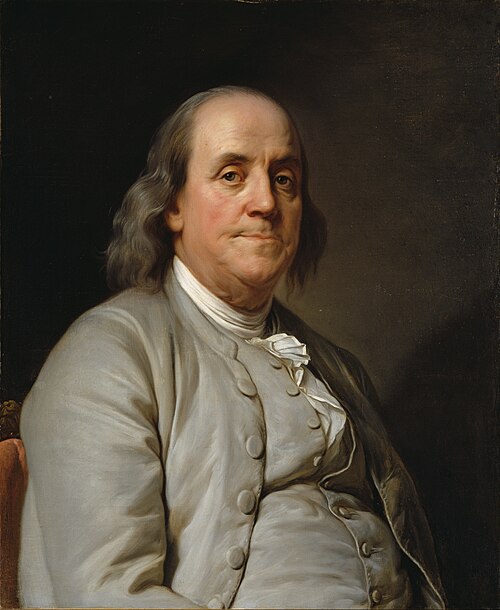
The son of a candlemaker, Benjamin Franklin was born in Boston, Massachusetts, on January 17, 1706. He was the youngest son of Josiah Franklin’s seventeen children. His father attempted to teach Benjamin his trade, but Benjamin was not interested. He attended grammar school at age eight, but was put to work at ten. He apprenticed as indentured as a printer to his brother half-brother James, who printed the New England Courant. Reportedly, James was a harsh master, often beating young Benjamin.
Benjamin beat James at his own game. Franklin lived frugally so he could purchase books and educate himself. At age twelve, Benjamin published his first article. He wrote secret letters under the pseudonym of “Mrs. Silence Dogwood,” a middle-aged widow with very set opinions. As Mrs. Dogwood he wrote about politics, business practices, politics, and society, including fashion. James published the letters, which were very popular. Unfortunately, James had no idea that Benjamin was the author. Young Benjamin was an avid reader, inquisitive and skeptical. Through his satirical articles, he poked fun at the people of Boston and soon wore out his welcome, both with his brother and with the city. He ran away to New York and then on to Philadelphia at the age of 16, looking for work as a printer.
In Philadelphia, he took a position with another printer. He managed a commission to Europe for the purpose of buying supplies to establish a new printing house in Philadelphia, but found himself abandoned when he stepped off ship.
Ironically, although he had no formal education beyond the age of 10 years, Franklin was celebrated throughout Europe, welcomed in any Royal Court, sought out by every prestigious society. Through hard work and frugality he bought his fare back to Philadelphia in 1732 and set up shop as a printer. He started The Pennsylvania Gazette and also published an annual (beginning in 1741) entitled Poor Richard’s Almanack. Some of our most common sayings come to us from Poor Richard’s Almanack. For example, we have “Early to bed, and early to rise, makes a Man healthy, wealthy, and wise.” and “A Penny saved is a penny earned.” and “Three may keep a secret if two of them are dead.” and my personal favorite “If you would not be forgotten, as soon as you are dead and rotten, either write things worth reading, or do things worth writing.” Along with the Bible, Poor Richard’s Almanack was indispensable. The pamphlet included a calendar and planting advice.
He was appointed clerk of the Pennsylvania Assembly in 1736, and as Postmaster the following year. He was elected to the Pennsylvania Assembly in 1751 and served as an agent for Pennsylvania (and ultimately for three other colonies) to England, France, and several other European powers. At age 42, Franklin turned over his business to his partner and became a philanthropist. He promoted the first American hospital, library, and volunteer fire department in his beloved Philadelphia. He set the groundwork for the school that would become the University of Pennsylvania. But it was not only Pennsylvania that he served. He was a proponent of a colonial mail system. As such, the British Parliament named him Postmaster General. As an inventor, Franklin claims the lightning rod, bifocals, and the Franklin stove.
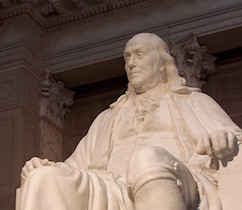 He lived some 30 years in England and Europe. He spent time in London as an ambitious young man. In addition, he lived predominantly in London from 1757 to 1770, where he represented the views of the Pennsylvania colony to the British Parliament. While there he was awarded the honorary degree of “Doctor Franklin.” Artists painted him as a modern-day Prometheus, complete with lightning bolts behind him. The day after his arrival in England, Franklin was summoned to explain the colonial objection to the Stamp Act to the House of Commons. He wrote articles for the British newspapers in hopes of explaining the American point of view, but to no avail. He leaked anti-rebel letters penned by the Massachusetts royal governor. He was arraigned for disloyalty to the Crown in 1774, which resulted in nothing more than his being stripped of his Postmaster position.
He returned to the colonies in 1775. The Revolutionary War had begun. He was nearly 70 years of age when he accepted the role of Congressman. He was accustomed to life in England and Europe, and at his advanced age, he would often have a sedan chair (powered by four inmates from the local jail) carry him to the statehouse from his home. Franklin’s power was centered upon his ability to twist the written word to whip up the colonists. Moreover, he had the ability of print whatever he chose to share with others. He also joined fellow signer, Robert Morris, in financing the revolution. Franklin donated his pay as the American Postmaster General, as well as £3000 of his own money.
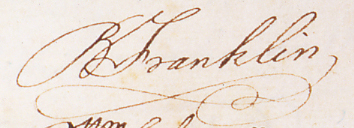 He did fail in convincing the Canadian government in joining the revolt against Great Britain. Returning to Pennsylvania, he was appointed to the Committee of Five, along with Thomas Jefferson, John Adams, Roger Sherman and Robert Linvingston, to draft the Declaration of Independence. Jefferson wrote the first draft of the document, but Franklin made one important change. He switched out Jefferson’s “We hold these truths to be sacred and undeniable” for “We hold these truths to be self-evident.” It was also Franklin who convinced John Morton to break the tie of the Pennsylvania delegation to vote in favor of withdrawing from British rule.
In the fall of 1776, he departed for France to seek assistance from the French in the war against Great Britain. Franklin took two grandsons with him: Temple (age 17) and Benny (age 7). By this time in his life, Franklin was more than a bit eccentric. He took “air baths” for he thought going naked was good for his health. He wore a fur frontiersman cap to keep his bald scalp warm, which started a “fur cap” fashion statement among the French aristocratic females. He managed to convince the French to aid the American effort. 44,000 French troops served along with the American patriots.
Franklin helped draft the Treaty of Paris, which ended the Revolutionary War. He signed the peace treaty in 1783. Benjamin remained in France until 1785. He returned to America to assist in drafting the U. S. Constitution, which he also signed.
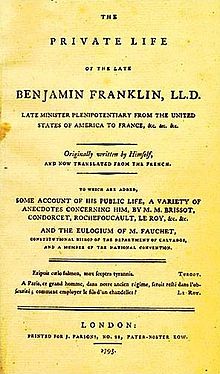
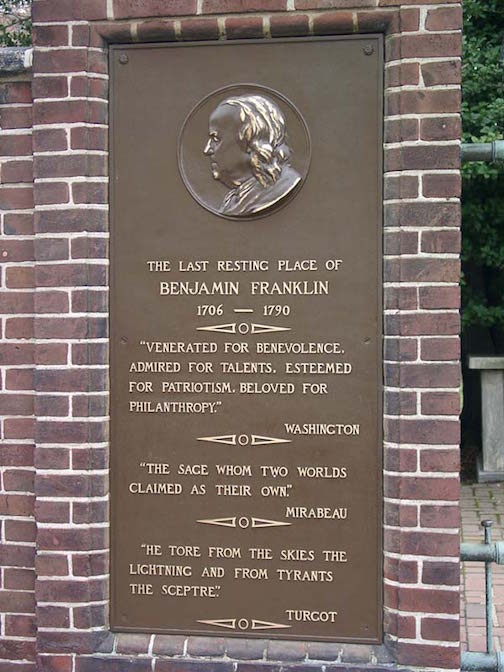
Franklin’s personal life was a bit from step from other signers. Deborah Read, was his common-law wife. They were together for some 44 years. She died in 1774. He sired three children. Two with Deborah and one with another woman. His illegitimate son, William Franklin, Temple’s father, was the royal governor of New Jersey. In that role, William Franklin was imprisoned by the U. S. government in January 1776. Franklin refused to assist his son because of William’s alignment with Great Britain. William was released in 1778. In his waning years, Franklin wrote his autobiography, which was published in 1793. Franklin died at the age of 84 on April 17, 1790.
Resources:
Signers of the Declaration of Independence. USHistory.org
The Society of the Descendants of the Signers of the Declaration of Independence


 Every Woman Dreams...