This is a follow up question regarding the one from last Friday, 7 March 2025, regarding posting a letter during the Regency Era. This one is about “Post Offices.”
Question: If someone was to send a letter from Cornwall in our time period, would a) there have been any regular postal service from there or would they have to send it by personal messenger and b) was there special funeral stationary to write on or is that a Victorian convention and c) would you put a return address on the outside of the letter?
Postal delivery started improving about 1760 or so. After 1784, country areas had three deliveries and two collections, with deliveries sent out from London by horse messenger to the receiving houses. So even in the wilds of Cornwall there would be great postal service. No return address is ever put on the letter. And the address/directions to where it is going might be as simple as the person’s name, and either the house name or the village (or city). No numbers even. The person who received the letter paid for it in general (but one could pre-pay and the letter would be stamped as such.
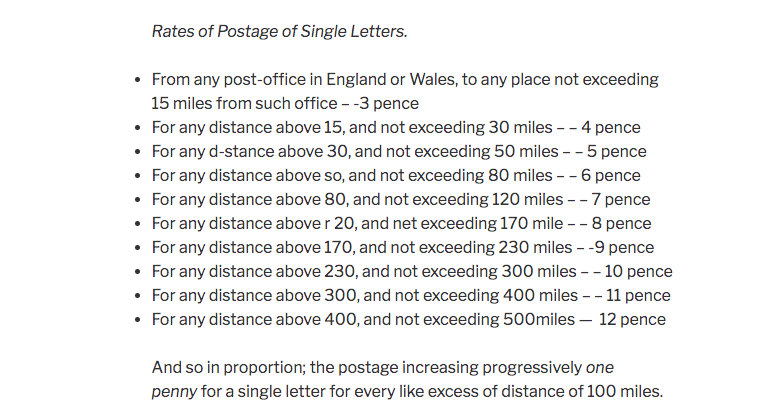
Postage was based on the number of miles the letter traveled from point A to point B and the number of sheets of paper used. The paper that one folded and sealed was one item. Even one tiny slip of paper inside counted as a second item, doubling the cost. Recipients paid, rather than the sender of the letter. Naturally, the person receiving the letter could refuse it and send it back to the sender.
These were the going rates for a single page: fourpence for the first fifteen miles, eightpence for eighty miles, etc., etc., up to seventeen pence for a letter covering seven hundred miles. Additional pages increased the price accordingly. Afterward, costs were standardized and based on weight instead of distance times number of enclosures.
A “two penny post,” which was developed for mail delivery within London proper, was separate from the General Post Office, which dealt with the national mail. There were designated shops for dropping off the mail. As with the writing of the letter, abbreviations were used as part of the address/directions to speed the delivery: “W” for the West End; “N” for north of the Old City, etc.
As to the part about the funeral: The black border started up quite a bit earlier so it was around in Regency times. The width of the black showed how deep in mourning you were. The letters were always folded sheets (no envelopes around). Black bordered paper could be used for mourning letters with black seals. People were often sent black gloves when invited to a funeral.
How To Write Like a Duke or Duchess: A Guide To Regency Era Stationery For Bridgerton and Period Drama Fans tells us, “Sombre Statements: Elaborately designed black-bordered stationery was used for mourning announcements and condolences. The thickness of the border and the quality of the paper indicated the closeness of the relationship between the sender and the deceased. Intricate flourishes or emblems were replaced with simple designs. In stark contrast to the vibrant colours and playful illustrations used in happier times. This shift in stationery served as a visual reminder of loss.”

Shapell.org also tells us something of mourning paper, though their examples are set in America rather than England. “Black Bordered & Victorian Mourning Stationery: In the Shapell Manuscript Collection, there are a number of black-bordered manuscripts that are available to the public to view online. It’s easy to overlook this aspect of letter writing and stationery, but to the writer and recipient of such papers, this border signifies an important sociological phenomenon. These marked papers, known as mourning stationery, are immediately identifiable by a black border surrounding the page, and are often accompanied by a black-bordered envelope. The recipient would instantly understand that the sender is in mourning. Though this practice has its origins in the seventeenth century, it became popular in the Victorian era and remained in vogue for much of the nineteenth and first part of the twentieth century. Generally, the mourner would begin with a thick black border around his or her stationery, which would narrow over time.”
To see what they looked like Google Stampless Postal Covers – https://www.google.com/search?q=stampless+postal+covers&source=lnms&tbm=isch&sa=X&ved=0ahUKEwi0hoL2977NAhVW-2MKHQ8VB4UQ_AUICCgB&biw=911&bih=439 And you can include the year in your search if you like.
The mail service was pretty good from all parts of the kingdom, though they might have to travel to a post office in some places. Usually the post offices were where the mail and stage coaches stopped or else they could be near by. A shopkeeper could also run the post office. Quite often it was a part of the inn where the stage coaches or mail coaches stopped. Post chaises were hired from the post office and these were available in most larger towns.
A mail route ran down the spine of Cornwall. Smaller towns all had local arrangements to carry mail to the nearest official stop. I have not seen return addresses on the outside, but I cannot rule those out. Letters generally show the recipient’s address plus a signature across one corner if the letter has been franked plus a stamped notation showing the mail stop that first received the letter since the cost to the recipient is based on the distance traveled.
Mail smuggling was also rife; it was said that four out of every five letters sent from Manchester never saw the inside of a post office.
The call for postal reform was tied to the rise in literacy: When only rich people could read & write, paying to receive letters was not a problem, but as literacy spread to the middling classes, affordable postage became an issue.
Note: Susana Ives, who I quoted about have lots more information on the postal system during the Regency for who are hoping to write a scene dealing with mail delivery. Lost in the Regency Mail


 Every Woman Dreams...