This subject of this post came from a faithful reader of the blog. Below are some of the items I shared with her.
People went to the local post office to mail a letter.
Usually the recipient paid.
People sent mail from and received it from a post office.
This was usually near a place where the post horses were changed or a busy inn where stage coaches stopped.
Stamps were the kind made with a stamper.
The letter had to be in hand ready to mail.
Governesses and others looking for work usually requested prepaid and the respondents were not necessarily in London.
All stamps were hand stamps or postage cost was hand written on the letter. The One Penny Black–the first stamp–comes in place around 1840.

One could NOT get a sheet with of stamps that were marked PREPAID. However, one could–if he knew his local MP (member of Parliament) or was friends with a lord–have them FRANK a sheet. All Members of Parliament were allowed to frank their letters–sign them to send them free in the post.
To see what all this looks like:
Google “prepaid stampless covers”
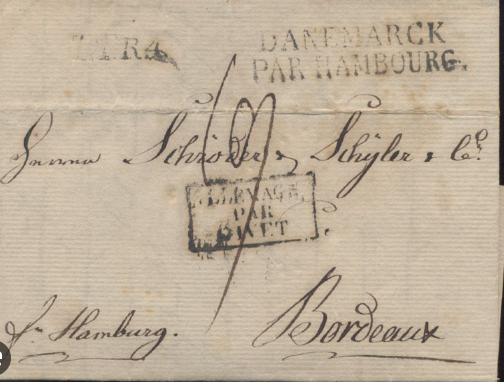
And “franked stampless covers“
Postmarks were in use in various forms for centuries. Google the four penny post (and you will see its postmark) certainly predates the Regency Era. But it will show you that by 1805, the initial of the name of the place the letter was mailed from had been part of the postmark for some time.
It was also common for those post offices through which that letter passed (on its way to the recipient) to postmark the letter as well. The postmarks had the initials of the place of posting, and the date.
“The uniform fourpenny post was a short-lived uniform pre-paid letter rate in United Kingdom of Great Britain and Ireland that lasted for 36 days from 5 December 1839 until 9 January 1840. The Uniform Fourpenny Post was the first component of the comprehensive reform to the Royal Mail postal service that took place in the 19th century.
“From 5 December 1839 until 9 January 1840, a uniform charge of 4d was levied for pre-paid letters up to half an ounce in weight instead of postage being calculated by distance and number of sheets of paper. One ounce letters were charged 8d and each additional ounce, up to 16 ounces, cost 8d. Unpaid was charged double the pre-paid rates. For mail whose rates were already less than 4d, the existing lower rates applied to those letters.
“The quantity of letters carried increased significantly. For the week ending 29 November 1839, the London post office carried 1,585,973 letters. For the week ending 22 December, the quantity was 2,008,687 and by the week ending 23 February 1840 they carried 3,199,637.”
Sources
- Reynolds, Mairead (1983). A History of The Irish Post Office. Dublin, IE: MacDonnell Whyte. 91 pp.
- Grimwood-Taylor, James (1990). The British Postal Reforms of 1839 to 1840. Derby, ENG, UK: Cavendish Philatelic Auctions. 67 pp.
- Crouch, Guy Robert. The Uniform Fourpenny Post Office Stamps.
- Kane, William (1990). The Uniform 4d Post of Ireland. UK: Irish Philatelic Circle. 28 pp.
Postal marks were hand stamps (and sometimes writing), and most post offices (particularly those in London) stamped the covers.
A good selection for you to view …
There would be a mark indicating postage due on receipt (most folks paid to receive letters, not to send them).
For more information, check out these writers who have also posted on the process of sending and receiving letters during the Regency Era.
Jane Austen Centre – Regency Letter Writing
Jane Austen Foundation – Issue 111: An Exploration of Regency Letter Writing
Regina Jeffers – We Get Stacks and Stacks of Letters-The Expense of Mail During the Regency Period
Shannon Donnelly – The Regency Post: A Pity We’ve Lost Letters


 Every Woman Dreams...