

July 18, 2024 marked the 207th anniversary of the death of Jane Austen. Tribute from Austen’s most loyal fans continue to flow through any number of activities, readings, evensongs, and events, leading us to July 24, the date of her funeral. In the UK, for the 200th anniversary of her death, public benches were dedicated to Austen, and the “Rain Jane” program had Austen’s words appear in public places throughout Hampshire whenever there was precipitation. Yet, this year, which is not so monumental in terms to be marked, it will those of the Austen brigade, those who still read her daily or study her with an intensity many in the public eye cannot fathom or write their own versions of her stories who will stop and take note of the passing of a lady from Hampshire, England.
Even in this “off” year, Winchester Cathedral, where she is interred, will likely see a steady influx of visitors. For the 200th Anniversary of her burial, the UK unveiled a £10 note (image above), graced with her face. As she is also on the £2 coin, Austen is the first person, other than a monarch, to appear on more than one form of British currency at the same time. Cathedral bell, on that day, tolled 41 times to mark each of her years on this earth.
In mid April 1817 Jane Austen was so ill she took to her bed in Chawton. By the 27th April she had written her will. After a visit from her brother James and his wife Mary she agreed to go to Winchester to be close to her surgeon who would take care of her there. (Jane Austen’s World)
Austen came to Winchester due to its proximity to Chawton, where Jane was initially brought when her illness reached a point she could no longer deny. She stayed at #8 College Street, along with her family. She reportedly passed away in her sister Cassandra’s arm. Jane Austen was but 41 years of age. There are rumors that she might have died of arsenic poisoning, but something sinister, but it was common for physicians to administer arsenic during the late Georgian era.
“In early June of 1817 James Austen wrote to his son at Oxford, ‘I grieve to write what will grieve to read; but I must tell you that we can no longer flatter ourselves with the least hope of having your dear valuable Aunt Jane restored to us.’”

We who love Austen, likely know the answer, but in case some of you have not thought twice about the lady, permit to answer this question: Why, when this comparatively obscure spinster died in 1817, was she buried in a cathedral which houses the bones of Saxon kings and saints?
It seems highly unusual for an ordinary citizen to be buried in a place normally reserved for secular and religious leaders. According to Jo Bartholomew, curator and librarian at the cathedral, the mortuary chests hold such dignitaries as: Cynigils and Cenwalh, two Christian kings from the seventh century; Kings Egbert and Ethelwulf (grandfather and father of King Alfred); King Cnut (Canute) and his Queen Emma; two bishops, Alwyn and Stigand; and king William Rufus. Most had been originally buried in Old Minster, the predecessor to Winchester Cathedral, which was just to the north and partially beneath it.
Was it common for an ordinary citizen to be buried there in 1817, or was this an extraordinary honor? In those days, not so extraordinary after all. Indeed, Jane was the third and last person buried there that year. Cost, rather than rank, may have been the limiting factor for a cathedral interment. Jane’s funeral expenses came to £92, a significant amount for someone of her means. Clearly, she or her family was determined to make a statement—after all, none of her brothers, including Frank, who died the highest-ranking naval officer in England, received such a burial.

In Memory of
JANE AUSTEN
Youngest daughter of the late
Rev GEORGE AUSTEN,
formerly Rector of Steventon in this County
she departed this Life on the 18th of July 1817,
aged 41, after a long illness supported with
the patience and the hopes of a Christian.
The benevolence of her heart,
the sweetness of her temper, and
the extraordinary endowments of her mind
obtained the regard of all who knew her and
the warmest love of her intimate connections.
Their grief is in proportion to their affection
they know their loss to be irreparable.
but in their deepest affliction they are consoled
by a firm though humble hope that her charity,
devotion, faith and purity have rendered
her soul acceptable in the sight of her
REDEEMER.
Elizabeth Proudman, vice chairman of the Jane Austen Society and an expert on Jane Austen, said in a letter that the location was likely Austen’s choice: “I believe that she is buried there, because she wanted to be. It was up to the Dean in those days to decide who could and who could not be buried in the Cathedral. Usually it was enough to be respectable and ‘gentry.’ This, of course, she was as her late father and two of her brothers were in the church.”
Jane’s father, George, had been the rector at Steventon, fourteen miles away, until he retired in 1801. He was succeeded by James, his oldest son, who still held that position in 1817. Henry, who had taken up the cloth after his bank collapsed in the recession of 1816, also had a clerical position nearby. It probably did not hurt that Jane’s brother Edward was the wealthy inheritor of the Knight estate, with extensive holdings in Steventon and Chawton, which was sixteen miles away. From his recent ordination, Henry knew the Bishop, according to Claire Tomalin; and the Dean, Thomas Rennell, was a friend of the important Chute family who were relatives of the Austens.
Having lived at Chawton for nine years, where she wrote or significantly revised her oeuvre, Jane was taken to Winchester for unsuccessful medical treatment. “She had been ill in Winchester for about two months, and I think her burial must have been discussed,” Proudman says. “I like to think that her family would have talked about it with her, and that they followed her wishes. … It may be that she had no particular attachment to the village [of Chawton]. We know that she admired Winchester Cathedral, and she knew several of the clergy. When she died she had some money from her writing, and her funeral expenses were paid from her estate. It was a tiny funeral, only 3 brothers and a nephew attended, and it had to be over before the daily business of the Cathedral began at 10.00 am.”

In fact, most funerals were relatively small in those days, and women did not attend. Cassandra, with their friend Martha Lloyd (James’s sister-in-law), “watched the little mournful procession the length of the street & when it turned from my sight I had lost her forever.” In a letter to their niece Fanny in the days after Jane’s death, Cassandra added: “I have lost a treasure, such a Sister, such a friend as can never be surpassed,—She was the sun of my life, the gilder of every pleasure, the soother of every sorrow, I had not a thought concealed from her, & it is as if I have lost a part of myself. … Never was [a] human being more sincerely mourned … than was this dear creature.”

known to many by her
writings, endeared to
her family by the
varied charms of her
Character and ennobled
by Christian Faith
and Piety, was born
at Steventon in the
county of Hands Dec.
xvi mdcclxxv, and buried
In this Cathedral
July xxiv mdcccxvii
“She openeth her
mouth with wisdom
and in her tongue is
the law of kindness”
Prov xxxi. v. xxvi
Edward, Francis, and Henry were the brothers who attended. Charles was too far away to come. James was ill (He died two years later.), but his son, James Edward, rode from Steventon to Winchester for the service. Thomas Watkins, the Precentor (a member of a church who facilitates worship), read the service. Jane was interred in a brick-lined vault on the north side of the nave.

Tomalin believes it was Henry who “surely sought permission for their sister to be buried in the cathedral; splendid as it is, she might have preferred the open churchyard at Steventon or Chawton.” One suspects it was Henry who pushed for the cathedral, and Jane would have been happy to be at rest anywhere. Yet, modest as she was in many ways, she understood the worth of her writing. She may have made the decision with a view to posterity. In any event, Cassandra was pleased with the decision. “It is a satisfaction to me,” she said, that Jane’s remains were “to lie in a building she admired so much—her precious soul I presume to hope reposes in a far superior mansion.”
Henry arranged for a plaque to be installed in the cathedral to commemorate Jane’s benevolence, sweetness, and intellect—but curiously enough, not her writing. As the popularity of her novels grew over time, officials were baffled by the pilgrims coming to visit the crypt of a woman the church knew not as a brilliant novelist but only as the daughter of a rural clergyman.
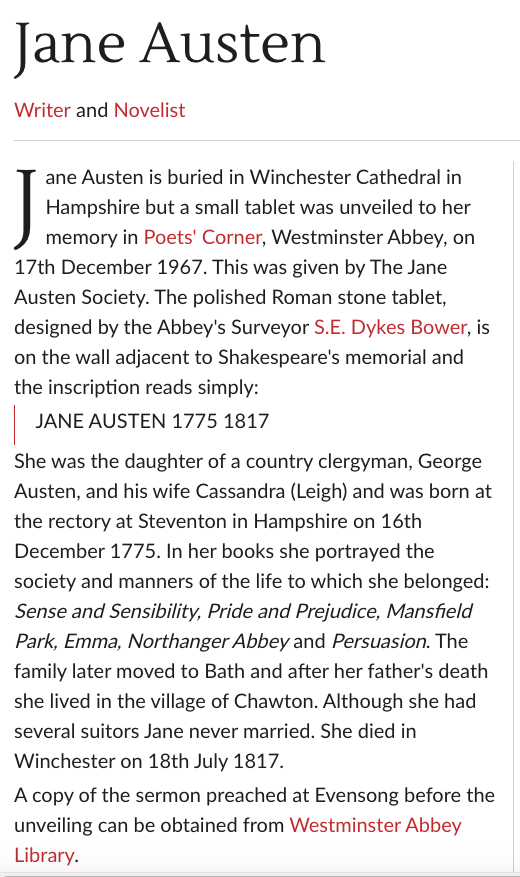
Spencer Means tells us, “Her memorial stone makes no mention of her writing, but that fact was rectified by the addition of a brass plaque nearby in 1872 and a stained glass window in her honor in 1900. Although the stone is the original location of Austen’s tomb, it is said by Cathedral guides that the coffin was moved “a yard or two to the right” when central heating was installed in the 1930s.The question of why she is buried here among saints, kings, and bishops has been the subject of speculation, as you can see here: www.jasa.net.au/l&t/grave.htm. The Cathedral Web site’s answer to “Why here?” is that she “greatly admired” the building (!). It also acknowledges that only four persons attended the “modest funeral.”
Meanwhile, the Winchester Cathedral website provides us with this information:


 Every Woman Dreams...