Title
- The honours of the table, or, Rules for behaviour during meals : with the whole art of carving, illustrated by a variety of cuts. Together with directions for going to market, and the method of distinguishing good provisions from bad; to which is added a number of hints or concise lessons for the improvement of youth, on all occasions in life.
Names
- Trusler, John, 1735-1820.
Created / Published
- London, The author, 1791.
Headings
- – Table etiquette
- – Carving (Meat, etc.)
- – Grocery shopping
Notes
- – By John Trusler, the editor of Lord Chesterfield’s Principles of politeness.
The Honours of the Table, or Rules for Behavior During Meals (Library of Congress site)

This is how the RareTome website listing describes the book as . . .
A delightful work, by a self-proclaimed 18th century jack-of-all trades and master-of-all, John Trusler.
Prepared and published by the author, Honours of the Table functions as a how-to for considerations of the 18th century dinner table; it still holds strong interest for what it did accomplish (meat carving and market guide) and what it endeavored to accomplish (burdensome and humorous late 18th century social guidelines).
This work has developed particular interest for culinary collectors; it contains an early illustrated guide to properly cutting various meats, The Art of Carving, and a guide to selecting meat, eggs, etc. at the market.
The chapters on appropriate 18th century table behavior, for both “youth” and “young women”, contain a number of eyebrow raising guidelines.
Just a few quotes, from many:
“Smell not your meat when eating.”
“Spit not on the carpet.”
“Punch no one in conversation.”
For young women:
“Dread becoming cheap.”
“Read no novels, but let your study be in history, etc.”
“Trust no female acquaintance.”
Trusler, in contemporary advertisements, was proud of his works; regarding his The Progress of Man and Society, he states:
“… it will be found to be the most entertaining and informing book that ever yet was published, and what every parent or instructor should put in the hands of youth…”
And when discussing the woodcuts he prepared for Proverbs Exemplified:
“… so well designed, and the characters in human life so well drawn and preserved, the persons of taste may examine them with pleasure; and Dr. Trusler ventures to say, are no ways inferior to Hogarth’s.”
Unfortunately this copy does not include his aggrandizing advertisements.
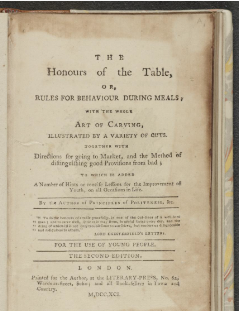
Title Page –
Not uncommon to this period, the title page attempts to describe the entire work:
The Honours of the Table, or, Rules for Behaviour During Meals; with the whole Art of Carving, illustrated by a variety of cuts. Together with Directions for Going to the Market, and the Method of Distinguishing Good Provisions from Bad; to which is added A Number of Hints or Concise Lessons for the Improvement of Youth, on all Occasions in Life. By the Author of Principles of Politeness, etc. For the Use of Young People.
Physical Attributes –
Measures approx. 16 x 10 x 1 cm, Calf binding. Illustrated. Pages – 120.
***************************************************
Of all the graceful accomplishments, and of every branch of polite education, it has long been admitted, that a gentleman and a lady never shew themselves to more advantage, than in acquitting themselves well in the honours of their table; that is to say, in serving their guests and treating their friends agreeable to their rank and situation in life.
John Trusler
Above is the opening line of the Reverend John Trusler’s The Honours of the Table, a book describing proper behavior at the dinner table. Reprinted five times, i was initially published in 1791 and was still used during the Regency and late Georgian eras.
As we learned in last Monday’s post, Trusler had been ordained, but the church was not what held his interest. He studied medicine on the European continent—ran a literary society—taught oratory skills. As the book above proves, he was an author, an author of an extensive number of books. He did abridgments of famous books so the common man could claim they had read them. He wrote travelogues such as one might find in the book store Hugh Grant ran in the movie, Notting Hill. He wrote both drama and romances, as well as tomes on farming, husbandry, law, language, and mannersYou may find a list of his contributions on The Online Book Page for John Trusler.
As you saw in the previous post, Trusler wrote anything demanded of him as long as he was paid for the piece. The book I featured there was The Works of William Hogarth: In a Series of Engravings; With Description, and a Comment on Their Moral Tendency. In this book, Trusler attempted to explain Hogarth’s work to the common man, but the book comes off as simply another means to make money.
The Buzzy’s Bonnet Live Journal tells us, “Of all his writing, by far the most popular was The Honours of the Table. It is an invaluable resource to writers of historical fiction of the era, as it describes in detail a wide variety of customs that were rarely discussed in texts of the time. After all, if you were of the class of people who practiced such customs, you already knew what they were. Conduct manuals of the time were mostly guides to proper comportment for young females, targeted at those aspiring to marry above their birth. But Trusler wrote for the newly emerging middle class, the products of the Industrial Revolution and the explosion of consumerism that enriched merchants and manufacturers, allowing them to aspire to upper class lifestyles. And Trusler wrote them guides, which in turn provide us with insight into how their betters behaved. Honours covers topics like how to carve, where dishes should be set, what servants should be doing during the meal, etc. Below is the section on seating, something no one actually of the upper classes needed to be taught, as it was common knowledge in their circles, but which aspiring entrants to that class would get wrong at their peril.
“One quick aid to reading – you can tell the difference between the letters “f” and “s” by the strong middle bar in the “f”. This is the word “first” – note the difference between the two letters:

So, here’s Trusler on seating at dinner parties:


“In the Regency era, there were no carefully planned seating arrangements, no place-cards, and no careful manipulation of positions for romantic purposes. Neither did the gentlemen escort particular ladies into dinner. If everyone was aware of both the relative ranks of the company and the preference of the hostess for traditional or mixed seating, then the only organization necessary was for the hostess to say something like, ‘shall we go in to dinner?’ whereupon everyone would arrange themselves in the proper order. If the hostess wanted to make sure it was done properly, she would invite her guests, one at a time, to go in, either as Trusler describes or in alternating male-female order.
“Even casual family dinners would follow the same sort of precedence, as we see in P&P when the family is entering the dining parlor and Elizabeth observes in disgust as, ‘Lydia, with anxious parade, walk up to her mother’s right hand, and hear her say to her eldest sister, ‘Ah, Jane, I take your place now, and you must go lower, because I am a married woman!’ Of course, in the freewheeling atmosphere of the Regency era, either host or hostess could override tradition and be seen, not as radical, but as modern and daring. Something along the lines of, ‘Let’s hang tradition, Miss Bennet. I simply must have your company,’ from a gentleman, or ‘My dear Miss Bennet, do sit by me,’ from a lady would do the trick nicely.”
If your interest has been piqued, one can find a reproduction of the book on Amazon for around $25. Walmart has it for $26. Otherwise, most copies I found are considered “rare” and run from around $700 to over $3200.
The Honours Of The Table, Or, Rules For Behaviour During Meals: With The Whole Art Of Carving, Illustrated By A Variety Of Cuts. Together With … Of Distinguishing Good Provisions From Bad


 Every Woman Dreams...