What is the “Windsor Uniform”? The Windsor uniform is a type of formal dress worn at Windsor Castle by male members of the British royal family (and some very senior courtiers). [“Windsor uniform”. Dress and insignia worn at His Majesty’s court (London: 1921).]

https://en.wikipedia.org/wiki/Windsor_uniform#/media/File:Peter_Edward_Stroehling_-Portrait_of_King_George_III(1807).jpg
Introduced in 1777 by George III, the full dress version of the Windsor uniform did not survive after 1936. It was quite strict and consider too ornate for modern times. Just too much gold!
However, the “undress” version, introduced in 1798, is still worn today. It includes a dark blue jacket with red facings. For those of you who do not know the term “facings,” it is a common tailoring technique for European military uniforms where the visible inside lining of a standard military jacket, coat or tunic is of a different color to that of the garment itself. The jacket lining evolved to be of different colored material, then of specific hues. Accordingly, when the material was turned back on itself: the cuffs, lapels and tails of the jacket exposed the contrasting colours of the lining or facings, enabling ready visual distinction of different units, each with their own specific and prominent colors.
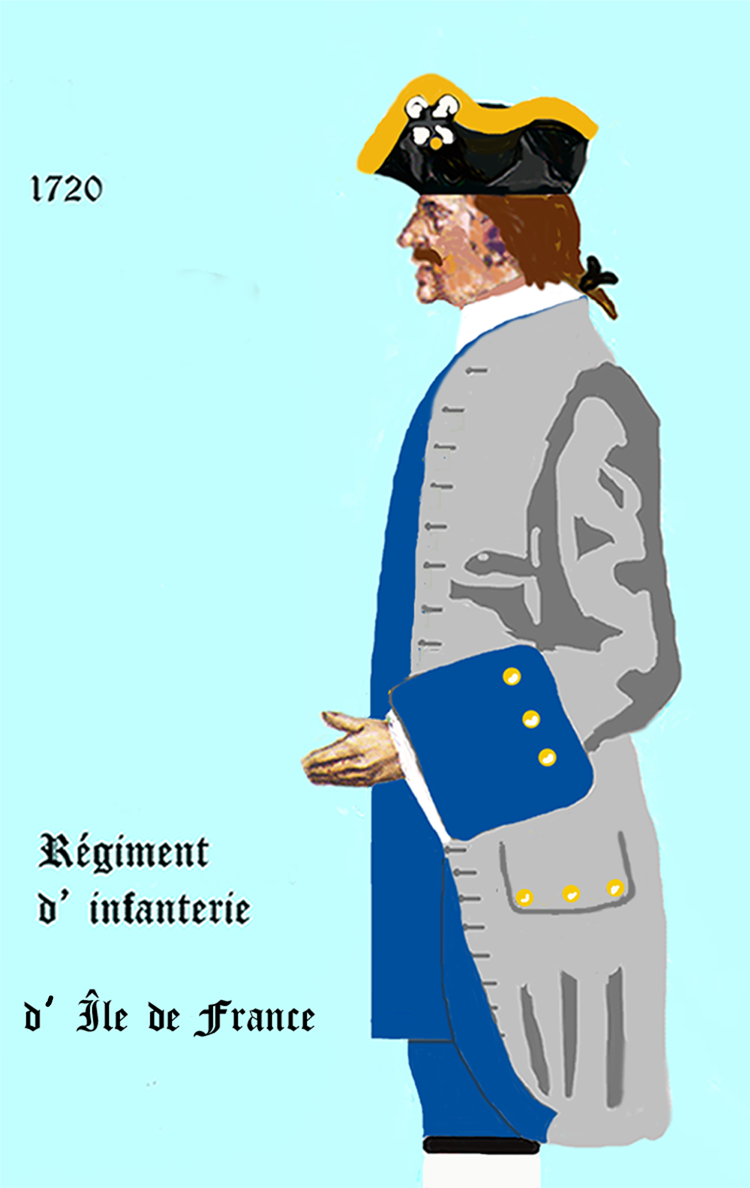
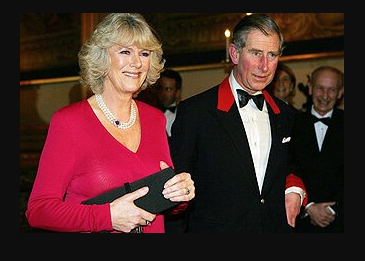
It is now worn only at Windsor Castle, and since the reign of King Edward VII, it has generally been worn only as evening dress (although King Charles III has worn a version of it as a riding coat).
The uniform currently takes the form of an evening tail coat of dark blue cloth, lapelled, with scarlet collar and cuffs. There are three buttons on each front, two at the back of the waist, two at the end of each tail, and also two on each cuff (plus one above). The gilt buttons bear a design of a Garter star within a garter, surmounted by the imperial crown.
It is worn with a white single-breasted waistcoat with three small gilt buttons of the same pattern, and with plain black evening-dress trousers. When the court is in mourning, a black waistcoat and black armband are worn. As well as the tail coat version, the late Prince Philip, Duke of Edinburgh, also wore (and King Charles III continues to wear) a dinner jacket version of the coat.
During the reign of George III, females at court were expected to dress in a manner which reflected their status. They wore silks and the formal court mantua or suit.
In the early 1700s, women wore the open-fronted mantua, with a train and a matching petticoat. To keep the shape, stays and hooped petticoat or panniers were worn underneath. They were decorated with opulent embroidery, often using silver or gold thread or gilt lace.
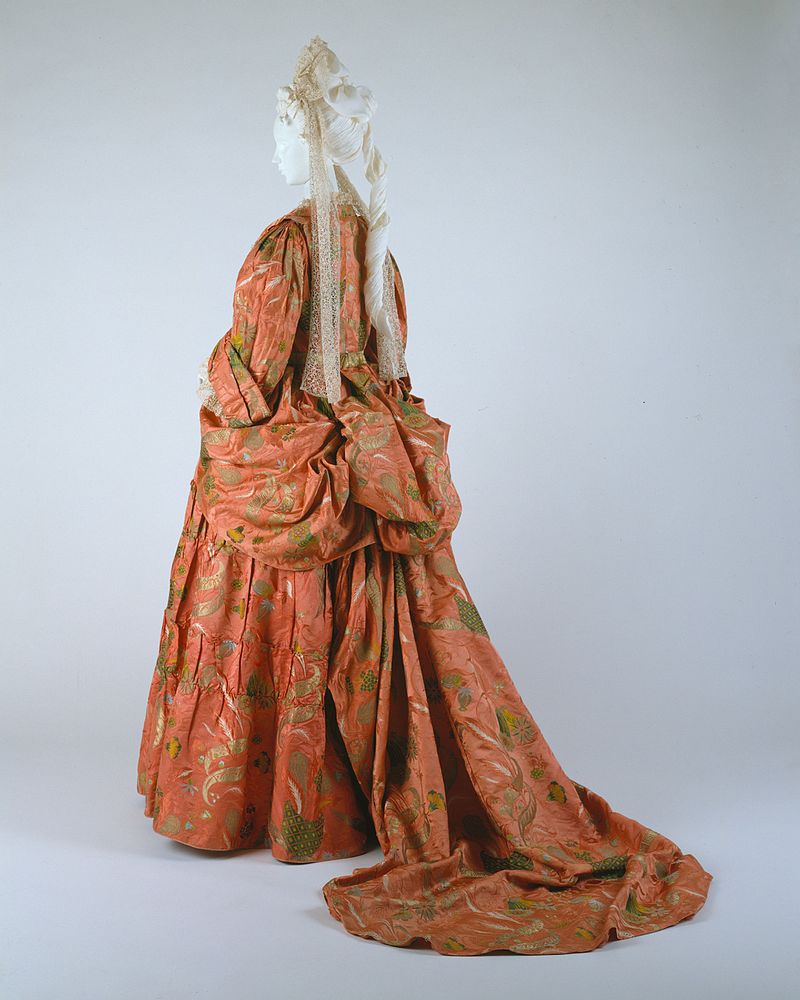
Both George III and his wife Queen Charlotte made moves to protect British silk making, going so far as to, in 1765, King George introduced an Act of Parliament that prevented the import of French silks, while Queen Charlotte encouraged members of her court to wear English silks instead.
George III was considered by many to be a bit eccentric, often dressing in practical clothes and wandering about London. [See the post from Wednesday on His Majesty, Farmer George]
Kelly Crawford tells us, “In 1777, the King introduced what became known as the ‘Windsor uniform’, which he originally intended to wear while at Windsor Castle. The blue suit was very similar to military uniforms and hunting outfits of the day, and it is possible he was inspired by a similar hunting outfit worn by his father, Frederick, Prince of Wales (1707‒1751). Dark blue was also an increasingly popular colour of choice for men’s coats in the second half of the century. There were two versions of the suit, a plain and a dress uniform, both dark blue with red facings (collars and cuffs) and the only difference being the dress uniform had gold embellishment and gilt, monogrammed buttons.”
Meanwhile, Nancy Mayer, Regency Researcher brings us this information. “
From Notes and Queries of 1854 Vol.10:
——- the Windsor uniform, rich, handsome, and laced as it was, and worn with a sword, cocked hat, and buckles, ——-was a frock; because the cape and collars were red, while the coat was blue ; and because the cape was a double one. Of this Windsor uniform there were three classes in the last thirty years of George III.: the common blue frock with red cape and cuffs, worn in the morning ; the laced blue frock, with gold‑laced button‑holes on the breasts, pocket‑flaps, capes, and cuffs; with this coat, white breeches, and a cocked hat and sword, were worn. It was the dress of those who attended the king when not actually at court. The third was a blue full‑dress coat with standing collar, embroidered, with red silk breeches: this was a complete court dress, but worn only by cabinet ministers and the great officers of the crown. The Princes of the Blood, and the Lord Lieutenant of Ireland, have a kind of frock uniform; blue for the former, &c.j the latter the colour he may choose, lined with silk, and with a button bearing the initial and coronet of the Prince or Lord Lieutenant; but not otherwise differing from the usual frock coat. The uniform of George IV., when Prince of Wales, was blue lined with buff, and buff waistcoats and breeches. When he became Prince Regent, the buttons bore G. P. R., and also the members of his government wore it. There was also established a kind of full dress of blue, with black cape and cuffs, and gold frogs, and Brandenberg embroidery; but it did not take.
From Gentleman’s Fancy Dress published in 1882:
WINDSOR UNIFORM. The Windsor uniform, of blue coat and red collar, dates from the early part of the reign of George III. It has been asserted that the King adopted the blue and red in compliment to the Countess of Pembroke, who at that time was an object of the King’s admiration; blue and red being the colours of the Pembroke livery. This uniform is worn only by members of the Household, or by those to whom the privilege has been granted by the sovereign. The blue coat and red collar are its distinctive characteristics, but the shape of the coat and the other parts of the dress are adapted to the fashion of the day. The coat for ordinary occasions is cut like the usual evening coat, but the full‑dress one is made like a military uniform, buttoned up the centre, with a stand‑up collar and gold embroidery. A cocked hat, edged with white feathers ; blue trousers, with a broad stripe of gold lace, and a sword, complete the equipment. The present Ministerial and Diplomatic uniforms are the same as the Windsor uniform, with the exception of black velvet in lieu of red collars, and were first introduced during the Regency. Drawings of all State uniforms are deposited in the Lord Chamberlain’s office. An Evening Dress Coat, with red cloth or blue silk cuffs and lapels, is an easy and effective method of wearing a fancy costume, and is called Windsor Uniform.


 Every Woman Dreams...