Excerpt from “Darcy’s Passions”~Darcy and Bingley Dine at Longbourn

Several of the Bennet sisters welcomed Bingley and Darcy upon their entrance to Longbourn. Elizabeth took their greatcoats and briefly greeted Darcy with a hint of a smile and an obligatory curtsy. When they repaired to the dining room, Darcy had hoped to be seated near Elizabeth, but finding himself seated instead close to Mrs. Bennet dashed those hopes. Bingley located a seat near Jane Bennet; oh, for such pleasure with Elizabeth! Darcy could hear nothing of what she said. Only once did he notice Miss Elizabeth’s attentions towards him. It was when Bingley placed himself beside Miss Bennet; Elizabeth gave Darcy a triumphant look, and he bore it with presumed indifference. The meal included venison and a white soup. Darcy attempted to make conversation with Mrs. Bennet, “I extend my compliments on the partridge, Ma’am,” he said a bit awkwardly.

“Thank you, Mr. Darcy,” the house’s mistress said with equal awkwardness. However, Darcy noticed that his words had obviously pleased Elizabeth’s mother.

She clearly had made a statement with the menu, and his good breeding required he take notice, but he would rather have taken notice of her second daughter’s eyes. Generally though, Darcy spoke very little to anyone at the table.

He had hoped for the opportunity of some conversation with Elizabeth as the evening progressed; all he required was a few moments alone. He would ask her to meet him privately, and then he would offer her his hand again. Following the meal, useless and mundane time was spent in the dining room with the gentlemen; he was anxious to return to the ladies. When the gentlemen entered the drawing room, Darcy planned immediately to approach Elizabeth, but she served coffee to the guests and was surrounded by ladies who appeared to be protecting her~for they stood close by. He moved toward her, but one of the girls stepped closer, taking on a conspiratorial stance. Darcy, therefore, took his cup and walked away to another part of the room.

The evening went badly, but, eventually, Darcy returned with his coffee cup. Elizabeth, thankfully, seized the opportunity of saying, “May I inquire of Miss Darcy?” She even forced herself to look at him.

“Georgiana is at Pemberley with Mrs. Annesley. She will remain there until the Festive Season.”

“Then her friends have gone to Scarborough?”

“They have, Miss Elizabeth.” Darcy was barely able to utter the words; her beauty enthralled him.

“I am sorry we could not dine at Pemberley as we had planned.” She struggled to express her regrets.

“Georgiana and I both regretted your sudden departure. We hope to see you at Pemberley again.” Did she understand the double meaning of his words?

The conversation staled at that point. Searching for something more to say, he stood by her, but what he wished to tell her could not be done so in public. He wanted only a few minutes’ conversation with Elizabeth again, and he would be satisfied if only the opportunity occurred. Noting the girl still listened in, Darcy eventually walked away.

That was the last of their conversation for he was relegated to a table of whist at Mrs. Bennet’s insistence; Elizabeth sat at a different table. Darcy’s mind searched for her rather than paying attention to the game, causing him to play poorly. When the others took their leave, Mrs. Bennet attempted to keep them for supper, but their carriage had been ordered, and Bingley and Darcy were soon on their way to Netherfield.

Although he guarded his feelings from Darcy, Bingley rejoiced in the progress he made with Miss Bennet. Memories of Darcy’s censure of Jane Bennet required Bingley to be cautious. Obviously, his friend wanted to retain Darcy’s regard, but Bingley also desired Miss Bennet’s affection. Despite his own misery, Darcy knew the time for telling Bingley the truth had arrived, but he could not do so this evening. His own heart was breaking as he wrote a quick passage to his sister.

(This excerpt comes from Chapter 15 of my first novel, Darcy’s Passions.

Posted in book excerpts, Jane Austen, Regency era, Ulysses Press | Tagged , , , | 2 Comments

The Future: Reselling of eBooks? What Does That Mean for Publishers and Authors?

This article comes from Publisher’s Weekly. To read the complete article visit http://www.publishersweekly.com/pw/by-topic/digital/retailing/article/53334-redigi-plans-to-sell-used-e-books.html

For serial entrepreneur John Ossenmacher, founder, president, and CEO of ReDigi, which bills itself as “the world’s first pre-owned digital marketplace,” the copyright infringement case filed by Capitol Records in U.S. District Court in Manhattan at the start of the year to shut it down is only a “hiccup in the road.” ReDigi, which launched its Web site (redigi.com) with used digital music late last year, is poised to start reselling e-books once the case is resolved. Ossenmacher and CTO Larry Rudolph, who took a leave of absence from his work at MIT, are eager to do so, since e-books will have a much higher ticket price than 69¢ songs. Their goal is to unlock the billions of dollars that consumers have invested in digital goods by reselling them, using the partners’ patented cloud-based technology, which enables them to weed out pirated goods.

If ReDigi prevails in court, it could upend the way e-books and other digital products are sold, since such products would get a second life on the resale market and provide a new revenue stream for publishers and authors. Ironically, the Cambridge, Mass.–based firm could be competing for customers with its neighbor at the Cambridge Innovation Center, Amazon. Currently, ReDigi can’t resell Amazon’s music or other digital files; it is partnering with iTunes.

Posted in Industry News/Publishing | Comments Off on The Future: Reselling of eBooks? What Does That Mean for Publishers and Authors?

How Many of the Most “Difficult” Books Have You Read?

This article teaser comes from Publisher’s Weekly. To see the complete list of “difficult” books, please visit http://www.publishersweekly.com/pw/by-topic/book-news/tip-sheet/article/53409-the-top-10-most-difficult-books.html

Back in 2009, The Millions started its “Difficult Books” series–devoted to identifying the hardest and most frustrating books ever written, as well as what made them so hard and frustrating. The two curators, Emily Colette Wilkinson and Garth Risk Hallberg, have selected the most difficult of the most difficult, telling us about the 10 literary Mt. Everests waiting out there for you to climb, should you be so bold. If you can somehow read all 10, you probably ascend to the being immediately above Homo sapiens. How many have you read? What books would you add? Let us know in the comments!

Posted in Industry News/Publishing | 5 Comments

Excerpt from “Darcy’s Passions” – Darcy and Bingley Call at Longbourn

At Austen Authors (http://austenauthors.net), we are celebrating the 200th anniversary of the events found in Pride and Prejudice. This is another of my excerpts from “Darcy’s Passions.” In this one, Darcy returns to Longbourn in hopes of renewing his proposal to Elizabeth Bennet. 

Returning to the security of Pemberley, having both Georgiana’s and Bingley’s company brought Darcy comfort. The turmoil of the past few weeks had taken its toll on his usually resilient composure. He required the company of family and friends after his dealings with the nefarious Mr. Wickham. Yet, being with Bingley constantly reminded Darcy that he must make amends for his duplicity in separating Bingley from Jane Bennet. One early autumn day, he and Bingley sought time outdoors.

Bingley said wistfully as he accepted the loaded gun from Darcy’s servant, “I believe the last time we partook of the season’s shooting was at Netherfield.”

“I believe you correct, Bingley,” Darcy paused as he planted the idea. “That was a pleasant time, was it not?” Although he did not purposely initiate it, a sigh slipped from his lips. If he were to maintain his sanity, he desperately needed to know Elizabeth’s company again. “I was wondering, Bingley, have you made a decision on Netherfield? It appears a waste of your father’s inheritance to let an estate one never uses.”

As expected, Bingley readily seized upon Darcy’s veiled suggestion. “Not having stayed through the winter, I remain uncertain of the house’s soundness. Mayhap I should return to Netherfield and make my decision based on what I find.”

“That appears a most prudent means of making a your verdict.”

Bingley asked cautiously, “Would you consider joining me, Darcy? We could shoot, ride, and enjoy my estate. My sisters remain in Hampshire. I would be indebted if you would come with me.”

Darcy chuckled with the success of his ploy. “I would enjoy that, Bingley.”

“Capital! I will send servants to open the house. We could travel to Hertfordshire next week if you are agreeable.”

Darcy’s heart leapt: He would see Elizabeth again. Could they continue what they had begun at Pemberley? “I would be happy for the time together,” Darcy said. His friend took his words to mean his time with Bingley, but Elizabeth was very close to Darcy’s mind.

Over supper that evening, Bingley told Georgiana of his plan to return to Netherfield. “Your brother has consented to join me,” he shared. Georgiana smiled knowingly at Darcy, but she said nothing other than to assure Bingley that she and Mrs. Annesley would be quite content to remain at Pemberley. Georgiana knew Darcy well enough to know the uncertainty he felt in returning to Elizabeth’s home. Everything could change in the next few weeks.

When he and Bingley set out on the following Monday, Georgiana hugged Darcy a bit longer than usual and reached up to caress his cheek. “I shall say a prayer for your safe and successful journey, Brother. As always, I wish you the greatest of happiness.” He smiled weakly at her as he boarded his coach; Darcy could think of nothing but Elizabeth and the tenuous situation of their relationship.

* * *

 “Darcy, we have been at Netherfield for two days,” Bingley mused, “and Mr. Bennet has yet to call. Would it be bad manners if we would call on him first?” His friend stared morosely out the library’s window. Darcy had taken up residence in one of the overstuffed chairs, but, in reality, his mind was no more on the book he held on his lap than was Bingley’s mind on the gardeners he watched. Darcy had found it as frustrating as his friend that Mr. Bennet had ignored Bingley’s return. The snub would make it more difficult for Darcy to determine if Miss Bennet would accept a renewal of Bingley’s affections, and Darcy still required a legitimate excuse to call upon Miss Elizabeth.

“Let us wait until tomorrow to see if the situation changes. If not, then, we can offer our own civilities,” Darcy said evenly. He prayed his hopes did not pepper his words.

“Tomorrow it is then.” Bingley continued to stare out the window. “It has been too long since we have enjoyed the Bennets’ companies.”

Darcy’s heart clinched in anticipation. The past two days had played havoc with Darcy’s emotions. There were few places at Netherfield where images of Elizabeth did not dance through Darcy’s head. He saw her on the staircase, as she was on that last Sunday before she and her sister had returned to Longbourn; he saw her carrying the water through the upper passage to Jane Bennet’s sickroom; he saw Elizabeth reaching for a book of poetry in the library. The images haunted his waking, as well as his sleeping hours. Tomorrow, he thought, tomorrow will speak to whether I declare my love to Elizabeth Bennet again.

* * *

Riding beside Bingley as he entered the pathway leading to Longbourn, both gentlemen remained silent, deep in the bewilderment of what the next hour would bring. Darcy held no doubt that Bingley wondered if he could renew his relationship with Jane Bennet; meanwhile, Darcy wondered whether Elizabeth would welcome his presence in her home. Of course, this was Longbourn, not Pemberley. The excellent company he had found in Mr. and Mrs. Gardiner would be replaced by the simple-mindedness of Mrs. Bennet, but what Mrs. Bennet said did not interest him. Elizabeth was his only concern. He could tolerate any insensibility on Mrs. Bennet’s part for the pleasure of seeing the lady’s second daughter smiling genuinely at him. Today, Darcy had a dual purpose for this visit: assess Jane Bennet’s feelings for Bingley and Elizabeth Bennet’s feelings for him.

“Mr. Darcy and Mr. Bingley,” the Longbourn servant announced as the door to the small drawing room opened to the sight of Mrs. Bennet surrounded by four of her daughters.

Darcy’s eyes immediately sought Elizabeth. Weeks had passed since he had last seen her; his wish was to determine whether she had recovered from that awful day at the Lambton inn when Elizabeth had wept for the ruination of her youngest sister and for her family. Those tears had driven him to action. Memorizing Elizabeth’s every gesture and the full gamut of her emotions, he had observed his Elizabeth for weeks last fall; therefore, he instantly recognized her uneasiness; however, the source of the awkwardness remained in question. Was it his presence at Longbourn? Was it that others might discover what happened at Hunsford and at Pemberley? Was it embarrassment regarding his knowledge of Miss Lydia’s folly? I must be patient, he cautioned his foolish heart. Let me first see how she reacts to my coming to Hertfordshire; then I will decide my next step. Regrettably, Elizabeth lowered her eyes before she made both gentlemen a curtsy and then eagerly returned to her needlework.

Mrs. Bennet warmly welcomed Bingley. “Please, Mr. Bingley, you must come sit by me,” she insisted. “Allow me to send Mrs. Hill for refreshments.” Barely civil, she acknowledged Darcy only by name. “And you are welcome as well, Mr. Darcy. Please have a seat.”

Darcy chose a chair where he might observe both Elizabeth and her elder sister. Jane Bennet appeared a bit paler and more sedate than he expected; but she received them with tolerable ease. If Jane Bennet held no resentment, Charles stood a chance to recapture the lady’s heart. Darcy wished her sister would show him some preference. As far as he could tell, Elizabeth had ventured only one glance in his direction. He wanted to be alone with her, to hear her voice, to observe her smile; he wanted only the opportunity to profess his continuing love. Instead, he swallowed hard and forced himself to say, “Miss Elizabeth, may I inquire about the health of your aunt and uncle?”

“They are…they are well, Sir,” she stammered.

“I am pleased to hear it.” He smiled easily at her. It was important for her to know that she brought him great pleasure.

“They were,” she hazarded another quick glance in his direction, but, in reality, she spoke to the floor, “so pleased with Pemberley. My uncle still speaks fondly of enjoying the sport he found there.”

Darcy said earnestly, “He will always be most welcome there.”

Before the conversation could continue, however, Mrs. Bennet interrupted, “You may not be aware, Mr. Bingley, of changes in the neighborhood. Miss Lucas has married Mr. Bennet’s cousin, Mr. Collins, and my youngest daughter has married Mr. Wickham. Although I cannot think it necessary for Mr. Wickham to accept a commission that has sent him to Newcastle, I must tell you, Mr. Bingley, that having a daughter well situated is a great relief.”

The mention of Wickham’s name sent a shiver down Darcy’s spine. He could easily recall the immundity in which he had found Mr. Wickham and Miss Lydia. He regretted that the foolish girl would not accept Darcy’s warning that she must marry quickly if she were to save her own reputation and the reputations of her sisters. He seriously wished that he could have placed the youngest Bennet sister in a better situation, but the girl appeared to hold Darcy’s former friend in deep affection. He hoped it would be enough to carry them forward for he knew Mr. Wickham loved no one but himself

Too mortified to look at him, Elizabeth notably stiffened as Mrs. Bennet asked, “Mr. Bingley, did you by some chance see the announcement of our dear Lydia’s marriage in the London papers? She married from my brother Gardiner’s home, and, of course, he did not put in more than a brief mention of her family.” Elizabeth may not meet his gaze, but Darcy could not force his eyes from her.

“I did see it; may I offer my congratulations,” Bingley replied. Darcy purposely did not join the conversation for fear his tone would betray his true thoughts of George Wickham.’s worthiness.

Mrs. Bennet lamented, “With Mr. Wickham’s having been stationed in the North, I have no idea when we might see our dear Lydia again.” Personally, Darcy had rejoiced in Mr. Wickham’s removal. The commission Darcy had purchased for his former friend was under a very strict comm.

Mrs. Bennet’s next remark offered Darcy a purposeful cut. “Thank Heavens, Mr. Wickham has some friends, though perhaps not so many as he deserves!” If Mrs. Bennet only knew what Wickham truly deserves, Darcy thought. Hopefully, the lady would never know of the perfidy that Mr. Wickham regularly practiced.

This time it was Darcy’s turn to lower his eyes. He could not say what he wished to tell the Bennets: How much he loved Elizabeth, how he had rushed to Miss Lydia’s rescue, and how foolish Mrs. Bennet was to consider Mr. Wickham a proper match for the lady’s youngest daughter. Instead, he assumed the characteristically aloof air that had served him well in the past, but which he knew would mark him as a proud, disdainful man in the Bennet family’s estimation.

As he cursed under his breath, Darcy heard Elizabeth ask, “Do you plan to stay long in the country, Mr. Bingley?”

Her words reached Darcy as nothing else could; even the simplest phrase added to the image he drew of her. The words she said did not fascinate him; it was the way she responded to each situation–how she knew him–had known he needed her to deflect her mother’s attention. She had reacted in a similar manner at Netherfield when Mrs. Benent had argued against his comment regarding the simplicity of country life. Elizabeth had a way of manipulating her family to protect him, and Darcy loved her for it. Her tenacity added to his portrait of Elizabeth Bennet.

Nervousness echoed in Bingley’s response, “I hope to stay several weeks, Miss Elizabeth–for the shooting. Several weeks would be most gratifying.” Bingley hesitated as he shot a quick glance at Jane Bennet.

Both Elizabeth and Darcy observed how Bingley’s response to Elizabeth’s question affected Miss Bennet. Darcy wondered why he had never seen the admiration the lady held for Bingley. Elizabeth glowed as the spark between her sister and Bingley was rekindled. Darcy wished she would look at him with such persuasion. Elizabeth had protected him from her mother, but was that because she feared further embarrassing censure of her family or because she held feelings for him?

When Bingley and Darcy rose to take their leave, Mrs. Bennet issued an invitation to Mr. Bingley for dinner in a few days’ time. “You are quite a visit in my debt, Mr. Bingley, for when you departed last winter you had promised to take dinner with us as soon as you returned. I have not forgot, you see.” A less civil invitation was also issued to Darcy. “Of course, you may join us too, Mr. Darcy.”

“That would be most congenial,” Bingley said with a full smile.

The gentlemen were shown to the door. As the Bennet family gathered around, there was no way for Darcy to speak to Elizabeth again. His bow and her curtsy were all they could manage.

Returning to Netherfield, Bingley was obviously ecstatic, his hopes held possibilities. Jane Bennet did not turn from his friend’s attentions, as Bingley had successfully engaged her over and over. Miss Bennet smiled at him, laughed lightly at his attempts at humor, and made eye contact with Charles repeatedly.

Darcy, on the other hand, experienced pure misery. Elizabeth had appeared uneasy from the beginning; she had answered his questions, and her voice became stronger with each response, but she barely looked at him, and she had offered him no encouragement. His hopes plummeted as scenes from previous encounters at Netherfield and Hunsford flashed before his eyes. You were the last man in the world whom I could ever be prevailed on to marry…. I hear such different accounts of you as puzzle me exceedingly…. I have every reason to think ill of you…. Had you behaved in a more gentleman-like manner…. All the old insecurities had returned. Would he never succeed in making her love him? He had thought positively when they were alone at Pemberley, but at Longbourn she had been so different. How was he to judge her sentiment? Mayhap, he should leave. The feel of the hand as he had assisted Elizabeth into her uncle’s carriage said otherwise; the backward gaze as she and her family departed his home said she cared; her caress of the petals of the boxwood rose said she believed in constancy. Which images? Which images should he believe regarding Elizabeth Bennet? He would wait until after he and Bingley dined at Longbourn before making his decision. Possibly, it was the shock of his being in her home. Possibly, she was embarrassed by her mother’s actions. Possibly, she was more concerned with Miss Bennet’s welfare. All of these possibilities were characteristic of Elizabeth. I must remain calm and allow life to take its course, he cautioned his bruised heart. After Mrs. Bennet’s invitation is met, he confirmed his resolve. Only if Miss Elizabeth offers me proper encouragement will I remain in Hertfordshire. Besides, I must assess Jane Bennet’s estimation of Bingley’s affections before I confessed my previous deceit. Darcy told himself all these things. Surely, if Elizabeth cared for him as he hoped she did, their hearts would find each other before long.

This excerpt comes from Chapter 14 of my first novel, Darcy’s Passions: Fitzwilliam Darcy’s Story. Recently, Ulysses Press has sent Darcy’s Passions for a second printing.

Posted in book excerpts, Jane Austen | Tagged , , , | 1 Comment

iDreamBooks: Aggregates Professional Book Reviews

This article comes from Diana Dilworth at Galley Cat. I thought it an interesting way to improve the “craziness” found in book reviews these days. To read the complete article, please visit http://www.mediabistro.com/galleycat/idreambooks-applies-rotten-tomatoes-model-to-book-reviews_b54320

Trying to choose between Fifty Shades of Grey by E.L. James and Strange Flesh: A Novel by Michael Olson? Well according to a new book reviews website iDreamBooks Fifty Shades gets a 30 ranking, and Strange Flesh gets an 80 ranking, which could help make the decision for you. iDreamBooks Applies Rotten Tomatoes Model to Book Reviews

The new website aggregates professional book reviews from around the web and makes recommendations on books to read based on these reviews. It works like Rotten Tomatoes orMetacritic and will recommend a book if 70 percent of critics give it a positive rating.

Posted in Industry News/Publishing | 2 Comments

Universal Themes and Jane Austen: First Impressions

Have you ever met someone with whom you have corresponded several times (Facebook, Twitter, phone, or the old-fashioned way by a letter) only to be surprised by his/her appearance? He/She looks nothing like what you anticipated. First impressions are hard pressed upon our memory, and they are not easily abandoned.  My vanity (Remember that Austen says there is a difference between pride and vanity. “Pride relates more to our opinion of ourselves; vanity to what we would have others think of us.”) leads me to hope that those I have not met previously will find me congenial, and that I will not be a disappointment (not of the nature they had first anticipated).

As we all know, “First Impressions” was the original title for Jane Austen’s “Pride and Prejudice.” First Impressions is also the theme of this classic novel. From the first line to the end, Austen reminds us over and over that First Impressions are often false ones. They are mistaken impressions. I often say that Austen hits her readers over the head with examples of false impressions. Miss Austen was a master of theme.

“It is a truth universally acknowledge, that a single man in possession of a good fortune, must be in want of a wife.” This famous first line in a tongue-in-cheek statement of potential theme, but the reader quickly learns that Mr. Darcy is not in want of a wife. In fact, he has likely come to Netherfield to “escape” the London Season. Obviously, with his wealth and family name, Darcy could have his choice of women. He certainly is not desperate enough to pursue a woman of poor connections and little dowry. This line sets the tone of irony for the novel. In reality, it is the mothers and single daughters of the community who are in “want” of a rich husband.

“I am sick of Mr. Bingley,” cried his wife. This line is a bit misleading. It is well matched with Mrs. Bennet’s later profession when her sister, Mrs. Philips, brings news of Bingleys return to Netherfield. The lady says, “Well, so much the better. Not that I care about it, though. He is nothing to us, you know, and I am sure I never want to see him again.” Mrs. Bennet’s obsession is finding her daughters husbands before the entail sends the family into penury. Of course, she is concerned with what happens to the richest man in the community.

Within her letter to Elizabeth regarding Darcy’s involvement in settling the scandal of Lydia’s elopement, Mrs. Gardiner says, “He generously imputed the whole of his mistaken pride, and confessed that he had before thought it beneath him, to lay his private actions open to the world. His character was to speak for itself.” Darcy’s character does speak for itself, but not in the way Elizabeth originally thought of him.

Of Mr. Darcy’s first appearance in Meryton, we learn, “…Mr. Darcy soon drew the attention of the room by his fine, tall person, handsome features, noble mien; and the report which was in general circulation within five minutes after his entrance, of his having ten thousand a year.” Later in the same paragraph, the reader’s first impression of Darcy is quickly altered. “The gentlemen pronounced him to be a fine figure of a man, the ladies declared he was much handsomer than Mr. Bingley, and he was looked at with great admiration for about half the evening, till his manners gave a disgust, which turned the tide of his popularity; for he was discovered to be proud, to be above his company, and above being pleased, and not all his large estate in Derbyshire could then save him from having a most forbidding, disagreeable countenance, and being unworthy to be compared with his friend.” Austen has manipulated her readers. Our Jane has assured that we will not see through Darcy’s façade. We are ready to believe Elizabeth’s false impressions of the man, who will eventually win her heart.

Elizabeth is the first daughter that is mentioned in the story line. She is also the first one to speak. That is Austen’s way to introduce her readers to the main character of the story. Mr. Bennet says of Elizabeth, “They have none of them much to recommend them,” replied he. “They are all silly and ignorant little girls; but Lizzy has something more of quickness than her sisters.” Mr. Bennet praises Elizabeth’s intelligence, and the reader believes what the man says. Yet, Elizabeth believes all the falsehoods about Darcy and sets upon them the disaster that could have ruined her family. In fact, it is the mild-mannered Jane Bennet who recognizes Darcy’s true worth long before her sister. However, even as Jane declares Darcy incapable of the deceit that Wickham has shared of his life at Darcy’s hand, neither the reader, nor Elizabeth believes her because “Lizzy has something more of quickness than her sisters.”

Mrs. Bennet says of her second daughter, “Lizzy is not a bit better than the others; and I am sure she is not half so handsome as Jane, nor half so good-humored as Lydia.” Again, this is our first impression of Elizabeth from her mother’s lips. Yet, we know that Elizabeth possesses so much more depth of character than either Jane or Lydia.

Darcy’s says of Elizabeth, “She is tolerable, but not handsome enough to tempt me.” Oh, poor delusional Darcy!!!

Our first impression of Mr. Wickham says, “This was exactly as it should be; for the young man wanted only regimentals to make him completely charming. His appearance was greatly in his favour; he had all the best part of beauty, a fine countenance, a good figure, and a very pleasing address.” Now, if we astute readers, we would have compared this description of Wickham with the earlier one of Darcy. If we were incorrect in our first impression of a man of Darcy’s consequence, how could we be correct about the put-upon Mr. Wickham? Oh, we are so gullible, and Austen used our gullibility to mislead us once again.

At the Netherfield Ball, Elizabeth says of Darcy, “Merely to the illustration of your character,” said she, endeavouring to shake off her gravity. “I am trying to make it out.” Although she claims to have taken an interest in Darcy’s character, Elizabeth, in reality, only wishes to confirm her earlier first impressions of the man. The exchange actually speaks more to Elizabeth’s negativity and impetuosity than it does of Darcy’s character.

So, Darcyholic visitors, where are there other examples of “Mistaken First Impressions” in Pride and Prejudice? Add a few below in your comments.  (By the way, I’ll leave you with another enticing “first impression.” My next Austen release will be The Mysterious Death of Mr. Darcy. Did I earn your attention with that one?)

Posted in Jane Austen, Regency era, writing | Tagged , , , , | 7 Comments

How a Minor Character Controls the Story’s Action: Jane Austen’s Use of George Wickham

Yesterday, on Austenesque Extravganza, I interviewed our favorite bad boy, Mr. George Wickham. Actually, I held a celebrity intervention, but as an afterthought to that momentous event, I thought we might take a closer look at George Wickham’s importance to the Pride and Prejudice’s plot. For a minor character, with few lines and little description, the action of Pride and Prejudice greatly rests on the scoundrel’s shoulders.

What do we know of George Wickham? There is much in Jane Austen’s introduction of Mr. Wickham.

But the attention of every lady was soon caught by a young man, whom they had never seen before, of most gentlemanlike appearance, walking with an officer on the other side of the way. The officer was the very Mr. Denny, concerning whose return from London Lydia came to inquire, and he bowed as they passed. All were struck with the stranger’s air, all wondered who he could be, and Kitty and Lydia, determined if possible to find out, led the way across the street, under pretence of wanting something in an opposite shop, and fortunately had just gained the pavement when the two gentlemen, turning back, had reached the same spot. Mr. Denny addressed them directly, and entreated permission to introduce his friend, Mr. Wickham, who had returned with him the day before from town, and he was happy to say, had accepted a commission in their corps. This was exactly as it should be; for the young man wanted only regimentals to make him completely charming. His appearance was greatly in his favour; he had all the best part of beauty — a fine countenance, a good figure, and very pleasing address. The introduction was followed up on his side by a happy readiness of conversation — a readiness at the same time perfectly correct and unassuming; and the whole party were still standing and talking together very agreeably, when the sound of horses drew their notice, and Darcy and Bingley were seen riding down the street. On distinguishing the ladies of the group, the two gentlemen came directly towards them, and began the usual civilities. Bingley was the principal spokesman, and Miss Bennet the principal object. He was then, he said, on his way to Longbourn on purpose to inquire after her. Mr. Darcy corroborated it with a bow, and was beginning to determine not to fix his eyes on Elizabeth, when they were suddenly arrested by the sight of the stranger, and Elizabeth happening to see the countenance of both as they looked at each other, was all astonishment at the effect of the meeting. Both changed colour, one looked white, the other red. Mr. Wickham, after a few moments, touched his hat — a salutation, which Mr. Darcy just deigned to return. What could be the meaning of it? — It was impossible to imagine; it was impossible not to long to know.

Elizabeth Bennet’s observation lays the basis for her believing Mr. Wickham’s lies about Mr. Darcy. What we do not see in this passage is what Mr. Wickham notes during the exchange. Some scholars believe that Wickham is a good “reader” of Darcy’s notice of Elizabeth Bennet, and that the man sets his sights on Elizabeth as part of his revenge on Darcy. At a minimum, Wickham, as Darcy’s childhood friend, would recognize how Darcy would react to Wickham’s presence. Poor Darcy operates within a strict code of behavior, and Wickham holds no scruples in manipulating his former friend. 

Wickham is very much a scoundrel and a cad. He is perceptive. Likely, he has heard of Darcy’s snub of Elizabeth at the Meryton Assembly. It was common knowledge among several families in the neighborhood. Such gossip would provide Wickham with the opportunity to build on the general dislike of Mr. Darcy’s manners by coloring Darcy’s actions. Wickham is looking for a rich wife, and gossip is important to him in that cause. He will use whatever he discovers to his benefit.

Mr. Denny confirms that Wickham has spoken ill of Darcy to the regiment when he says, I do not imagine his business would have called him away just now, if he had not wished to avoid a certain gentleman here.

One must notice how Wickham’s attacks on Darcy’s reputation increase after the Netherfield Ball. First, Darcy has withdrawn, and Mr. Wickham no longer fears that anyone will “correct” his insinuations. Secondly, it is likely that Denny and the other officers have informed Wickham of Darcy’s attentions to Elizabeth at the ball. Because Darcy has danced with no other female from Hertfordshire, he has labeled Elizabeth as someone he admires. Wickham would understand this fact. 

Please recall it is Wickham who tells Elizabeth that Darcy will marry his cousin Anne De Bourgh, an assumption of Lady Catherine’s, but never a possibility in Darcy’s mind. Instead of listening to what Mr. Wickham does not say, Elizabeth concentrates on the irony of Miss Bingley’s ill-fated pursuit of Mr. Darcy.

He tells her that he is an expert on Mr. Darcy. You could not have met with a person more capable of giving you certain information on that head myself – for I have been connected with his family in a particular manner from my infancy. Elizabeth’s unexpected obsession with Mr. Darcy leads her to believe Mr. Wickham’s falsehoods. The man later reinforces her prejudices when Austen says, And in his manner of bidding her adieu, wishing her every enjoyment, reminding her of what she was to expect in Lady Catherine De Bourgh, and trusting their opinion of her – their opinion of every body – would always coincide, there was a solicitude, an interest which she felt must ever attach her to him with a most sincere regard. Notice this is right before Darcy and Elizabeth reunite.

After her return from Rosings and Mr. Darcy’s letter, Elizabeth has a better understanding of Mr. Wickham’s character, and she baits him. However, Mr. Wickham is not easily swayed from his goal of destroying Mr. Darcy. “You, who so well know my feelings towards Mr. Darcy, will readily comprehend how sincerely I must rejoice that he is wise enough to assume even the appearance of what is right…I only fear that the sort of cautiousness, to which you, I imagine, have been alluding, is merely adopted on his visits to his aunt, of whose good opinion and judgment he stands much in awe. His fear of her, has always operated, I know, when they were together, and a good deal is to be imputed to his wish of forwarding the match with Miss De Bourgh, which I am certain he has very much at heart.” Needless to say, Elizabeth has first hand knowledge that Darcy does not intend to marry his cousin Anne. He has proposed to Elizabeth and been refused. 

Even after Wickham marries Lydia and returns to Longbourn, he does not abandon his tale. Did you go by the village of Kympton? I mention it because it is the living, which I ought to have had. A most delightful place! Excellent parsonage house! It would have suited me in every respect.

So, I ask dear readers what would Pride and Prejudice be without George Wickham’s manipulations? A bland short story? Mr. Wickham is the impetus behind Elizabeth’s continued blindness regarding Mr. Darcy’s true character; the designer of a carefully constructed “revenge” plan that disrupts the lives of each of the story’s families; a scoundrel and a cad; a master manipulator. George Wickham is the man we love to hate.


Posted in Jane Austen, writing | Tagged , , , , | 2 Comments

An Intervention with Mr. Wickham


(Applause)

Voice Over: Welcome to the Doctor Richard Belton Show. Please place your hands together for our resident psychologist, Doctor Richard.

(Applause)

Doctor Richard: Good Afternoon and Welcome. We have an interesting program planned for you today. Our guests have experienced another setback in their dealings with a family member by marriage. They have reluctantly asked for our assistance, but before we speak to specifics, allow me to introduce you to Lieutenant George Wickham.

(Video Rolls)

(Image of a young George Wickham is displayed on the screen.)

Voice Over: George Wickham grew up as the son of a steward on the great estate of Pemberley in Derbyshire. His father was a very respectable man, who had for many years the management of all the Pemberley estates, and whose good conduct in the discharge of his trust naturally inclined the late Mr George Darcy to be of service to him, and on George Wickham, who was his godson, his kindness was therefore liberally bestowed.

(Image of a woman identified on screen as Mrs Anna Reynolds, Pemberley’s housekeeper, is displayed.)

Mrs Reynolds: At his own expense, Pemberley’s late master brought up Mr Wickham in a better lifestyle than he could have imagined with just his father. Mr Wickham has gone into the army, but I am afraid he has turned out very wild.”

(Switch to an image identified as Pemberley’s current master, Mr Fitzwilliam Darcy.)

Mr Darcy: My father supported Mr Wickham at school, and afterward at Cambridge–most important assistance, as his own father, always poor from the extravagance of his wife, would have been unable to give him a gentleman’s education. My father was not only fond of this young man’s society, whose manners were always engaging, he had the highest opinion of him, and, hoping the Church would be his profession, intended to provide for him in it.

Voice Over: Although Mr Wickham could have lived comfortably with what his godfather offered, it was apparently never enough.

(An image of Elizabeth Bennet Darcy, Pemberley’s mistress, is displayed.)

Mrs Darcy: I recall when I first met Mr Wickham. He quite fooled my entire family, especially me. Despite his possessing the most gentleman-like appearance and lacking nothing but regimentals to make him completely charming, Mr Wickham also turned out to be one of the most worthless young men in England.

Dr Richard: Let us meet our guests and then bring out Mr Wickham, who, by the way, thinks himself here to compete for a place on Ecarte Stars, when in reality, we have arranged an intervention regarding George Wickham’s mounting gaming debts. Please welcome Fitzwilliam Darcy, his wife Elizabeth Darcy and his sister Georgiana Darcy Fitzwilliam, as well as Mr Wickham’s wife Lydia. (The camera comes in close on each countenance as the names are announced.) Mr Darcy, Sir. Perhaps you may speak as to the reason your family has chosen to so publicly confront Mr Wickham regarding his gambling debts.

(An image of Fitzwilliam Darcy shifting uncomfortably appears on the screen.)

Mr Darcy: I assure you, Doctor Richard, that this is a last resort. Mr. Wickham has forced my hand.

Dr Richard: Then it is true that Mr Wickham has sold his story to The Hot Ton?

Mr Darcy (biting back his revulsion): Mr Wickham has been given every opportunity for success. In my father’s name, I have spent a small fortune to smooth Mr. Wickham’s way, but the man seems set on calumniating tales that will malign my family’s name.

Dr Richard: Suppose we bring out Mr Wickham and settle this. (Applause) (Dr Richard shakes Mr Wickham’s hand and gestures him on in a cushioned chair.)

Mr Wickham: (Seeing his accusers on the front row) What is amiss? I thought this an opportunity to better myself.

Dr Richard: Actually, Mr. Wickham, your friends and family have come to our set today for an intervention.

Mr Wickham: An intervention? (Mr Wickham stands suddenly.) What means this? I shan’t tolerate it. Do you hear me? (He turned accusingly upon his wife.) I can understand Darcy going on. The world is blinded by his fortune and consequence or frightened by his high and imposing manners, and sees him only as he chuses to be seen. But you, Mrs Wickham? Surely you do not wish to shame me so?

Mrs Wickham: Of course, not. You know the strength of my love.

Dr Richard: Please have a seat, Mr Wickham. Perhaps, you might best direct your remarks to me, rather than to our other guests.

Mr Wickham: (The screen was filled with a close up of Mr Wickham’s countenance. The perceptive viewer would note his anxiousness.) There is nothing to discuss. I have no regrets. My actions are above reproof.

Mr Darcy: Are you saying that the story you reportedly have shared with The Hot Ton is fabrication on the newspaper’s part?

Mr Wickham: I am saying that what you think is conjecture is, in reality, the truth?

Mr Darcy: (Begins to rise, but a hand by his wife on his arm restrains the man.) Then share with us your form of the truth. (Mr Darcy spoke through gritted teeth.)

Mr Wickham (smiled knowingly): The truth is that I debauched your sister when she was but fifteen.

(The audience in the studio gasped loudly.)

Mrs Darcy: (stayed her husband again) Although you are known for your life of self-indulgence, I have it on good authority that you did no such thing.

Mrs Wickham (sneered): Your sister in marriage has no more say than I do in this matter.

Dr Richard: You have known Mrs Fitzwilliam intimately?

Mr Wickham (glanced to the audience): Yes.

Mr Darcy: You offer a prevarication, Sir. I will demand your honor!

Mrs Fitzwilliam (dabbing at the tears): I had thought you loved me.

Dr Richard: Again, I will ask you to state your grievances against the Darcys so that we might all understand the situation.

Mr Wickham: I cannot pretend to be sorry that many do not speak favorably of Mr Darcy. That he or that any man should not be estimated beyond their deserts. However, with Mr Darcy I believe it does not often happen. I have sought Darcy’s companionship on many occasions, but he has chosen to ignore me. We are not on friendly terms, and it always pains me to meet him, but I have no reason for avoiding him but what I might proclaim to the entire world–a sense of very great ill usage, and most painful regrets at his being what he is. His father, the late Mr Darcy, was one of the best men that ever breathed, and the truest friend I ever had, and I can never be in company with this Mr Darcy without being grieved to the soul by a thousand tender recollections. His behavior to myself has been scandalous, but I verily believe I could forgive him anything and everything rather than his disappointing the hopes and disgracing the memory of his father.

Mrs Darcy: You told me such tales previously, and each has proved untrue. The author Jane Austen proved your words nothing but mendacity.

Mr Wickham: That spinster! What does a woman who never knew love in her personal life know about anything? Miss Austen twisted my words. She made my intended elopement with Miss Darcy a farce.

Mrs Darcy: There are many who consider Miss Austen one of the most influential writers of her time. If the lady created you, would not Miss Austen take sympathy on you? That is IF you possessed any redeeming qualities.

Mr Darcy: By Miss Austen’s account, you attempted an alliance with several heiresses, among them my sister and a Miss King in Meryton. The lady proved that your accusations regarding my family were unfounded. Yet, even with that knowledge, I moved beyond my pride to assist you when your gaming debts drove you from Meryton and then from Brighton.

Mr Wickham: Do not play the saint, Darcy. What you did, you did for Miss Elizabeth. Any debts of mine that you paid were to protect Miss Elizabeth’s reputation. Otherwise, you would not have been given me a second thought.

Mr Darcy: After Mr Wickham resigned all claim to assistance in the Church, he accepted three thousand pounds in lieu of the preferment. All connection between us seemed dissolved. I admit I thought too ill of him to invite him to Pemberley or to admit his society in Town. Free from all restraint, his life was a life of idleness and dissipation. You will hardly blame me for refusing to comply with his repeated entreaties for compensation. Mr Wickham’s resentment was in proportion to the distress of his circumstances, and he was doubtless as violent in his abuse of me to others as in his reproaches to myself. After this period every appearance of acquaintance was dropped. How he lived, I know not.

Mr Wickham: See, I spoke the truth. Fitzwilliam Darcy knows jealousy.

Dr Richard: How about I run the tape of my interview with Mrs Fitzwilliam?

(The video rolls.) Dr Richard: I know this is difficult, but please tell us what actually happened in Ramsgate some five years prior.

Mrs Fitzwilliam: At the age of fifteen, I was taken from school, and an establishment was formed for me in London. During the summer, I traveled to Ramsgate with my companion; and thither also came Mr Wickham–undoubtedly by design; for there proved to have been a prior acquaintance between him and Mrs Younge, in whose character my family was most unhappily deceived. By my companion’s connivance and aid, Mr Wickham recommended himself to me. (She blushed thoroughly.) I am ashamed to admit that my foolishly affectionate heart had retained a strong impression of his kindness to me as a child. I was persuaded to believe myself in love and to consent to an elopement. Thankfully, my brother arrived unexpectedly before the intended elopement. I was unable to support the idea of grieving and offending a brother whom I looked up to as a father, and I acknowledged the whole to him. Mr Wickham’s chief object was, unquestionably, my fortune, which was thirty thousand pounds.

Dr Richard: Did you consent to intimacies with Mr Wickham?

Mrs Fitzwilliam: (Flustered) Nothing more than a brief kiss on the cheek. I realize a lady does not permit any familiarity, but my family’s long-standing acquaintance with Mr Wickham and, of course, my naïveté led me to agree to his advances.

Mr Wickham: By the lady’s own words, I was permitted liberties.

Dr Richard: Perhaps, we should bring out our next guest. Audience, assist me in welcoming Austen-inspired author, Regina Jeffers.

Mr Wickham: Why? (He protested physically by sitting forward and gesturing wildly.) Why would you bring out that woman? She despises me.

Dr Richard: Perhaps we should permit Ms Jeffers to respond to those accusations.

Mr Darcy: Personally, I have found Ms Jeffers most amiable.

Mr Wickham: Of course, you would. The woman is in love with the Darcy mystique. She writes wonderfully crafted scenes in which you prevail.

Dr Richard: Ms Jeffers, you have heard Mr Wickham’s accusations. How would you respond?

Regina Jeffers: As Miss Austen has written him, Mr Wickham lacks depth, and I like to think it was a purposeful device: a symbol of his true character. We who recreate and expand upon Jane Austen’s works are, therefore, at liberty to draw his character as we may. Yet, that being said, there are inferences from direct dialogue and actions that define the man.

Dr Richard: You are saying that Mr Wickham has been a keen observer of Mr Darcy and has used it to his advantage.

Regina Jeffers: Absolutely. Mr Wickham likely knows Mr Darcy better than anyone. Against the back story of Mr Wickham’s relationship with the former Mr Darcy, Miss Austen’s work tells us that Mr Wickham knows how to “pull Mr Darcy’s strings.” I can only imagine that this latest maneuver of his is another attempt at revenge on the Darcy name. At the beginning of Miss Austen’s novel, Mr Wickham appears to be the perfect romantic hero, but the reader forgets that perfection cannot exist. The man is a put upon underdog, and he knows how to flatter women. But he is also a cad, a scoundrel, and a pathological liar.

(Mr Wickham shoots to his feet.) Mr Wickham: I do not have to listen to this craziness one more minute. The reading public may decide for themselves the truth of the matter.

Dr Richard: Please have a seat, Mr Wickham.

Mr Wickham: I will do no such thing! I will not sit by and allow this woman (He points an accusing finger at Ms Jeffers.) to drape borrowed clothes upon my shoulders. Do you not realize what she had done with her caustic pen?

Dr Richard: Perhaps, you should explain what misfortunes Ms Jeffers has laid at your feet.

Mr Wickham: (He ticks off his accusations on his fingers.) Let me tell you the truth of this deranged woman. In her novel Darcy’s Temptation, she allows Mrs Darcy to shoot me in the shoulder. In Vampire Darcy’s Desire, she turns me into a vampire–one who dances with the dead in a graveyard before she has me run through and buried on a magical island. In The Disappearance of Georgiana Darcy, Ms Jeffers first portrays me as a man who abuses his wife, and then she sends me off to America to lick the boots of that awful hag, Caroline Bingley. In her short story, “The Pemberley Ball” from The Road to Pemberley, the woman had the audacity to permit Darcy to thrash me in my own home. She even allowed Darcy to send me to jail in her modern version of the tale, Honor and Hope, and I will not give credence to what she did to me in her Phantom of Pemberley. It is inconceivable.

Regina Jeffers: (The author smirks.) You will be happy to know that you only have a brief mention in my next novel.

Mr Wickham: See how she treats me. The lady shows me no respect, and I will not have it!

Regina Jeffers: I could have Major-General Fitzwilliam run you through. I am certain the gentleman would oblige. You have insulted his wife.

Mr Wickham: We are not amused, Madam. In the future, I will assume my chances with other Austen authors!!! (He stalks away to disappear behind the proscenium arch.)

Dr Richard: It appears we have failed to bring Mr Wickham to the line. He will continue his nefarious ways until the world knows of his perfidy. Until then, read more about him in Regina Jeffers’s novels and draw your own conclusions on the man’s character.

____________________________

My Austen publisher, Ulysses Press, has provided Meredith and Austenesque Reviews with eight novels as part of the AR celebration giveaways, and I have autographed them for several lucky readers. Be certain to enter the AR giveaways.

Dear Readers: What scenes involving Mr Wickham’s duplicity have you enjoyed in Austenesque novels? Leave your comments below.

_________________________________________

Regina Jeffers, a public classroom teacher for thirty-nine years, considers herself a Jane Austen enthusiast. She is the author of several Austen-inspired novels, including Darcy’s Passions, Darcy’s Temptation, Vampire Darcy’s Desire, Captain Wentworth’s Persuasion, The Phantom of Pemberley, Christmas at Pemberley, The Disappearance of Georgiana Darcy, Honor and Hope, and the upcoming The Mysterious Death of Mr. Darcy. She also writes Regency romances: The Scandal of Lady Eleanor, A Touch of Velvet, A Touch of Cashémere, A Touch of Grace, and The First Wives’ Club. A Time Warner Star Teacher and Martha Holden Jennings Scholar, Jeffers often serves as a consultant in language arts and media literacy. Currently living outside Charlotte, North Carolina, she spends her time with her writing, gardening, and her adorable grandson.

Website www.rjeffers.com

Austen Authors http://austenauthors.net

English History Fiction Authors englishhistoryauthors.blogspot.com/

Twitter – @reginajeffers

Facebook – Regina Jeffers

(Books available from Amazon, Barnes & Noble, Books-a-Million, Joseph Beth, CreateSpace, and Ulysses Press.)

For those of you have followed my career from the beginning, you will likely see a new copy of “Darcy’s Passions” on the internet. First, let me say, THIS IS NOT A NEW BOOK. It is the same story as the previous title. I have chosen to release it only through CreateSpace. The reason is simple. The original cover from Ulysses Press is currently out of print. Ulysses intends to bring it out for a second printing. I do not wish to compete with Ulysses. They have been very good to me over the years. However, I found myself in a bit of a pinch lately. With the Ulysses print not available, I have had to order copies of my book from sources all over the world in order to have copies for the recent Decatur Book Festival and several upcoming festivals. By doing so, I have to pay more for the book than what it costs me. I bought a copy from a German online seller and from a Canadian seller to have copies for Decatur. It seems foolish to pay $15-20 for a book and resell it at $10. I brought this  version out to eliminate that possibility. BTW, the newest cover is from my favorite go-to girl, Rebecca Young. Tell me what you think.

Posted in Jane Austen, Regency era, Ulysses Press, writing | Tagged , , , , , , , , , , , , | 38 Comments

Regency Fashion for Women

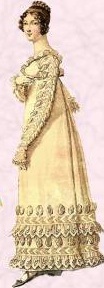
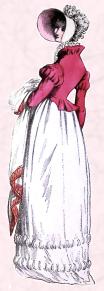
The graceful style for women of the early 19th Century is known as the Empire style. Tightly laced corsets were overthrown for the more natural flowing gown. By the end of the 1790s, the Empire cut, which had begun as a chemise shift that was gathered under the breasts, was the accepted form of dress for ladies. Originally, the bustline was drawn together with a girdle. By 1800, the gown had a very low square neckline, which exposed the woman’s décolleté. The barely-there puff sleeve was pulled back by the short narrow backed bodice, which greatly restricted a woman’s arm movement. (The image is of a dress of 1799 from Le Journal Des Dames et Des Modes.)

The dress was regularly made of fine white muslin or batiste. Different colored clothing were used for riding, morning calls, and evening suppers. Pale colors were prevalent. It would be rare to find a pattern in the gown. Muslin gathered with less puckering and was the material of choice, but it was difficult to keep clean. Therefore, pastels were used for day gowns. During the winter, heavier cloths, such as velvet or wool or even cotton was used. It was not uncommon for a woman to wear flannel petticoats during the colder months.

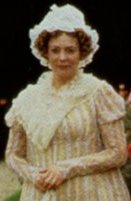
Mrs. Bennet in 1995’s “Pride and Prejudice” sports a mob cap.

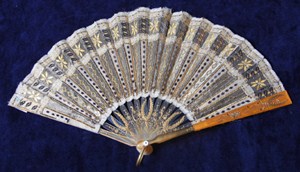
Women on longer wore wigs or powdered their hair; yet, very conservative women still sported a mob cap at home. No respectable woman would leave home without a bonnet. Gloves were always worn outdoors, but they were also required for a lady during a ball or a social call. One removed her gloves for dining. As dresses had no pockets, reticules, a small material bag that closed with a pull string, were worn about one’s wrist. A lady would carry a parasol with riding with her gentleman friend to protect her skin from the sun. Decorative fans were also seen as an important accessory for the well dressed female.

Early on in the 1800s, female garments were decorated with Greek symbols and patterns at the hem, around the neckline, or as a trim for the sleeve. More ornate trims were exported from France. The Empress Josephine remained a fashion icon through the early 1800s. Egyptian symbols and marking replaced those of the Greek line. With the onset of the Napoleonic Wars, frogging, braids, and cording were seen on both the male and female form.

Gothic Style 1816

By the later years of the Regency Period, the bodice of the dress had more support and gave the female form a broader shoulder line. Flounces and padded rolls were added to the line. Some influences from the Elizabethan and the Tudor periods crept into the trim and pleated forms. By 1820, the Empire line had disappeared, instead taking on a more Gothic line, which lasted until Queen Victoria’s accession to the throne.

The Spencer was worn both indoors and out. It was made of silk or wool (kerseymere). As an indoor garment, the Spencer was called a canezou. As with the Regency gown, the Spencer knew its share of trimming and decorative touches. From 1800 to 1810, to keep warm, women wore pelisses over their gowns. It was an empire lien coat that reached the woman’s hip or knee. After 1810, the pelisse was longer and heavier, with full sleeves. High- waisted like the Empire gown, the pelisse frequently sported a fur collar for additional warmth. Normally, the pelisse was brown or dark blue.

1812 Pelisse

A woman’s underwear lacked the touches of “Victoria’s Secret.” A chemisette, which was a side opening half blouse, filled in the woman’s bare neckline by day. Because the gowns were so thin, stays were avoided unless the figure demanded it. One may remember that the Empire line allowed the woman’s gown to cling to all her curves. That could be a good thing if she were svelte, but not so good if she had a bit of “pudge.” For warmth, women resorted to flesh tone pantaloons, which came to their knees. Pantaloons were the first “slimmers.” Since women wore white satin slips over the stays to give the gown a smoother line. Drawers tied around the waist became a staple during the Regency Era, as well as stockings held up by garters.

1810 Corsette

Posted in British history, Regency era | Tagged | Comments Off on Regency Fashion for Women

How Indie eBooks Are Changing the Publishing Business for the Good and the Bad

This article comes from David Vinjamuri, a contributor at Forbes. To read the complete article, please visit http://www.forbes.com/sites/davidvinjamuri/2012/08/15/publishing-is-broken-were-drowning-in-indie-books-and-thats-a-good-thing/

Since then I read more ebooks than physical books. I buy a lot more books, too.  Last year I noticed that books were getting cheaper, but the writing was getting worse.  It started to get harder and harder to shop the Kindle store because I was either upset by the price of a book or the quality of its writing.  Accidentally, I had stumbled upon the new face of self-publishing.

My experience reflects a profound and wrenching transformation of publishing that is shaking the industry to its roots.  The beneficiaries of the existing order – major publishers and their most successful authors have become the most visible opponents of the turmoil that these “Indie” authors have introduced.

Posted in Industry News/Publishing | Comments Off on How Indie eBooks Are Changing the Publishing Business for the Good and the Bad