Victorian Celebrities: Thomas Henderson, First Person to Measure the Distance to Alpha Centauri

220px-Thomas_James_Henderson,_1798-1844_Henderson-01r A Scottish astronomer and mathematician, Thomas James Alan Henderson (28 December 1798 – 23 November 1844) was the first person to measure the distance to Alpha Centauri, the major component of the nearest stellar system to Earth, and for being the first Astronomer Royal for Scotland.

Early Life
Born in Dundee, he was educated at the High School of Dundee, after which he trained as a lawyer, working his way up through the profession as an assistant to a variety of nobles. However, his major hobbies were astronomy and mathematics, and after coming up with a new method for using lunar occultation to measure longitude, he came to the attention of Thomas Young, superintendent of the Royal Navy’s “Nautical Almanac.” Young helped Henderson enter the larger world of astronomical science, and on his death a posthumous letter recommended to the Admiralty that Henderson take his place.

Career:
Africa

Henderson was passed over for that position, but the recommendation was enough to get him a position at the Royal Observatory at the Cape of Good Hope in South Africa. There he made a considerable number of stellar observations between April 1832 and May 1833, including those for which he is remembered today. It was pointed out to him that the bright southern star Alpha Centauri had a large proper motion, and Henderson concluded that it might be a close star.

The 1830s version of the “space race” was to be the first person to measure the distance to a star using parallax. Parallax is a displacement or difference in the apparent position of an object viewed along two different lines of sight, and is measured by the angle or semi-angle of inclination between those two lines. The term is derived from the Greek παράλλαξις (parallaxis), meaning “alteration.” Nearby objects have a larger parallax than more distant objects when observed from different positions, so parallax can be used to determine distances.

Henderson was thus in a good position to be this person. After retiring back to the United Kingdom due to bad health, he began analysing his measurements and eventually came to the conclusion that Alpha Centauri was just slightly less than one parsec away, 3.25 light years. This figure is reasonably accurate, being 25.6% too small.{The parsec (symbol: pc) is a unit of length used in astronomy, equal to about 3.26 light-years, or about 30.9 trillion kilometres (19.2 trillion miles).}

Doubts about the accuracy of his instruments kept him from publishing, however (there had been previous, discredited attempts to claim a measurement of stellar parallax), and eventually he was beaten to the punch by Friedrich Wilhelm Bessel, who published a parallax of 10.4 light years (8.8% too small) for 61 Cygni in 1838. Henderson published his results in 1839, but was relegated to second place because of his lack of confidence.

Scotland
In the meantime, his measurement work at the Cape had led him to be appointed the first Astronomer Royal for Scotland in 1834. The vacant chair of astronomy at the University of Edinburgh was given to him on the advice of Prime Minister Lord Melbourne. From 1834 he worked at the City Observatory (then called the Calton Hill Observatory) in Edinburgh until his death. In April, 1840 he was elected a Fellow of the Royal Society.

Henderson became a member or fellow of several distinguished societies, including the Royal Astronomical Society (1832) and the Royal Society of Edinburgh (1834).

Personal Life and Death
He was married in 1836 and had one daughter. He died in Edinburgh on 23 November 1844 and is buried in Greyfriars Kirkyard.

Posted in British history, Great Britain, real life tales, Scotland, Victorian era | Tagged , , , , , , | 1 Comment

The Sad State of Education in North Carolina

This week I am stepping into the “PC” ring. As many of you know, I spent 39 years in the public classrooms of three different states. Recently, the local news station (CBS) on the number of Charlotte-Mecklenberg school teachers who had resigned this school year. By mid-October some 169 teachers had resigned their positions. “The president of the Charlotte – Mecklenburg Association of Educators, Charles Smith, believes the higher departures are due to low wages and the state not offering more money to teachers who earn advanced degrees.”

So what does all this mean?

The NC General Assembly…

***Eliminated 9,306.5 education position this school year. 5,184.5 were teachers; 3,850 were teacher assistants; and 272 were support personnel (guidance counselors, speech pathologists, psychologists, etc.)

*** The current budget provides NO pay increases for educators. (My son has been at the same pay scale for the last four years. He and his wife, who is also a teacher, are struggling to make ends meet. He works three jobs to see to the welfare of his wife and two children.) In 2007-2008, NC was ranked 25th in teacher pay. At the moment, they are at the bottom.

*** While removing all the incentives for teachers to stay in NC, the Legislature adopted a $50 million school voucher program.

*** The State Legislature has eliminated career status for ALL teachers. The new standard requires each school district to identify the top 25% of effective teachers. Unfortunately, they did not provide the criteria upon which to base these evaluations. Teachers will no longer receive tenure. They will be placed on 1-, 2-, or 4-year contracts. The top 25% will be given the option of receiving $500 to compensate them for the loss of their due process rights.

*** Educators will receive no additional pay for a master’s degree unless their job requires it (i.e., counselors, school psychologists, etc.) Those currently paid for a master’s degree will be grandfathered in. To me, this means NC students will receive inferior educations. How can one convince a student to be a life-long learner when the teacher is penalized for loving education?

*** Schools will be graded from “A” to “F.” The score will be based 80% on standardized test scores and 20% on growth. No other variables will be considered in the grading.

*** The national model for recruiting teachers (the NC Teaching Fellows Program) is no funded.

*** Textbook funding will be cut by $77.4 million dollars.

*** Classroom supplies will be cut $45.7 million dollars.

*** Limited English Proficiency (LEP) funding will be reduced by $6 million dollars.

*** Retired educators will receive NO Cost of Living Adjustments (COLA).

Posted in Education in NC | Tagged , , , | 17 Comments

November 30 – Saint Andrew’s Day

standrew Who was Saint Andrew ? Despite what many may think, St. Andrew, who is the patron saint of Scotland, did not live and work in that country. In fact, his legendary connections to Scotland appeared centuries after his death.

Andrew, one of the twelve disciples of Jesus, was a fisherman by trade. After Jesus’s crucifixion, Andrew carried on Jesus’s work. He brought the gospel to parts of Asia Minor, specifically to Syria. Roman soldiers ended Andrew’s life. According to the traditions of the time, the soldiers crucified Andrew on a diagonal cross. Later, his “relics” were taken to Constantinople. Reportedly, those relics were moved to Italy in the later part of the fourth century. During that time, Saint Regulus managed to bring some of Saint Andrew’s bones to Fife, in Scotland. We are unsure of these facts because the bones no longer exist. They were reportedly lost during the Reformation, but a plaque in the ruins of St Andrews Cathedral marks where the bones once were kept.

Outside of Scotland, Saint Andrew’s Day is of little significance. However, it is a special day for Scots worldwide.

Why is Saint Andrew the patron saint of Scotland? In the ninth century AD, control of the area around Lothian led to a conflict between the Picts and the Scots and the Northumbrians. Near Athelstaneford in East Lothian, Angus McFergus, the leader of the Picts, had a dream in which St. Andrew promised him a victory. In the midst of the battle the following day, Angus supposedly saw an X-shaped cross in the sky above him. The sight gave the Picts the inspiration they needed to win the confrontation. The white cross against a blue background became part of the saltire, the Scottish national flag. 220px-Flag_of_Scotland.svg

Posted in British history, Great Britain, religion, Scotland | Tagged , , | 8 Comments

Thanksgiving Trivia: Happy Turkey Day!

cornucopia03 It took more than 200 years after the first Thanksgiving before it became an official holiday.

The first Thanksgiving was a three day feast, which included hunting, athletic games, and eating. The Pilgrims dined on venison, NOT turkey. There was also NO pumpkin pie or potatoes or cranberry sauce.

In 1789, George Washington announced the first NATIONAL Thanksgiving holiday, but Thanksgiving did not become an annual tradition until the 19th Century. The Americans celebrated on Thursday, November 26, 1789.

As the first Thanksgiving (1622) was to celebrate the Pilgrims’ first successful harvest, the celebration was not repeated.

American writer, Sarah Josepha Hale, was inspired by A Diary of Pilgrim Life. In 1827, Hale began a 30 year campaign to make to make Thanksgiving a national tradition. At her own expense, Hale published recipes for pumpkin pie, stuffing, turkey, etc. (By the way, Hale is the author of the nursery rhyme “Mary Had a Little Lamb.”)

In 1939, FDR moved the holiday to the 3rd Thursday in November to give retailers an extra week to make money during the holiday buying season. It was the Depression, after all.

In 1863, Abraham Lincoln declared Thanksgiving will would be celebrated on the last Thursday of November.

Ironically, in 1941, FDR signed a bill to keep Thanksgiving on the 4th Thursday of November.

In 1989, George H. W. Bush gave the first official turkey pardon.

turkey03 These facts and lots more about Thanksgiving can be found at History.com.

Posted in food and drink, holidays | Tagged | 4 Comments

Time Warner Will Carry the Ovation Network Again Beginning In January 2014!

Time Warner Cable and Bright House Networks will be reinstating Ovation to their channel line-up starting January 1, 2014!

To read the entire Press Release announcement, please click here.

Together, we Stand For The Arts,

Chad E. Gutstein
Chief Operating Officer
​Ovation

Posted in Uncategorized | Comments Off on Time Warner Will Carry the Ovation Network Again Beginning In January 2014!

Regency Celebrity: Mary Ann Duff, Anglo-American Tragedienne, One of the Greatest on the American Stage

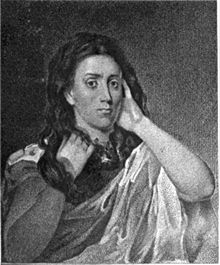
220px-Mary_Ann_Duff_0001 Mary Ann Duff, born Mary Ann Dyke (1794- September 5, 1857), was an Anglo-American tragedienne, in her time regarded as the greatest upon the American stage. She was born in London, England, and died in New York City, USA.

Biography
Mary Ann Dyke and her younger sisters Elizabeth and Ann were all born in London. Their father was an Englishman, employed in the service of the British East India Company, and he died abroad while they were children. Their mother prepared them for the stage under James Harvey D’Egville, ballet-master of the King’s Theatre, London.

Early Career
The sisters made their first appearance in 1809, at a Dublin theatre and were described as “remarkable for beauty of person and winning sweetness of disposition.”

While Mary was performing in Dublin, she met Irish poet Thomas Moore who proposed to her, but was rejected as Mary had already formed an attachment to the man who became her husband. Moore turned his attentions to her sister Elizabeth, whom he married soon after.

Mary Ann married in her sixteenth year John R. Duff (1787–1831), an Irish actor. (The youngest sister Ann married William Murray, the brother of Harriet Murray), but died soon after the marriage.)

John Duff had been a classmate of Moore at Trinity College, where he had read law, but was drawn to the stage. He was seen in Dublin by actor Thomas Apthorpe Cooper who recommended him to Powell and Dickson of the Boston Theatre. He was immediately engaged and he and Mary, barely sixteen, moved to America in 1810. In 1817, John became a partner in the Boston Theatre, but relinquished his share after three years.

American Career
Mary Ann Duff first appeared in Boston as Juliet on December 31, 1810, with her husband as Romeo. The part of Mercutio was played by John Bernard. Although one critic remarked on her attractiveness, he felt that her youth with its concomitant lack of experience caused her performance to lack “both conception and power.”

Her next performance was on January 3, 1811, when she played Lady Anne in Richard III with George Frederick Cooke in the title rôle, following it with Lady Rodolpha Lumbercourt to his Sir Pertinax MacSycophant in Charles Macklin’s Man of the World, Charlotte to his Sir Archy MacSarcasm in Love a la Mode by the same author, and Lady Percy to his Falstaff in Henry IV, Part 1.

Other roles she played at this time were Miranda, opposite her husband as Marplot, in The Busy Bodie by Susanna Centlivre and Eliza Ratcliff with John Bernard as Sheva in The Jew by Richard Cumberland. She also appeared in the pantomimes Oscar and Malvina by William Reeve, in which she also danced, and Brazen Mask by James Hewitt.

On April 29, 1811 the Duffs appeared at a benefit in which Mary danced a solo while her husband performed in The Three and the Deuce by Prince Hoare. The latter was so popular that he would go on to repeat this triple-role performance more than eighty times over the course of his career. Mary’s first season in Boston ended with Victoria in Hannah Cowley’s A Bold Stroke for a Husband.

In July, the company made its annual migration to Providence, Rhode Island. Ellen Darley (neé Westwray) having retired as leading “juvenile lady,” Mary succeeded to most of her characters.

Other tragic rôles included Ophelia, Desdemona, and Lady Macbeth. In 1821, also in Boston, she played Hermione in The Distrest Mother, by Ambrose Philips, an adaptation of Racine’s Andromaque. So powerful was her performance that Edmund Kean feared it might be forgotten that he was the “star.” She first appeared in New York City in 1823, as Hermione, to the Orestes of the elder Booth.

In 1828, she played at Drury Lane, London, but soon returned to America where Mr. Duff died in 1831. He had been for some time in poor health and had declined in professional popularity, while his wife, at first viewed as inferior to him in ability, had surpassed and eclipsed him. After her husband’s death, Mary had a hard struggle with poverty, as she was the mother of ten children and actors, even of the best order, were poorly paid in those days.

In 1826, in New York, Mr. and Mrs. Duff received jointly, during ten weeks, a salary of only $55 a week, together with the net proceeds of one benefit. In 1835, she played for the last time in New York and was married to Joel G. Sevier, of New Orleans in 1836. Her farewell to the stage in 1838 occurred there.

Final Years
She lived in New Orleans, renounced the Stage, left the Catholic faith, and became a Methodist. For many years her life was devoted to works of piety and benevolence. About 1854, the once great and renowned actress, took up her abode with her youngest daughter, Mrs. I. Reillieux, at 36 West Ninth Street, New York City, where, on September 5, 1857, she died. Although she suffered from cancer, the immediate cause of death was an internal hemorrhage.

An article in The Philadelphia Sunday Mercury, August 9, 1874, written by James Rees, relates the strange circumstances of her burial. According to that authority, the body of Mrs. Duff-Sevier was laid in the receiving tomb at Greenwood, September 6, 1857, and shortly afterward that of her daughter, Mrs. Reillieux, was likewise laid there; but on April 15, 1858, both those bodies were thence removed and were finally buried in the same grave, which is No. 805, in Lot 8,999, in that part of the cemetery known as “The Hill of Graves,” — the certificate describing them as “Mrs. Matilda I. Reillieux & Co.” The grave was then marked with a headstone, inscribed with the words, “My Mother and Grandmother.” There seems to have been a purpose to conceal the identity of Mrs. Sevier with Mrs. Duff, and to hide the fact that the mother of Mrs. Reillieux had ever been on the stage, — but the grave of the actress was finally discovered and restored.

Posted in acting, British history, Great Britain, Living in the Regency, real life tales, Regency era, Regency personalities | Tagged , , , , , , , | Comments Off on Regency Celebrity: Mary Ann Duff, Anglo-American Tragedienne, One of the Greatest on the American Stage

Happenings During the Reign of William IV: The Merthyr Rising of 1831

The Merthyr Rising of 1831 was the violent climax to many years of simmering unrest among the large working class population of Merthyr Tydfil in South Wales and the surrounding area.

Beginnings

Throughout May 1831, the coal miners and others who worked for William Crawshay took to the streets of Merthyr Tydfil, calling for reform, protesting against the lowering of their wages and general unemployment. Gradually the protest spread to nearby industrial towns and villages and by the end of May, the whole area was in rebellion, and for the first time in the world the red flag of revolution was flown.

Events
After storming Merthyr town, the rebels sacked the local debtors’ court and the goods that had been collected. Unpaid debts were taken and given back to their original owners. Account books containing debtors’ details were also destroyed. Among the shouts were cries of Caws a bara (cheese and bread) and I lawr â’r Brenin (down with the king).

On 1 June 1831, the protesters marched to local mines and persuaded the men on shift there to stop working and join their protest. In the meantime, the British government in London had ordered in the army, with contingents of the Argyll and Sutherland Highlanders dispatched to Merthyr Tydfil to restore order. Since the crowd was now too large to be dispersed, the soldiers were ordered to protect essential buildings and people.

On 2 June, while local employers and magistrates were holding a meeting with the High Sheriff of Glamorgan at the Castle Inn, a group led by Lewsyn yr Heliwr (also known as Lewis Lewis) marched there to demand a reduction in the price of bread and an increase in their wages. The demands were rejected, and after being advised to return to their homes, attacked the inn. Engaged by the 93rd (Highland) Regiment, after the rioters seized some of their weapons, the troops were commanded to open fire. After a protracted struggle in which hundreds sustained injury, some fatal, the Highlanders were compelled to withdraw to Penydarren House, and abandon the town to the rioters.

Some 7,000 to 10,000 workers marched under a red flag, which was later adopted internationally as the symbol of the working classes. For four days, magistrates and ironmasters were under siege in the Castle Hotel, and the protesters effectively controlled Merthyr.

For eight days, Penydarren House was the sole refuge of authority. With armed insurrection fully in place in the town by 4 June, the rioters had commandeered arms and explosives, set up road-blocks, formed guerrilla detachments, and had banners capped with a symbolic loaf and literally dyed in blood. Those who had military experience had taken the lead in drilling the armed para-military formation, and created an effective central command and communication system.
This allowed them to control the town and engage the formal military system, including:
** Ambushing the 93rd’s baggage-train on the Brecon Road, under escort of forty of the Glamorgan Yeomanry, and drove them into the Brecon hills
** Beating off a relief force of a hundred cavalry sent from Penydarren House
** Ambushing and disarming the Swansea Yeomanry on the Swansea Road, and throwing them back in disorder to Neath
** Organising a mass demonstration against Penydarren House

Having sent messengers, who had started strikes in Northern Monmouthshire, Neath and Swansea Valleys, the riots reached their peak. However, panic had spread to the family oriented and peaceful town folk, who had now started to flee what was an out of control town. With the rioters arranging a mass meeting for Sunday 6th, the government representatives in Penydarren House managed to split the rioters council. When 450 troops marched to the mass meeting at Waun above Dowlais with levelled weapons, the meeting dispersed and the riots were effectively over.

Outcome
By 7 June the authorities had regained control of the town through force. Twenty-six people were arrested and put on trial for taking part in the revolt. Several were sentenced to terms of imprisonment, others sentenced to penal transportation to Australia, and two were sentenced to death by hanging – Lewsyn yr Heliwr (also known as Lewis Lewis) for robbery and Dic Penderyn (also known as Richard Lewis) for stabbing a soldier (Private Donald Black of the Highland Regiment) in the leg with a seized bayonet.

Lewsyn yr Heliwr had his sentence downgraded to a life sentence and penal transportation to Australia when one of the police officers who had tried to disperse the crowd testified that he had tried to shield him from the rioters. He was transported aboard the vessel John in 1832 and died 6 September 1847 in Port Macquarie.

Following this reprieve the British government, led by Lord Melbourne, was determined that at least one rebel should die as an example of what happened to rebels. The people of Merthyr Tydfil were convinced that Dic Penderyn, a 23-year-old miner, was not responsible for the stabbing, and 11,000 signed a petition demanding his release. The government refused, and Penderyn was hanged at Cardiff market on August 13, 1831. In 1874 it was discovered that another man named Ianto Parker, not Dic Penderyn, had stabbed Donald Black and then fled to America fearing capture by the authorities, and also that rebuttal witness James Abbott, who had testified at Penderyn’s trial, admitted that he had lied under oath, under the orders of Lord Melbourne, in order to secure a conviction.

Posted in British history, Living in the Regency, South Wales, William IV | Tagged , , , | 1 Comment

Regency Celebrity: Maria Theresa Kemble, Actress and Playwright

220px-Kemble_as_Catherine_-_Garrick_Production Maria Theresa Kemble (1774–1838), née Marie Thérèse Du Camp, was an actress on the English stage and wife of Charles Kemble. She wrote a number of comedies.

Early Life
The daughter of George De Camp, real name possibly De Fleury, she was born in Vienna 17 January 1774 into a family of musicians and dancers. Brought to England, she appeared when six years old at the Opera House, as Cupid in a ballet by Jean-Georges Noverre. After playing at the age of eight in a theatre directed by M. Le Texier Zélie in a translation of La Colombe by Madame de Genlis, she was engaged for the Royal Circus.

George Colman took her for the Haymarket Theatre. Her first performance at the Haymarket was in The Nosegay on 14 June 1786 with James Harvey D’Egville in the presence of the royal family. On 21 June she danced in The Polonaise, and on 7 July she appeared in a ballet entitled Jamie’s Return with James Harvey and his brother George D’Egville.

She was then secured by Thomas King for the Drury Lane Theatre, where on 24 October 1786, she played Julie, a small part in John Burgoyne’s Richard Cœur de Lion. Her father had left her in England for Germany, where he died while she was still young; she picked up English, and played juvenile and small parts.

Stage Success
She first caught the public taste 15 August 1792 at the Haymarket, when, in a travestied Beggar’s Opera she performed Macheath to the Polly of John Bannister and the Lucy of John Henry Johnstone. Biddy in Miss in her Teens (David Garrick), Adelaide in The Count of Narbonne adapted from the Castle of Otranto, Gillian in the Quaker, and Lucy in The Recruiting Officer were then assigned her; and she played some original parts, including Lindamira in Richard Cumberland’s Box Lobby Challenge.

In singing parts she was allowed at times to replace Nancy Storace and Anna Maria Crouch. She was the original Judith in The Iron Chest (George Colman the Younger), and Florimel in Kemble’s Celadon and Florimel (from The Maiden Queen). Miranda in the Busybody, Page (Cherubin) in Follies of a Day, (Figaro), Le Mariage de Figaro, and Kitty in High Life Below Stairs (James Townley) followed.

At the Haymarket, 15 July 1797, she was the original Caroline Dormer in The Heir-at-Law (George Colman the Younger), and in the same year she played Portia and Desdemona, followed at Drury Lane by Katherine in Katherine and Petruchio, and Hippolito in Kemble’s alteration of The Tempest.

For her benefit, 3 May 1799, she gave at Drury Lane her own unprinted play of First Faults. In 1799 William Earle printed a piece called Natural Faults, and accused Miss De Camp in the preface of having stolen his plot and characters. In a letter to the Morning Post of 10 June, she denied the charge, and asserted that her play was copied by Earle from recitation. John Genest considered that Earle’s statement ‘has the appearance of truth.’ Lady Teazle, Miss Hoyden, Lady Plyant in The Double Dealer (William Congreve), Hypolita in She would and she would not, Little Pickle, and Dollalolla in Tom Thumb were some of the other parts she played before her marriage to Charles Kemble, which took place 2 July 1806.

As a Kemble
Accompanying the Kembles to Covent Garden, she made her first appearance there, 1 October 1806, as Maria in the Citizen, and remained there for the rest of her acting career. Her comedy, The Day after the Wedding, or a Wife’s First Lesson, 1808, was played at Covent Garden for the benefit of her husband, who enacted Colonel Freelove (18 May 1808), while she was Lady Elizabeth Freelove. Match-making, or ‘Tis a Wise Child that knows its own Father was played for her own benefit on the 24th; it is also assigned to her. It was not acted a second time, nor printed.

She also assisted her husband in the preparation of Deaf and Dumb. Among the parts now assigned her were Ophelia, Mrs. Sullen, Violante, Beatrice in Much Ado about Nothing, Mrs. Ford, and Juliana in the Honeymoon, and the like. In 1813–14 and 1814–15 she was not engaged. On 12 December 1815, she made an appearance as Lady Emily Gerald in her own comedy Smiles and Tears, or the Widow’s Stratagem.

Last Years
She then disappeared from the stage until 1818–19, when she played Mrs. Sterling, and was the original Madge Wildfire in Daniel Terry’s musical version of Heart of Midlothian. For her own and her husband’s benefit she played Lady Julia in ‘Personation,’ 9 June 1819, when she retired. A solitary reappearance was made at Covent Garden on the occasion of the début as Juliet of her daughter Fanny Kemble, 5 October 1829, when she played Lady Capulet.

She died at Chertsey, Surrey, on 3 September 1838.

Family Members
Besides Fanny Kemble, her daughter Adelaide Kemble was known on the stage. A son John Mitchell Kemble was a classical scholar.

Her brother occasionally acted fops and footmen at Drury Lane and the Haymarket, and was subsequently an actor and a cowkeeper in America. Her sister Adelaide, an actress in a line similar to her own, was popular in Newcastle upon Tyne.

Posted in acting, British history, Great Britain, Living in the Regency, real life tales, Regency era, Regency personalities | Tagged , , , | 3 Comments

Regency Celebrity: James Harvey D’Egville, English Dancer and Choreorgrapher

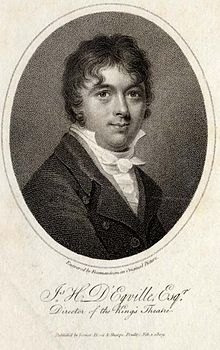
220px-James_Harvey_D'Egville_001 James Harvey D’Egville (ca. 1770 – ca. 1836) was an English dancer and choreographer.

James’ father Pierre D’Egville was ballet master at Drury Lane and Sadler’s Wells Theatres. His other son George D’Egville was also a dancer.

James D’Egville performed at the Paris Opera from 1784 to 1785.

Back in England, in June 1786, he danced in The Nosegay at the Haymarket Theatre with Maria Theresa Kemble in the presence of the Royal Family. On 7 July he appeared in a ballet entitled Jamie’s Return with Kemble and his brother George. It was well received, which inspired an artist named Miller to do a painting depicting the three of them.

Between 1799 and 1809 he was choreographer at the King’s Theatre, now Her Majesty’s Theatre where he had danced as a child in 1783.

One of his pupils was Mary Ann Dyke who became tragedienne Mary Ann Duff, an Anglo-American tragedienne, who in her time was regarded as the greatest upon the American stage.

In 1827, the London Magazine published an article decrying the fact that D’Egville had won a libel suit against The Spirit of the Age newspaper for writing about his alleged association with the assassin of Princess Lambelle while he was in France in 1792. It annoyed the magazine immensely that simply writing that someone had said something libellous was grounds to win damages against a periodical.

Princess Maria Teresa of Savoy-Carignan (Marie Thérèse) (8 September 1749 – 3 September 1792) was a member of a cadet branch of the House of Savoy. She was married at the age of 17 to Louis Alexandre de Bourbon-Penthièvre, Prince de Lamballe, the heir to the greatest fortune in France. After her marriage, which lasted a year, she went to court and became the confidante of Queen Marie Antoinette. Her death in the massacres of September 1792 during the French Revolution initiated the implementation of the Reign of Terror.

The magazine also had snide things to say about D’Egville’s ballets. They wrote of him, “The gentleman who deserves the thanks of all the saints on earth, for having cured the young men of the present day of the sinful taste for ballets.

Posted in British history, Great Britain, Living in the Regency, Napoleonic Wars, real life tales, Regency era, Regency personalities, royalty | Tagged , , , , | 1 Comment

Regency Celebrity: John Philip Kemble, a Great Exponent of Shakespearean Roles

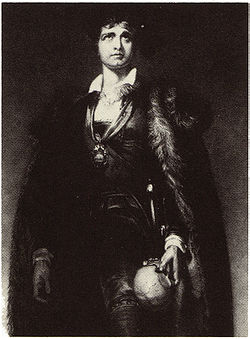
250px-John_Philip_Kemble_Hamlet_1802 John Philip Kemble (1 February 1757 – 26 February 1823) was an English actor. He was born into a theatrical family as the eldest son of Roger Kemble, actor-manager of a touring troupe. His elder sister Sarah Siddons achieved fame with him on the stage of the Theatre Royal, Drury Lane. His other siblings Charles Kemble, Stephen Kemble, Ann Hatton and Elizabeth Whitlock also enjoyed success on the stage.

Early Life
The second child of Roger Kemble – the manager of the travelling theatre company the Warwickshire Company of Comedians – John was born at Prescot, Lancashire. His mother being a Roman Catholic, he was educated at Sedgley Park Catholic seminary (now Park Hall Hotel), near Wolverhampton, and the English college at Douai, France, with a view to becoming a priest.

At the end of the four years’ course, he still felt no vocation for the priesthood, and returning to England he joined the theatrical company of Crump & Chamberlain, his first appearance being as Theodosius in Nathaniel Lee’s tragedy of that name at Wolverhampton on 8 January 1776.

In 1778, Kemble joined the York company of Tate Wilkinson, appearing at Wakefield as Captain Plume in George Farquhar’s The Recruiting Officer; in Hull for the first time as Macbeth on 30 October, and in York as Orestes in Ambrose Philips’s Distresset Mother. In 1781, he obtained a “star” engagement at Dublin making his first appearance there on 2 November as Hamlet. He also achieved great success as Raymond in The Count of Narbonne, a play taken from Horace Walpole’s Castle of Otranto.

Drury Lane
Gradually he won for himself a high reputation as a careful and finished actor, and this, combined with the greater fame of his sister, Sarah, led to an engagement at the Theatre Royal, Drury Lane, where he made his first appearance on 30 September 1783 as Hamlet. In this role he awakened interest and discussion among the critics such as Harriet Evans Martin rather than the enthusiastic approval of the public.

As Macbeth on 31 March 1785 he shared in the enthusiasm aroused by Sarah Siddons, and established a reputation among living actors second only to hers. Brother and sister had first appeared together at Drury Lane on 22 November 1783, as Beverley and Mrs Beverley in Edward Moore’s The Gamester, and as King John and Constance in Shakespeare’s tragedy.

In the following year they played Montgomerie and Matilda in Richard Cumberland’s The Carmelite, and in 1785 Adorni and Camiola in Kemble’s adaptation of Philip Massinger’s A Maid of Honor, and Othello and Desdemona. Between 1785 and 1787, Kemble appeared in a variety of roles, his Mentevole in Robert Jephson’s Julia producing an overwhelming impression.

In December 1787 he married Priscilla Hopkins Brereton, the widow of an actor and herself an actress. Kemble’s appointment as manager of the Drury Lane theatre in 1788 gave him full opportunity to dress the characters less according to tradition than in harmony with his own conception of what was suitable. He was also able to experiment with whatever parts might strike his fancy, and of this privilege he took advantage with greater courage than discretion.

He played a huge number of parts, including a large number of Shakespearean characters and also a great many in plays now forgotten, in his own version of Coriolanus, which was revived during his first season, the character of the “noble Roman” was so exactly suited to his powers that he not only played it with a perfection that has never been approached, but, it is said, unconsciously allowed its influence to colour his private manner and modes of speech. His tall and imposing person, noble countenance, and solemn and grave demeanour were uniquely adapted for the Roman characters in Shakespeare’s plays; and, when in addition had to depict the gradual growth and development of one absorbing passion, his representation gathered a momentum and majestic force that were irresistible.

In 1785 the well-known actor, John Henderson, asked his friend, the critic Richard “Conversation” Sharp, to go and see the newcomer, Kemble, and to report back to him. Sharp later wrote to Henderson with the following insightful description of what he had found:

“I went, as I promised, to see the new ‘Hamlet,’ whose provincial fame had excited your curiosity as well as mine. There has not been such a first appearance since yours: yet Nature, though she has been bountiful to him in figure and feature, has denied him voice; of course he could not exemplify his own direction for the players to ‘speak the speech trippingly on the tongue,’ and now and then he was as deliberate in his delivery as if he had been reading prayers, and had waited for the response. He is a very handsome man, almost tall and almost large, with features of a sensible but fixed and tragic cast; his action is graceful, though somewhat formal, which you will find it hard to believe, yet it is true. Very careful study appears in all he says and all he does; but there is more singularity and ingenuity, than simplicity and fire. Upon the whole he strikes me rather as a finished French performer, than as a varied and vigorous English actor, and it is plain he will succeed better in heroic, than in natural and passionate tragedy. Excepting in serious parts, I suppose he will never put on the sock. You have been so long without a ‘brother near the throne’ that it will perhaps be serviceable to you to be obliged to bestir yourself in Hamlet, Macbeth, Lord Townley and Maskwell; but in Lear, Richard, Falstaff and Benedict you have nothing to fear…”

His defect was in flexibility, variety, rapidity; the characteristic of his style was method, regularity, precision, elaboration even of the minutest details, founded on a thorough psychological study of the special personality he had to represent. His elocutionary art, his fine sense of rhythm and emphasis, enabled him to excel in declamation, but physically he was incapable of giving expression to impetuous vehemence and searching pathos. In Coriolanus and Cato he was beyond praise, and possibly he may have been superior to both Garrick and Kean in Macbeth, although it must be remembered that in it part of his inspiration must have been caught from Mrs Siddons.

In all the other great Shakespearean characters he was, according to the best critics, inferior to them, least so in Lear (though he never played Shakespeare’s tragic Lear, preferring the happy ending History of King Lear as adapted by Nahum Tate), Hamlet and Wolsey, and most so in Shylock and Richard III.

His production of Cymbeline was staged regularly from 1801 on. On account of the eccentricities of Sheridan, the proprietor of Drury Lane, Kemble withdrew from the management, and, although he resumed his duties at the beginning of the season 1800-1801, he at the close of 1802 finally resigned connection with it.

Covent Garden
In 1803 he became manager of the Theatre Royal, Covent Garden, in which he had acquired a sixth share for £23,000. The theatre was burned down on 20 September 1808, and the raising of the prices after the opening of the new theatre, in 1809, led to the Old Price Riots, which practically suspended the performances for three months. Kemble had been nearly ruined by the fire, and was only saved by a generous loan, afterwards converted into a gift, of £10,000 from the Duke of Northumberland. Kemble took his final leave of the stage in the part of Coriolanus on 23 June 1817.

His retirement was probably hastened by the rising popularity of Edmund Kean. The remaining years of his life were spent chiefly abroad, and he died at Lausanne on 26 February 1823.

Posted in British history, Great Britain, Living in the Regency, real life tales, Regency era, Regency personalities, Wales | Tagged , , , , | Comments Off on Regency Celebrity: John Philip Kemble, a Great Exponent of Shakespearean Roles