Regency Happenings: The Battle of Vitoria, the end to the Peninsular War

300px-Vitoria_-_Plaza_de_la_Virgen_Blanca_10 At the Battle of Vitoria (21 June 1813) a British, Portuguese and Spanish army under General the Marquess of Wellington broke the French army under Joseph Bonaparte and Marshal Jean-Baptiste Jourdan near Vitoria in Spain, eventually leading to victory in the Peninsular War.

Background

In July 1812, after the Battle of Salamanca, the French had evacuated Madrid, which Wellington’s army entered on 12 August 1812. Deploying three divisions to guard its southern approaches, Wellington marched north with the rest of his army to lay siege to the fortress of Burgos, 140 miles (230 km) away, but he had underestimated the enemy’s strength, and on 21 October, he had to abandon the Siege of Burgos and retreat. By 31 October, he had abandoned Madrid too, and retreated first to Salamanca then to Ciudad Rodrigo, near the Portuguese frontier, to avoid encirclement by French armies from the north-east and south-east.

Wellington spent the winter reorganizing and strengthening his forces. By contrast, Napoleon withdrew many soldiers to rebuild his main army after his disastrous invasion of Russia. By 20 May 1813, Wellington marched 121,000 troops (53,749 British, 39,608 Spanish and 27,569 Portuguese) from northern Portugal across the mountains of northern Spain and the Esla River to outflank Marshal Jourdan’s army of 68,000, strung out between the Douro and the Tagus. The French retreated to Burgos, with Wellington’s forces marching hard to cut them off from the road to France. Wellington himself commanded the small central force in a strategic feint, while Sir Thomas Graham conducted the bulk of the army around the French right flank over landscape considered impassable.

Wellington launched his attack at Vitoria on 21 June, in four columns. After hard fighting, Thomas Picton’s 3rd Division broke the enemy’s center and soon the French defense crumbled. About 5,000 French soldiers were killed or wounded, and 3,000 were taken prisoner, while Wellington suffered about 5,000 killed or wounded. 152 cannons were captured, but Bonaparte narrowly escaped. The battle led to the collapse of Napoleonic rule in Spain.

Terrain
The battlefield centers on the Zadorra River, which runs from east to west. As the Zadorra runs west, it loops into a hairpin bend, finally swinging generally to the southwest. On the south of the battlefield are the Heights of La Puebla. To the northwest is the mass of Monte Arrato. Vitoria stands to the east, two miles (3 km) south of the Zadorra. Five roads radiate from Vitoria, north to Bilbao, northeast to Salinas and Bayonne, east to Salvatierra, south to Logroño and west to Burgos on the south side of the Zadorra.

Plans
Jourdan was ill with a fever all day on 20 June. Because of this, few orders were issued, and the French forces stood idle. An enormous wagon train of booty clogged the streets of Vitoria. A convoy left during the night, but it had to leave siege artillery behind because there were not enough draft animals to pull the cannons.
Gazan’s divisions guarded the narrow western end of the Zadorra valley, deployed south of the river. Maransin’s brigade was posted in advance, at the village of Subijana. The divisions were disposed with Leval on the right, Daricau in the centre, Conroux on the left, and Villate in reserve. Only a picket guarded the western extremity of the Heights of La Puebla.

Further back, D’Erlon’s force stood in a second line, also south of the river. D’Armagnac’s division deployed on the right and Cassagne’s on the left. D’Erlon failed to destroy three bridges near the river’s hairpin bend and posted Avy’s weak cavalry division to guard them. Reille’s men originally formed a third line, but Sarrut’s division was sent north of the river to guard the Bilbao road, while Lamartinière’s division and the Spanish Royal Guard units held the river bank.

Wellington directed Hill’s 20,000-man Right Column to drive the French from the Zadorra defile on the south side of the river. While the French were preoccupied with Hill, Wellington’s Right Centre column moved along the north bank of the river and crossed it near the hairpin bend behind the French right flank.

Graham’s 20,000-man Left Column was sent around the north side of Monte Arrato. It drove down the Bilbao road, cutting off the bulk of the French army. Dalhousie’s Left Centre column cut across Monte Arrato and struck the river east of the hairpin, providing a link between Graham and Wellington.

Battle
Coming up the Burgos road, Hill sent Morillo’s Division to the right on a climb up the Heights of La Puebla. Stewart’s 2nd Division began deploying to the left in the narrow plain just south of the river. Seeing these moves, Gazan sent Maransin forward to drive Morillo off the heights. Hill moved Col. Henry Cadogan’s brigade of the 2nd Division to assist Morillo. Gazan responded by committing Villatte’s reserve division to the battle on the heights.

About this time, Gazan first spotted Wellington’s column moving north of the Zadorra to turn his right flank. He asked Jourdan, now recovered from his fever, for reinforcements. Having become obsessed with the safety of his left flank, the marshal refused to help Gazan, instead ordering some of D’Erlon’s troops to guard the Logroño road.

Wellington thrust James Kempt’s brigade of the Light Division across the Zadorra at the hairpin. At the same time, Stewart took Subijana and was counterattacked by two of Gazan’s divisions. On the heights, Cadogan was killed, but the Anglo-Spanish force managed to hang on to its foothold. Wellington suspended his attacks to allow Graham’s column time to make an impression, and a lull descended on the battlefield.

At noon, Graham’s column appeared on the Bilbao road. Jourdan immediately realized he was in danger of envelopment and ordered Gazan to pull back toward Vitoria. Graham drove Sarrut’s division back across the river, but could not force his way across the Zadorra despite bitter fighting. Further east, Longa’s Spanish troops defeated the Spanish Royal Guards and cut the road to Bayonne.

With some help from Kempt’s brigade, Picton’s 3rd Division from Dalhousie’s column crossed to the south side of the river. According to Picton, the enemy responded by pummeling the 3rd with 40 to 50 cannons and a counter-attack on their right flank, still open because they had captured the bridge so quickly, causing the 3rd to lose 1,800 men (over one third of all Allied losses at the battle) as they held their ground. Cole’s 4th Division crossed further west. With Gazan on the left and D’Erlon on the right, the French attempted a stand at the village of Arinez. Formed in a menacing line, the 4th, Light, 3rd and 7th Divisions soon captured this position. The French fell back to the Zuazo ridge, covered by their well-handled and numerous field artillery. This position fell to Wellington’s attack when Gazan refused to cooperate with his colleague D’Erlon.

French morale collapsed, and the soldiers of Gazan and D’Erlon ran for it. Artillerists left their guns behind as they fled on the trace horses. Soon the road was jammed with a mass of wagons and carriages. The efforts of Reille’s two divisions, holding off Graham, allowed tens of thousands of French troops to escape by the Salvatierra road.

Aftermath
The Allied army lost about 5,000 men, with 3,675 British, 921 Portuguese and 562 Spanish casualties. French losses totaled at least 5,200 killed and wounded, plus 2,800 men and 151 cannon captured. By army, the losses were South 4,300, Centre 2,100 and Portugal 1,600. There were no casualty returns from the Royal Guard or the artillery.

French losses were not higher for several reasons. First, the Allied army had already marched 20 miles (32 km) that morning and was in no condition to pursue. Second, Reille’s men valiantly held off Graham’s column. Third, the valley by which the French retreated was narrow and well-covered by the 3rd Hussar and the 15th Dragoon Regiments acting as rearguard. Last, the French left their booty behind.

Many British soldiers turned aside to plunder the abandoned French wagons, containing “the loot of a kingdom.” It is estimated that over one million pounds of booty (perhaps £100 million in modern equivalent) was seized, but the gross abandonment of discipline caused an enraged Wellington to write in a dispatch to Earl Bathurst, “We have in the service the scum of the earth as common soldiers.”The British general also vented his fury on a new cavalry regiment, writing, “The 18th Hussars are a disgrace to the name of soldier, in action as well as elsewhere; and I propose to draft their horses from them and send the men to England if I cannot get the better of them in any other manner.” (On 8 April 1814, the 18th redeemed their reputation in a gallant charge at Croix d’Orade, shortly before the Battle of Toulouse.)

Order was soon restored, and by December, after detachments had seized San Sebastián and Pamplona, Wellington’s army was encamped in France.

The battle was the inspiration for Beethoven’s Opus 91, often called the “Battle Symphony” or “Wellington’s Victory,” which portrays the battle as musical drama. The climax of the movie The Firefly, starring Jeanette MacDonald, occurs with Wellington’s attack on the French centre. (The film used music from an opera of the same name by Rudolf Friml, but with a totally different plot.)

Posted in British history, Living in the Regency, real life tales, Regency era, Regency personalities, Uncategorized | Tagged , , , , , | Comments Off on Regency Happenings: The Battle of Vitoria, the end to the Peninsular War

BAM Tiptoeing into Print on Demand Market

This article comes from Laura Owen and Paid Content.

Books-A-Million, the nation’s second-largest bookstore chain after Barnes & Noble (not that there’s a lot of competition these days) is tiptoeing into the print-on-demand market: The chain signed a deal with the print-on-demand company On Demand Books to install an Espresso Book Machine in its Portland, Maine store. A second Books-A-Million store will get an Espresso Book Machine “at a later date.”

“This offering means something special for BAM customers, who will now have access to a virtual inventory of seven million titles instantly available to them,” Terrance G. Finley, CEO of Books-A-Million, said in a statement. “Our customers will also be able to print their self-published works or any user generated content, photo books, recipes, etc. in a matter of minutes and pick it up in our store.”

To read the complete article, please visit http://paidcontent.org/2013/07/18/print-on-demand-may-be-coming-soon-to-a-books-a-million-near-you/

Posted in Uncategorized | Comments Off on BAM Tiptoeing into Print on Demand Market

Regency Happenings: The Battle of Stoney Creek from the War of 1812

300px-Battle_of_stoney_creek The Battle of Stoney Creek was fought on 6 June 1813 during the War of 1812 near present day Stoney Creek, Ontario. British units made a night attack on an American encampment. Due in large part to the capture of the two senior officers of the American force, and an overestimation of British strength by the Americans, the battle was a victory for the British, and a turning point in the defense of Upper Canada.

Background
On 27 May, the Americans had won the Battle of Fort George, forcing the British defenders of Fort George into a hasty retreat, with heavy casualties. The British commander, Brigadier General John Vincent, gathered in all his outposts along the Niagara River, disbanded the militia contingents in his force and retreated to Burlington Heights (at the west end of Burlington Bay), with about 1,600 men in total. The Americans under the overall leadership of General Henry Dearborn, who was elderly and ill, were slow to pursue. A brigade under Brigadier General William H. Winder first followed up Vincent, but Winder decided that Vincent’s forces were too strong to engage, and halted at the Forty Mile Creek. Another brigade joined him, commanded by Brigadier General John Chandler, who was the senior, and took overall command. Their combined force, numbering 3,400, advanced to Stoney Creek, where they encamped on 5 June. The two generals set up their headquarters at the Gage Farm.

Vincent sent his Deputy Assistant Adjutant General, Lieutenant Colonel John Harvey, to reconnoitre the American position. Harvey recommended a night attack, reporting that “the enemy’s guards were few and negligent; his line of encampment was long and broken; his artillery was feebly supported; several of his corps were placed too far to the rear to aid in repelling a blow which might be rapidly struck in front.” The American dispositions described by Harvey account for the statement in the post-battle report of the U.S. Assistant Adjutant-General that only 1,328 American troops were engaged against the British, out of Chandler’s total force of 3,400.

A British column of five companies from the 1/8th (King’s) Regiment of Foot and the main body of the 49th Regiment of Foot, about 700 men in all, was formed. Although Vincent accompanied the column, he placed Harvey in command.

At this point, the story of Billy Green comes to light. Billy Green was a 19 year old local resident, who had witnessed the advance of the Americans from the top of the Niagara Escarpment earlier in the day. Billy’s brother-in-law, Isaac Corman, had been briefly captured by the Americans, but was released after he convinced them (truthfully) that he was the cousin of American General William Henry Harrison. In order to be able to pass through the American lines, he was given the challenge response password for the day – “WIL-HEN-HAR” (an abbreviation of Harrison’s name). He gave his word of honor that he would not divulge this to the British army. He kept his word, but did reveal the word to Billy Green, who rode his brother-in-law’s horse part way, and ran on foot the rest of the way to Burlington Heights. Here, he revealed the password to Lieutenant James FitzGibbon. He was provided with a sword and uniform and used his knowledge of the terrain to guide the British to the American position. Billy Green was present at the battle.

However, it has been suggested that the password was actually obtained by Lieutenant Colonel Harvey. According to an account given after the war by Frederick Snider, a neighbour of the Gages, Harvey had executed a ruse on the first sentry to be accosted. Pretending to be the American officer of the day making Grand Rounds, he approached the sentry and when challenged, came close to the sentry’s ear as if to whisper the countersign. But with bayonet secreted in hand, he grabbed the surprised sentry by the throat and threw him to the ground. With the bayonet at his throat, the sentry gave up the password.

This suggestion illustrates the incomplete research into several aspects of the Battle of Stoney Creek. Snider gave this account not long before his death in 1877, and his source for it was the April 1871 issue of The Canadian Literary Journal. Snider was confusing Harvey with Colonel Murray, June 1813 with December 1813 and Stoney Creek with Youngstown near Fort Niagara. Snider makes several obvious errors, such as “the British General St. Vincent was found some days after wandering about in the woods nearly dead of hunger.” His name was Vincent, and he did not wander about the woods for days. His source for the provenance of the countersign should thus be considered to be unreliable.

Battle
The British left their camp at Burlington Heights at 11:30 P.M. on 5 June. While Vincent was the senior officer present, the troops were placed under the conduct and direction of Lieutenant Colonel Harvey, who led them silently toward Stoney Creek. They had removed the flints from their muskets to ensure that there were no accidental discharges and dared not utter even a whisper. A sentry post of American soldiers was surprised and either captured or killed by bayonet. Billy Green is said to have bayoneted one of the American sentries personally, although this is not mentioned in any official British record.

The British continued advancing toward the American campfires in silence. However, at the repeated urging of Second Lieutenant Ephraim Shaler, the U.S. 25th Regiment, which had earlier been camped there had been moved from their previous exposed position, leaving behind only the cooks who were preparing the troops’ meal for the next day. Shaler had returned to the original position when he heard a sentry cry out as he was being tomahawked after being shot with an arrow from one of John Norton’s small band of First Nations warriors.

Around the same time, a group of Vincent’s staff officers who had come forward to watch the action let out a cheer. Their men took up the cheer, relieving their tension but depriving them of the element of surprise that was their primary advantage given the lopsided number of troops they faced. Instead of striking fear in their adversaries, the yells served to direct their attention to where the British were, helping the rousing troops to focus their attention and musket fire and making it nearly impossible for officers’ orders to be heard above the din. Any hope of catching the Americans unaware and bayoneting them in their sleep was now lost, and the British fixed their flints to their muskets and attacked. Lieutenant James FitzGibbon and three sergeants of the Light Company of the 49th were able to keep their men from taking up the shout “until a late stage of the affair, when firing on our side became general.” Gradually, the American troops began to recover from the initial surprise, recover their poise and start firing at the attacking British, at times from as far away as 200 yards (180 m). The American artillery also entered the fray after having previously been rendered useless due to the dampness settling into the powder.

Holding the high ground, the Americans were able to pour both musket and artillery fire into the exposed British line, and the line began to lose cohesion. For ammunition, the U.S. Twenty-Fifth Infantry was firing a variant of ‘buck and ball,’ in this instance firing 12 buckshot balls instead of the usual .65 calibre ball and 3 buckshot. This effectively turned their muskets into shotguns. Despite repeated charges by the British, the centre of the American line was holding and with the withering fire that the British line was sustaining, it was only a matter of time before they would have to retire.

A series of events coincided to change the course of the battle. General Winder ordered the U.S. 5th Infantry to protect the left flank. In doing so, he created a gap in the American line while at the same time leaving the artillery unsupported by infantry. At the same time, the American commander, John Chandler, hearing musket shots from the far right of the American line and having already sent his staff officers off with other orders, rode out himself to investigate. But his horse fell (or was shot – Chandler used both excuses at different times), and he was knocked out in the fall.

Major Charles Plenderleath, commanding the British 49th Regiment, was able to ascertain the position of the American artillery when two field guns fired in quick succession (43.218493°N 79.764344°W). Realizing the importance of possession of the guns, he gathered troops of FitzGibbon’s and other nearby companies to charge the guns before they could reload. First to volunteer for what could be a suicidal attack were 23-year-old Sergeant Alexander Fraser and his 21-year-old brother Peter, a corporal in FitzGibbon’s company, with 20 to 30 others. With bayonets fixed, Plenderleath led the charge up Gage’s Lane, volunteers following at a run, all fearing the next discharge from the cannons might annihilate them.

However, the U.S. 2nd Artillery under the command of Captain Nathaniel Towson at that moment responded to an order to cease firing, unaware of the British troops advancing on their position. The gunners were without arms of their own. The British charged the field guns, and when they were within a few yards of the gun emplacement, the men began yelling “Come on, Brant.” They set upon the helpless gunners, bayoneting man and horse, quickly overrunning and capturing the position before continuing on to engage the U.S. 23rd Infantry, which got off one round before the momentum of the 49th scattered them. The remaining British forces followed soon after.

At this point General Chandler, conscious again and aware of the commotion near his artillery but not of the reason, stumbled to the position to investigate. Thinking himself to be among the U.S. 23rd Infantry and intending to bring order back to the “new and undisciplined” troops, he realized to his horror that the soldiers were British and Alexander Fraser immediately took him prisoner at bayonet point. Winder very shortly thereafter fell prey to the same mistake. Realizing his error, he pulled his pistol, aiming it at Fraser who was poised to take him prisoner, as he had Chandler. With his musket pointed at Winder’s breast, Fraser told him menacingly “If you stir, sir; you die” and Winder was made prisoner also, proffering his sword to Fraser.

Major Joseph Lee Smith of the 25th U.S. Infantry was very nearly captured himself, but having made good his escape, alerted his men to make a quick withdrawal, thereby avoiding capture. Command of the American forces fell to cavalry officer Colonel James Burn. The cavalry charged forward firing, but once again in the darkness, the Americans suffered from a case of mistaken identity – they were firing on their own U.S. 16th Infantry, who were themselves wandering around without their commander and firing at each other in confusion. Shortly afterwards, the Americans fell back, convinced that they had been defeated, when in fact they still retained a superior force.

The battle lasted less than 45 minutes, but its intensity led to heavy casualties on both sides. As dawn broke, Harvey ordered the outnumbered British to fall back into the woods in order to hide their small numbers. They succeeded in carrying away two of the captured guns, and spiked two more, leaving them on the ground due to their lack of the ability to move them. They later watched from a distance as the Americans returned to their camp after daybreak, burned their provisions and tents, and retreated toward Forty Mile Creek (present day Grimsby, Ontario). By afternoon on 6 June, the British occupied the former site of the American camp.

For much of the morning of 6 June, General Vincent was missing. He had been injured after a fall from his horse during the battle and was found wandering in a state of confusion, convinced that the entire British force had been destroyed. He was finally located about seven miles from the battle scene; his horse, hat and sword all missing.

Casualties
The British casualty return gave 23 killed, 136 wounded, and 55 missing. Of the men reported as “missing,” 52 were captured by the Americans.

The American casualty return for 6 June gave 17 killed, 38 wounded, and 7 officers (2 brigadier-generals, 1 major, 3 captains and 1 lieutenant) and 93 enlisted men missing. The British report of prisoners taken on the morning of 6 June corresponds exactly to the American list of “missing” as concerns the number and ranks of the captured officers, but gives 94 enlisted men captured, indicating that one of the Americans who was presumed to have been killed in the casualty return was in fact captured. Of the seven officers who were captured on the morning of 6 June, three (Gen. Chandler, Captain Peter Mills and Captain George Steele) were wounded, which suggests that a substantial number of the enlisted prisoners may also have been wounded.
Killed in action at the Battle of Stoney Creek, 6 June 1813 (as listed on the Stoney Creek Battlefield Monument): Samuel Hooker, Joseph Hunt, James Daig, Thomas Fearnsides, Richard Hugill, George Longley, Laurence Mead, John Regler, John Wale, Charles Page, James Adams, Alexander Brown, Michael Burke, Henry Carroll, Nathaniel Catlin, Martin Curley, Martin Donnolly, Peter Henley, John Hostler, Edward Killoran, Edward Little, Patrick Martin, John Maxwell. The names of the American dead are not recorded.

Aftermath
Casualties in the fight had been roughly even, but the Americans had been shaken. It is most probable that if their generals had not been captured, the battle might have turned out quite differently. However, the British had a reasonable claim to victory in this battle. Under the de facto leadership of Colonel Harvey, and with some good fortune, they had successfully forced the Americans back toward the Niagara River. American forces would never again advance so far from the Niagara.

At Forty Mile Creek, the retreating American troops were met by reinforcements under Dearborn’s second-in-command, Major General Morgan Lewis. Dearborn had ordered Lewis to proceed to Stoney Creek to attack the British, but almost as the two groups met, the British fleet under Captain Sir James Lucas Yeo appeared in Lake Ontario. The American armed vessels under Commodore Isaac Chauncey had abruptly vanished when they heard that Yeo and troops under Lieutenant General Sir George Prevost had attacked their own base at Sackett’s Harbor, New York. (The Battle of Sackett’s Harbor was a defeat for the British, but large quantities of stores and equipment had mistakenly been set on fire by the Americans, hampering the Americans’ efforts to build large fighting vessels.)

With Yeo threatening his communications, which ran for 40 miles (64 km) along the edge of the lake, Lewis decided to retreat at once to Fort George, leaving a large quantity of tents, arms and supplies for the British to acquire. The British vigorously followed up the American withdrawal. A skirmish on 7 June brought in 12 more prisoners; a captain and 11 enlisted men. During 8–10 June, 80 more prisoners were taken, making a total American loss, during 6–10 June, of 16 killed, 38 wounded, and 192 captured: total 230 men.

The Americans retired into a small defensive perimeter around Fort George, where they remained until abandoning the fort and retreating across the Niagara River into U.S. territory in December.

Brigadier General Winder was later exchanged and subsequently commanded the Tenth Military District around Washington, where he attracted censure following the Burning of Washington.

Legacy
170px-Stoney_Creek_Battlefield_Monument The site of the battle is a National Historic Site of Canada. A stone tower, dedicated exactly 100 years after the battle by Queen Mary, commemorates the British soldiers who died at this location. The Gage farm house is also preserved and serves as a museum. The battle is re-enacted annually on the weekend closest to 6 June.

“More dearly than their lives they held those principles and traditions of British Liberty of which Canada is the inheritor.” – inscription on the Stoney Creek Battlefield Monument

The battle is commemorated in the song Billy Green from the 2000 album From Coffee House to Concert Hall by the late Canadian folk singer Stan Rogers.

Posted in British history, Living in the Regency, real life tales, Regency era, Regency personalities | Tagged , , , , , , , | 2 Comments

Georgian Celebrity: Chevalier d’Eon, French Diplomat, Spy, Soldier, and Transvestite

220px-Thomas_Stewart_–_Chevalier_d'Eon Charles-Geneviève-Louis-Auguste-André-Timothée d’Éon de Beaumont (5 October 1728 – 21 May 1810), usually known as the Chevalier d’Éon, was a French diplomat, spy and soldier, whose first 49 years were spent as a man, and whose last 33 years were spent as a woman. From 1777, d’Éon claimed to be anatomically a woman, and dressed as such. Doctors who examined the body after d’Éon’s death discovered that he was anatomically male. He is considered to be one of the earliest openly transvestite or transgender people.

The title chevalier, French for knight, refers to the honorary title “chevalier des ordres du Roi,” to which d’Éon was entitled after receiving the Order of Saint-Louis in 1763.

Early Life
Chevalier d’Éon de Beaumont was born at the Hôtel d’Uzès in Tonnerre, Burgundy, into a poor, but noble family. His father, Louis d’Éon de Beaumont, was an attorney and director of the king’s dominions, later mayor of Tonnerre and sub-delegate of the intendant of the généralité of Paris. His mother, Françoise de Charanton, was daughter of a Commissioner General to the armies of the wars of Spain and Italy. Most of what is known about d’Éon’s early life comes from a partly ghost-written autobiography, The Interests of the Chevalier d’Éon de Beaumont.

D’Éon excelled in school, moving from Tonnerre to Paris in 1743, graduating in civil law and canon law from the Collège Mazarin, in 1749 at age 21. D’Éon became secretary to Bertier de Sauvigny, intendant of Paris, served as a secretary to the administrator of the fiscal department, and was appointed a royal censor for history and literature by Malesherbes in 1758.

Life as a Spy
In 1756, d’Éon joined the secret network of spies called the Secret du Roi, which worked for King Louis XV personally, without the knowledge of the government, and sometimes against official policies and treaties. The monarch sent d’Éon with the Chevalier Douglas, Alexandre-Pierre de Mackensie-Douglas, baron de Kildin, a Scottish Jacobite in French service, on a secret mission to Russia in order to meet Empress Elizabeth and intrigue with the pro-French faction against the Habsburg monarchy. D’Éon disguised himself as a lady, Lea de Beaumont, to do so, and even became a maid of honour to the Empress (although there is no documentary proof of d’Éon being sent on this mission).

At the time the English would only allow women and children across the border into Russia in an attempt to prevent the French from reaching the Empress, since the French and English were at odds with each other. Given the delicate nature of the spy work, d’Éon had to convince the Russians, the English, and even his own France that he was a woman or he would have been executed by the English upon discovery. His career in Russia is the subject of one of Valentin Pikul’s novels, Le chevalier d’Éon et la guerre de Sept ans. Chevalier Douglas became French ambassador to Russia, and d’Éon was secretary to the embassy in Saint Petersburg from 1756 to 1760, serving Douglas and his successor, the marquis de l’Hôpital.

D’Éon returned to France in October 1760, and was granted a pension of 2,000 livres as reward for his service in Russia. In May 1761, he became a captain of dragoons under the maréchal de Broglie and fought in the later stages of the Seven Years’ War. D’Éon served at the Battle of Villinghausen in July 1761, and was wounded at Ulstrop. After Empress Elizabeth died in January 1762, he was considered for further service in Russia, but instead was appointed secretary to the duc de Nivernais, awarded 1,000 livres, and sent to London to draft the peace treaty to formally end the Seven Years’ War, which was signed in Paris on 10 February 1763. As a result of this, he was awarded a further 6,000 livres, and received the Order of Saint-Louis on 30 March 1763, becoming the Chevalier d’Éon.

Back in London, d’Éon became chargé d’affaires in April 1763, and then plenipotentiary minister – essentially interim ambassador – when the duc de Nivernais returned to Paris in July. D’Éon used this position also to spy for the king. He collected information for a potential invasion – an unfortunate and clumsy initiative of Louis XV, of which Louis’s ministers were unaware – assisting a French agent, Louis François Carlet de la Rozière, who was surveying the British coastal defenses. D’Éon formed connections with English nobility by sending them the produce of his vineyard and abundantly enjoyed the splendour of this interim embassy.

Upon the arrival of the new ambassador, the comte de Guerchy in October 1763, d’Éon was reduced to his former rank as secretary and humiliated by the count. D’Éon found himself trapped between two French factions: Guerchy was a supporter of the duc de Choiseul, duc de Praslin and Madame de Pompadour, in opposition to the comte de Broglie and his brother the maréchal de Broglie. D’Éon complained, and eventually decided to disobey orders to return to France. In his letter to the king, d’Éon claimed the new ambassador had tried to drug him at a dinner at the ambassador’s residence in Monmouth House in Soho Square.

The British government declined a French request to extradite d’Éon, and his 2,000 livres pension was stopped in February 1764. In an effort to save his station in London, he published much of the secret diplomatic correspondence about his recall under the title Lettres, mémoires et négociations particulières du chevalier d’Éon in March 1764, disavowing Guerchy and calling him unfit for his job.

This breach of diplomatic secrecy was scandalous to the point of being unheard of, but d’Éon had not yet published everything (he kept the King’s secret invasion documents and those relative to the Secret du Roi as “insurance”), and the French government became very cautious in its dealings with d’Éon, even when d’Éon sued Guerchy for attempted murder.

With the invasion documents in hand, d’Éon held the king in check. D’Éon did not defend himself when Guerchy sued for libel, and he was declared an outlaw and went into hiding. However, d’Éon but secured the sympathy of the British public: the mob jeered Guerchy in public, and threw stones at his residence. D’Éon busied himself writing a long book on public administration, Les loisirs du Chevalier d’Éon, which was which published in thirteen volumes in Amsterdam in 1774.

Guerchy was recalled to France, and in July 1766, Louis XV granted d’Éon a pension for his services (or as a pay-off for silence) and gave him a 12,000-livre annuity, but refused a demand for over 100,000 livres to clear d’Éon’s extensive debts. D’Éon continued to work as a spy, but lived in political exile in London. His possession of the king’s secret letters protected him against further actions, but d’Éon could not return to France.

Life as a Woman
Despite d’Éon habitually wearing a dragoon’s uniform, there were rumours that he was actually a woman, and a betting pool was started on the London Stock Exchange about his true sex. D’Éon was invited to join, but declined, saying an examination would be dishonouring, whatever the result. After a year without progress, the wager was abandoned.

In 1774, after the death of Louis XV, the secret du roi was abolished, and d’Éon tried to negotiate a return from exile. The French government’s side of the negotiations was handled by the writer Pierre de Beaumarchais. The resulting twenty-page treaty permitted d’Éon to return to France and keep his ministerial pension, but required that d’Éon turn over the correspondence regarding the secret du roi.

The Chevalier d’Éon claimed to be physically not a man, but a woman, and demanded recognition by the government as such. He claimed to have been born anatomically female, but to have been raised as a boy because Louis d’Éon de Beaumont could only inherit from his in-laws if he had a son. King Louis XVI and his court complied, but demanded that d’Éon dress appropriately and wear women’s clothing, although he was allowed to continue to wear the insignia of the Order of Saint-Louis. He agreed, especially when the king granted the chevalière funds for a new wardrobe. In 1777, after fourteen months of negotiation, d’Éon returned to France, and was banished to Tonnerre for six years.

When France began to help the rebels during the American War of Independence, d’Éon asked to join the French troops in America, but his banishment prevented him from doing so.

In 1779, d’Éon published the memoirs La Vie Militaire, politique, et privée de Mademoiselle d’Éon. They were ghostwritten by a friend named La Fortelle and are probably embellished.

He was allowed to return to England in 1785. The pension, which had been granted by Louis XV, was lost because of the French Revolution necessitating the sale of d’Éon’s personal library, jewellery, and plate. The family’s properties in Tonnerre were confiscated by the revolutionary government. In 1792, he sent a letter to the French National Assembly, offering to lead a division of women soldiers against the Habsburgs, but the offer was rebuffed.

D’Éon participated in fencing tournaments until being seriously wounded in Southampton in 1796. His last years were spent with a widow, Mrs. Cole. In 1804, d’Éon was sent to a debtors’ prison for five months, and signed a contract for a biography to be written by Thomas William Plummer. The book was never published because d’Éon became paralyzed following a fall. His final four years were spent bedridden, and on 21 May 1810, he died in poverty in London at the age of 82.

Doctors who examined the body after death discovered that the Chevalier was anatomically male. He was buried in the churchyard of St Pancras Old Church. His remaining possessions were sold by Christie’s in 1813.

Legacy
The term eonism was coined by Havelock Ellis to describe similar cases of transgender behavior; it is rarely used now.

The Beaumont Society, a long standing society for transgendered people, is named after the Chevalier.

The film Le secret du Chevalier d’Éon is loosely based on his life, but it portrays him as a woman masquerading as a man.

Le Chevallier D’eon – a series of manga written by Tou Ubukata and illustrated by Kiriko Yumeji. It is published by Del Rey Manga

Le Chevalier d’Eon – 2006 anime series loosely based on the Chevalier d’Éon.

Eonnagata, a 2010 theatre piece by Canadian Robert Lepage, combining drama and dance, based on the life of Chevalier d’Éon.

Some of d’Éon’s papers are at the Brotherton Library in Leeds, U.K.

In 2012, a painting owned by the Philip Mould Gallery was identified as being a portrait of d’Éon.

Posted in British history, Georgian Era, Living in the Regency, real life tales, Regency era, Regency personalities | Tagged , , , | 4 Comments

Regency Celebrity: Vice Admiral Cuthbert Collingwood

220px-Cuthbert_Collingwood,_Baron_Collingwood_by_Henry_Howard Vice Admiral Cuthbert Collingwood, 1st Baron Collingwood (26 September 1748 – 7 March 1810) was an admiral of the Royal Navy, notable as a partner with Lord Nelson in several of the British victories of the Napoleonic Wars, and frequently as Nelson’s successor in commands.

Early Years
Collingwood was born in Newcastle upon Tyne. His early education was at the Royal Grammar School, Newcastle. At the age of twelve, he went to sea as a volunteer on board the frigate HMS Shannon under the command of his cousin Captain (later Admiral) Richard Brathwaite (or Braithwaite), who took charge of his nautical education. After several years of service under Captain Brathwaite and a short period attached to HMS Lenox, a guardship at Portsmouth commanded by Captain (later Admiral) Robert Roddam, Collingwood sailed to Boston in 1774 with Admiral Samuel Graves on board HMS Preston, where he fought in the British naval brigade at the Battle of Bunker Hill (June 1775), and was afterwards commissioned as a Lieutenant (17 June 1775).

In 1777, Collingwood first met Nelson when both served in HMS Lowestoffe. Two years later, Collingwood succeeded Nelson as Commander (20 June 1779) of HMS Badger, and the next year he again succeeded Nelson as Post-Captain (22 March 1780) of HMS Hinchinbrook, a small frigate. Nelson had been the captain of a failed expedition to cross Central America from the Atlantic Ocean to the Pacific Ocean by navigating boats along the San Juan River, Lake Nicaragua and Lake Leon. Nelson was debilitated by disease and had to recover before being promoted to a larger vessel, and Collingwood succeeded him in command of the Hinchinbrook and brought the remainder of the expedition back to Jamaica.

First Major Command
After commanding in another small frigate, HMS Pelican, in which he was shipwrecked by a hurricane in 1781, Collingwood was promoted to 64 gun ship of the line HMS Sampson, and in 1783 he was appointed to HMS Mediator and posted to the West Indies, where he remained until the end of 1786, again, together with Nelson and this time his brother, Captain Wilfred Collingwood, preventing American ships from trading with the West Indies.

In 1786, Collingwood returned to England, where, with the exception of a voyage to the West Indies, he remained until 1793. In that year, he was appointed captain of HMS Prince, the flagship of Rear Admiral George Bowyer in the Channel Fleet. On 16 June 1791, Collingwood married Sarah Blackett, daughter of a wealthy Newcastle merchant and granddaughter of Robert Roddam (1711–1744) of Hethpoole and Caldburne (not to be confused with his former commander, later Admiral, Robert Roddam).

As captain of Barfleur, Collingwood was present at the Glorious First of June. On board the Excellent, he participated in the victory of the Battle of Cape St Vincent in 1797, establishing a good reputation in the fleet for his conduct during the battle. After blockading Cadiz, he returned for a few weeks to Portsmouth to repair. At the beginning of 1799, Collingwood was raised to the rank of Rear-Admiral (of the White 14 February 1799; of the Red 1 January 1801) and, hoisting his flag in the Triumph, joined the Channel Fleet and sailed to the Mediterranean where the principal naval forces of France and Spain were assembled. Collingwood continued to be actively employed in blockading the enemy until the peace of Amiens allowed him to return to England.

With the resumption of hostilities with France in the spring of 1803. he left home, never to return. First he blockaded the French fleet off Brest. In 1804, he was promoted to Vice-Admiral (of the Blue 23 April 1804; of the Red 9 November 1805). Nearly two years were spent here, but with Napoleon planning and equipping his armed forces for an invasion of Britain, the campaign, which was to decide the fate of Europe and the command of the sea, was starting. The French fleet having sailed from Toulon, Admiral Collingwood was appointed to command a squadron, with orders to pursue them. The combined fleets of France and Spain, after sailing to the West Indies, returned to Cadiz. On their way they encountered Collingwood’s small squadron off Cadiz. He only had three ships with him; but he succeeded in avoiding the pursuit, although chased by sixteen ships of the line. Before half of the enemy’s force had entered the harbour he resumed the blockade, using false signals to disguise the small size of his squadron. He was shortly joined by Nelson who hoped to lure the combined fleet into a major engagement.

Battle of Trafalgar
The combined fleet sailed from Cadiz in October 1805. The Battle of Trafalgar immediately followed. Villeneuve, the French admiral, drew up his fleet in the form of a crescent. The British fleet bore down in two separate lines, the one led by Nelson in the Victory, and the other by Collingwood in the Royal Sovereign. The Royal Sovereign was the swifter sailer, mainly because its hull had been given a new layer of copper which lacked the friction of old, well used copper and thus was much faster. Having drawn considerably ahead of the rest of the fleet, it was the first engaged.

“See”, said Nelson, pointing to the Royal Sovereign as she penetrated the centre of the enemy’s line, “see how that noble fellow Collingwood carries his ship into action!” Probably it was at the same moment that Collingwood, as if in response to the observation of his great commander, remarked to his captain, “What would Nelson give to be here?”

The Royal Sovereign closed with the Spanish admiral’s ship and fired her broadsides with such rapidity and precision at the Santa Ana that the Spanish ship was on the verge of sinking almost before another British ship had fired a gun. Several other vessels came to Santa Ana‘s assistance and hemmed in the Royal Sovereign on all sides; the latter, after being severely damaged, was relieved by the arrival of the rest of the British squadron, but was left unable to manoeuvre. Not long afterwards, the Santa Ana struck her colours. On the death of Nelson, Collingwood assumed the command-in-chief, transferring his flag to the frigate Euryalus. Knowing that a severe storm was in the offing, Nelson had intended that the fleet should anchor after the battle, but Collingwood chose not to issue such an order: many of the British ships and prizes were so damaged that they were unable to anchor, and Collingwood concentrated efforts on taking damaged vessels in tow. In the ensuing gale, many of the prizes were wrecked on the rocky shore and others were destroyed to prevent their recapture, though no British ship was lost.

On 9 November 1805, Collingwood was promoted Vice-Admiral of the Red and raised to the peerage as Baron Collingwood, of Caldburne and Hethpool in the County of Northumberland. He also received the thanks of both Houses of Parliament and was awarded a pension of £2000 per annum. Together with all the other captains and admirals, he also received a gold medal, his third, after those for the Glorious First of June and the Cape St Vincent; only Nelson and Sir Edward Berry share the distinction of three gold medals for service during the wars against France.

When not at sea he resided at Collingwood House in the town of Morpeth, which lies some 15 miles north of Newcastle upon Tyne and Chirton Hall in Chirton, now a western suburb of North Shields. He is known to have remarked, “whenever I think how I am to be happy again, my thoughts carry me back to Morpeth.”

Later Career
From Trafalgar until his death no great naval action was fought, though several small French fleets would attempt to run the blockade, and one successfully landed troops in the Caribbean two months after Trafalgar; however, the majority were hunted down and overwhelmed in battle. During this time, Collingwood was occupied in important political and diplomatic transactions in the Mediterranean, in which he displayed tact and judgement. In 1805, he was appointed to the Commander-in-Chief, Mediterranean Fleet. He requested to be relieved of his command so he might return home; however, the government urgently requested an admiral with the experience and skill of Collingwood to remain, on the grounds his country could not dispense with his services in the face of the still potent threat the French and their allies could pose.

His health began to decline alarmingly in 1809, and he was forced to request the Admiralty to allow him to return home, which was finally granted. Collingwood died on board the Ville de Paris, off Port Mahon as he sailed for England, on 7 March 1810. He was laid to rest besides Nelson in the crypt of St Paul’s Cathedral.

The Collingwood Monument at Tynemouth

The Collingwood Monument at Tynemouth

Evaluation
Collingwood’s merits as a naval officer were in many respects of the first order. His political judgement was remarkable, and he was consulted on questions of general policy, of regulation, and even of trade. He was opposed to impressment and to flogging and was considered so kind and generous that he was called “father” by the common sailors. Between Nelson and Collingwood a close friendship existed, from their first acquaintance in early life until Nelson’s death at Trafalgar; and they lie side by side in St Paul’s Cathedral. As Collingwood died without male issue, his barony became extinct at his death.

Dudley Pope relates an aspect of Collingwood at the beginning of chapter three of his Life in Nelson’s Navy: “Captain Cuthbert Collingwood, later to become an admiral and Nelson’s second in command at Trafalgar, had his home at Morpeth, in Northumberland, and when he was there on half pay or on leave he loved to walk over the hills with his dog Bounce. He always started off with a handful of acorns in his pockets, and as he walked he would press an acorn into the soil whenever he saw a good place for an oak tree to grow. Some of the oaks he planted are probably still growing more than a century and a half later ready to be cut to build ships of the line at a time when nuclear submarines are patrolling the seas, because Collingwood’s purpose was to make sure that the Navy would never want for oaks to build the fighting ships upon which the country’s safety depended.”

Memorials
The Maritime Warfare School of the Royal Navy is commissioned as HMS Collingwood, home to training for warfare, weapon engineering and communications disciplines.

The town of Collingwood, Ontario, on Georgian Bay in Canada, the suburb of Collingwood in the Australian city of Melbourne, the town of Collingwood, New Zealand and the Collingwood Channel (an entrance of Howe Sound near Vancouver, British Columbia), are named in his honour.

A statue erected in his honour overlooks the River Tyne in the town of Tynemouth, at the foot of which are some of the cannon from the Royal Sovereign.

One of the four houses at Collingwood’s old school the Royal Grammar School, Newcastle, is named after him. One of the five houses of British public school Churcher’s College is named after him, as is one of the eleven houses at The Royal Hospital School.
March 2010 saw the 200th anniversary of Collingwood’s death and a number of major events were organised by ‘Collingwood 2010’ on Tyneside, in Morpeth and the island of Menorca.

Posted in British history, Georgian Era, Jane Austen, Living in the Regency, real life tales, Regency era, Regency personalities, Uncategorized | Tagged , , | Comments Off on Regency Celebrity: Vice Admiral Cuthbert Collingwood

Regency Folly: The Walcheren Campaign

The Walcheren Campaign was an unsuccessful British expedition to the Netherlands in 1809 intended to open another front in the Austrian Empire’s struggle with France during the War of the Fifth Coalition. Around 40,000 soldiers, 15,000 horses together with field artillery and two siege trains crossed the North Sea and landed at Walcheren on 30 July. This was the largest British expedition of that year, larger than the army serving in the Peninsular War in Portugal. The Walcheren Campaign involved little fighting, but heavy losses from the sickness popularly dubbed “Walcheren Fever.” Over 4,000 British troops died (only 106 in combat) and the rest withdrew on 9 December 1809.

The primary aim of the campaign was to destroy the French fleet thought to be in Flushing whilst providing a diversion for the hard-pressed Austrians. However, the Battle of Wagram had already occurred before the start of the campaign, and the Austrians had effectively already lost the war.

The army was commanded by John Pitt, 2nd Earl of Chatham whilst the navy was commanded by Sir Richard Strachan. As a first move, the British seized the swampy island of Walcheren at the mouth of river Scheldt, as well as South Beveland island, both in the present-day Netherlands. The British troops soon began to suffer from malaria; within a month of seizing the island, they had over 8,000 fever cases. The medical provisions for the expedition proved inadequate, despite reports that an occupying French force had lost 80% of its numbers a few years earlier, also due to disease.

The French forces were commanded by Jean-Baptiste Bernadotte, who had just been stripped of his command after disobeying orders at Wagram. Dismissed from Napoleon’s Grande Armée, Bernadotte returned to Paris and was sent to the defence of the Netherlands by the council of ministers. He led the French forces competently and although the British captured Flushing, after a ferocious bombardment, and surrounding towns on 15 August, he had already ordered the French fleet to Antwerp and heavily reinforced the city. With the main objective for the British out of reach, the expedition was called off in early September. Around 12,000 troops stayed on Walcheren, but by October only 5,500 remained fit for duty.

In all, the British government spent almost £8 million on the campaign. Along with the 4,000 men that had died during the campaign, almost 12,000 were still ill by February 1810, and many others remained permanently weakened. Those sent to the Peninsular War to join Wellington’s army caused a permanent doubling of the sick lists there.

Order of Battle
British Expeditionary Force to Walcheren
Commander-in-Chief: General Lord Chatham
Second-in-Command: Lieutenant General Sir Eyre Coote
Chief-of-Staff: Sir Robert Brownrigg
Royal Artillery
Brigadier General John Macleod, RA
1 troop, Royal Horse Artillery
2 brigades, 2nd Battalion, Royal Artillery
8 brigades, 3rd Battalion, Royal Artillery
2 brigades, 5th Battalion, Royal Artillery (including 1 heavy brigade)
4 brigades, 9th Battalion, Royal Artillery
1st Division
Lieutenant General Sir John Craddock
Major General Graham’s Brigade (3/1st; 2/35th; 2/81st)
Major General Houston’s Brigade (2/14th; 51st; 2/63rd)
2nd Division
Lieutenant General the Marquess of Huntly
Major General Dyott’s Brigade (1/6th; 1/50th; 1/91st)
Brigadier General Montresor’s Brigade (1/9th; 1/38th; 1/42nd)
3rd Division
Lieutenant General T. Gresvenor
Major General Leith’s Brigade (2/11th; 2/59th; 1/79th)
Brigadier General Acland’s Brigade (2nd; 76th; 2/84th)
4th Division
Lieutenant General Alexander Mackenzie-Fraser
Brigadier General Browne’s Brigade (1/5th; 1/26th; 1/32nd; 4 coys., 2/23rd)
Major General Picton’s Brigade (1/36th; 77th; 1/82nd; 2 coys., 2/8th)
Light Division
Lieutenant General James, Earl of Rosslyn
Major General Stewart’s Brigade (2/43rd; 2/52nd; 8 coys., 2/95th)
Major General von Linsingen’s Cavalry Brigade (3rd Dragoons; 9th Light Dragoons, 12th Light Dragoons; 2nd Hussars, KGL)
Reserve
Lieutenant General John Hope
Brigadier General Disney’s Brigade (1/1st Foot Guards, 3/1st Foot Guards; Flank coys., 2nd Bn., Coldstream Guards & 2/3rd Foot Guards)
Major General Erskine’s Brigade (20th, 1/92nd)
Major General Lord Dalhousie’s Brigade (1/4th, 2/4th, 1/28th)
1 coy, 2/95th
Light Troops, Attached to the Left Wing of the Army
Brigadier General Baron de Rottenberg’s Brigade (68th, 1/71st, 85th, 2 Coys., 2/95th)
Brigadier General Mahon (9th Light Dragoons)

Naval Forces
In addition to the large number of naval vessels, customs-house and excise cutters participated, as did a packet ship. The City of London, Loyal Greenwich, and Royal Harbour River Fencibles also contributed men to the expedition.

Irish Legion
The 1st battalion of the Irish legion (raised for an invasion of Ireland that never happened) was stationed in Flushing during the assault, and was therefor almost completely captured. However, two officers went into hiding with the regimental eagle, and after a few days they crossed the river and escaped towards the south. Napoleon gave them the Légion d’honneur and a promotion as a sign of gratitude.

Posted in British history, Living in the Regency, real life tales, Regency era, Regency personalities | Tagged , , , , , | Comments Off on Regency Folly: The Walcheren Campaign

Regency Celebrity: John Gale Jones, Radical Orator

John Gale Jones (1769–1838) was an English radical orator. He was several times imprisoned for provocative agitation against the government.

Early Life
He was admitted to Merchant Taylors’ School in 1783 and was then described as born on 16 October 1769. By profession he was a surgeon and apothecary, having been trained by William North, a member of the Royal College of Surgeons practising at Chelsea. It is questionable whether he was fully qualified as a physician; and Charles Roach Smith wrote that Jones’s political advocacy ruined his professional prospects.

Activist
Jones was a member of the London Corresponding Society. At the British and Westminster forums, he publicly supported the progress of the French Revolution. In James Gillray’s caricature of the public meeting held at Copenhagen Fields on 12 November 1795, Jones is shown on the hustings to the left; and at the other meetings of that body he was one of the chief declaimers.

 James Gillray's cartoon, Jones speaking (left side) at Copenhagen Fields on 12 November 1795.


James Gillray’s cartoon, Jones speaking (left side) at Copenhagen Fields on 12 November 1795.


On 11 March 1796 in that year he, and John Binns delivered lectures, as delegates from the London Corresponding Society, in Birmingham; but the meeting was broken up. Next year (9 April 1797) Jones was tried at Warwick before Justice Nash Grose, and, although defended by Samuel Romilly and Sir John Vaughan, was convicted on one count, the seditious expression “that he was sent to know whether the people of Birmingham would submit to the Treason and Sedition Bills.”

Early in 1810, Charles Philip Yorke insisted on the exclusion of strangers from the House of Commons during the debates on the Walcheren expedition. After a debate on this proceeding in the British forum, the result condemning Yorke was announced outside the building in a placard drawn up by Jones. Yorke brought the matter before the House of Commons as a breach of privilege (19 February 1810), and Jones was ordered to attend the House. He acknowledged the authorship, was voted guilty, and committed to Newgate Prison, where he remained until 21 June, when the House of Commons rose. He declined to recognize the legality of his restraint or to petition for his release, and was, it is said, only got out at last by a stratagem. During his imprisonment, Francis Burdett (see August 15 post on this website), Romilly, and Sir James Hall made motions for his release, but they were all unsuccessful, although in Romilly’s case the majority was only 160 to 112. A letter which Burdett wrote on Jones’s treatment led to Burdett’s committal to Newgate.

In this same year, 26 November 1810, Jones was sentenced to twelve months’ imprisonment, and ordered to provide sureties to keep the peace for three years, for a libel on Lord Castlereagh. The rumour that he was ill-treated in this prison was found, on the investigation of Coleridge and Daniel Stuart, to be groundless.

Later Life
At the Westminster elections of 1818 and 1820, he exerted himself, but he took little further part in politics. He died at Somers Town on 4 April 1838. His portrait was engraved and published by P. Brown, of 4 Crown Street, Soho, on 14 March 1798.

Works
About 1798 he published Observations on the Tussis Convulsiva, or Hoopping-cough, as read at the Lyceum Medicum Londinense. In 1796 he published Sketch of a Political Tour through Rochester, Chatham, Maidstone, and Gravesend.

Other works were:
‘Speech at Westminster Forum on 9, 16, 23, and 30 Dec. 1794’ (in favour of parliamentary reform), 1795.
‘Substance of Speech at the Ciceronian School, Globe Tavern, Fleet Street, 2 March 1795’ (in favour of Charles James Fox), 1795.
‘Account of Proceedings of London Corresponding Society, near Copenhagen House, 26 Oct. 1795, including speeches of Citizens Binns, Thelwall, Jones.’
‘Oration at the Great Room in Brewer Street on General Washington,’ 1796; new edition, with alterations, in 1825, when Jones wrote to George Canning asking for his subscription to the reprint.
Farewell oration, including a short narrative of his arrest and imprisonment in the Birmingham dungeon, 1798.
‘Invocation to Edward Quin of the Society of the Eccentrics,’ 1803. It was a poetical invocation, descriptive of a coterie, mostly of newspaper writers, meeting in a tavern.
‘Galerio and Nerissa’ (anon.), 1804, a romantic tale, with some verse.
‘Five Letters to George Tierney,’ 1806.
‘Westminster Election. Proceedings at Meeting held at the Crown and Anchor, Strand, 1 June 1818, to secure the Election of Henry Hunt, with the Speech at length of Gale Jones.’
‘Speech at the British Forum’ (on the justice of prosecuting Richard Carlile for continuing to publish works of Tom Paine), 1819.
Substance of speeches at the British forum (on the same issue), 1819.

Posted in British history, legends and myths, Living in the Regency, real life tales, Regency era, Regency personalities | Tagged , , , , , , | Comments Off on Regency Celebrity: John Gale Jones, Radical Orator

Late Regency Happening: The Peterloo Massacre

A depiction of the Peterloo Massacre by Richard Carlile

A depiction of the Peterloo Massacre by Richard Carlile

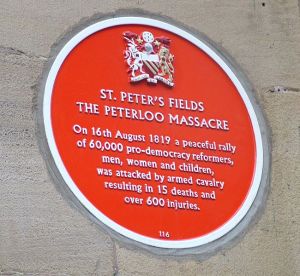
On August 16, 1819, the Peterloo Massacre occurred at St. Peter’s Field in Manchester. A crowd of 60,000-80,000 had gathered to protest the lack of parliamentary representation for the heavily populated industrialized areas.

With the end of the Napoleonic Wars in 1815, the Corn Laws exacerbated the famine of the Year without Summer (1816) and the growing unemployment problems. By the beginning of 1819 the pressure generated by poor economic conditions, coupled with the lack of suffrage in northern England, had enhanced the appeal of political radicalism. In response, the Manchester Patriotic Union, a group agitating for parliamentary reform, organized a demonstration to be addressed by the well-known radical orator Henry Hunt.

Fearing the worst, local magistrates called on the military to dispense with the crowd. They also demanded the arrest of Hunt and the other featured speakers. The Cavalry charged the crowd with sabers drawn. In the melee, 15 people were killed and some 500+ were injured. The massacre was given the name Peterloo, an ironic comparison to the devastation found at the Battle of Waterloo. The Peterloo Massacre became a defining moment of the age. Unfortunately, the massacre’s immediate effect was the passage of the Six Acts, which labelled any meeting for radical reform as “an overt act” of treasonable conspiracy.”

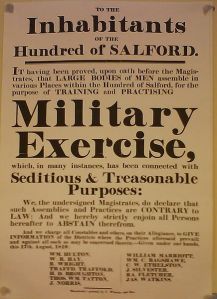
435px-Peterloo_posterIt also led directly to the foundation of The Manchester Guardian, but had little other effect on the pace of reform. In a survey conducted by The Guardian in 2006, Peterloo came second to the Putney Debates as the event from British history that most deserved a proper monument or a memorial. A plaque close to the site, a replacement for an earlier one that was criticized as being inadequate, as it did not reflect the scale of the massacre, commemorates Peterloo.650px-PeterlooRedPlaque
Posted in British history, legends and myths, real life tales, Regency era | Tagged , , , | 4 Comments

Regency Celebrity: Sir Francis Burdett, Reformist Politician Known as “Old Glory”

240px-Sir_Francis_Burdett,_5th_Bt_by_Thomas_Phillips Sir Francis Burdett, 5th Baronet (25 January 1770 – 23 January 1844) was an English reformist politician, the son of Francis Burdett and his wife Eleanor, daughter of William Jones of Ramsbury manor, Wiltshire, and grandson of Sir Robert Burdett, Bart. From 1820 until his death he lived at 25 St James’s Place.

Family
Sir Francis Burdett (5th Bart.) was a member of the Burdett family of Bramcote and inherited the family baronetcy from his grandfather Sir Robert Burdett in 1797.

Education and Early Life
He was educated at Westminster School and the University of Oxford. When young, he was for a long time the notorious lover of Lady Oxford (according to the journal of Thomas Raikes), and afterwards travelled in France and Switzerland. He was in Paris during the earlier days of the French Revolution.

Returning to England in 1793, he married Sophia Coutts, the second daughter of the wealthy banker Thomas Coutts. She brought him the large fortune of £25,000. Their youngest daughter – Angela Burdett-Coutts – ultimately inherited the Coutts fortune and became a well-known philanthropist.

In 1796, he became Member of Parliament for Boroughbridge, having purchased this seat from the representatives of the Duke of Newcastle, and in 1797 succeeded his grandfather as 5th Baronet.

Political Career
Baronet and Member of Parliament
His inheritance included the family seat of Foremarke Hall and ‘the hamlets of Ingleby and Foremark (sometimes referred to as a manor) which were under his Lordship.’

In Parliament he soon became prominent as an opponent of William Pitt the Younger, and as an advocate of popular rights. He denounced the war with France, the suspension of the Habeas Corpus Act, and the proposed exclusion of John Horne Tooke from Parliament, and quickly became the idol of the people. In 1797 he made the acquaintance of Horne Tooke, whose pupil he became, not only in politics, but also in philology. He was instrumental in securing an inquiry into the condition of Coldbath Fields Prison, and as a result was for a time prevented by the government from visiting any prison in the kingdom.

His Last Election?
At the general election of 1802, Burdett was returned as Member of Parliament for the county of Middlesex, but his return was declared void in 1804, and he lost the ensuing by-election owing to the machinations of the returning officer. In 1805, this return was amended in his favor, but as this decision was again quickly reversed, Burdett, who had spent an immense sum of money over the affair, declared he would not stand for Parliament again.

At the general election of 1806, Burdett was a leading supporter of James Paull, the reform candidate for the City of Westminster; but in the following year a misunderstanding led to a duel between Burdett and Paull in which both combatants were wounded. At the general election in 1807, Burdett, in spite of his reluctance, was nominated for Westminster, and amidst great enthusiasm was returned at the top of the poll.

He again attacked abuses, agitated for reform, and in 1810 came sharply into collision with the House of Commons. The radical John Gale Jones had been committed to prison by the House, and Burdett questioned the power of the House to take this step, and trying in vain to have him released. He then issued a revised edition of his speech on this occasion which was published by William Cobbett in the Weekly Register.

A Warrant for His Arrest
The House voted this action a breach of privilege, and the speaker issued a warrant for Burdett’s arrest. The charge was libelling the House of Commons. Barring himself in his house for two days, he defied the authorities, while a mob gathered in his defence. Burdett’s colleague Thomas Cochrane offered assistance, but, realizing that Cochrane intended to use military tactics during this civil and political affair, Burdett declined. At length the house was entered, and under an escort of soldiers he was conveyed to the Tower of London. Released when Parliament was in recess, he caused his supporters much disappointment by returning to Westminster by water, and so avoiding a demonstration in his honor. He then brought legal actions against the speaker and the sergeant-at-arms, but the courts upheld the action of the House.

Reform
In Parliament, Burdett denounced corporal punishment in the army, and supported all attempts to check corruption, but his principal efforts were directed towards procuring a reform of Parliament, and the removal of Roman Catholic disabilities. In 1809, he had proposed a scheme of Parliamentary reform, and returning to the subject in 1817 and 1818, he anticipated the Chartist movement by suggesting universal male suffrage, equal electoral districts, vote by ballot, and annual Parliaments; but his motions met with very little support. He succeeded, however, in carrying a resolution in 1825 that the House should consider the laws concerning Roman Catholics. This was followed by a bill embodying his proposals, which passed the Commons, but was rejected by the House of Lords. In 1827 and 1828 he again proposed resolutions on this subject and saw his proposals become law in 1829. In 1820 Burdett had again come into serious conflict with the government. Having severely censured its action with reference to the Peterloo Massacre (see tomorrow’s post on the Peterloo Massacre), he was prosecuted at Leicester assizes, fined £1,000, and committed to prison for three months. After the passing of the Reform Bill in 1832, the ardour of the veteran reformer was somewhat abated, and a number of his constituents soon took umbrage at his changed attitude.

His Legacy and Death
Consequently, he resigned his seat early in 1837, but was re-elected. However, at the general election in the same year he forsook Westminster and was elected member for North Wiltshire, which seat he retained, acting in general with the Conservatives, until his death. He was nicknamed by fellow conservatives as “Old Glory.” His wife, Lady Burdett, to whom he was devoted, died on 13 January 1844. Sir Francis, then two days short of his 74th birthday, became inconsolable and felt he had nothing left to live for. He refused all food and died just ten days later on 23 January 1844. He and his wife were buried at the same time in the same vault at Ramsbury Church, Wiltshire. He left a son, Robert, who succeeded to the baronetcy, and who inherited his very large fortune, and five daughters, the youngest of whom became the celebrated Baroness Burdett-Coutts after inheriting the Coutts fortune from her grandfather’s widow Harriet (Duchess of St Albans) and appending the Coutts surname under the terms of Harriet’s will. He was a member of the Literary Association of the Friends of Poland.

Posted in British history, Living in the Regency, real life tales, Regency era, Regency personalities | Tagged , , , , , | 6 Comments

Regency Celebrity: Benjamin Bathurst, Disappearing Diplomat

220px-Benjamin_Bathurst Benjamin Bathurst (18 March 1784 – 1809?) was a British diplomatic envoy who disappeared in Germany during the Napoleonic Wars. He was the third son of Henry Bathurst, Bishop of Norwich.

Bathurst disappeared on or about 25 November 1809, sparking much debate and speculation about his ultimate fate, especially in science fiction stories, based on a perception (fostered by secondary sources) that his disappearance was a case of particularly sudden, perhaps supernatural, vanishing. Recent research suggests the circumstances of Bathurst’s disappearance were wildly exaggerated, and that he was almost certainly murdered.

Career
Benjamin Bathurst entered the diplomatic service at an early age and was promoted to the post of Secretary of the British Legation at Livorno. In 1805, he married Phillida Call, daughter of Sir John Call, a Cornish landowner and baronet.

In 1809, he was dispatched to Vienna as an envoy by his relative Henry Bathurst, pro tempore Secretary for Foreign Affairs. His mission was to assist in the reconstruction of Britain and Austria’s alliance and to try to encourage Emperor Francis II to declare war on France, which the Emperor did in April.

However, the Austrians were forced to abandon Vienna to the French forces and eventually sued for peace after they were badly defeated by the French at the Battle of Wagram in July 1809. Bathurst was promptly recalled to London and decided that the safest route was to travel north and take ship from Hamburg.

Disappearance
On 25 November 1809, Bathurst and his German courier, a Herr Krause, who were travelling by chaise under the aliases of “Baron de Koch” and “Fischer” respectively, stopped at the town of Perleberg, west of Berlin.

After ordering fresh horses at the post house, Bathurst and his companion walked to a nearby inn, the White Swan. After ordering an early dinner, Bathurst is said to have spent several hours writing in a small room set aside for him at the inn. The travellers’ departure was delayed, and it was not until 9 P.M. that they were told that the horses were about to be harnessed to their carriage. Bathurst immediately left his room, followed shortly afterwards by Krause, who was surprised to find Bathurst was not in the chaise when he reached it and indeed was nowhere to be found.

The disappearance did not create much excitement at the time, since the country was infested with bandits, stragglers from the French army, and German revolutionaries. Additionally, murders and robberies were so common that the loss of one commercial traveller (which Bathurst was travelling as) was barely noticed, especially since at the time there were hardly any legal authorities in Prussia.

News of Bathurst’s disappearance did not reach England for some weeks, until Krause managed to reach Hamburg and take ship for England. In December, Bathurst’s father, the Bishop of Norwich, received a summons from the Foreign Secretary, Richard Wellesley, to attend him at Apsley House, where Wellesley informed the Bishop of his son’s disappearance.

Bathurst’s wife Phillida immediately left for Germany to search for her husband, accompanied by the explorer Heinrich Röntgen. They arrived at Perleberg to find that the authorities had been looking into the affair and that a Captain von Klitzing had been put in charge of the investigation. After Captain Klitzing was notified of Bathurst’s disappearance, he took immediate steps to mobilise his troops and conducted a vigorous search, apparently working on the initial assumption that the missing man had vanished of his own accord. On the 26th the river Stepenitz was dragged, and civilian officials ordered a second search of the village. On 27 November 1809 the Englishman’s valuable fur coat — worth 200 or 300 Prussian thalers — was discovered hidden in an outhouse owned by a family named Schmidt. Then, on 16 December, two old women out scavenging in the woods near Quitzow, three miles north of Perleberg, came across Bathurst’s pantaloons.

Investigation quickly revealed that one Auguste Schmidt had been working as ostler in the courtyard of the White Swan on the night Bathurst disappeared, and that his mother, who also worked at the inn, had taken the Englishman’s coat. Frau Kestern, a woman employed at the German Coffee House, testified years later that immediately after Bathurst had visited the establishment, Auguste Schmidt had come in, asked her where the visitor had gone, then hastened after him and (she supposed) taken some opportunity to destroy him.

A reward of 500 thalers was offered for any news, and money was paid to members of the local police to expedite matters. This, however, caused the waters to be muddied as many false reports and offers of information were made by people seeking a share of the reward.

In March, Mrs. Bathurst had the entire area of Perleberg searched at vast expense, which included the use of trained dogs, but to no avail. She then travelled to Berlin and then Paris to see Napoleon himself, hoping to obtain from him some account of her husband’s fate. However, when she was received by Napoleon, he declared his ignorance of the affair and offered his assistance.

Contemporary Press Reports
By January 1810, the English and French press had become aware of the affair and had begun to discuss it. The Times published a piece in January 1810 which subsequently appeared in other English newspapers:

There is too much reason to fear that the account of the death of Mr. Bathurst, late envoy to the Emperor of Austria, inserted in a Paris journal, is correct as to the principal fact. It was stated, as an article of Berlin news, of the date of December 10, that Mr. Bathurst had evinced symptoms of insanity on his journey through the city, and that he had subsequently fallen by his own hand in the vicinity of Perleberg. Information, however, has been received within these few days, which forcibly tends to fix the guilt of Mr. Bathurst’s death, or disappearance, on the French Government. It appears that Mr. Bathurst left Berlin with passports from the Prussian Government, and in excellent health, both of mind and body. He was to proceed to Hamburg, but Hamburg he never reached. At some town near the French territories he was seized, as is supposed, by a party of French soldiers. What happened afterwards is not accurately known. His pantaloons have been found near the town where he was seized, and a letter in them to his wife; but nothing else. The Prussian Government, upon receiving the intelligence, evinced the deepest regret, and offered a large reward for the discovery of his body. No success, however, has attended the offer.
The Times, 20 January 1810

The French government were agitated by the accusation that they had kidnapped or murdered Bathurst and replied in their official journal, Le Moniteur Universel:

England alone, among all civilised nations, has renewed the example of paying assassins and encouraging crimes. It appears by the accounts from Berlin, that Mr. Bathurst was deranged in his mind. This is the custom of the British Cabinet – to give their diplomatic missions to the most foolish and senseless persons the nation produces. The English diplomatic corps is the only one in which examples of madness are common.

1852 Discovery
On 15 April 1852, during the demolition of a house on the Hamburg road in Perleberg three hundred paces from the White Swan, a skeleton was discovered under the threshold of the stable. The back of the skull showed a fracture as though from the blow of a heavy instrument. All of the upper teeth were perfect, but one of the lower molars showed signs of having been removed by a dentist. The owner of the house, a mason named Kiesewetter, had purchased the house in 1834 from Christian Mertens, who had been a serving man at the White Swan during the period when Bathurst disappeared.

Bathurst’s sister, Mrs. Thistlethwaite, travelled to Perleberg but could not conclusively say whether the skull belonged to her brother or not.

Recent Investigation
A detailed investigation conducted by writer Mike Dash first published in Fortean Times concluded that the allegedly mysterious details of the Bathurst disappearance had been greatly exaggerated over the years, and that Bathurst was almost certainly murdered.

References in Pop Culture

Bathurst’s case is mentioned by Charles Fort in his book Lo!.

In Science Fiction
In H. Beam Piper’s 1948 science fiction story He Walked Around the Horses, Bathurst slips into a parallel universe where the American Revolution and the French Revolution were both suppressed, and there were no Napoleonic Wars. In that alternate world, Bathurst has a counterpart serving as the Lieutenant Governor of the Crown Colony of Georgia. The Bathurst from our universe is judged to be either insane or a spy and so imprisoned. He attempts escape and is fatally shot. His last testament is read by a high ranking British officer, who pronounces it a work of madness. He is especially puzzled by references to a British general named “Wellington.” The officer is revealed to be Sir Arthur Wellesley. Piper describes Bathurst in the story as “a rather stout gentleman, of past middle age,” although the real Bathurst was 25 years old at the time of his disappearance.

A short story A Toy for Juliette by Robert Bloch mentions Bathurst as being transported into the distant future where he serves to satisfy the cruel pleasures of the story’s main character, Juliette.

The short novel Time Echo by Lionel Roberts (a pseudonym of Lionel Fanthorpe) has Bathurst accidentally transported to a future time where his hatred of Napoleon makes him join with conspirators seeking to overthrow a cruel future conqueror and tyrant.

Avram Davidson’s Masters of the Maze, has Bathurst as one of a select group of humans (and other sentient beings) who had penetrated to the center of a mysterious “Maze” traversing all of space and time. There he dwells in eternal repose, in company with the Biblical Enoch, the Chinese King Wen and Lao Tze, the Greek Apollonius of Tyana, and various other sages of the past and future, some of them Martians.

In A. Bertram Chandler’s “Into the Alternate Universe” the protagonists’ spaceship accidentally falls into “a crack between the universes,” a vacuum without any matter except people (and other beings) who had fallen there earlier, and who (unless in a spaceship) suffocated instantly. Among others, they see the forever floating body of a man in 19th Century upper-class clothing, who seems to be Bathurst.

Bathurst’s disappearance is also mentioned in passing in Robert A. Heinlein’s short story “Elsewhen,” Murray Leinster’s short novel The Other World, Poul Anderson’s novel Operation Chaos, Joel Rosenberg’s “Guardians of the Flame” Series, Simon Hawke’s TimeWars series, in Jane Jensen’s novel Dante’s Equation and early in the 7 November chapter of Anthony Boucher’s 1942 “detective novel” Rocket to the Morgue.

In Kim Newman’s short story “The Gypsies in the Wood,” it is mentioned that the Diogenes Club investigated his disappearance.

In Music
Bathurst is also one of the people suspected to be “Benjamin Breeg” from the song “The Reincarnation of Benjamin Breeg” by British heavy metal group Iron Maiden.

Posted in British history, Living in the Regency, real life tales, Regency era, Regency personalities | Tagged , , , , , | 2 Comments