QUESTION: What do you know about horses and stud farms that might assist me in writing my story?
In truth, when I have a question on horses or riding, my editor is quite helpful. She owns several horses and can usually find what I need quicker than I do.
Since you did not center in on one particular aspect, below you will find some information that might assist in your search.
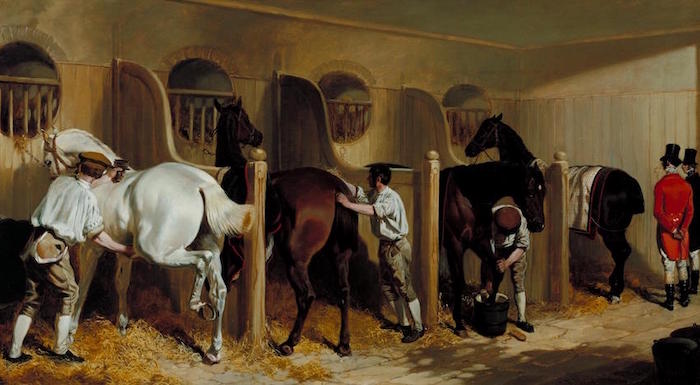
The Duke of Rutland and the earl of Jersey, both present in the Regency era, had much to do with racing. I think the Duke had a stud farm. Some of his horses won races. See if the Sporting Magazine is in Google books or stud books. Warning: Watch when searching for “stud records” because of the pornographers
Regency Reticle has a piece entitled “Eighteenth and Nineteenth Century Horse and Stable Management” and Jane Austen’s World has “A Grim Reality: The Life of a Coach Horse in the Regency Era,” but those do not speak to stud farms.
Some of the web pages about the Foundation horses in England have information about the breeders and then one can cross check with other media.
I do know some basics that should prove true in any era. Race horses are actually a great way to spend money (not so good at making money). The Prince Regent was said to have spent 30,000 pounds on his stud in one year. There’s a tremendous amount of capital that must go into breeding operations–not just the land and stables, but staff to care for the horse and the horses themselves. And, if you’re taking race horses, they have to be raced–you can’t get the stud feeds for unproven sires (or unproven dams). That means the expense of transport for the horse to various racing meets, the training, the jockeys, the entry fees, feed because a race horse must be grained, shoes, equipment, stabling, and on and on.
Then there is the purchase of breeding stock–you do need mares and lots of them, and it is going to take years to get foals on the ground and running (most breeding programs are the work of a lifetime). You might get other folks to pay for stud fees and bring their mares to your stallions, but the foal belongs to the mare’s owner (not to you), so it will not advance any breeding program you have. And stud fees will not cover costs unless you have a name sire–that proven stallion with a great reputation. That means you have to pay to buy that stud unless someone gifts you that horse.
There’s also the heartache of the two-year-old who breaks down, the three-year-old hopeful who ends up not winning any races, and the mares who have colic or lose their foals for other reasons. On top of that you have to add in the mares who end up barren and studs that prove a disappointment in that they do not pass along their success or whose bloodlines fall out of fashion.
More specifically to the Regency era, stud farms in the Regency era were large, privately owned estates for breeding horses, particularly for racing, with some of the most elaborate belonging to the nobility and royalty. These farms were complex operations, featuring elaborate stables, separate buildings for feed and equipment, and living quarters for staff, while most working horses were stabled in individual stalls, and breeding stock was kept at pasture.
Key features of Regency stud farms
While most were private, monastic institutions also played a role in horse breeding, particularly before the Regency era, and some, like the Einsiedeln Abbey stud in Switzerland, still exist today.
Cost
The most impressive studs were for the wealthy and aristocratic classes, who could afford to build large, multi-building complexes. Some even had ornate features and decorations, with stables comparable in grandeur to the main house.
A major focus was breeding horses for the lucrative sport of horse racing. The Prince Regent, for example, reportedly had a racing stud that cost him a fortune annually.
Stables and housing:
Stables were often housed in large, courtyard-style buildings. Housing included individual stalls, with a log and rope system, while loose boxes were less common and reserved for stallions or mares about to foal. Above the stables, haylofts stored fodder, and living quarters for grooms and other staff were often located. Areas for washing down horses and storing tack and carriages were also included.
Support staff and infrastructure:
A large staff of grooms and other workers was essential for the upkeep of the horses, which included feeding, grooming, and general care to keep the animals in prime condition.
Pasture and exercise:
Breeding stock was kept at pasture, but most working horses spent their time stabled, returning to pasture when needed for exercise.
If the person is lucky, and he has the right stallion with a great reputation (not just for racing, but for also breeding winners), and then the person has the right mare to breed as well, and all goes well, then in two years, he might get a yearling that will fetch a really good price at auction, say at Tattersalls:
http://www.edwardianpromenade.com/london/tattersalls-in-the-edwardian-era/
However, it’s unlikely the huge prices will go for an unknown stable with unproven stock. And this is not a short-term investment. You need that capital to put down to start that breeding program, and if that luck is with you, you might start seeing really good success in something more like five to ten years.
Some good reference books:


 Every Woman Dreams...