I am glad you asked this question. It made me think again of book I have started where the heroine is accused of stealing cloth, though she is innocent. I have it drafted with main points, but have yet to find time to write it.
To answer your question, first, you should know how the name of such a person might identified to the public. How will others know that someone they thought respectable is an actual thief? How would others find out about the crime? One could, for example, sometimes find the names of those caught stealing in the Hue and Cry. However, that publication was mostly used to tell others of wanted criminals but could possibly have also been used to list stolen items of value. This newspaper later became the Police Gazette so be aware of the year in which your story is placed.
QUESTION 1: Did merchants mark a “whole bolt of cloth.”?
If the cloth was commissioned for that Merchant, from the weavers who made it, then it could have the merchant’s name woven into the selvedge, repeating for the entire length of the bolt. You can see bolts of cloth today that have that sort of marking. When the cloth is used, that quarter inch or so on the edge is either cut off or turned into a hem or seam, so the final product is not affected by its existence.
QUESTION 2: I couldn’t think of a way to mark the cloth other than an ink blot on the edge or something or a thread could be pulled loose. Any suggestions?
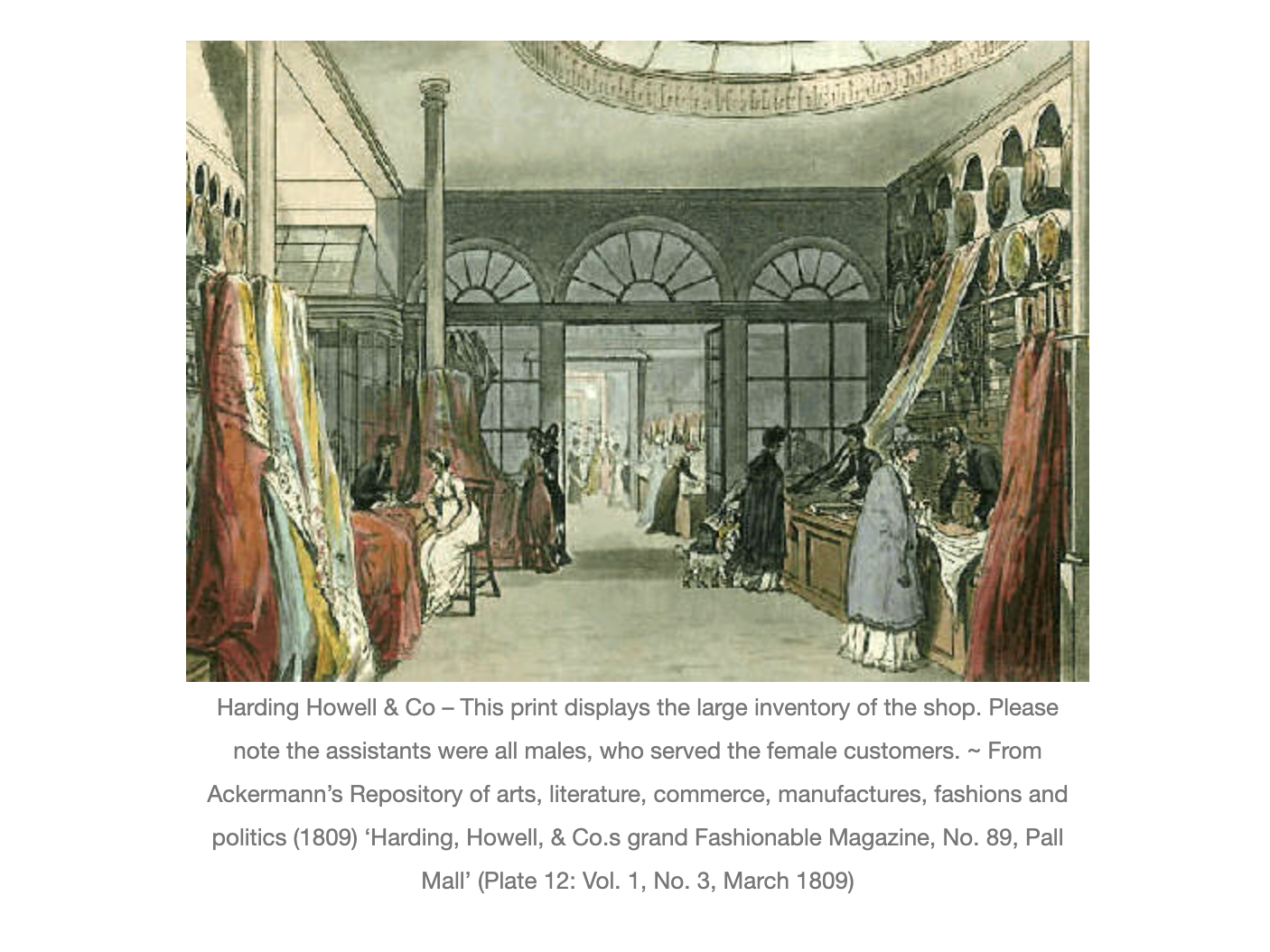
The first thing a thief would do would be to throw away the board or roll on which it was wrapped if he had taken that. Pictures of drapers of the time show most of the material on large rolls on the wall.
I think there will be problems convicting unless the pattern was woven specifically for that merchant. That would be a very expensive roll of cloth. More value equals more substantial charges against the person. Unless the thief was caught red handed within feet of the shop or where there was no possibility of his having gone into another draper’s shop and bought the cloth, it would be difficult to make a charge of theft stick.
A person could be hanged for stealing goods worth forty shillings, meaning approximately 2 pounds, which was quite a bit in the Regency era. Jurors and barristers often brought the value down to something like 38 shillings so that the man was transported instead of hanged. They did not like convicting a person for stealing. Even children were hanged for stealing food, though usually an attempt was made to lower the value of the item.
Back to your idea of marking the cloth in some manner, if you want to be able to identify a bolt of linen cloth, the weaver may have put a couple of coloured threads into the selvedge. Though I would suggest that you tread carefully, for I recall reading something about some sort of legislation, at least, in regards to wool cloth, something regarding selvedge indications as to what was for export. I will see if I can find the exact legislation, but you may want to look out for the information. Another alternative to recognize the cloth is have it be a particular pattern. This could be for linen damask, which would be very expensive or for a simpler weave used for toweling, not terry toweling as we think of it today, or table linen, although there were not so many varieties of patterns for those. Alternatively, there may be some identifying merchant’s mark on the board that the fabric is wrapped around.
Unfortunately, as I was doing something similar for the Regency era, I doubt this would be the case with linen cloth then. I really liked the tale I had concocted in my head, sort of a follow up book to my The Road to Understanding, but I needed to find something a bit more realistic to proceed. Most linen at this time would be woven on 2 or 4 shaft looms, and you cannot weave a name into the selvedge with that few shafts, without doing a special and complicated pick up on every throw of the shuttle, which would make the weaving at least 4 times as slow. You technically could do it with a draw loom or Jacquard loom, but draw looms were very expensive and Jacquard looms were not invented until about 1803 and did not spread to the UK for, at least, a decade or so afterwards, and would only have been used for weaving linen damasks, not everyday linens. I am happy to be corrected by someone with more knowledge than I, but I just cannot see how it would be possible given the looms being used at the time for anything but a damask.
If you want to be able to identify a bolt of linen cloth and have the weaver put a couple of coloured threads into the selvedge, you should do more research first. If I recall correctly, there was some legislation, at least for wool cloth, regarding selvedge indications as to what was for export.
QUESTION 3: Do you know how many feet or ells were usually on a bolt?
One source I have describes cloth for dresses as being an ell long by 27 inches wide. An ell was 45 inches. Jane Austen uses “ells” in a poem to describe the amount of lace on a wrist: “And twelve ells of lace on my wrist …”


 Every Woman Dreams...