What was the difference between the militia officers found in Regency-based novels such as Mr. Wickham in Pride and Prejudice and the Regulars, such as Colonel Fitzwilliam, in the same book?
At the time of the war with Napoleon, Great Britain did not employ a standing militia. They were only recruited when the Regulars were required to engage the enemy. The militia assumed the “policing” of the country in the absence of the Regulars. They served on home land. They were dispensed to squash riots and seditious actions. They protected British soil while the Regulars engaged the enemy outside of the home land. The militia was often dispatched to shires away from their homes to avoid their sympathizing with those they were charged to dispatch. In Pride and Prejudice, the militia which Mr. Wickham joins in Hertfordshire, is supposedly peppered with Derbyshire volunteers.
“In the novel the anonymous regiment of – shires caused a considerable stir on its arrival in the quiet country town of Meryton – and among the Bennet family of five unmarried daughters. “. . . They were well supplied both with news and happiness by the recent arrival of a militia regiment in the neighborhood; it was to remain the whole winter, and Meryton was the head quarters.” (P&P 28). The regiment and its officers figure prominently in the fortunes of the Bennet family for the remainder of the novel. Jane Austen’s own experience of the militia was probably not too different from that of the Bennet sisters. From about the age of sixteen she began to attend the monthly assembly at the town of Basingstoke, about seven miles distant from her home village of Steventon. Here, during the winter of 1794-95, the assemblies would have been graced by officers of the South Devon Militia: three of their eight companies were quartered in Basingstoke. Their colonel was John Tolle, Member of Parliament for Devonshire since 1780, whose support for William Pitt, the Prime Minister, had made him the butt of the opposition Whigs in the mock-epic Rolliad. The officers of the South Devonshires would have enlivened local society just as the -shires did at Meryton. As they all came from the neighborhood of Exeter, it is likely that Jane Austen heard a great deal about that area from them, and it is probably not coincidence that when she wrote the beginnings of her first mature novel in the summer of 1795 about two girls called Elinor and Marianne, she set their new home, Barton, in South Devon “within four miles northward of Exeter” (SAS 25).” (Breihan and Caplan: Jane Austen and the Militia)

Wickham costume The Militia in Pride and Prejudice – WHS HBL Jane Austen sites.google.com
“Pride and Prejudice takes place in Regency England during the French Revolution, which began in 1789. To combat the threat of Napoleon’s conquest of Europe, militia forces were moved across the countryside to lie in wait of an attack at camps where they were involved in training sessions. Landowning aristocrats generally led the militia of their locality, although the soldiers of each regiment came from various places. Though the militia was made up of volunteers, a commission was needed to enroll. With the Militia Act of 1757, which created a more professional force with proper uniforms and better weapons, the militia became seen as a more respectable occupation, especially for younger sons who would not inherit land.” (The Militia in “Pride and Prejudice”)
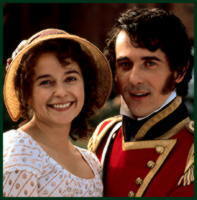 Few members of the militia were trained in military tactics, such as shooting, horsemanship, or use of a sword. They were required to have their own guns to be a member of the militia. Those picked or volunteering for militia duty in the rank and file served five years, while some served for seven years. Officer commissions were not available (as opposed to those in the Regulars). Those who held rank in the militia received that rank based on how much land the family held. Captain Denny in Pride and Prejudice would need either to be the heir of land worth at least £400 per year or actually own land worth at least £200 per year. Although we are given nothing of Denny’s background in Austen’s novel, we are told that George Wickham becomes a lieutenant in the Meryton militia. This is a bit confusing to many who know something of military history, for a lieutenant in the militia would be required to hold land worth £50 per year. If Wickham had nothing of his own upon which to depend, how did he receive his lieutenancy? Most experts speak of a lowering of the standards for the few who would qualify as a junior officer otherwise, meaning Wickham held a gentleman’s education, making him “qualify as a junior officer.” The wages presented to the officers was only to cover their expenses, not replace their income from their land.
All Protestant males were required to be available for the militia. There was a quota for each area. A local nobleman (customarily referred to as the Lord Lieutenant) was charged “by the King” (or rather by the King’s spokesman) to gather a force of able-bodied men between the ages of 18 – 45 to serve as part of the country’s militia. A local landowner was appointed as the “colonel” in charge of the men of the unit. These men were “guaranteed” not to know service outside of the homeland, meaning they would not know the battlefield frequented by professional soldiers. They also experienced a steady social life provided by the local gentry. Only clergymen were exempt from this duty.
There were substantial signing bonuses during the wars as the militia, Regulars and volunteers competed for the same pool of men, so anyone from outside the county would and did join the militia for the bonus and pay. Parishes were fined if they did not raise the required numbers of militiamen, so they were happy to have anyone fill the rosters, paying a bonus that was far less than the fine. And of course, sooner or later the parishes and Regular army learned not to pay the bonuses before the men were marched away. More than a few made a living by receiving the bonuses and then skipping out, only to ‘enlist’ again someplace else for bonuses there. A man who did not wish to serve could pay another to serve in his stead. They were offered between £25 and £60, which was equivalent to a year’s wage for many in the Regency.
 As part of the community, as well as the neighborhood, there was a certain sense of pomp and circumstance as part of the militia. They would conduct military reviews (much as we see in reenactments today). This would include close order marching, marksmanship contests, and even staged “fights” for the entertainment of the neighborhood.
In any case, when Napoleon returned from Elba, the militia were called up and regular army volunteers were asked for from the militia, both officers and men. A number went to Belgium, but the militias were held in readiness on the coasts during and after Waterloo. After Waterloo, there was an effort to stop the surge in smugglers and ex-patriots trying to escape a now Monarchial France, landing along the English coasts.
Because of the militia riots of 1813, militias were more often kept in the county of origin in small groups across the countryside. Most Regular Army units were not disbanded or reduced until the fall of 1816, so the militia would not have been sent to their homes until about the same time, depending on the mood of the county folks and the coastal activity.
We must recall that what we term as the “Napoleonic Wars” is a twenty year period, 1792-1815. There were several kinds of militia during this time, including yeomanry, fensible, and volunteer organizations. The threat of invasion and the desperate need for manpower in the Regular army also affected how and where militia were used. There were very few barracks at all at the start of the Napoleonic wars, better than 85% of the ones existing for militia and Regular troops in 1815 were built during the wars. And then there are the various militia revolts which colored the way militia was deployed in later years.
Austen began Pride and Prejudice about 1796 and did not publish it until 1813, sixteen years later, so the when of the book and the militia being stationed in her area likely changed quite often based on training for several different reasons… and types of militia.
“Reading Pride and Prejudice, one may notice that there is a conspicuous lack of war in the text despite the historical context of the Napoleonic Wars and the near-constant presence of the militia. The soldiers Austen depicts are more likely to play card games or dance rather than tell tales of bloodshed, partly because the militia received few chances to fight. The aristocrats that led each local militia tended to be corrupt as well, handing out promotions in exchange for money or sexual bribes. Lydia’s fantasies exemplify the moral laxity of the militia; she imagines ‘the streets of that gay bathing place covered with officers… She saw all the glories of the camp; its tents stretched forth in beauteous uniformity of lines, crowded with the young and the gay, and dazzling with scarlet; and to complete the view, she saw herself seated beneath a tent, tenderly flirting with at least six officers at once’ (262). Lydia’s description reveals the militia’s superficial attractions, one of which is novelty–the militia are still a new enough presence in England to appear young and gay and dazzling in their uniforms rather than war-weary. Undercurrents of sexuality run through Lydia’s fantasy in her image of “herself seated… tenderly flirting with at least six officers at once.” Although Lydia’s vision seems romantic enough, sexual deviance was a prominent spectacle of military life. Soldiers invited their mistresses into their tents at night and several prominent aristocrats such as the Duke of York were involved in highly publicized sex scandals.
“Added to the immorality that a military life offered was the anonymity and respectable status, which allowed men to climb social ranks easily. Due to the constant movement of the militia across the country, the new regimentals a man wore, and his new title as an officer, he could escape the hold of his past. Tim Fulford explores this idea in his essay ‘Sighing for a Soldier,’ writing that ‘[a soldier’s] dress and rank might well have been earned not by experience on the battlefield or parade ground but by influence, and the shiny uniforms masked a variety of characters and origins” (Fulford 157). The idea that ‘influence’ can earn a man status is not new to England, a country in which the aristocracy thrive off of patronage, and in the militia ‘influence’ took the form of underhanded bribes and secret deals among officers. ‘[S]hiny uniforms” and the opulence and novelty of militia camps mostly covered up this corruption from the public; however, corruption on such large a scale could never be wholly hidden.” (The Militia in “Pride and Prejudice”)


 Every Woman Dreams...
During the Napoleonic Wars the Militia became a source of recruits (both officers and men) for the Regular Army, and quite a few served with Wellington’s army in Spain. The differences between the Fencibles (hostilities-only Regulars who could only serve within the UK), the Militia (usually part-time Infantry who could be embodied (called up for full-time service in time of emergency) to served within the UK), and Yeomanry (the mounted equivalent of the Militia) are sometimes blurred. For example, some of the coastal fortifications were partially manned by Fencibles and Invalids (the latter being pensioned Regulars recalled to the Colours) with additional personnel coming from the local Militia.
Thanks for adding more depth to the post with your insights. I appreciate your taking the time to respond.
Thanks! I hope that you found my comment of interest.
I did. I welcome any ideas you wish to add. I do not profess to be an expert in all areas of history, but it does fascinate me.
Hmmmm, very interesting, and not unlike the American system in the 19th century. Your post raises a question I never thouhht of before. Why wasn’t Darcy in the militia?
As the master of a great estate, I would assume that when the call came up, he paid another to complete his service. He could not be removed from Pemberley for 5 years.
Perhaps ,’the American system was not unlike the English system’ would you not think? XD in the English of Miss Austen 😉
This is probably trivia, but I actually have a little question. Do you know why JA refers to the officers as members of ___shire and doesn’t use a name. Everyone puts ___before the shire in their stories but I don’t really understand why. Jen Red
I have heard that it would be “understood” by people of the time that the “shire” was Derbyshire if Wickham was part of it. There is also some speculation that Austen did not wish actually to name a particular shire for fear of insulting an actual unit. As it is likely that every shire had a militia unit, that would make sense. I usually go with those who believe the unit was peopled with those from Derbyshire in my stories.
Thanks so much. I appreciate you help. Jen
I had known some of this before. Thank you!
denise
Regina, nice info on the Militia. Clergy were not actually “exempt” from being in the Militia. Some people, however, felt it improper for a man of the cloth to bear arms. The Lord Lieutenant of Hampshire seems to have been of that view, which is why Jane’s brother, James, did not formally serve in the Militia or the Volunteers even though he helped recruit about 100 men from four parishes to serve in the Volunteers. Likewise, his father, Mr. Austen, recruited 35 men of the Steventon parish for the Militia. The Volunteers were a separate organization, which came into being when fear of an invasion was at its peak. They would have been the last line of defense had Napoleon invaded.
I appreciate the additional information, Collins. Do you know whether any of the clergy served as a “chaplain” for the militia? I have found such references in regards to the Regulars, but not the militia.
Very interesting information! Thanks Regina!!
Glad you enjoyed it, Daniela.
I’m surprised that Darcy could have been called to the militia as with nobody managing such a huge estate I would think this would have such an adverse effect not only on Darcy but on all the hundreds of people who depended on it.
Thanks for another great excerpt and I agree with Lord Matlock – he should have told Elizabeth about Wickham.
That would make the story much shorter, Glynis. LOL!
I definitely look forward to reading this! Loved the history presented.
Thanks for joining me, Lynn.
Very interesting post. I think Darcy is making a mistake of not sharing the truth about Mr Wickham with Elizabeth.
Totally agree.
Wonderful info, and wonderful excerpt. Thanks!
Many thanks, Debbie.
Very interesting info! Your books are always so informing, though. I appreciate the time and effort that you must put into research for each one.
If one does not get the facts correct, a reviewer will call him/her out on it.
I don’t have the time with three boys running amok. I appreciate all who do the research and put the time into every book.
Enjoyed the history of the militia. My middle son enjoys military history, think he might like to branch out. Will have him read if he seems interested. Also nice to branch out from American history.
As for Lizzy and Darcy, he is a fool for not dropping hints. Then again it would be a short story with no interesting climax and conclusion. There needs to be strife and Lizzy needs to have her moment(s) of reflection. Our dear couple needs to learn to trust through errors in judgment and reflection. Happily ever afters aren’t Disney movie versions. Their should be discord for a better understanding later.
Can’t wait to read! Enjoying all P&P variations. Interesting to see where different authors place them and how they come to their understandings.
You can always count on me to add a bit of angst (or perhaps I should say a large dollop).
The more the better. Nothing like a page turner and ODC provide much angst and strife that keep us coming back for more.
I would love to read your latest offering!
If I bought every book I wanted I would have no money and an upset husband. Have to read all the previews from Amazon and IBook then the reviews. Then be satisfied. The life of a book worm.
Hang in there, Gillian. I am hosting a sale beginning Christmas Day through Twelfth Night.
Great article, Regina! I always learn something new to add to my knowdedge
Best way to fight off “old timer’s disease.”
Great article Regina, I didn’t know an officer needed to be a small land owner to achieve his rank. I guess Wickham had won his in a card game. 😉
More likely, someone paid him to take his place, which was a common practice during the war.
That was my second thought, but you are right Regina. I like your explanation better. 🙂
Very Interesting. I love learning more about how things were done 200 years ago.
Thanks for joining me, Leslie.
I learned something new today.
I try to do that every day, Ria. Keeps you younger…
Your Wickham sounds even more dastardly than Jane Austen’s. JA’s Wickham ran away to London rather than face Darcy at Netherfield, yours tried to disrupt the wedding and breakfast. I hope he gets his comeuppance but good!
Oh, yes, I was in the mood for a “dastardly” Wickham when I wrote this one, but I am always one to have him know the punishment meant for him and him alone. I have only killed him off once in all my novels. LOL! I wish him to suffer. (She rubs her hands together in a diabolical manner!!!)