
In the singular form the lexicon of a particular subject is all the terms associated with it. The lexicon of a person or group is all the words they commonly use. As a plural noun, a lexicon is an alphabetical list of the words in a language or the words associated with a particular subject. To distinguish lexicon from a dictionary, it is an alphabetical list of the words in a language or the words associated with a particular subject.
These examples are a mix of what one might hear upon the lips of the aristocracy, as well as examples of Cant used upon London’s streets and those terms used by farmers and like in the country.
chair – a light and agile, as well as inexpensive, one-horse carriage (not be confused with the sedan chair, which was a rickshaw-like vehicle)
champagne – From: http://www.intowine.com/champagne.html#history From the Eight Ages of Justerini’s ~ In their still forms Sillery and Champagne had been much esteemed in England from the time of Henry VIII and …the sparkling wines of Marne and Montagne de Rheims met with ever growing demand. “Yet strange as it may seem to us today, the great bulk of these wines were shipped in cask and bottled here ( England) , with the result that they were not truly sparkling but merely effervescent … a law made early in the reign of George II which forbade the import of wine in cases, flasks or bottles; the object of the law being to check the smuggling of wine in small parcels that were easy to handle… It was not until 1802 that Champagne was allowed to be imported direct from France in bottles.
English law prohibited importation of wine in bottles until a law passed about 1802– at the time of the treaty of Ameins. It is reasonable that still wines would be smuggled. Movement hurts sparkling wines. As you say, the French bottles had a tendency to explode and also took up much more space.
Chancellor of the Exchequer – the highest post after the Prime Minister; controlled the treasury
Chancery – the court of equity law; generally sat at Westminster Hall
chandler – a man who dealt in candles
Change – an abbreviation of the Royal Exchange often used in speech
changing one’s name – Was it possible for someone to change his name during the Regency? I have a book An Index to Changes of Names under Authority of Act of parliament or Or Royal Licence and Including Irregular Changes from 1 George III to 64 Victoria 1760-1901.
One was not supposed to change the first name so casually because it was given at the sacrament of Baptism and confirmed at confirmation. The bishop sometimes changed baptismal names at confirmation if he found them displeasing. One could change the surname at any time and as informally as one wished as long as it wasn’t done to cheat creditors or commit bigamy, or the like. If it was a permanent change one would put a notice in the Times. The official changes were listed in the Gazette.
chap – a fellow; usually, referring to a strange fellow
chaperone – the cicisbeo, or gentleman usher to a lady, comes to us from the French language
Charabanc – a large carriage with two seats facing forward; lightweight and speedy
charades – If you are writing, do not be tricked by this one. There are several puzzle verses that were called Charades and the acting out game supposedly didn’t exist until around 1840. The game of Charades originated in France and became popular in England in the second half of the 19th century. The Brothers Mayhew published a guide to the new game in 1850 – Acting Charades or Deeds not Words – A Christmas game to make a long evening short.

charities – Here is a partial list of charity names. It is long, but this may give you some ideas of what charitable organizations at the time were called, and help you to craft a name. Some Charity Names:
The Society for Organising Charitable Relief and Repressing Mendicity, aka Charity Organisation Society or COS (this one took the position that most charities were being “hoodwinked by the cunning poor,” BTW p. 5)
Manchester and Salford District Provident Society (DPS)
Liverpool Central Relief Society
Brightelmston Provident Institution
Brighton Provident and District Society
Liverpool Provident District Society
Central Relief SocietySociety for the Relief of Distressed Travellers and Others (1814)
Oxford Charity Organisation Committee
Anti-Mendicity Society
Oxford Anti-Mendicity and Charity Organisation Association
Society for the Relief of Distress (1860)
Invalid Children’s Aid Associaton (1888)
Salvation Army (seen by the COS as “hopelessly sentimental” with their “open-handed and undiscriminating charity cutting at the root of all teachings and endeavors of twenty years” p. 62)
Barnardo Evangelical Trustees
Manchester and Salford Provident Dispensary Association
Edgbaston Mendicity Society
Brighton, Hove and Preston Charity Organisation Society
Leamington Charity Organisation and Relief Society
Vigilance Association (noted to be unpopular)
Birkhead Provident and Benevolent Society, later became the Birkhead Association for Organising Charitable Relief and Repressing Mendicity
Ladies’ Sanitary Society- goal to promote habits of cleanliness among the working classes (Um, could I have something to feed my children instead???)
[City Name] Relief Fund
Toxteth Relief Society
Brighton Jubilee and Accident Fund
Provident Dispensary Association
Oxford Working Women’s Benefit Society- basically a pool, women paid a small amount weekly and could claim benefits if they became sick.
Croydon Charitable Society
Reading Destitute Children Aid Committee- provided footwear with insistence on weekly repayments
Sick Relief Fund
Penny Savings Bank
London Ethical Society
Lock Hospital
Foundling Hospital
General Lying-In Hospital (also British Lying-In Hospital, Lying-In Charity, etc.)
Marine Society
Philanthropic Society
Magdalen House
St. Thomas’s Hospita
Asylum for Orphaned Girls (also Asylum for the Reception of Orphaned Girls at Lambeth)
London Hospital
Society for the Discharge and Relief of Persons Imprisoned for Small Debts
Salters Guild
Smallpox Hospital
Society for Improving the Comfort and Bettering the Conditions of the Poor
Middlesex Hospital
Ladies Society for Employing the Female Poor
London Female Penitentiary
Lambeth Refuge for the Destitute
Dorking Provident Institution
The Church of England Waifs and Strays Society
Crutch & Kindness League (for ‘cripples’)
Metropolitan Association for Befriending Young Servants
Church Missionary Society
Society for Promoting the Religious Instruction of Youth
Female Friendly Society for the Relief of Poor, Infirm, Aged Widows and Single Women of Good Character, Who Have Seen Better Days
chariot – a four-horse vehicle; the two seats both faced front; lighter than a chaise
charlotte – Late Georgian (1750–1790 C.E.). Woman’s wide, tightly gathered hat on brim with wide flounce. Named for Queen Charlotte of United Kingdom.
Chase and Four – a closed carriage used for traveling; pulled by four horses

chatterbox – one whose tongue runs four score to a dozen; hard to get a word in for their chattering
chatts – lice, perhaps an abbreviation of chattels, with lice being the chief live stock of beggars, gypsies, the canting crew, etc.
chaunt – a song
chaunter culls – grub street writers, who compose songs, carrols etc., for ballad singers
chaw bacon – country fellow
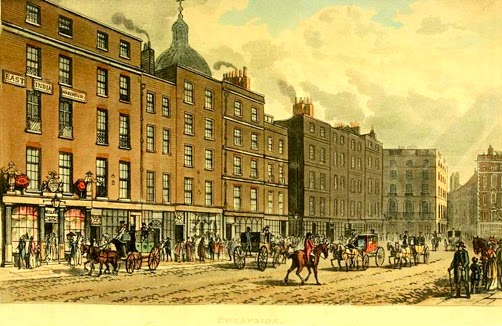
Cheapside – a street in eastern London close to the river Thames; a non-fashionable side of London
cheats – sham sleeves to put over a dirty shirt or shift or to cover frayed edges; Restoration (1660–1700 C.E.). Men’s waistcoats with front made from elaborate fabric and back from cheap fabric. 2. Romantic (1815–1840 C.E.). Man’s shirt with collar attached already.
On a side note: Check out the complete Costume Dictionary HERE.
cheese it – be silent; be quiet; do not take action
chemise – a woman’s long undergarment; much in the form of a nightgown
chemise à la Reine: Late Georgian (1750–1790 C.E.). France. Popularized by Marie Antoinette, a loose, unfitted gown with deep décolletage worn sashed at waist

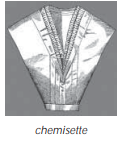
chemisette – a partial shirt worn tucked into a very low-cut gown; 1. Early Georgian
(1700–1750 C.E.) to Late Georgian (1750–1790 C.E.). Prussia. Cuirassier’s waistcoat. 2. Romantic (1815–1840 C.E.). White muslin or cambric wrap to fill décolletage
of gown.
Cheshire cat – who who shows his teeth and gums when laughing; the connotation that the person who is grinning is in possession of knowledge that the beholder is not aware of

chicken nabob – one returned from the East Indies with but a moderate fortune of 50 to 60 thousand pounds, a diminutive nabob: a term borrowed from the chicken turtle
chimneypiece – a mantelpiece or decorative moulding about the chimney
climbing boy – the child who would climb up into the chimney to clean it
Cheney silks – made by the firm of Cheney brothers, which first began manufacturing silks immediately after the bursting of the great mulberry tree bubble in 1838. At that time it was though practicable to grow mulberry trees and raise silk worms in Great Britain, but England’s climate was too much for the endeavor. The Cheney Brothers have 75 years of experience in the manufacturing of silks. Cheney’s grosgrains were very popular.
Another side note: Check out Cheney Silks: A Glossary of Silk Terms HERE.
cherryderry: Early Georgian (1700–1750 C.E.) to Late Georgian (1750–1790 C.E.). India. Cotton fabric similar to gingham.

1770 – 1780 (weaving), 1775 – 1780 (sewing), 1870 – 1910 (altered)
ARTIST/MAKER
A woman’s gown, of cream silk warp and cotton weft, with vertical stripes of yellow, brown, green and pink (possibly the Indian export fabric known as cherryderry). The gown is in the English (tight-back) style, open at the front with elbow-length sleeves. The bodice meets at the centre front. ~ https://collections.vam.ac.uk/item/O350640/gown-unknown/
cheyney: Romantic (1815–1840 C.E.). Worsted or woolen fabric with pattern printed on prior to weaving, creating shadow design.

chignon flottant: Late Georgian (1750–1790 C.E.). Woman’s hairstyle incorporating ringlets or curls hanging over back of neck

chignon strap: Band that loops beneath hair in back to hold woman’s hat in place.
Chinese green: Romantic (1815–1840 C.E.). United Kingdom. Malachite green
chip hat: Late Georgian (1750–1790 C.E.). Woman’s hat woven from thin wooden strips. The Ryde Social Heritage Group provides additional information:
“• wood or Cuban palm leaf split into slips, or straw plaited in a special manner, for making hats or bonnets.
• a thin strip of wood or straw used for making woven hats, baskets, etc. Wood, palm leaves, straw, or similar material cut and dried for weaving.
“We even found a classic literature link: ‘With the money that I get from the sale of these eggs I’ll buy myself a new dimity frock and a chip hat; and when I go to market, won’t all the young men come up and speak to me?’ (extract from Aesop’s Fables)”

The image on the left is from the June 1794 Issue of ‘The Gallery of Fashion.’ It shows a two chip hats one a “Straw-coloured gipsy hat, trimmed with lilac riband” and the other is a “Plain chip hat, trimmed with purple ribands.”
The image on the right is from the August 1794 Issue of ‘The Gallery of Fashion.’ It shows a lady in half-mourning – Head-dress: white chip hat bound with black, and trimmed with a piece of black silk; two black feathers placed on the right side, near the front. The toupee combed straight, and the hair behind in ringlets.”
Sources:
Isle of Wight Times 10 June 1880; dictionary.die.net; thefreedictionary.com
chirping merry – exhilarated with liquor
chit – an infant or baby
chitterlings: Restoration (1660–1700 C.E.) to Directoire and First Empire (1790–1815 C.E.). United Kingdom. Linen or lace frills on front of men’s shirts.
chiveret: Elizabethan (1550–1625 C.E.) to Late Georgian (1750–1790 C.E.). Popular woolen fabric
chivey – a hearty scolding
choak away, the churchyard’s near – a jocular saying to a person taken with a violent cough
to give chocolate without sugar – a military term for to reprove
chop churches – simoniacal dealers in livings or other ecclesiastical preferences
to chouse – to cheat or trick
Christmas – It was Christ’s Mass at first and was a Quarter day. It was celebrated except during the rule of the Puritans.
Christmas day was a day for church. The 12 days of Christmas started the next day. In Britain, the Holy Days and Fasting Days Act of 1551 (which has not yet been repealed by the Regency era) stated that every citizen must attend a Christian church service on Christmas Day and must not use any kind of vehicle to get to the service.
chub – a foolish fellow, easily imposed on
chum – a chamber-fellow, particularly at the universities or prisons
chummage – money paid by the richer sort of prisoners in Fleet and King’s Bench, to the poorer, for their share of the room. When prisons are full, which is too often, particularly on the eve of an insolvent act, two or three persons are obliged to sleep in a room. A prisoner who can pay for being alone, chooses two poor chums, who for a stipulated price, called “chummage,” give up their share of the room and sleep on the stairs, etc.
church courts – The church courts controlled the behavior of clergyman. The bishop of each diocese had to approve anyone who was given a living. The bishops had to ordain all clergymen. They were the judges dealing with all aspects of marriage. They probated wills. The bishop or his representative was supposed to visit the churches in his diocese to hear complaints of defamation, scold, blasphemy, and sacrilege and other offenses for which there was no legal remedy. This was popularly called the bawdy court. All the bishop could do was shame the person in church or have them excommunicated. Most of the power was over the churches and the clergymen.
churching – In Christian tradition the churching of women, also known as thanksgiving for the birth or adoption of a child, is the ceremony wherein a blessing is given to mothers after recovery from childbirth. The ceremony includes thanksgiving for the woman’s survival of childbirth, and is performed even when the child is stillborn, or has died unbaptized.
churl – rude, surly, boorish fellow


 Every Woman Dreams...