
At the beginning of the 19th Century, Edinburgh, Scotland, held its position as one of the world’s intellectual centers. The Scottish Enlightenment held a reputation for developing some the most gifted minds of the period. One of the leaders of the group was Francis Jeffrey, a Scottish lawyer, and founder of the Edinburgh Review. Among the earliest contributors to the Whig magazine was Sydney Smith, Henry Brougham, John Murray, and Sir Walter Scott.
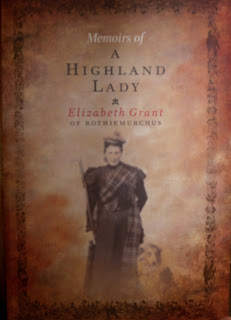 One of the more controversial tenets of the movement was the idea of universal education. The “Highland Lady,” Elizabeth Grant (1797-1886) of Rothiemurchus, was an early success of the movement. Elizabeth Grant was a writer and social observer. She was the eldest child of Sir John Peter Grant. In her early years, Grant was educated at home, much to the standard of the day. Unlike some of her contemporaries, Grant had the opportunity to meet many “movers and shakers” of the Highland scene and society. From these familial acquaintances, Grant absorbed details not normally in the realm of an “educated” lady. After her life, the Memoirs of a Highland Lady (1898) were published, after the original manuscript was loaned to the National Library of Scotland by one of the lady’s descendants.
Spending much of time in Edinburgh, Elizabeth met and socialized with a variety of eminent people, all of whom she recorded in sharp detail. In 1827, she and her family moved to Bombay so her father might avoid his financial troubles. When she was younger, Elizabeth had fallen in love with a young man of which her father disapproved. Sir John had argued with the boy’s father, and Grant would not permit his daughter’s joining to his enemy’s sons. While in India, Elizabeth married Colonel Henry Smith of Baltiboys, Co Wicklow. She lived in Ireland for over 50 years.  Her The Highland Lady in Ireland: Journals 1840-1850 brings readers a different look at the potato famine. Likewise, Grant’s A Highland Lady in France 1843-1845 detailed her time on the Continent.
For Colonel Smith, theirs was a marriage of convenience. Smith was the second son with no great inheritance to his name, and he had chronic and acute asthma. He was also 17 years older than Elizabeth Grant. Grant was two and thirty at the time and possessed a small dowry so finding a “gentleman” husband was an acceptable consequence for her. Surprisingly, Henry lived a long time, and the marriage was a “happy” one.
Several days before the marriage, word arrived that Henry’s brother John passed, without issue, in Paris, and Henry was the new master of the estate at Baltiboys. From Jim Corley and History Articles, we learn, “Well before that, however, a marriage agreement had been drawn up between the couple. It should be kept in mind that even in the event of Henry’s death the estate in Co. Wicklow could never be owned by Elizabeth, but would be held in trust by trustees. A son or daughter would be heir to the property, and in the event of no children the estate would pass to the nearest male relative. In the possibility, indeed probability, of the demise of her husband, Elizabeth would be well looked after. She would get an annuity of £230. She would have an entitlement from the Military Fund of the East India Company. A sum of £4,000 would be provided for any children of the union. A further £6,000 would become available on her death.  Sums of £4,000 and £3,000 were to be immediately directed to the trustees. Provision for the maintenance and education was arranged for any boys till the age of 21 and girls also to 21 or until they married. If Henry were to expire in India Elizabeth was to be paid 8,000 rupees to provide passage to England and she would be left all household furniture, jewels, plate, books, linen, china, uisce (whiskey), and other liquors. £6,000 had been secured on the lands of Kinloss in Scotland by Elizabeth’s father Sir John Peter Grant to the three younger children of his marriage, of whom Elizabeth was one.
“While still in their first year of wedded life, they were advised by their doctor that if husband Henry were to remain in the oppressive climate of India in the pursuit of his career, he faced certain death in the not too distant future. A decision was made, therefore, to return to the more suitable climate of Europe and, in particular, Baltiboys. So it was that on the 4th of November 1829, they headed for home in a sailing ship, the Childe Harold.”
O their return journey, the Colonel and Mrs Smith visited Napoleon’s tomb. Of it she writes, “The tomb was saddening; ‘after life’s fitful fever’ to see this stranger grave; in a hollow, a square iron railing on a low wall enclosed the stone trap entrance to a vault, forget-me-nots were scattered on the sod around, and the weeping willow drooped over the flag. The ocean filled the distance. It would have been better to have left him there, with the whole island for his monument.” They reached Portsmouth at the end of April 1830. Since they had departed Bombay almost five months had passed
Again from Crowley, we discover, “A few weeks later they arrived in Ireland. Baltiboys House was in a bad state as were its tenants. The previous owner, Henry’s brother John, had fled abroad at the time of the 1798 rebellion. The estate had been neglected. Within a short time plans were drawn up for a new house (these plans are still extant ). The tenants’ lot was improved. They had some employment in building the new mansion, and later on draining their farms. Thousands of trees were sown. An effort was made to do away with small uneconomical holdings, without raising too many hackles. When the potatoes rotted in the mid 1840,s the Smiths were not found wanting in their efforts to relieve their hungry tenants.
“Remember the all important Marriage Settlement made in Bombay in 1829? Well, it was still a binding legal document and came into unexpected prominence many years later. On Henry Smith’s death their only son, Jack, inherited the house and estate at Baltiboys. Jack was married in June 1871 to Frances Harvey, (a relation of the Capt. Harvey R. N. who fought alongside the great Nelson), but died a mere 2 years and 5 months later. Two months after his death his little girl Elizabeth was born. Because Jack had made no will in favour of his mother, this baby was now mistress of the house and estate. Her grandmother was now just a tenant where for 40 years she had held sway. Without Elizabeth’s knowledge there was an auction of her property. All her fine cows were gone. As were her pigs and poultry, horses and carts, implements, beehives, frames, plants from greenhouse, tubs and watering pots and so on. All had belonged to her son Capt. Smith. The scandal of an auction could have been prevented by John J. Hornidge of Russelstown, she felt, but he was bent on doing his utmost for the young widow and orphan child, and the deed was done before she knew of it. Mr Hornidge then tried to sell the house furniture. The Smith solicitor, Mr Cathcart, was contacted to see if this auction could be stopped. Mr Cathcart came down with the Marriage Settlement made in India in 1829. He pointed out the part that stated that in the event of Henry Smith’s death all furniture, plate et cetera would go to his wife Elizabeth. The plans for auction were abandoned. The Highland Lady continued to live at Baltiboys. She purchased a horse and cart, 2 wheelbarrows, spades, rakes, a shovel, plough, harrow, cow, pig, 6 hens, 3 Aylesbury ducks, and had work on her hands for many a year to come. Her jointure paid the rent on Baltiboys, and she took in grazing cattle to pay the workmen and housemaids. Her daughter-in-law Frances was very kind to her and had not allowed her brougham to be sold nor the double harness Jack had given her for it. Frances herself had to buy Jack’s watch, rings, pictures, books, sword and so on. Such was the law. Aunt Bourne had died and left most of her estate to Mrs Smith. Her share came to £30,000, with which she released her family from liabilities, lent £10,000 to the Bermingham estate in Tuam, Co. Galway, at five and a half % per annum, purchased the townland of Lacken, also land at Golden Hill. Later on her daughter Annie and her 10 children came to live at Baltiboys.”
In her memoirs, Elizabeth speaks of her early education. She writes, “It is curious that I have no recollection of learning anything from and body except thus by chance as it were, though I have understood that I was a little wonder, my Aunts having amused themselves in making a sort of show of me.” Unlike other young girls of her time, Elizabeth’s nursery was full of educational toys: small bags of beans to count, books such as Puss in Boots, Riquet, Blue Beard, Cinderella, colorful prints. A procession of private tutors instructed her and her sisters, including one for the pianoforte, one for the harp, one for French, another for Italian, one for drawing, another for writing and ciphering, and one for dancing. Her brothers had tutors for chemistry, math and natural philosophy, and even a metaphysician as a tutor.
***There is a wonderful review of Grant’s works on “I Prefer Reading.”


 Every Woman Dreams...
Very interesting, Regina.
Thanks for joining me today, Gerri.