
 SATURDAY, 20 AUGUST 2011
SENSE AND SENSIBILITY BICENTENARY CELEBRATION : SETTLING THE COMPROMISE MARRIAGE. GUESTPOST BY REGINA JEFFERS + GIVEAWAY
This month’s guestblog to celebrate the bicentenary of Sense and Sensibility (1811 – 2011) is by Regina Jeffers and is about the idea of a “compromise marriage” in Jane Austen’s world and novels, with special reference to the Dashwood sisters.
This month’s giveaway is of a signed copy of Regina Jeffers’ latest publication, The Scandal of Lady Eleanor. The details of the giveaway can be found at the end of this post.
You can read all the guestposts in the Sense and Sensibility Bicentenary Celebration following this link http://thesecretunderstandingofthehearts.blogspot.com/2011/08/sense-and-sensibility-bicentenary.html.
Settling for the Comprise Marriage
What hope was there for the dowerless daughters of the middle class during Jane Austen’s lifetime? Such is a topic Austen explored repeatedly in her novels. Elizabeth and Jane Bennet sought men of a like mind. The Dashwood sisters found their choices limited by their financial situation. Fanny Harville and Captain Benwick could not marry until he earned his future. General Tilney drove Catherine Morland from his home because of the lady’s lack of funds. Charlotte Lucas accepted Mr. Collins as her last opportunity for a respectable match. The intricacies and tedium of high society, particularly of partner selection, and the conflicts of marriage for love and marriage for property are repeated themes.
Marriage provided women with financial security. Henry Tilney of Northanger Abbey explains, “… in both [marriage and a country dance], man has the advantage of choice, woman only the power of refusal: that in both, it is an engagement between man and woman, formed for the advantage of each.” Women of Austen’s gentry class had no legal identity. No matter how clever the woman might be, finding a husband was the only option. A woman could not buy property or write a will without her husband’s approval. If a woman was fortunate, she would bring to her marriage a settlement – money secured for her when she came of age – usually an inheritance from her mother. The oldest son or male heir received the family estate, and the unmarried or widowed females lived on his kindness.
The ladies of Sense and Sensibility have this reality thrust upon them when Uncle Dashwood changes his will and leaves Norland to his grandnephew. In Uncle Dashwood’s thinking, this change will keep Norland in the Dashwood family. However, the four Dashwood ladies suddenly find themselves living in a modest cottage with an income of £500 annually. As such, they have no occasion for visits to London unless someone else assumes the expenses. Their social circle shrinks, and the opportunities to meet eligible suitors becomes nearly non-existent. With dowries of £1000 each, the Dashwood sisters are not likely to attract a man, who will improve their lots.
Jane Austen, herself, lived quite modestly. The Austens lived frugally among the country gentry. The Austen sisters were well educated by the standards of the day, but without chances for dowries, Jane and Cassandra possessed limited prospects. Jane met a Mr. Blackall the year Cassandra lost her Mr. Fowle. In a letter, Blackall expressed to Mrs. Lefroy a desire to know Jane better; yet, he confided, “But at present I cannot indulge any expectation of it.” To which, Jane Austen responded, “This is rational enough. There is less love and more sense in it than sometimes appeared before, and I am very well satisfied.” Imperfect opportunities were Jane Austen’s reality. In 1802, Jane Austen accepted an offer of marriage from Harris Bigg. With this marriage, Jane would have become the mistress of Manydown.
Yet, despite her affection for the family, Austen could not deceive Bigg. The following morning, she refused the man’s proposal. Whether she thought to some day find another or whether Austen accepted the fact that her refusal doomed her to a life as a spinster, we shall never know. In the “limited” world in which Jane Austen lived, she could not have known her eventual influence on the literary canon.
Austen held personal knowledge of young women seeking husbands in one of the British colonies. Reverend Austen’s sister, Philadelphia, traveled to India in 1752, where she married an English surgeon Tysoe Hancock, a man twenty years her senior. When the Hancocks returned to England a decade later, Reverend Austen traveled to London to greet his sister. However, Philadelphia and Tysoe were not to live “happily ever after.” Unable to support his family in proper English style, Tysoe returned to India to make his living. He never saw his wife and child again. Despite its tragic ending, this “marriage” secured Philadelphia’s future and the lady’s place in society. Only marriage could offer a woman respectability.
In Jane Austen for Dummies (page 134), Joan Klingel Ray breaks down the financial prospects of the Dashwood sisters. Converting the £500 to a modern equivalent, Ray comes out with a figure of $46,875. For the gentry, supporting four women, two maids, a man servant, paying rent, buying clothes, food, coal, etc., that sum would have meant a poor existence. I find in reading Sense and Sensibility that I am often disappointed with the eventual choices of the Dashwood sisters. Edward Ferras and Colonel Brandon have less of the “glitz and the glamour” that my innate Cinderella syndrome requires in a love match. However, if any affection did exist between the couples, then Marianne and Elinor, under the circumstances and the times, made brilliant matches. They settled for the “compromise” marriage common in the Regency era.
 About the author:
Regina Jeffers is the author of several Jane Austen adaptations, as well as Regency romance, including Darcy’s Passions, Darcy’s Temptation, Captain Wentworth’s Persuasion, Vampire Darcy’s Desire, The Phantom of Pemberley, and The Scandal of Lady Eleanor. She considers herself a Janeite and spends much of her free time with the Jane Austen Society of North America and AustenAuthors.net. A teacher for 39 years, Regina Jeffers is a Time Warner Star Teacher Award winner, a Martha Holden Jennings Scholar, a Columbus Educator Award winner, and a guest panelist for the Smithsonian. She has served on various national educational committees and is often sought as a media literacy consultant.
Giveaway time!!! Leave a comment at http://thesecretunderstandingofthehearts.blogspot.com/2011/08/sense-and-sensibility-bicentenary.html for a chance to win a copy of The Scandal of Lady Eleanor.
The giveaway is open internationally and ends August 31st.
About the book
The Scandal of Lady Eleanor is a sweep-the-reader-away story of romance, adventure, and intrigue set in the Jane Austen era.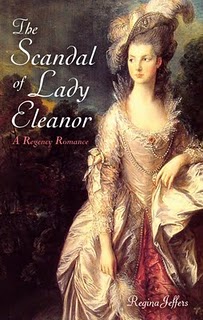
A master at capturing the elegance, grandeur, and literary style of the Regency era, Regina Jeffers has developed a loyal following with her many popular Jane Austen spin-off novels. In The Scandal of Lady Eleanor, Jeffers offers a completely original Regency romance featuring highly engaging characters and exciting—even shocking—plot twists. James Kerrington, a future Earl and a key member of the British government’s secret unit, the Realm, never expected to find love again after the loss of his beloved wife. Kerrington’s world shifts on its axis when Eleanor Fowler stumbles into his arms. Eleanor, however, is hiding a deep secret: she had hoped the death of her father, the Duke William Fowler, would give her family a chance at redemption from the dark past, but when Sir Louis Levering proves her father’s debauchery, Eleanor is thrown into a web of immorality and blackmail. Kerrington and his friends must free Eleanor from Levering’s diabolic hold.


 Every Woman Dreams...
Remember to be eligible for the giveaway, you must leave your comment on the My Jane Austen Book Club website.
However, I welcome your comments below if the giveaway is not your prime reason for visiting this post.